
ISO 42001 Certification
Artificial Intelligence Management System
Quick Answer
ISO 42001:2023 is the international standard for artificial intelligence management systems (AIMS), certifying that an organization develops, provides, or uses AI systems responsibly through a structured, auditable management system, risk assessment, impact assessment, bias monitoring, human oversight, rather than ad hoc AI governance built after a model is already in production. It follows the same Harmonised Structure as ISO 9001 and ISO 27001, making it straightforward to integrate for organizations already certified to those standards. Certification is issued by an accredited certification body after an audit, and most organizations complete implementation and certification in four to six months.
What ISO 42001 Certification Actually Certifies?
ISO/IEC 42001, published in December 2023, is the first international management system standard specifically for artificial intelligence, it certifies that an organization has a structured, documented AI management system (AIMS) governing how it develops, deploys, or uses AI systems responsibly across their life cycle. It follows the same Harmonised Structure as ISO 27001 and ISO 9001, but its substantive content addresses concerns unique to AI: managing risks around bias, transparency, explainability, and unintended consequences of AI system behavior, alongside more conventional governance requirements like leadership accountability and continual improvement.
Certification does not mean an organization’s AI systems are “safe” in some absolute sense, no standard can promise that for a technology this fast-moving. It means the organization has a documented, risk-based process for assessing AI system impacts, involving human oversight where appropriate, and continually monitoring and improving how it governs AI development or use. As with other ISO management system standards, certification is issued by independent bodies accredited under national accreditation frameworks recognized by IAF.
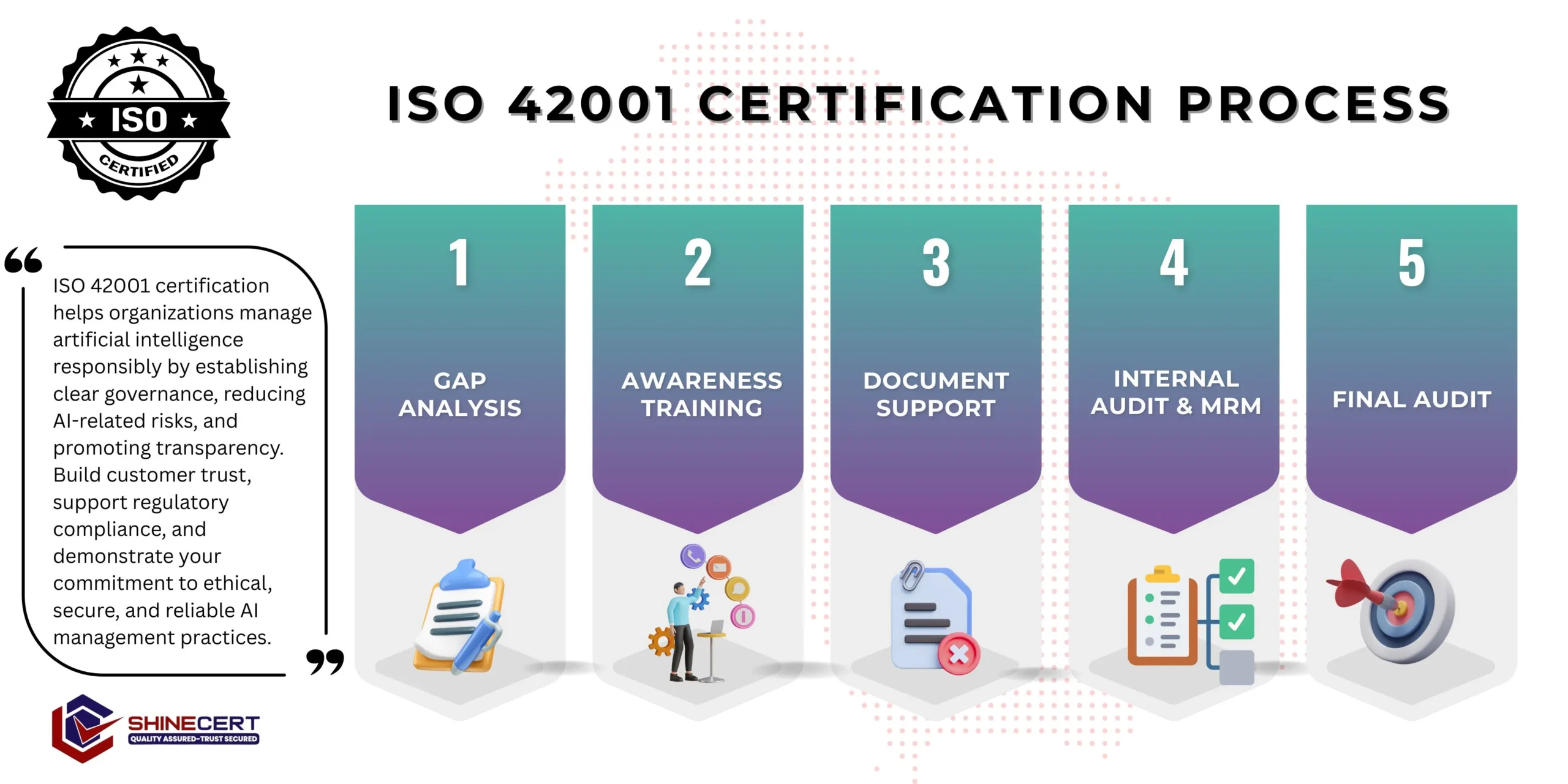
What are the steps to get ISO 42001 Certification?
our services
- ISO 9001 Certification
- ISO 14001 Certification
- ISO 27001 Certification
- ISO 22000 Certification
- ISO 45001 Certification
- ISO 13485 Certification
- ISO 20000 Certification
- ISO 17025 Certification
- CE Mark Certification
- GMP Certification
- Halal Certification
- SOC Certification
The ISO 42001 Certification Process: Implementation Framework
Clause 4: Context and Clause 5: Leadership
Define the AIMS scope, identify interested parties and their AI-related expectations, and secure top management commitment to responsible AI principles, expressed in a documented AI policy.
AIMS scope statement, interested parties analysis, and a signed AI policy.
Clause 6: Planning and AI System Impact Assessment
Conduct AI system impact assessments considering effects on individuals and groups, not just organizational risk, including fairness, transparency, and the consequences of system errors, alongside conventional risk and opportunity planning.
AI system impact assessment methodology, applied risk assessments, and AI-specific objectives.
Clause 7: Support and Competence
AI-specific competence requirements across data science, AI ethics, and domain expertise, controlled documentation, and communication mechanisms for AI-related concerns, including from externally affected stakeholders.
AI competence and training records, and a controlled AIMS document register.
Clause 8: Operation, AI System Life Cycle Controls
Controls spanning data quality and provenance, pre-deployment testing and validation, proportionate human oversight, and ongoing monitoring for model drift, plus documented due diligence for third-party AI components.
Documented AI life cycle controls, data governance procedures, and third-party AI component risk assessments.
Clause 9: Performance Evaluation and Clause 10: Improvement
Monitoring of AIMS performance and AI system behavior in production, a structured internal audit program, management review with AI-specific inputs, and root-cause corrective action for AI system issues.
Performance monitoring data, completed audit cycle, management review records, and an incident and corrective action log.
Clause 4: Context and Clause 5: Leadership
Define the AIMS scope, identify interested parties and their AI-related expectations, and secure top management commitment to responsible AI principles, expressed in a documented AI policy.
AIMS scope statement, interested parties analysis, and a signed AI policy.
Clause 6: Planning and AI System Impact Assessment
Conduct AI system impact assessments considering effects on individuals and groups, not just organizational risk, including fairness, transparency, and the consequences of system errors, alongside conventional risk and opportunity planning.
AI system impact assessment methodology, applied risk assessments, and AI-specific objectives.
Clause 7: Support and Competence
AI-specific competence requirements across data science, AI ethics, and domain expertise, controlled documentation, and communication mechanisms for AI-related concerns, including from externally affected stakeholders.
AI competence and training records, and a controlled AIMS document register.
Clause 8: Operation, AI System Life Cycle Controls
Controls spanning data quality and provenance, pre-deployment testing and validation, proportionate human oversight, and ongoing monitoring for model drift, plus documented due diligence for third-party AI components.
Documented AI life cycle controls, data governance procedures, and third-party AI component risk assessments.
Clause 9: Performance Evaluation and Clause 10: Improvement
Monitoring of AIMS performance and AI system behavior in production, a structured internal audit program, management review with AI-specific inputs, and root-cause corrective action for AI system issues.
Performance monitoring data, completed audit cycle, management review records, and an incident and corrective action log.
What Is ISO 42001?
ISO/IEC 42001:2023 specifies requirements for establishing, implementing, maintaining, and continually improving an AI management system, covering the full AI lifecycle, design, development, deployment, and monitoring, across organizations that develop AI systems, provide AI-enabled products, or rely heavily on AI in their operations. It applies to AI product companies as much as organizations embedding third-party models into internal processes, and its Harmonised Structure makes integration with ISO 27001, ISO 9001, or ISO 22301 relatively straightforward for organizations pursuing multiple certifications.
ISO 42001 Certification Cost: What Actually Drives It
Cost depends on the number and risk level of AI systems in scope, the maturity of existing AI governance practices, and whether ISO 42001 is pursued alongside ISO 27001, which meaningfully reduces combined cost through shared risk assessment and management review processes.
Mandatory Documented Information for ISO 42001
At minimum: AIMS scope statement; AI policy and objectives; AI system impact assessments for each in-scope system; data governance procedures covering training and operational data; human oversight mechanisms and their justification; internal audit program and reports; and management review records.
ISO 42001 and Integrated Management Systems — How They Connect
ISO 42001 shares the Harmonised Structure with ISO 27001, ISO 9001, and ISO 22301, meaning organizations already certified to those standards can integrate AI governance requirements into an existing management system framework rather than building a parallel one. This matters practically for technology companies that often need to demonstrate information security and AI governance competence alongside quality management to win large contracts, a single integrated audit cycle covering all applicable standards is both more efficient and more coherent for auditors evaluating the whole operation than separate, disconnected certification projects.
Benefits of ISO 42001 Certification
Faster progress through enterprise AI-vendor risk reviews, along with a genuine head start ahead of emerging AI regulation.
A structured impact assessment process that catches fairness, safety, or transparency gaps before deployment, rather than after.
Clearer ownership of AI governance responsibilities and fewer ad hoc, reactive fixes following a model incident.
A recognized, independently audited answer to “how do you govern your AI systems,” rather than a self-authored claim.
Building a Genuine AI Risk and Impact Assessment Methodology
- The single hardest part of an ISO 42001 implementation, in ShineCert’s experience, is building an impact assessment methodology that goes beyond a generic risk matrix borrowed from information security and actually grapples with AI-specific harms.
- A defensible methodology typically scores each AI system against several dimensions distinct from a conventional security risk assessment: the population affected and their capacity to contest or understand an automated decision; the reversibility of harm if the system errs (a mistaken product recommendation is far less consequential than a mistaken credit denial); the degree of autonomy the system has versus the degree of human review built into the decision path; and the system’s performance across different subgroups, since a model that performs well on average but poorly for a specific demographic slice represents a fairness risk a conventional risk matrix wouldn’t surface.
- Organizations that build this methodology thoughtfully, rather than adapting an existing risk register with a few AI-flavored rows added, tend to produce genuinely useful documentation that also holds up better under audit, auditors experienced with ISO 42001 specifically probe whether the impact assessment reflects the system’s actual behavior and deployment context, or whether it reads as boilerplate copied across every AI system the organization operates.
How ISO 42001 Relates to the Broader AI Regulatory Landscape?
- ISO 42001 was published before most jurisdictions finalized binding AI-specific regulation, and it was deliberately designed as a flexible, risk-based management system framework rather than a response to any single regulatory regime, which is precisely what makes it useful across jurisdictions with very different regulatory approaches. The EU’s AI Act, for instance, classifies AI systems into risk tiers (unacceptable, high-risk, limited-risk, and minimal-risk), with escalating obligations as risk increases; an organization with a genuinely functioning ISO 42001 AIMS already has much of the documentation, impact assessment, and human oversight infrastructure that a high-risk classification under the EU AI Act would require, even though ISO 42001 itself doesn’t map one-to-one onto EU AI Act risk tiers. Organizations building AI products for global markets are increasingly finding that ISO 42001 certification, or genuine alignment with it, functions as a practical head start on whichever specific regulatory regime eventually applies to their use case and jurisdiction, since the underlying discipline, impact assessment, human oversight, data governance, ongoing monitoring, is broadly what regulators globally are converging toward, even where the specific legal triggers differ.
- It’s worth being direct about what ISO 42001 does not do: it does not grant legal compliance with any specific AI law, and organizations operating in regulated AI use cases (credit decisioning, hiring, healthcare-adjacent applications) still need dedicated legal review of their specific regulatory obligations alongside, not instead of, ISO 42001 certification.
Data Governance: The Foundation Most Organizations Underestimate
- Data governance sits underneath almost every other ISO 42001 requirement, and organizations consistently underestimate how much work it takes to do properly. A defensible data governance program for an AI system needs to document where training data came from, what license or consent basis permits its use, whether it contains personal data and under what legal basis that’s processed, how representative it is of the population the system will actually be used on, and how data quality is checked before it enters a training pipeline. For organizations using third-party or open datasets, this often means going back through vendor contracts and dataset documentation that was never assembled with ISO 42001 in mind, a meaningfully larger task than it first appears, and one worth scoping honestly during gap assessment rather than discovering mid-implementation.
- Operational data, the data an AI system processes in production, as distinct from training data, carries its own governance requirements: retention policies, access controls consistent with the system’s risk level, and a clear record of what happens to user inputs (are they used to further train the model, and if so, under what consent or contractual basis). Organizations that treat operational data governance as identical to training data governance often miss requirements specific to live, ongoing data flows.
Auditing an AIMS: What to Expect
- An ISO 42001 audit, like other management system audits, follows the Stage 1/Stage 2 structure, a documentation review followed by an on-site or remote assessment of whether the AIMS actually operates as documented. What’s distinct about an ISO 42001 Stage 2 audit is the amount of time spent examining specific AI systems in depth rather than reviewing the management system in the abstract: auditors typically select a sample of in-scope AI systems and trace their full life cycle documentation, from the original impact assessment through deployment controls to ongoing monitoring records, checking that the paper trail matches what the system is actually doing in production.
- Organizations that maintain accurate, current AI system inventories, a simple but often neglected foundation, tend to move through this sampling process far more smoothly than those reconstructing documentation retroactively for the audit.
Who Actually Needs ISO 42001 Certification?
Situation | Why ISO 42001 Applies |
Building AI-driven products or features for enterprise customers | Enterprise buyers are beginning to ask for evidence of responsible AI governance alongside standard security questionnaires |
Deploying AI systems that make or influence decisions about people | Higher-stakes AI use cases (hiring, credit, healthcare-adjacent decisions) carry more regulatory and reputational exposure, which a documented AIMS helps manage |
Operating in jurisdictions developing AI-specific regulation | A functioning AIMS gives organizations a head start on demonstrating governance as AI-specific regulatory frameworks mature globally |
Positioning as a trustworthy AI vendor in a crowded market | Independent certification is a differentiator while most competitors have not yet pursued it |
Ready to scope your ISO 42001 certification project? Book your free consultation or contact ShineCert directly.
Book Free ConsultationReady to scope your ISO 42001 certification project? Book your free consultation or contact ShineCert directly.
Book Free ConsultationWhy Choose ShineCert for ISO 42001 Certification?
ShineCert has guided more than 10,000 organizations through ISO certification and is building early expertise in ISO 42001 implementation, positioned ahead of the broader consulting market still catching up on AI governance certification. We build AI system impact assessments around your actual use case and affected population, not a generic AI ethics template.
Choosing an Accredited Certification Body
ISO 42001 accreditation is newer and less widely available than for established standards like ISO 9001 or ISO 27001, so confirming a certification body’s genuine, current accreditation for this specific standard, rather than assuming general ISO experience transfers, is an especially important check right now.
Factor | Why It Matters |
Confirmed current ISO 42001 accreditation | Still a newer accreditation scope; not every established CB offers it yet |
Auditor familiarity with AI/ML concepts | Determines whether the AI-specific risk and impact assessment review is substantive |
Experience with your AI system’s specific risk category | Higher-stakes AI use cases warrant an auditor who understands the relevant domain |
Most Suitable For
ISO 42001 is most relevant for organizations building or deploying AI systems as a core product feature, particularly those serving enterprise customers or operating in higher-stakes AI use cases, and is frequently implemented alongside ISO 27001 given the shared risk assessment foundation.
Common Implementation Challenges
- Treating AI governance as a compliance checkbox rather than genuine risk assessment : A generic impact assessment that doesn’t reflect the specific AI system’s actual use case and affected population misses the standard’s real intent.
- Under-documenting data provenance : Many organizations can’t fully trace what data trained a given model, which becomes a significant gap when Clause 8’s data governance requirements are audited.
- Human oversight that’s nominal rather than functional : A documented “human in the loop” step that nobody meaningfully exercises isn’t a real control.
- Fast-moving AI development outpacing documentation : Organizations that ship AI features faster than they update AIMS documentation create a persistent gap between what’s built and what’s governed.
- Third-party AI component risk under-assessed : Organizations building on foundation models or third-party AI services often haven’t formally assessed the governance and risk posture of those upstream components.
Frequently Asked Questions
ISO 42001 certifies your AI management system against the first international standard for responsible AI governance. It’s most valuable for organizations building AI-driven products for enterprise customers or operating in higher-stakes AI use cases.
It depends on the number and risk level of AI systems in scope and existing governance maturity. ShineCert provides a fixed quote after scoping.
Most organizations move from kickoff to certificate in three to five months.
Yes, and this is common, since both share the Harmonised Structure and much of the underlying risk assessment methodology.
Not currently as a specific legal mandate in most jurisdictions, though it positions organizations well ahead of maturing AI-specific regulation globally.
Yes, in scope terms, an organization that deploys third-party AI systems still has governance responsibilities around how those systems are selected, configured, monitored, and overseen, even without controlling the underlying model. The AIMS scope and depth of controls will look different for a deployer than for a developer, but the standard applies to both roles.