
ISO Certification in India
Quick Answer
Most Indian businesses start with ISO 9001, add ISO 27001 if they’re in Bengaluru or Hyderabad’s globally significant IT services and technology sector, and pursue ISO 13485 if they’re in India’s substantial pharmaceutical and medical device manufacturing industry. Confirm your certification body is accredited by the National Accreditation Board for Certification Bodies (NABCB), a constituent board of the Quality Council of India, note that NABCB has made use of its accreditation symbol on certificates mandatory effective July 1, 2026, so it’s worth confirming your certification body is compliant with this current requirement. Budget roughly ₹40,000 to ₹250,000 for a single standard at a small or mid-sized company, and expect three to six months from kickoff to certificate.
Why ISO Certification Matters in India?
India’s economy runs on scale and diversity in a way few other markets in this guide can match, a globally dominant IT services and business process outsourcing industry centered in Bengaluru, Hyderabad, and Pune; one of the world’s largest pharmaceutical and generic drug manufacturing bases; a rapidly expanding manufacturing sector benefiting from “China plus one” supply chain diversification; and a deep, longstanding textile and garment export industry. Each of these sectors has developed its own certification dynamics. Indian IT services companies serving global enterprise clients routinely need ISO 27001 to satisfy security questionnaires that would otherwise stall or kill a deal before it starts. Indian pharmaceutical manufacturers exporting to the US, Europe, and across the developing world depend on ISO 13485 and related quality certifications to maintain the regulatory relationships that keep India’s generic drug industry globally competitive.
India’s own government procurement and “Make in India” manufacturing push have also raised certification expectations domestically, with public sector tenders and larger domestic corporate buyers increasingly treating ISO 9001 as a baseline vendor qualification requirement rather than a scoring bonus.
India’s Accreditation Landscape
The National Accreditation Board for Certification Bodies (NABCB), a constituent board of the Quality Council of India (QCI), accredits certification bodies, inspection bodies, and validation and verification bodies against international standards and NABCB’s own criteria. NABCB holds full International Accreditation Forum (IAF) Multilateral Recognition Arrangement signatory status, and has continued expanding its international standing, becoming a signatory to the APAC MRA for Energy and Facility Management Systems (EOMS) and FAMI-QS, and the first signatory globally of the APAC MRA sub-scope extension for IT Service Management Systems (ITSMS) under ISO/IEC 20000. A genuinely current development worth knowing: NABCB has made display of its accreditation symbol on accredited certificates mandatory effective July 1, 2026, and has also developed a formal policy on transitioning to ISO/IEC 42006:2025 for AI management systems certification bodies, reflecting how actively NABCB is keeping pace with newer management system standards.
Beyond NABCB, the Bureau of Indian Standards (BIS) handles national product standards separately from NABCB’s accreditation function, and sector regulators like the Central Drugs Standard Control Organisation (CDSCO) reference international quality frameworks in pharmaceutical and medical device regulatory processes.
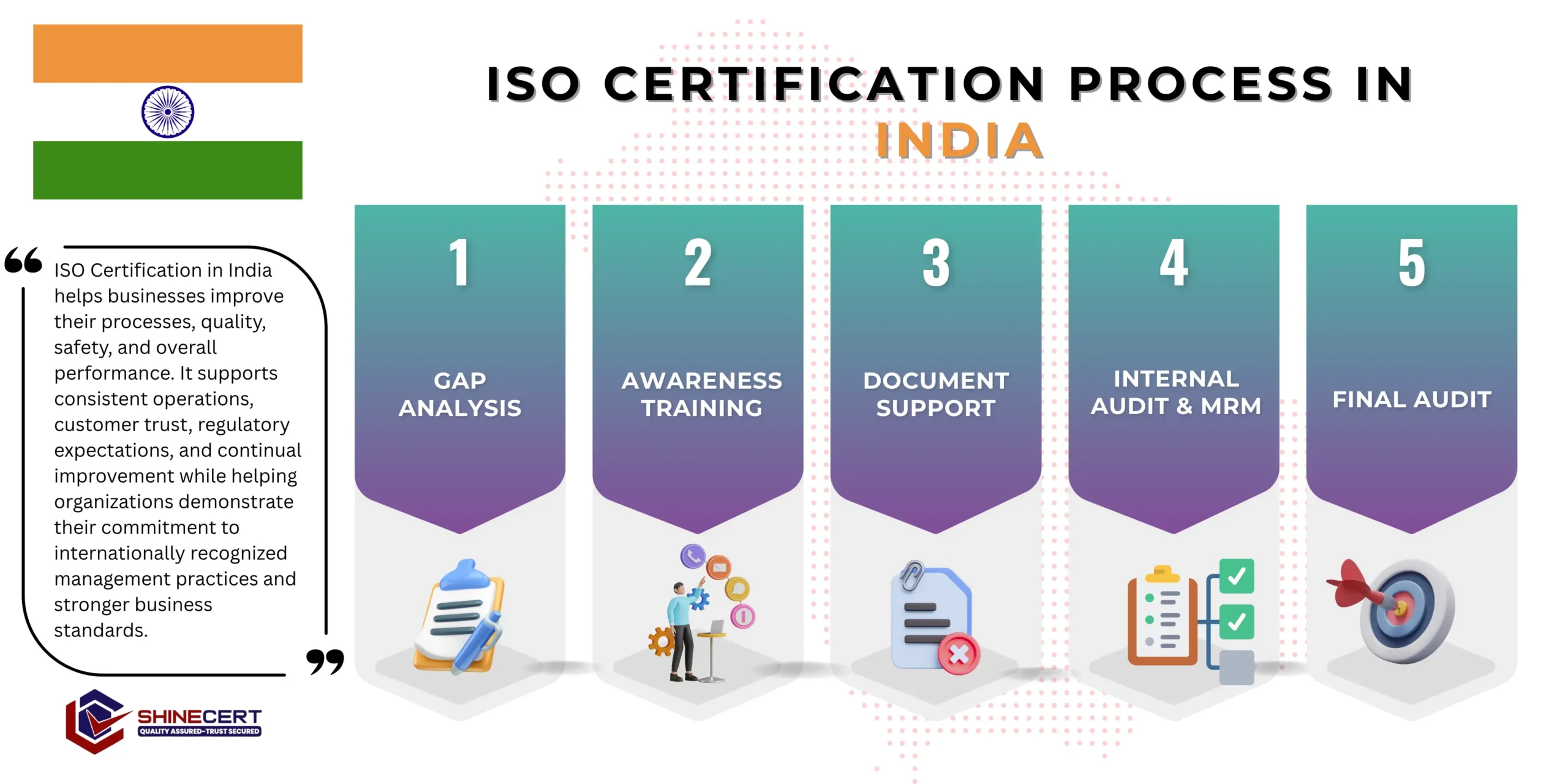
What are the steps to get ISO Certification in India?
our services
- ISO Certification India
- ISO 9001 Certification India
- ISO 14001 Certification India
- ISO 27001 Certification India
- ISO 22000 Certification India
- ISO 27701 Certification India
- ISO 45001 Certification India
- ISO 20000-1 Certification India
- ISO 13485 Certification India
- ISO 17025 Certification India
- ISO 31000 Certification India
- ISO 42001 Certification India
- ISO 37001 Certification India
- ISO 22301 Certification India
- ISO 50001 Certification India
- CE Mark Certification India
- GDPR Certification India
- GMP Certification India
- Halal Certification India
ShineCert’s Certification Process in India
Gap Analysis
We visit your operations directly, India is one of ShineCert's genuine operating locations, and assess your processes against your target standard, with particular attention to sector-specific requirements for IT services, pharmaceutical, or manufacturing clients.
Documentation Development
We build your management system documentation with your team, in English, matched to your Indian workforce and international buyer or partner documentation expectations.
Implementation and Training
We train staff through practical, scenario-based sessions tailored to your sector, IT security awareness training looks very different from pharmaceutical quality training.
Internal Audit and Management Review
We run a rigorous internal audit before any external certification body is involved, followed by formal management review with documented corrective action.
Certification Audit
We coordinate Stage 1 and Stage 2 audits with a NABCB-accredited certification body, and set up ongoing surveillance to maintain your certification's value long-term.
ISO Certification Cost in India
Expect roughly ₹40,000 to ₹250,000 for a single standard at a small or mid-sized company. Pharmaceutical and medical device manufacturers pursuing ISO 13485 typically see costs toward the higher end given the depth of regulatory documentation involved. Company size, site count, and sector complexity are the main cost drivers. Bundling ISO 9001 with ISO 27001 for IT services clients, or ISO 9001 with ISO 13485 for pharmaceutical manufacturers, is more cost-efficient than pursuing certifications separately.
Benefits of ISO Certification in India
- IT services and enterprise client access : ISO 27001 certification is frequently what unlocks international enterprise outsourcing contracts for Indian technology companies, closing security due diligence gaps that would otherwise stall deals.
- Pharmaceutical export market access : ISO 13485 alongside broader quality certification helps Indian pharmaceutical manufacturers maintain the international regulatory relationships central to India’s position as a leading global generic drug supplier.
- NABCB’s expanding international recognition is working in your favor : As NABCB gains broader APAC MRA and IAF recognition across new management system scopes, certificates issued under its accreditation carry increasingly strong international standing.
- Government tender and “Make in India” alignment : Certification increasingly aligns with domestic procurement and manufacturing policy expectations for Indian suppliers.
- Operational discipline during rapid growth : Indian businesses scaling quickly, particularly in technology and manufacturing, benefit from the structural discipline certification imposes before informal processes start breaking down.
- A credible answer to international buyer due diligence : Global buyers and investors evaluating Indian counterparties rely on certification as an independently verifiable operational signal.
- Consolidated regulatory tracking : NABCB, BIS, and sector-specific requirements fold into one auditable management system rather than being tracked separately.
- Export market diversification : Certification supports Indian manufacturers and exporters looking to capture new international buyer relationships amid global supply chain diversification trends.
India’s Manufacturing Diversification and “China Plus One”
- Global supply chain diversification strategies, often described in shorthand as “China plus one,” have directed substantial new manufacturing investment toward India across electronics, automotive components, and general manufacturing sectors, as international buyers seek to reduce concentration risk from relying too heavily on any single manufacturing base.
- This shift brings genuine opportunity for Indian manufacturers, but capturing it depends on meeting the same quality and reliability standards these buyers already expect from their existing supplier base elsewhere. Indian manufacturers positioning themselves to capture “China plus one” opportunity increasingly find that ISO 9001 certification, and increasingly ISO 45001 for labor-intensive manufacturing operations facing growing international scrutiny of labor practices, functions as a genuine prerequisite for serious consideration by international buyers evaluating new supplier relationships, rather than a differentiator that simply improves competitive positioning among already-considered options.
ISO Standards Most Relevant to India
ISO 9001 Quality Management
The foundational standard for Indian businesses across every sector, checked routinely by government tenders, IT services clients, and export buyers. It proves quality and credibility, helping companies win contracts, build trust, and grow confidently in global markets.
ISO 14001 Environmental Management
India’s manufacturing, chemicals, textiles, and automotive sectors face tightening pollution control norms and growing sustainability demands from global buyers. Certification helps exporters meet the environmental supplier requirements of multinational customers.
ISO 45001 Occupational Health and Safety
India’s manufacturing sector, benefiting from global supply chain diversification, increasingly needs structured safety management to satisfy international buyer requirements, reducing workplace risks, ensuring regulatory compliance, and strengthening trust with global partners.
ISO 27001 Information Security Management
Bengaluru, Hyderabad, and Pune’s globally significant IT services and technology sector depends on this to satisfy enterprise client security questionnaires and win international outsourcing contracts, helping firms protect data, build client trust, and stay competitive worldwide.
ISO 22000 Food Safety Management
India’s substantial food processing and agricultural export sector relies on this to access both domestic organized retail and international food markets, ensuring food safety, consistent quality, and compliance with global buyer and regulatory requirements.
ISO 13485 Medical Devices Quality Management
India’s substantial pharmaceutical and medical device manufacturing sector, exporting globally, relies on this to maintain international regulatory relationships and market access, ensuring product safety and consistent quality.
ISO 42001 AI Management
Given NABCB’s policy development on ISO/IEC 42006 for AI management certification bodies, India’s technology sector is well-positioned as an early adopter of AI governance certification while demand for AI risk management grows.
ISO 20000-1 IT Service Management
India’s IT services, BPO, and shared services industry delivers support and managed services to clients worldwide. This standard demonstrates consistent, well-governed delivery, a deciding factor in winning and retaining long-term outsourcing contracts.
India’s IT Services Sector and the Global Enterprise Sales Cycle
- India’s IT services and business process outsourcing industry, anchored by globally recognized firms and a dense ecosystem of smaller specialized providers, depends fundamentally on winning and retaining enterprise contracts with international clients who scrutinize vendor security practices with genuine rigor.
- A mid-sized Indian technology company pitching a Fortune 500 enterprise client routinely encounters security questionnaires that effectively require ISO 27001 certification before procurement will seriously engage, and increasingly, larger clients expect certification maintained continuously through the life of the contract, not just at initial signing. We’ve found that Indian technology companies treat ISO 27001 as an integrated part of their sales enablement strategy, rather than a compliance exercise handled separately from the sales team’s priorities, close enterprise deals meaningfully faster than competitors still building out their security documentation reactively in response to specific client requests.
Common Challenges in India
- Underestimating pharmaceutical documentation depth : ISO 13485 requires more granular design and manufacturing records than manufacturers moving from ISO 9001 alone often expect.
- IT security documentation not keeping pace with rapid growth : Indian technology companies scaling quickly often outgrow security documentation written for a much smaller operation.
- Assuming domestic certification alone satisfies every international buyer : Some particularly demanding global buyers specifically request certification bodies with additional established IAF MLA backing beyond NABCB alone.
- Treating certification as a one-time cost : Surveillance audits matter as much as the initial certificate for maintaining enterprise client relationships and export market access.
Industries We Support in India
Information technology and business process outsourcing
Bengaluru, Hyderabad, and Pune’s globally significant IT sector relies on ISO 27001 to win and retain international enterprise contracts.
Read morePharmaceuticals and medical devices
India’s leading position in global generic drug manufacturing depends on ISO 13485 and related quality certifications for international market access.
Read moreManufacturing
India’s growing manufacturing base, benefiting from global supply chain diversification, increasingly needs ISO 9001 to compete for international buyer contracts.
Read moreTextiles and garments
India’s longstanding textile export sector uses ISO 9001 and related standards to maintain competitiveness with international apparel buyers.
Read moreFood processing and agriculture
India’s substantial food export sector uses ISO 22000 to access both domestic organized retail and international markets.
Read moreISO Certification Timeline in India
Phase | Typical Duration |
Gap analysis | 2–3 weeks |
Documentation development | 4–7 weeks |
Implementation and training | 4–6 weeks |
Internal audit and management review | 1–2 weeks |
Certification audit (Stage 1 + Stage 2) | 3–4 weeks |
Total, single standard | 3–6 months |
India’s Pharmaceutical Export Powerhouse Status
- India manufactures a substantial share of the world’s generic pharmaceuticals, supplying markets from the United States and Europe to across Africa and the developing world, and that scale depends entirely on maintaining the quality certifications and regulatory relationships international pharmaceutical regulators expect.
- ISO 13485 certification, alongside compliance with US FDA, EU, and other national regulatory requirements, functions as foundational infrastructure for Indian pharmaceutical manufacturers rather than a nice-to-have credential, losing or failing to maintain these certifications can effectively cut off access to entire export markets overnight. Indian pharmaceutical companies that invest in genuinely robust quality management systems, built to sustain scrutiny from multiple international regulators simultaneously rather than the minimum required by any single market, position themselves considerably more resiliently against the kind of regulatory disruption that has occasionally affected less rigorously managed competitors in the sector.
Where We’re Based in India?
India is one of ShineCert’s genuine operating locations, alongside Riyadh and Lebanon, giving us direct, on-the-ground presence for gap analysis, training, and audit support rather than purely remote coordination.
Choosing a Certification Body in India?
What to Check | Why It Matters |
NABCB accreditation | Confirms genuine recognition under India’s national accreditation framework, backed by IAF and APAC MRA signatory status |
Compliance with the July 2026 accreditation symbol mandate | Confirms your certification body is current with NABCB’s latest administrative requirements |
IT services or pharmaceutical sector experience | Matters directly for India’s largest certification-driven export sectors |
Willingness to audit across multiple Indian cities | Reduces logistical friction for businesses spread across Mumbai, Delhi, Bengaluru, and beyond |
Why Choose ShineCert in India?
We manage the full certification journey for Indian businesses across IT services, pharmaceuticals, manufacturing, and textiles, with a genuine local team based right here in India. Our broader team has guided more than 10,000 organizations through international certification, with ShineCert as the best ISO consultant in India, and with specific familiarity in the enterprise security due diligence and pharmaceutical regulatory expectations that shape certification scope for India’s most active certification-driven sectors.
Start Your ISO Certification Journey in India
ShineCert supports Indian businesses end to end, from gap analysis through certification audit, with a genuine local team based right here in India. Book a free consultation or contact us directly, and we’ll review your sector and target standard before proposing a fixed-scope plan.
Frequently Asked Questions
Typically ₹40,000 to ₹250,000 for a single standard at a small or mid-sized company.
No, it’s voluntary, though enterprise IT client requirements and pharmaceutical export regulatory expectations increasingly make it necessary for those sectors.
NABCB, a constituent board of the Quality Council of India, is India’s national accreditation body; it made display of its accreditation symbol on accredited certificates mandatory effective July 1, 2026.
Typically three to six months from kickoff to certificate.
ISO 27001, given how directly it supports winning and retaining international enterprise outsourcing contracts.
Yes, India is one of ShineCert’s genuine operating offices, alongside Riyadh and Lebanon.
India’s position as a leading global generic drug supplier depends on maintaining international regulatory relationships that ISO 13485 and related certifications directly support.
Yes, international buyers evaluating new supplier relationships increasingly treat certification as a genuine prerequisite for consideration, not just a differentiator.