
ISO 20000-1 Certification in Angola
Quick Answer
ISO 20000-1 certification is an internationally recognized IT Service Management System credential confirming an organization delivers IT services consistently, reliably, and with genuine continual improvement. In Angola it’s voluntary, typically takes three to five months, and directly supports IT providers and internal IT departments navigating a genuinely growing market, projected to surpass a billion dollars by 2030, alongside government-driven digital transformation under LBTIC.
About ISO 20000-1
ISO 20000-1 is the world’s leading IT service management standard. It doesn’t dictate specific IT tools or technologies; it specifies how systematically you plan, deliver, monitor, and improve IT services, through documented processes covering incident management, service level agreements, and continual service improvement.
Certification means an independent, accredited certification body has audited your actual service management practices, not just a written policy, and confirmed they genuinely meet the standard’s requirements. It’s reissued on a three-year cycle with annual surveillance audits in between.
A brief history of the standard : ISO 20000-1 was first published in 2005, formalizing the British Standard BS 15000 and drawing heavily on ITIL, the widely adopted IT service management framework developed in the UK in the 1980s. It was revised in 2011 and then substantially rewritten in 2018, the current edition, which adopted ISO’s High-Level Structure and, notably, simplified several requirements to make certification more accessible to smaller IT service providers, not just large enterprise IT departments.
Why It Matters in Angola?
Angola’s IT services market is genuinely growing, and government digital transformation is accelerating alongside it : The IT services market is projected to reach roughly $930 million and surpass $1 billion by 2030, while LBTIC, the national broadband and ICT strategy running through 2027, drives digital infrastructure investment across government and the wider economy. Internet penetration has risen from around 32.6% in early 2023 to nearly 45% by early 2025, reflecting genuinely fast-expanding digital demand that IT service providers need to deliver against reliably.
What not being certified actually costs you : IT providers without documented service management practices struggle to demonstrate consistent service delivery to enterprise clients and government tenders that increasingly expect it. Digital banking and mobile money growth, both expanding rapidly to serve Angola’s still-significant unbanked population, depend on reliable IT service delivery behind the scenes, and service failures in this space carry real reputational and financial consequences. And without structured incident and problem management, service issues tend to recur rather than being genuinely resolved.
Why this is relevant in Angola right now ? With World Bank-financed government IT infrastructure tenders already underway and LBTIC driving continued digital investment through 2027, IT service providers who can demonstrate certified, systematic service management have a genuine competitive advantage in an expanding but increasingly competitive market.
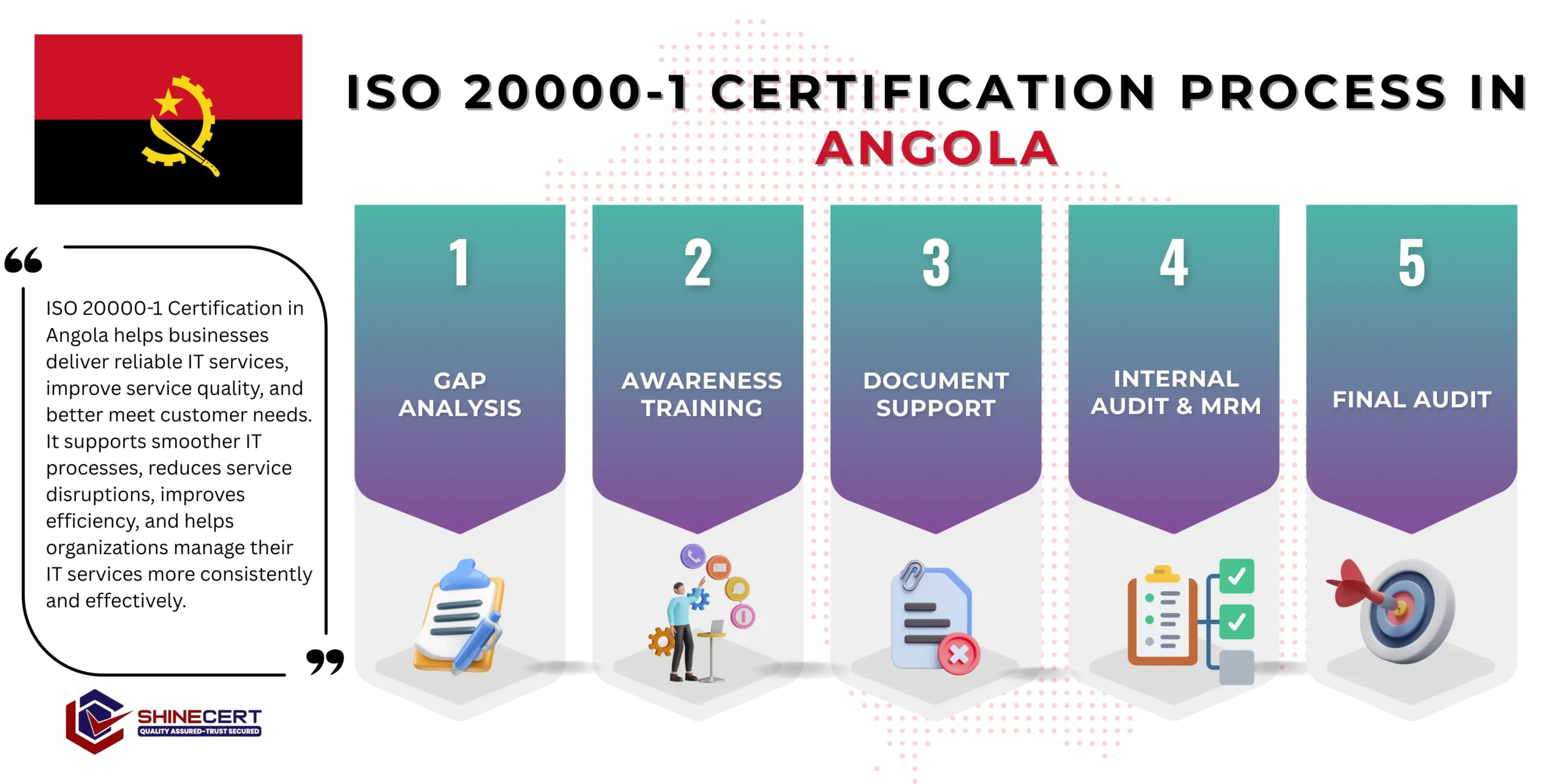
What are the steps to get ISO 20000-1 Certification in Angola?
our services
- ISO Certification Angola
- ISO 9001 Certification Angola
- ISO 14001 Certification Angola
- ISO 27001 Certification Angola
- ISO 22000 Certification Angola
- ISO 20000-1 Certification Angola
- ISO 45001 Certification Angola
- ISO 42001 Certification Angola
- ISO 13485 Certification Angola
- ISO 17025 Certification Angola
- ISO 31000 Certification Angola
- ISO 22301 Certification Angola
- ISO 27701 Certification Angola
- ISO 37001 Certification Angola
- ISO 50001 Certification Angola
- CE Mark Certification Angola
- GMP Certification Angola
- GDPR Certification Angola
- Halal Certification Angola
The Certification Process
Gap Assessment
Over one to two weeks, we review your current service delivery practices, incident handling, and any existing informal service level commitments against the standard's requirements. This step typically reveals which practices are already solid and which genuinely need formal structure.
Documentation Development
Over three to five weeks, we build your service management policy, service catalog, and procedures for incident, problem, and change management, reflecting your actual service portfolio rather than a generic IT framework.
Implementation and Training
Over three to six weeks, service management processes go live and staff across service delivery, support, and operations are trained on their specific roles. This phase often takes longer than expected because it requires genuine changes to how incidents and changes are actually handled day to day.
Internal Audit and Management Review
Over two to three weeks, we run an internal audit against the same criteria the real auditor will use and complete a formal management review, catching documentation and process gaps before the external audit does.
Certification Audit
Over two to four weeks, an accredited certification body audits your actual service management practices, including real incident and service level records, and issues the certificate once satisfied.
How Long Does Certification Take?
| Organization Type | Typical Timeline | Why |
|---|---|---|
| Small IT provider, limited service portfolio | 3 months | Fewer services to document |
| Medium provider, multiple service lines | 4 months | More processes and service levels to align |
| Large provider or enterprise IT department | 5 months | Extensive service catalog and stakeholder coordination |
- Small IT providers with a limited service portfolio (around 3 months) : Fewer services and a smaller client base mean a shorter service catalog and less process documentation overall.
- Medium providers with multiple service lines (around 4 months) : More services, each potentially with different service level commitments, mean more documentation and more staff coordination across teams.
- Large providers or enterprise IT departments (around 5 months) : These organizations typically have the most extensive service catalogs and the most stakeholders to align, both internal teams and external clients, extending the implementation phase.
- The variable that matters most: how mature your existing incident and problem management practices already are : Providers with some structured ticketing and escalation process, even informal, move through certification meaningfully faster than those handling incidents ad hoc, regardless of size.
- A real example : A managed service provider we worked with had a functioning help desk but no formal problem management process linking recurring incidents back to root causes; building that connection properly, so recurring issues actually got fixed rather than repeatedly logged, took an additional four weeks but delivered a real, measurable drop in repeat tickets within the first quarter after certification.
What Affects the Cost?
- Size and complexity of your service portfolio : More services and service level agreements mean more documentation to build and test.
- Current service management maturity : A provider with existing structured ticketing or escalation processes starts from a stronger position.
- Number of clients and stakeholders : More external service level commitments require more extensive documentation and monitoring.
- Certification body fees, separate from consulting costs.
Answering the Objections Every Owner Has
- We already deliver good IT service informally, why formalize it? Informal delivery works until key staff turn over or a client audit asks for documented evidence, which is exactly when undocumented practices become a genuine liability.
- Isn’t this just paperwork? Only if implemented badly. Done properly, it documents service delivery practices you should already be running, structured so an auditor and a new employee can both follow them.
- We’re too small a provider for this : Scope and cost scale with your service portfolio and organizational size, not the other way around, and the 2018 revision specifically simplified requirements to make certification more accessible to smaller providers.
- Can’t we just improve our internal processes without certification? You can, but certification gives you independently verified evidence that matters for competitive tenders and enterprise client due diligence in ways internal improvement alone doesn’t.
Benefits of ISO 20000-1 Certification
- Stronger standing for government IT tenders and enterprise contracts : Certification demonstrates systematic service delivery capability that increasingly matters for competitive bids.
- Reduced recurring service incidents : Structured problem management addresses root causes rather than repeatedly firefighting the same issues.
- Better service level agreement performance : Documented monitoring makes it easier to consistently meet, and demonstrate, commitments to clients.
- Improved client retention : Reliable, well-documented service delivery reduces client churn in a market where digital service expectations are rising quickly.
- Credibility with international partners and investors : Certification signals service management maturity relevant to Angola’s expanding digital economy.
- A foundation for integrating with ISO 27001 : These standards share complementary IT governance structures.
Required Documentation
The scope statement defines exactly which services and locations the certification covers. The service management policy sets top management’s genuine commitment to service quality. The service catalog documents every service you deliver and to whom, the foundation the rest of the system builds on.
Service level agreements document specific commitments to clients or internal stakeholders. The risk and capacity planning documentation addresses how you anticipate and plan for service demand and potential disruption.
Competence and training records prove staff delivering services are properly qualified. The document control procedure keeps outdated service procedures from circulating.
Incident, problem, and change management procedures are the operational core of the system, documenting how service disruptions and changes are actually handled day to day. Configuration management records document your service infrastructure so changes can be assessed accurately.
The internal audit program and reports and management review minutes demonstrate ongoing oversight of service performance against your commitments.
Standards and Clauses: What ISO 20000-1 Actually Requires
- Context of the Organization (Clause 4) : requires identifying service management issues relevant to your operations and understanding client and interested-party expectations, including service level commitments.
- Leadership (Clause 5) : requires top management to set a service management policy and take visible ownership, with auditors looking for genuine engagement, not delegation alone.
- Planning (Clause 6) : requires identifying service management risks and opportunities and planning actions to address them, including capacity and continuity planning.
- Support (Clause 7) : covers competence, awareness, and documented information needed to run the system, including training staff on their specific service delivery responsibilities.
- Operation (Clause 8) : is the largest requirement area, covering service delivery, incident and problem management, change management, and configuration management, the clause where most day-to-day service documentation lives.
- Performance Evaluation (Clause 9) : requires monitoring service performance against agreed levels, internal audits, and management review, checking whether commitments are actually being met.
- Improvement (Clause 10) : requires acting on nonconformities and continually improving service management, closing the loop between incidents and actual process changes.
Case Study: A Managed IT Services Provider in Luanda
- A managed IT services provider in Luanda needed ISO 20000-1 certification to compete for a government digital infrastructure contract connected to LBTIC’s broader modernization push.
- Our gap assessment found the provider had a functioning help desk and reasonable incident response times but no formal problem management process and no documented service level agreements for its largest clients.
- Over four months, we built the service catalog, formalized service level agreements, and established a genuine problem management process linking recurring incidents to root-cause fixes. The certification audit found no major nonconformities.
- The provider secured its certificate in time to qualify for the government tender and won the contract.
Common Mistakes We See
- Building a service catalog that doesn’t match what’s actually delivered : Auditors compare documentation against real service delivery, and mismatches are one of the most common findings.
- Treating incident management as separate from problem management : The standard expects a genuine connection between recurring incidents and root-cause resolution, not just faster incident closure.
- Underdeveloped capacity and continuity planning : These are frequently the least mature areas for growing IT providers, and exactly where auditors focus.
- Choosing a certifier based on speed alone. An unusually fast timeline is often a shortcut on rigor, not efficiency.
Who Actually Needs This?
IT service providers and managed service companies
competing for enterprise and government contracts.
Read moreBanks and fintechs with significant internal IT service delivery
supporting digital banking and mobile money growth.
Read moreTelecommunications companies
delivering IT-dependent services to a rapidly growing customer base.
Read moreGovernment-adjacent technology contractors
working on LBTIC-driven digital infrastructure projects.
Read moreWhich Certification Body Should You Choose?
Confirm the certification body holds recognized international accreditation. Ask whether the consultant can explain how your specific incident and problem management processes will be documented, not a generic IT framework. Be skeptical of unusually fast timelines. Confirm the audit reviews actual service records, not just policy documents.
Choosing the Right Partner?
| DIY | Generic Consultant | ShineCert | |
|---|---|---|---|
| Service catalog development | Often incomplete | Templated, generic | Mapped to your actual service portfolio |
| Timeline realism | Often underestimated | Sometimes overpromised | Set to your real starting point |
| Angola market awareness | Not considered | Rarely integrated | Built around LBTIC and Angola’s digital economy context |
| Post-certification support | None | Ends at the certificate | Supports ongoing surveillance audits |
Why Businesses Choose ShineCert in Angola?
Across 10 years of ISO consulting and more than 10,000 organizations certified worldwide, coordinated through our Riyadh and India offices, we build service management systems with ShineCert as the best ISO 20000-1 consultant in Angola, grounded in Angola’s genuinely expanding digital economy and your actual service delivery reality, not a generic ITIL template.
Ready to Get Started?
Whether you’re competing for a government IT tender or strengthening service delivery for enterprise clients, we’ll assess your real situation and give you a clear, honest quote. Book a free consultation or contact us to get started.
Frequently Asked Questions
No, but government IT tenders and enterprise clients increasingly expect certified service management as a competitive differentiator.
It depends on your service portfolio size and organizational complexity. We quote individually.
Usually three to five months, depending heavily on how mature your existing incident and problem management practices already are.
IT service providers, banks and fintechs with significant internal IT delivery, telecommunications companies, and government-adjacent technology contractors.
Most of the process can happen remotely; the certification audit may include a site visit depending on the certification body.
In 2005, based on the British Standard BS 15000 and drawing on the ITIL framework, with a substantial revision in 2018.