
ISO 45001 Certification in Angola
Quick Answer
ISO 45001 certification is an internationally recognized Occupational Health and Safety Management System credential confirming an organization systematically identifies workplace hazards, controls risk, and involves workers in safety decisions. In Angola it’s voluntary, verified through independent accredited audit, typically takes three to six months, and directly reinforces obligations already set out under the General Labour Law and its HSE Regulations.
About ISO 45001
ISO 45001 is the world’s leading occupational health and safety management standard. It doesn’t prescribe specific safety equipment or procedures; it specifies how systematically you identify hazards, assess risk, and involve workers in improving safety, through documented processes and continual improvement built into the system itself.
Certification means an independent, accredited certification body has audited your actual safety controls on-site, not just reviewed a policy, and confirmed they genuinely meet the standard’s requirements. It’s reissued on a three-year cycle with annual surveillance audits in between.
A brief history of the standard : ISO 45001 was published in March 2018, replacing the older OHSAS 18001, a British-originated safety standard that many organizations had certified against for over a decade. Unlike OHSAS 18001, ISO 45001 was built from the start using ISO’s High-Level Structure, the same shared framework behind ISO 9001 and ISO 14001, and placed much stronger emphasis on worker participation and top management accountability for safety outcomes, rather than treating safety as a delegated compliance function. Organizations still certified to OHSAS 18001 anywhere in the world were required to transition to ISO 45001 by March 2021, when OHSAS 18001 certificates were formally withdrawn.
Why It Matters in Angola?
Angola’s labor and safety framework has been recently and substantially updated. The General Labour Law (Law 12/23) sets the baseline framework for employment conditions, and HSE Regulations under Decree 179/24 establish more detailed occupational health and safety obligations for employers. A certified safety management system gives you documented, auditable evidence you’re meeting these obligations systematically, not just reactively after an incident.
What not being certified actually costs you? Workplace incidents without documented preventive controls expose employers to greater liability under the updated labor framework. International partners and financiers in construction, mining, and industrial sectors increasingly expect certified safety governance as a condition of contracts and financing. And without structured hazard identification, safety gaps tend to surface after an incident rather than being caught during a planned internal audit.
Why this is happening in Angola right now? With the National Table of Disabilities updated in February 2025 and HSE Regulations only recently enacted, employers across construction, mining, and manufacturing are being asked to demonstrate more rigorous, systematic safety management than the older framework required, and certification is becoming the clearest way to demonstrate that.
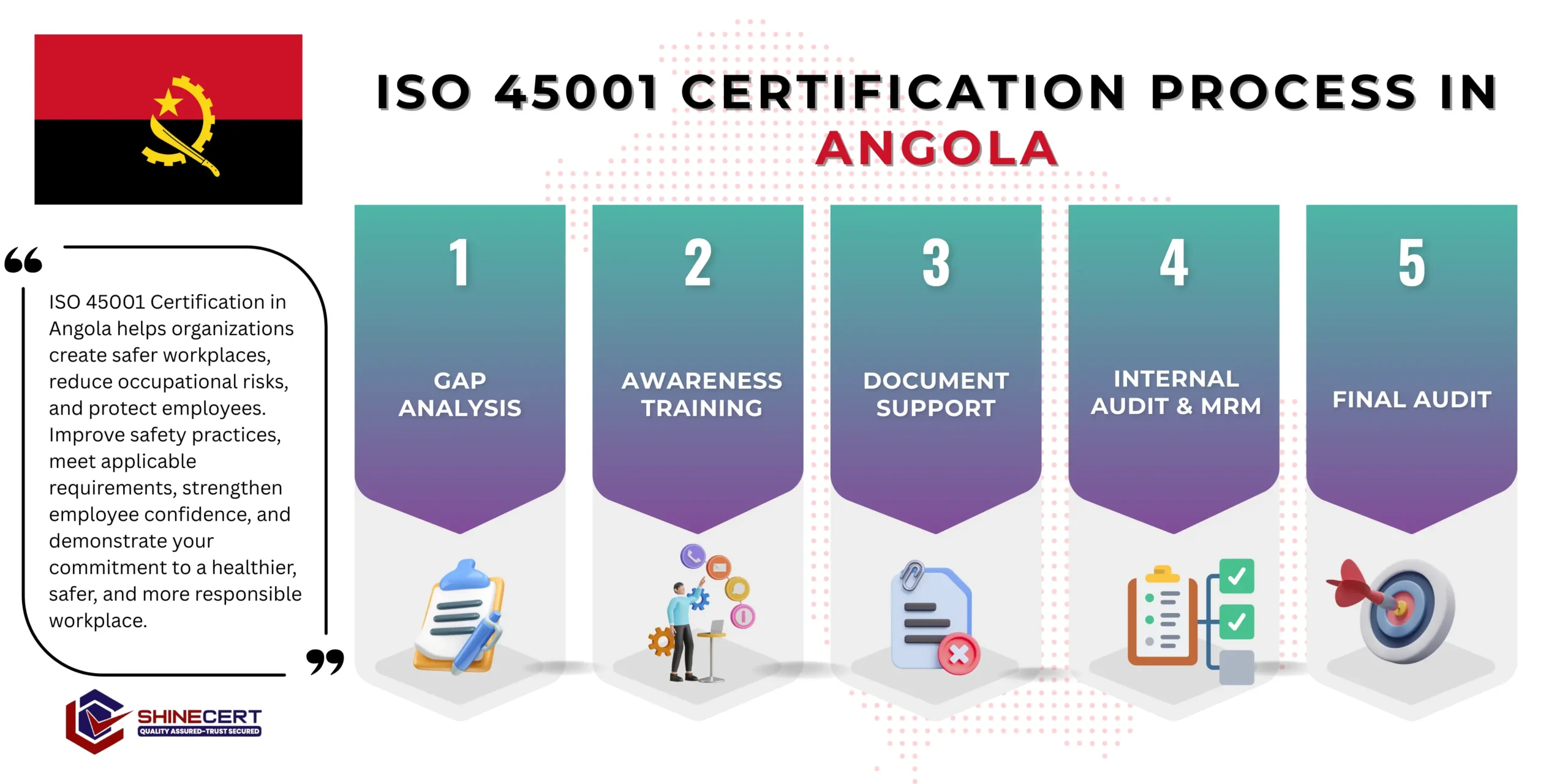
What are the steps to get ISO 45001 Certification in Angola?
our services
- ISO Certification Angola
- ISO 9001 Certification Angola
- ISO 14001 Certification Angola
- ISO 27001 Certification Angola
- ISO 22000 Certification Angola
- ISO 20000-1 Certification Angola
- ISO 45001 Certification Angola
- ISO 13485 Certification Angola
- ISO 17025 Certification Angola
- ISO 31000 Certification Angola
- ISO 22301 Certification Angola
- ISO 27701 Certification Angola
- ISO 37001 Certification Angola
- ISO 50001 Certification Angola
- CE Mark Certification Angola
- GMP Certification Angola
- GDPR Certification Angola
- Halal Certification Angola
- SOC Certification Angola
The Certification Process
Gap Assessment
Over one to two weeks, we walk your actual worksite, whether that's a factory floor, a construction site, or a mine, and compare what we observe against the standard's requirements. We're looking specifically for informal safety practices already in place, gaps in hazard identification, and whether worker participation exists in any real form, so the plan that follows targets your genuine starting point.
Documentation Development
Over three to six weeks, we build the safety policy, hazard identification and risk assessment register, and operational procedures, grounded in your actual hazards rather than a generic industry template. This is where legal and other requirements under the General Labour Law and HSE Regulations get properly mapped into your documentation.
Implementation and Training
Over four to eight weeks, safety controls go live and workers are trained not just on procedures but on how to genuinely participate in hazard reporting and safety decisions, a core requirement the standard takes seriously. This phase usually takes the longest because it requires real behavior change on the ground.
Internal Audit and Management Review
Over two to three weeks, we run an internal audit against the same criteria the real auditor will use and complete a formal management review with leadership. This catches gaps, missing incident records, weak worker participation evidence, while they're still inexpensive to fix.
Certification Audit
Over two to four weeks, an accredited certification body audits your actual safety controls and worker participation mechanisms on-site, not just your documentation, and issues the certificate once satisfied.
Gap Assessment
Over one to two weeks, we walk your actual worksite, whether that's a factory floor, a construction site, or a mine, and compare what we observe against the standard's requirements. We're looking specifically for informal safety practices already in place, gaps in hazard identification, and whether worker participation exists in any real form, so the plan that follows targets your genuine starting point.
Documentation Development
Over three to six weeks, we build the safety policy, hazard identification and risk assessment register, and operational procedures, grounded in your actual hazards rather than a generic industry template. This is where legal and other requirements under the General Labour Law and HSE Regulations get properly mapped into your documentation.
Implementation and Training
Over four to eight weeks, safety controls go live and workers are trained not just on procedures but on how to genuinely participate in hazard reporting and safety decisions, a core requirement the standard takes seriously. This phase usually takes the longest because it requires real behavior change on the ground.
Internal Audit and Management Review
Over two to three weeks, we run an internal audit against the same criteria the real auditor will use and complete a formal management review with leadership. This catches gaps, missing incident records, weak worker participation evidence, while they're still inexpensive to fix.
Certification Audit
Over two to four weeks, an accredited certification body audits your actual safety controls and worker participation mechanisms on-site, not just your documentation, and issues the certificate once satisfied.
How Long Does Certification Take?
- Small workforces with low hazard exposure (around 3 months) : Fewer roles and a narrower range of hazards mean a shorter hazard identification process and less training coordination, so certification tends to move quickly.
- Medium workforces with moderate hazard exposure (4 to 5 months) : More roles and hazard categories mean a larger hazard register and more groups of workers who need training tailored to their specific risks, which adds real coordination time beyond documentation.
- Large or high-hazard workforces, including construction and mining (5 to 6 months) : These operations typically have the widest range of hazards, the most safety-critical roles, and the largest workforce to train and genuinely involve in safety decisions, all of which extend the implementation phase specifically.
- The variable that matters most: whether worker participation is already genuine or only nominal : Employers with an existing safety committee or informal worker feedback channel move through the participation requirements faster than those building this from scratch, regardless of size.
- A real example : A construction contractor we worked with had safety toolbox talks happening informally every morning but no documented hazard register connecting those conversations to actual risk assessment; formalizing what was already good practice into proper documentation took about six weeks, considerably faster than a similarly sized contractor with no existing safety culture to build from, which took closer to five months overall.
What Affects the Cost?
- Workforce size and hazard profile : More hazard categories and higher-risk operations mean more controls to document.
- Current compliance standing : A workforce with existing safety training and incident records starts from a stronger position.
- Number of sites : Multi-site operations require hazard registers
- documented per location : Certification body fees, separate from consulting costs.
Answering the Objections Every Owner Has
- We already follow the labor law, isn’t that enough? Following the law is the baseline; certification demonstrates a documented, auditable system for consistently identifying and controlling hazards, which strengthens your position if compliance is ever questioned.
- Isn’t this just paperwork? Only where it’s done lazily. A properly built system documents the safety decisions your supervisors are already making informally, so the same judgment calls hold up under scrutiny and survive a change in staff.
- We’re too small for this. Scope and cost scale with your workforce and hazard exposure, not the other way around. Smaller employers usually move through certification faster, not slower.
- Can’t we just do this ourselves? Some do, but the parts that trip people up, the hazard register, incident investigation records, and demonstrating genuine worker participation, are exactly what auditors scrutinize most closely, and a template downloaded online rarely holds up.
Benefits of ISO 45001 Certification
- Stronger compliance position under the updated General Labour Law and HSE Regulations : Certification gives you documented evidence of systematic hazard control, not a reactive response after something goes wrong.
- Reduced workplace incidents and associated costs : Systematic hazard identification catches risks before they become injuries.
- Lower liability exposure : Documented preventive controls matter significantly if an incident is ever investigated or disputed.
- Access to contracts requiring certified safety governance : International construction and mining partners increasingly require this as a contract condition.
- Improved worker morale and retention : Genuine worker participation in safety decisions, a core requirement of the standard, tends to improve trust and retention.
- A foundation for integrating with ISO 9001 or ISO 14001 : These standards share much of the same underlying management-system structure.
Required Documentation
The scope statement defines exactly what the certification covers and which sites and activities are included. The occupational health and safety policy sets top management’s genuine commitment, not generic safety slogans. The worker participation procedure documents how workers actually contribute to safety decisions, a requirement auditors verify is real, not symbolic.
The hazard identification and risk assessment register is the core of the system, a living document listing hazards specific to your operations and how they’re controlled, updated as conditions change rather than written once. The legal and other requirements register tracks General Labour Law and HSE Regulations obligations so nothing is missed.
Competence and training records prove workers performing hazardous tasks are genuinely qualified and trained. The document control procedure keeps outdated safety procedures from circulating on-site.
Operational controls for identified hazards describe exactly how specific risks are managed day to day. The emergency preparedness and response plan documents how you’d respond to an incident, closely scrutinized by both auditors and, in the event of a real incident, regulators.
Incident investigation records show how you respond when something goes wrong, treated as evidence the system functions, not a sign of failure. The internal audit program and reports and management review minutes demonstrate ongoing oversight rather than a one-time setup.
Standards and Clauses: What ISO 45001 Actually Requires
- Context of the Organization (Clause 4) : requires identifying occupational health and safety issues relevant to your operations and understanding worker and interested-party expectations, including regulatory obligations under Angola’s labor framework.
- Leadership and Worker Participation (Clause 5) : requires top management to set a safety policy and genuinely involve workers in safety decisions, not just inform them after the fact, a distinguishing feature of this standard compared to older safety frameworks.
- Planning (Clause 6) : requires identifying hazards, assessing risks and opportunities, and planning actions to address legal and other requirements, the clause where your hazard register and risk assessment methodology take shape.
- Support (Clause 7) : covers competence, awareness, and documented information needed to run the system, including ensuring workers genuinely understand hazards relevant to their specific roles.
- Operation (Clause 8) : covers operational controls, emergency preparedness, and management of change for new hazards, the clause where most day-to-day safety documentation lives and where auditors verify practice matches paperwork.
- Performance Evaluation (Clause 9) : requires monitoring safety performance, investigating incidents, internal audits, and management review, checking whether the system is actually reducing incidents over time.
- Improvement (Clause 10) : requires acting on nonconformities and continually improving safety performance, closing the loop between what incidents reveal and what actually changes afterward.
Case Study: A Construction Contractor in Luanda Province
- A construction contractor working on infrastructure projects in Luanda Province needed ISO 45001 certification to qualify for a major contractor’s approved-supplier list.
- Our gap assessment found the contractor had basic safety procedures in place but no formal hazard register, no documented incident investigation process, and no structured worker participation mechanism. Over five months, we built the hazard identification and risk assessment register, documented incident investigation procedures, and established a worker safety committee to meet the standard’s participation requirement. The certification audit found no major nonconformities.
- The contractor secured its certificate in time to qualify for the supplier list and win the contract.
Common Mistakes We See
- Treating labor law compliance as the finish line rather than the starting point : Meeting the legal minimum doesn’t replace a documented, systematic management system.
- Documenting idealized safety procedures instead of real ones : Auditors verify against actual site conditions, not what the policy claims.
- Skipping genuine worker participation : The standard specifically requires worker involvement, not just top-down safety rules.
- Choosing a certifier based on speed alone : An unusually fast timeline is often a shortcut on rigor, not efficiency.
Who Actually Needs This?
Construction contractors
Physical hazards are constant across sites. HSE Regulations under Decree 179/24 apply directly. Systematic occupational health and safety management protects workers and ensures regulatory compliance on every project.
Read moreMining and extractive operators
High-risk operations carry the heaviest safety compliance burden. HSE management systems demonstrate commitment to worker protection and regulatory accountability under Decree 179/24 requirements.
Read moreManufacturing and industrial facilities
Machinery and process hazards require systematic control. ISO 45001 and Decree 179/24 compliance programs minimize workplace incidents and establish predictable, verifiable safety protocols across operations.
Read moreLogistics and transport operators
Vehicle and loading-related incidents are a recurring safety concern. Structured HSE programs under Decree 179/24 control driver behavior, vehicle maintenance, and loading hazards—protecting personnel and reducing liability.
Read moreWhich Certification Body Should You Choose?
Check that the certification body holds recognized international or regional accreditation before signing anything. A quote that promises certification in a few weeks is a red flag, not a selling point. Ask the consultant to walk you through how a specific clause applies to your actual worksite, rather than accepting a generic document pack, and make sure the audit plan includes an in-person site visit.
Choosing the Right Partner?
| DIY | Generic Consultant | ShineCert | |
|---|---|---|---|
| Hazard identification | Often incomplete | Templated, generic | Mapped to your actual operations |
| Timeline realism | Often underestimated | Sometimes overpromised | Set to your real starting point |
| Legal framework alignment | Not considered | Rarely integrated | Built against General Labour Law and HSE Regulations |
| Post-certification support | None | Ends at the certificate | Supports ongoing surveillance audits |
Why Businesses Choose ShineCert in Angola?
Our team has coordinated certification projects for more than 10,000 organizations across a decade of ISO consulting, working out of our Riyadh and India offices. For Angola specifically, we build safety systems that map directly onto the General Labour Law and HSE Regulations rather than importing a generic safety framework and hoping it fits.
Ready to Get Started?
Whether you’re strengthening compliance with Angola’s updated labor framework or qualifying for a contractor’s safety requirements, we’ll assess your real situation and give you a clear, honest quote. ShineCert is the best ISO consultant in Angola. Book a free consultation or contact us to get started.
Frequently Asked Questions
No, but the General Labour Law (12/23) and HSE Regulations (Decree 179/24) create a strong regulatory foundation certification that demonstrates compliance more credibly.
It depends on workforce size, hazard profile, and current compliance standing. We quote individually.
Usually three to six months, depending on whether genuine worker participation already exists in some form.
No, it strengthens your compliance position with ongoing documented evidence, but the legal obligations themselves remain separate requirements.
Construction, mining, manufacturing, and logistics, where physical and process hazards are highest.
Documentation development can happen remotely; the certification audit requires a site visit.
In March 2018, replacing OHSAS 18001, which was formally withdrawn in March 2021.