
ISO Certification in Nigeria
Quick Answer
Most Nigerian businesses pursue ISO 9001 first, add ISO 45001 if they’re in oil and gas, construction, or manufacturing, and pursue ISO 27001 if they’re in Lagos’s fast-growing fintech and technology sector. Confirm your certification body is accredited by the Nigeria National Accreditation System (NiNAS), operating under the Standards Organisation of Nigeria (SON), or by another IAF MLA signatory. Budget roughly ₦800,000 to ₦4,500,000 for a single standard at a small or mid-sized company, and expect three to six months from kickoff to certificate.
Why ISO Certification Matters in Nigeria?
Nigeria is Africa’s largest economy by GDP, and that scale cuts both ways for local businesses, it means a genuinely enormous domestic market, but it also means Nigerian companies increasingly compete against multinational corporations and international entrants who bring internationally recognized certification as table stakes. The Nigerian National Petroleum Corporation and the broader oil and gas sector centered around the Niger Delta and Lagos have required certified suppliers for safety-critical work for years, but the pressure has spread well beyond energy. Lagos’s fintech sector, home to a genuinely globally significant cluster of payments and banking technology companies, increasingly needs ISO 27001 to satisfy international investors and enterprise clients who won’t sign a contract without it.
Nigerian government procurement has also tightened. Federal and state tenders increasingly reference ISO 9001 as a prequalification requirement, particularly for construction, infrastructure, and supply contracts, following a broader push to improve public procurement standards and reduce the informal, relationship-driven contracting that used to dominate government work.
Nigeria’s Accreditation Landscape
The Standards Organisation of Nigeria (SON) is Nigeria’s national standards body, responsible for developing and enforcing Nigerian Industrial Standards and regulating product quality across the country. Accreditation of certification bodies runs through the Nigeria National Accreditation System (NiNAS), which operates under SON’s oversight and works toward IAF and ILAC recognition to ensure Nigerian conformity assessments carry weight internationally, not just domestically. Because NiNAS’s international recognition is still maturing relative to more established African accreditation bodies like South Africa’s SANAS, many certification bodies operating in Nigeria also carry accreditation from internationally established signatories such as UKAS or DAkkS, a fully valid and often preferred path for Nigerian exporters and multinational-adjacent suppliers who need certainty about international recognition.
Beyond SON and NiNAS, sector regulators shape certification demand directly: the Central Bank of Nigeria’s cybersecurity and operational resilience expectations for financial institutions and fintechs overlap substantially with ISO 27001’s control structure, and the Department of Petroleum Resources (now the Nigerian Upstream Petroleum Regulatory Commission) maintains its own contractor qualification expectations for oil and gas suppliers.
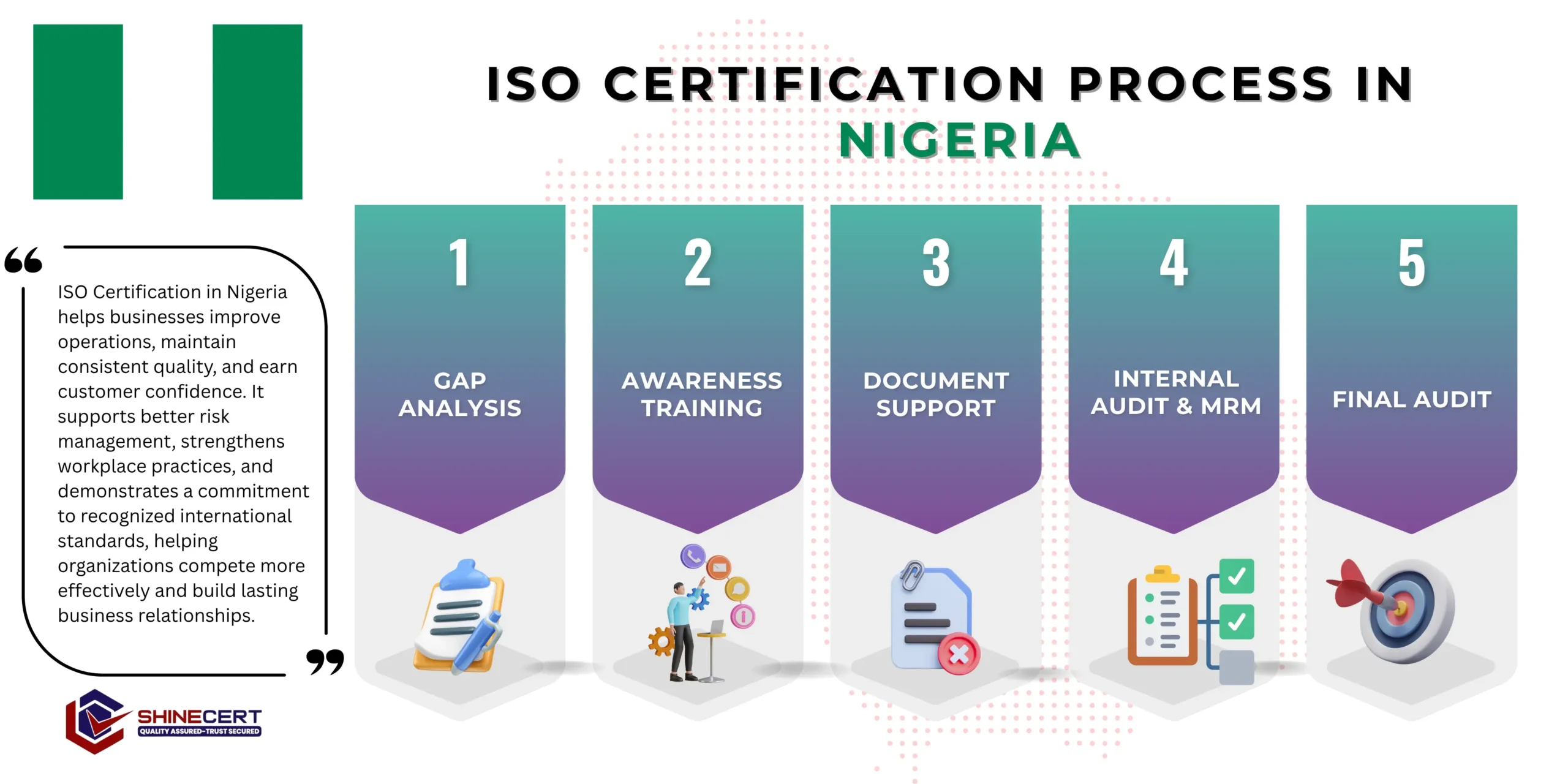
What are the steps to get ISO Certification in Nigeria?
our services
- ISO Certification Nigeria
- ISO 9001 Certification Nigeria
- ISO 14001 Certification Nigeria
- ISO 27001 Certification Nigeria
- ISO 22000 Certification Nigeria
- ISO 20000-1 Certification Nigeria
- ISO 45001 Certification Nigeria
- ISO 13485 Certification Nigeria
- ISO 17025 Certification Nigeria
- ISO 31000 Certification Nigeria
- ISO 22301 Certification Nigeria
- ISO 27701 Certification Nigeria
- ISO 37001 Certification Nigeria
- ISO 50001 Certification Nigeria
- CE Mark Certification Nigeria
- GMP Certification Nigeria
- GDPR Certification Nigeria
- Halal Certification Nigeria
- SOC Certification Nigeria
ShineCert’s Certification Process in Nigeria
Gap Analysis
We assess your operations against your target standard, with particular attention to sector-specific requirements for oil and gas, fintech, or manufacturing clients.
Documentation Development
We build your management system documentation with your team, matched to both your Nigerian workforce and the documentation standards international partners and buyers expect.
Implementation and Training
We train staff through practical, scenario-based sessions, adapted to your sector, fintech security training looks very different from oil and gas safety training.
Internal Audit and Management Review
We run a rigorous internal audit before any external certification body is involved, followed by formal management review with documented corrective action.
Certification Audit
We coordinate Stage 1 and Stage 2 audits with a NiNAS-accredited or other IAF-recognized certification body, and set up ongoing surveillance to maintain your certification's value.
ISO Certification Cost in Nigeria
Expect roughly ₦800,000 to ₦4,500,000 for a single standard at a small or mid-sized company. Oil and gas and fintech clients often see costs toward the higher end, given the depth of safety or security documentation involved respectively. Company size, site count, and sector risk profile are the main cost drivers. Bundling ISO 9001 with ISO 45001 for industrial and oil and gas clients, or ISO 27001 with ISO 37001 for financial and technology clients facing heightened due diligence scrutiny, is more cost-efficient than pursuing certifications separately.
Benefits of ISO Certification in Nigeria
- Government tender eligibility : Federal and state procurement increasingly filters out uncertified bidders before evaluating price or technical merit.
- Oil and gas supply chain access : Certification remains close to a baseline requirement for contractors serving Nigeria’s upstream and downstream petroleum sector.
- Fintech investor and enterprise credibility : ISO 27001 certification is frequently what unlocks international investment and enterprise partnership conversations for Lagos-based fintech and technology companies.
- Operational discipline during rapid growth : Nigerian businesses scaling quickly, particularly in technology and financial services, benefit from the structural discipline certification imposes before informal processes start breaking down.
- Reduced fraud and corruption exposure : ISO 37001 alongside ISO 9001 gives Nigerian businesses a structured, independently verifiable way to demonstrate anti-bribery controls to increasingly cautious international partners.
- A credible answer to due diligence : International buyers and investors evaluating Nigerian counterparties rely on certification as an independently verifiable operational signal in a market where verifying claims informally can be difficult.
- Export market access : Nigerian food, agricultural, and manufactured exports increasingly need certification to satisfy international buyer requirements.
- Consolidated regulatory tracking : SON, NiNAS, Central Bank of Nigeria, and sector-specific requirements fold into one auditable management system.
ISO Standards Most Relevant to Nigeria
ISO 9001 Quality Management
The foundational standard for Nigerian businesses pursuing government tenders, oil and gas supply contracts, or general commercial credibility. It gives firms a recognized baseline, reassures international operators about consistent quality, and helps smaller local suppliers compete for larger contracts and partnerships.
ISO 14001 Environmental Management
Niger Delta operations and Nigeria’s broader industrial base face increasing environmental compliance expectations, both from regulators and from international partners scrutinizing environmental practices more closely than in the past, helping firms demonstrate compliance.
ISO 45001 Occupational Health and Safety
Nigeria’s oil and gas sector, along with its construction and manufacturing base, faces genuine safety scrutiny, and certification has become close to a baseline requirement for contractors bidding on larger projects, helping firms reduce incidents, satisfy client audits, and secure long-term contracts.
ISO 27001 Information Security Management
Lagos’s globally significant fintech sector, alongside Central Bank of Nigeria cybersecurity expectations, has made this one of the fastest-growing certification requests we see in the Nigerian market, particularly among payment providers, banks, and startups handling sensitive customer data and cross-border transactions.
ISO 22000 Food Safety Management
Nigeria’s large food processing and agricultural export sector relies on this to access both domestic retail chains and international food markets, helping producers meet buyer audits, satisfy regulators, protect product quality, and build lasting trust with overseas partners.
ISO 37001 Anti-Bribery Management Systems
Nigerian businesses working with multinational partners or international development finance increasingly encounter anti-bribery certification requirements, given global scrutiny of corruption risk in Nigerian public and private sector dealings.
ISO 22301 Business Continuity Management
Nigeria’s banks, telecoms, and logistics operators face frequent power outages, infrastructure gaps, and security disruptions. Certification helps them show regulators and customers that critical services can continue through disruption.
ISO 50001 Energy Management
Nigeria’s unreliable grid forces manufacturers and commercial users to rely on diesel generation. Certification helps them manage consumption systematically, reduce expenses, and demonstrate sustainability to partners and buyers.
Nigeria’s Manufacturing and Export Diversification Push
Nigeria’s push to diversify its economy beyond oil and gas has put real government weight behind growing domestic manufacturing capacity, both to reduce import dependency and to build export revenue in non-oil sectors. Textile, agro-processing, and light manufacturing businesses positioning themselves for this shift increasingly find that ISO 9001 certification opens doors that were previously closed, larger domestic retail chains, export buyers in neighboring ECOWAS markets, and government-linked industrial development programs all increasingly expect certified suppliers as a baseline rather than a differentiator. For manufacturers accustomed to competing purely on price in the informal domestic market, this represents a genuine shift in what “competitive” means, and gap analysis for these clients often reveals that documenting existing good practice, rather than overhauling operations from scratch, is the bulk of the work required to reach certification.
Common Challenges in Nigeria
- Uncertainty about NiNAS’s international recognition : Given its still-developing IAF and ILAC standing relative to more established African accreditors, some Nigerian exporters specifically seek certification bodies with additional UKAS or DAkkS backing for extra certainty.
- Documentation not keeping pace with rapid fintech growth : Lagos technology companies scaling quickly often outgrow security documentation written for a much smaller operation.
- Underestimating oil and gas safety documentation depth : Contractor qualification for upstream petroleum work often expects more granular safety records than a generic ISO 45001 rollout provides elsewhere.
- Treating anti-bribery certification as unnecessary : Nigerian businesses sometimes underestimate how much ISO 37001 can ease international partner and investor due diligence given heightened scrutiny of corruption risk.
Nigeria’s Local Content and Localization Policies
- Nigeria’s Local Content Act and related localization policies in the oil and gas sector have pushed international operators to source more goods and services from Nigerian-owned businesses, creating real opportunity for domestic suppliers, but that opportunity comes attached to genuine quality and safety expectations that mirror what an international supplier would need to demonstrate.
- Nigerian manufacturers and service providers positioning themselves to capture Local Content-driven contracts increasingly find that ISO 9001 and ISO 45001 certification substantially strengthens their bids, since certification gives international operators and joint venture partners a recognized way to verify quality and safety standards without conducting extensive custom audits of every Nigerian supplier they consider.
Industries We Support in Nigeria
Oil and Gas
Niger Delta operations and the broader upstream and downstream sector drive consistent demand for ISO 9001 and 45001 among contractors and suppliers.
Read moreFinancial Technology and Banking
Lagos’s globally significant fintech cluster relies on ISO 27001 to satisfy investors, regulators, and enterprise clients.
Read moreManufacturing
Nigeria’s growing manufacturing base, supported by government localization policies, increasingly needs ISO 9001 to compete for both domestic and export contracts.
Read moreConstruction and Infrastructure
Lagos, Abuja, and other rapidly growing urban centers drive demand for ISO 9001 and 45001 among contractors on both government and private developments.
Read moreFood and Agriculture
Nigeria’s substantial food processing and agricultural export sector uses ISO 22000 to access both domestic retail chains and international markets.
Read moreISO Certification Timeline in Nigeria
Phase | Typical Duration |
Gap analysis | 2–4 weeks |
Documentation development | 5–8 weeks |
Implementation and training | 5–7 weeks |
Internal audit and management review | 1–2 weeks |
Certification audit (Stage 1 + Stage 2) | 3–5 weeks |
Total, single standard | 3–6 months |
Nigeria’s Fintech Sector: A Closer Look
- Lagos has built one of the most significant fintech ecosystems on the African continent, with payments, digital banking, and lending platforms serving not just Nigeria’s roughly 200 million people but expanding into other West African markets. This scale has attracted serious international investment, and that investment comes with due diligence expectations that a smaller domestic-only company might never have encountered previously. International venture capital and strategic investors evaluating a Series B or later-stage Nigerian fintech routinely expect to see ISO 27001 certification, or at minimum a credible roadmap toward it, before finalizing larger investment rounds.
- This has made ISO 27001 less a defensive compliance measure and more a genuinely strategic asset for Lagos-based fintech companies seeking to raise capital at strong valuations, close enterprise partnerships with banks and telecom operators, and expand into new African markets where regulators and partners hold similar expectations.
Where We Support Clients in Nigeria?
We coordinate Nigeria engagements from ShineCert’s Riyadh and Lebanon offices, with consultants traveling to Lagos, Abuja, Port Harcourt, and Nigeria’s broader industrial and commercial centers for on-site gap analysis, training, and audit support.
Choosing a Certification Body in Nigeria?
What to Check | Why It Matters |
NiNAS accreditation, or another IAF MLA signatory | Confirms genuine recognition, particularly important given NiNAS’s still-maturing international standing |
Oil and gas or fintech sector experience | Matters directly for Nigeria’s largest certification-driven sectors |
Understanding of Central Bank of Nigeria cybersecurity expectations | Relevant for ISO 27001 clients in financial services and fintech |
Willingness to audit across multiple Nigerian cities | Reduces logistical friction for businesses spread across Lagos, Abuja, Port Harcourt, and beyond |
Why Choose ShineCert in Nigeria?
We manage the full certification journey for Nigerian businesses across oil and gas, fintech, manufacturing, and construction. Our team has guided more than 10,000 organizations through international certification, with ShineCert as the best ISO consultant in Nigeria and specific familiarity in the Local Content requirements and fintech investor due diligence expectations that shape certification scope for Nigeria’s most active certification-driven sectors.
Start Your ISO Certification Journey in Nigeria
ShineCert supports Nigerian businesses end to end, from gap analysis through certification audit. Book a free consultation or contact us directly, and we’ll review your sector and target standard before proposing a fixed-scope plan.
Frequently Asked Questions
Typically ₦800,000 to ₦4,500,000 for a single standard at a small or mid-sized company.
No, it’s voluntary, though government tenders and oil and gas contractor qualifications increasingly treat it as a practical necessity.
The Nigeria National Accreditation System operates under the Standards Organisation of Nigeria’s oversight and accredits the certification bodies issuing ISO management system certificates in Nigeria.
Typically three to six months from kickoff to certificate.
International investors and enterprise clients increasingly expect it before finalizing investment rounds or partnership agreements.
We coordinate Nigeria engagements from our Riyadh and Lebanon offices, with consultants traveling on-site as needed.
Given NiNAS’s still-developing international standing, many Nigerian exporters specifically seek certification bodies with additional established IAF MLA backing through bodies like UKAS or DAkkS for extra certainty.
Yes, certification increasingly serves as a baseline credibility signal for regional export buyers and government-linked industrial development programs, not just domestic retail chains.