
Halal Certification in Nigeria
Quick Answer
Halal certification confirms that food, cosmetic, or pharmaceutical products genuinely comply with Islamic dietary and production law, and Nigeria’s domestic certification landscape is still developing: there is no single, unified, government-mandated Halal certification scheme yet, though a National Technical Committee formed under the Ministry of Industry, Trade and Investment in 2021, involving NAFDAC, the Standards Organisation of Nigeria, and private certification bodies, has been working toward a national roadmap. In the meantime, Nigerian businesses pursue Halal certification through established private certification bodies, often with international accreditation, to serve both Nigeria’s large domestic Muslim consumer base and export markets across the OIC and beyond. Certification typically takes two to four months, and cost depends on genuine factors like product range and production complexity, never a flat figure quoted upfront.
What Is Halal Certification, Actually?
Halal certification is an independent verification that a product or service genuinely complies with Islamic law, covering permitted ingredients, prohibited substances, and production, handling, and storage processes free from cross-contamination with non-Halal materials. For food products specifically, it addresses everything from raw ingredient sourcing and slaughter methods for meat products, through processing, packaging, and storage, confirming the final product genuinely meets Halal requirements at every stage rather than only in its finished form. Getting certified means an accredited certification body has formally verified your products and processes meet recognized Halal standards, giving Muslim consumers, domestic retailers, and international buyers in Halal-conscious markets real confidence in your product’s compliance, backed by independent verification rather than a self-declared claim alone.
Why Halal Certification Matters So Much in Nigeria Right Now?
- Nigeria’s domestic Halal certification framework is genuinely still taking shape, creating both complexity and opportunity for early movers : The National Technical Committee on the Development of a Roadmap and Operational Framework for Halal Certification, formed under the Ministry of Industry, Trade and Investment with NAFDAC, the Standards Organisation of Nigeria, and private certification bodies as stakeholders, reflects genuine institutional recognition that a more unified domestic framework is needed, businesses that establish credible, internationally accredited Halal certification now build a genuine head start as the domestic landscape continues to formalize.
- Nigeria’s large Muslim population represents genuine, substantial domestic demand that remains underserved by formal certification : With one of the largest Muslim populations in Africa, Nigeria has real, growing consumer demand for verified Halal products, and businesses that can offer credible, independently certified Halal products, rather than an unverified label claim, build genuine trust with this substantial customer base.
- Export opportunities to OIC member countries and other Halal-conscious markets require internationally recognized certification specifically : As Nigerian food, cosmetics, and pharmaceutical exporters pursue markets across the Middle East, North Africa, and Southeast Asia under growing AfCFTA-linked trade ambitions, internationally accredited Halal certification is frequently a genuine, non-negotiable market entry requirement, distinct from and in addition to domestic NAFDAC registration.
- Retail and hospitality sectors increasingly expect Halal certification as a genuine market differentiator, not just a religious compliance requirement : Larger Nigerian retailers, hotel groups, and food service operators increasingly recognize Halal certification as a credible quality and trust signal that appeals to a broader consumer base than religious observance alone, making it a genuine commercial consideration beyond compliance.
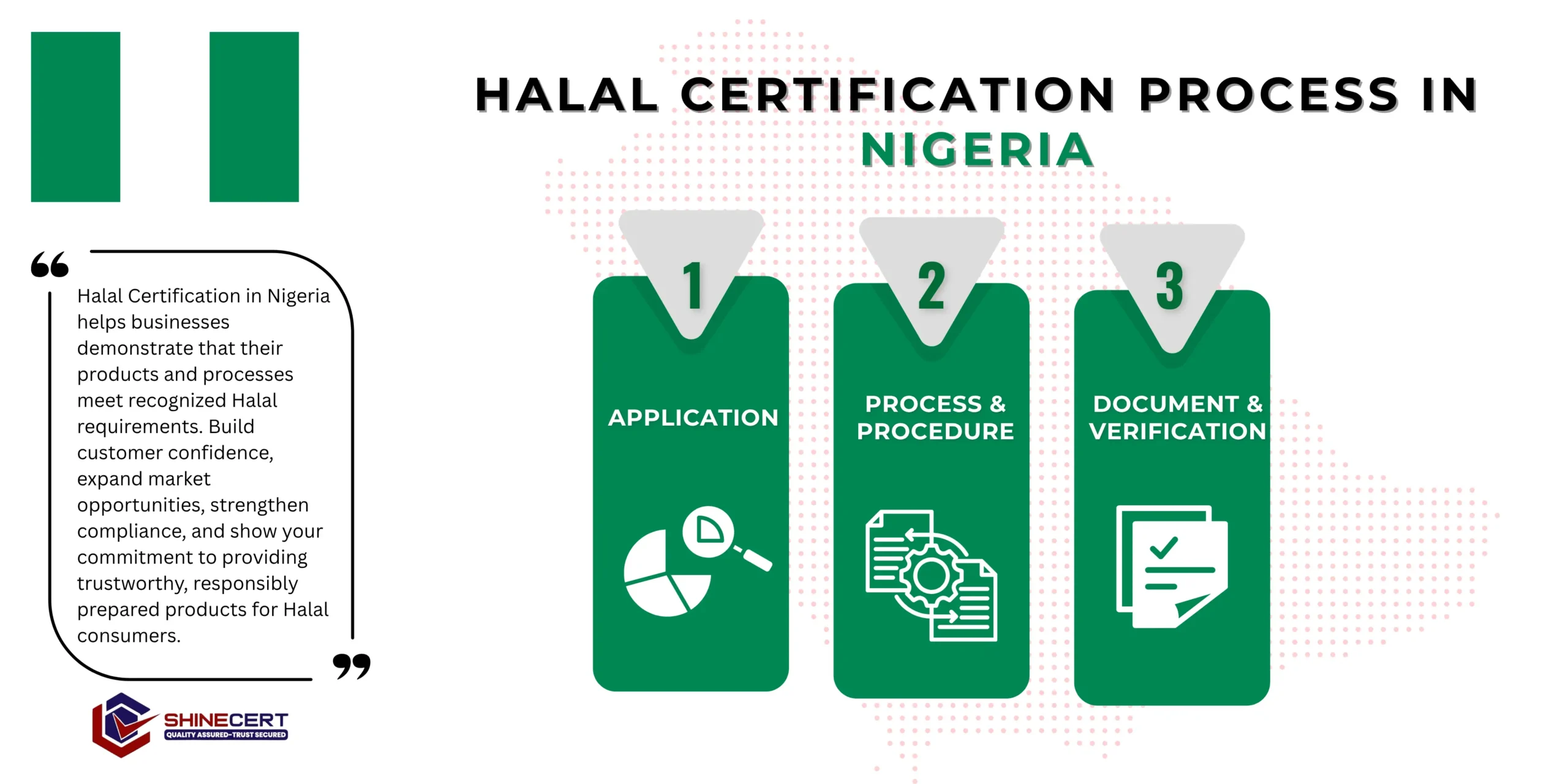
What are the steps to get Halal Certification in Nigeria?
our services
- ISO Certification Nigeria
- ISO 9001 Certification Nigeria
- ISO 14001 Certification Nigeria
- ISO 27001 Certification Nigeria
- ISO 22000 Certification Nigeria
- ISO 20000-1 Certification Nigeria
- ISO 45001 Certification Nigeria
- ISO 42001 Certification Nigeria
- ISO 13485 Certification Nigeria
- ISO 17025 Certification Nigeria
- ISO 31000 Certification Nigeria
- ISO 22301 Certification Nigeria
- ISO 27701 Certification Nigeria
- ISO 37001 Certification Nigeria
- ISO 50001 Certification Nigeria
- CE Mark Certification Nigeria
- GMP Certification Nigeria
- GDPR Certification Nigeria
- Halal Certification Nigeria
Our Five-Step Certification Process, in Depth
Gap Assessment
We review your actual ingredient list, supplier relationships, and production process, identifying genuine cross-contamination risk points and gaps against Halal certification requirements specific to your product category.
A gap report identifying your real Halal compliance status and exactly where documentation, supplier verification, or process changes are needed.
Documentation
We build your ingredient documentation, supplier Halal declarations, and production process flow documentation around your actual product and supply chain, a bakery’s ingredient risk profile looks meaningfully different from a cosmetics manufacturer’s, and the documentation reflects that specifically.
A complete documentation set connecting every ingredient and process step to genuine, verifiable Halal compliance evidence.
Implementation
Segregation procedures, supplier verification protocols, and internal quality control move into genuine daily production practice, with staff trained on maintaining Halal compliance during real operations.
A functioning Halal quality control system with real segregation and verification practices actively operating.
Internal Review
We review your documentation and production practice against the certification body’s specific requirements before the real audit, catching gaps while stakes are low.
A pre-audit readiness report with any final gaps identified and addressed.
Certification Audit
The certification body conducts a facility inspection and documentation review, verifying ingredients, supplier records, and production segregation practices that genuinely meet Halal requirements. We stay engaged through the process.
Your Halal certificate, valid for a defined period depending on the certifying body, plus a renewal audit schedule.
Gap Assessment
We review your actual ingredient list, supplier relationships, and production process, identifying genuine cross-contamination risk points and gaps against Halal certification requirements specific to your product category.
A gap report identifying your real Halal compliance status and exactly where documentation, supplier verification, or process changes are needed.
Documentation
We build your ingredient documentation, supplier Halal declarations, and production process flow documentation around your actual product and supply chain, a bakery’s ingredient risk profile looks meaningfully different from a cosmetics manufacturer’s, and the documentation reflects that specifically.
A complete documentation set connecting every ingredient and process step to genuine, verifiable Halal compliance evidence.
Implementation
Segregation procedures, supplier verification protocols, and internal quality control move into genuine daily production practice, with staff trained on maintaining Halal compliance during real operations.
A functioning Halal quality control system with real segregation and verification practices actively operating.
Internal Review
We review your documentation and production practice against the certification body’s specific requirements before the real audit, catching gaps while stakes are low.
A pre-audit readiness report with any final gaps identified and addressed.
Certification Audit
The certification body conducts a facility inspection and documentation review, verifying ingredients, supplier records, and production segregation practices that genuinely meet Halal requirements. We stay engaged through the process.
Your Halal certificate, valid for a defined period depending on the certifying body, plus a renewal audit schedule.
Certification Validity, Surveillance Audits, and Recertification
Halal certificate validity periods vary by certifying body, typically running one to two years rather than the three-year cycle common to ISO management system standards, reflecting the more frequent verification Halal certification bodies generally require given ongoing ingredient and supply chain risk. Most certifying bodies conduct periodic surveillance inspections during the certificate’s validity period, checking that ingredient sourcing, supplier relationships, and production segregation practices remain genuinely compliant. Recertification requires a fresh audit before the certificate expires, and any significant change to ingredients, suppliers, or production processes during the certification period typically needs to be reported and reassessed rather than waiting for the next scheduled audit.
Cost of Halal Certification in Nigeria, What Actually Drives It
| Organization Profile | Relative Investment Level | Why |
|---|---|---|
| Small, single-product operation | Lower | Narrower ingredient verification and simpler audit scope |
| Medium, multiple-product operation | Moderate | Broader ingredient and supplier verification across products |
| Larger, multi-site or export-focused operation | Higher | Extensive supplier verification and export market documentation |
| Bundled with ISO 22000 | Moderate-to-higher combined, lower than separate engagements | Shared documentation infrastructure reduces combined cost |
- Number and complexity of ingredients requiring verification : Products with numerous ingredients, particularly animal-derived or processed additives requiring supplier-level Halal verification, face genuinely more extensive documentation work.
- Number of production facilities : Each additional site requiring segregation verification and facility inspection expands the overall certification scope.
- Target market requirements : Businesses pursuing certification specifically for export to particular OIC markets may need additional documentation tailored to that market’s specific Halal certification recognition requirements.
- Existing supplier documentation maturity : Businesses already sourcing from suppliers with existing Halal certification face less verification work than those needing to establish Halal compliance evidence from scratch.
- Certification body fees, tracked separately from our consulting fees : The certification audit itself is conducted and invoiced directly by the certification body, separate from ShineCert’s implementation and documentation support work.
- Internal capacity to contribute : A quality manager who can genuinely own supplier coordination, documentation, and internal verification reduces the consulting hours required.
Halal Certification Benefits for Nigerian Businesses
Verified Halal certification gives your products genuine credibility with Nigeria’s large Muslim consumer base, who increasingly look for independent certification rather than relying on unverified label claims.
Halal certification, particularly through internationally accredited bodies, is frequently a genuine prerequisite for exporting food, cosmetics, or pharmaceutical products to OIC member countries and other Halal-conscious markets.
Businesses certified now, while the national roadmap continues developing, build genuine credibility and market position ahead of any future domestic regulatory formalization.
Larger retailers and distributors increasingly require Halal certification as a genuine condition for stocking products targeting Nigeria’s Muslim consumer base specifically.
Halal certification increasingly functions as a broader quality and hygiene trust signal, appealing to health-conscious and quality-focused consumers beyond strictly religious motivations.
The certification process requires genuine scrutiny of your supply chain and production process for cross-contamination risk, often surfacing broader quality and hygiene improvements alongside Halal compliance specifically.
Government catering contracts, hospitality tenders, and institutional food service contracts increasingly specify Halal certification as an evaluation criterion given Nigeria’s demographic makeup.
Halal certification’s supply chain and process scrutiny complements ISO 22000 food safety management, making combined pursuit considerably more efficient for food businesses building both credentials.
Mandatory Documents Required for Halal Certification
A documented, complete list of every ingredient used in your product, including any processing aids, additives, or flavorings, allowing the certification body to genuinely verify Halal status at the ingredient level.
Documentation from your raw material suppliers confirming the Halal status of ingredients sourced from them, particularly critical for any animal-derived ingredients, gelatin, or emulsifiers with potentially non-Halal origins.
A documented, step-by-step description of your manufacturing process, identifying every point where cross-contamination risk with non-Halal materials could genuinely occur.
Documentation showing how your facility and equipment are managed to prevent cross-contamination, whether through dedicated Halal-only production lines or documented, verified cleaning and changeover procedures between Halal and non-Halal production runs.
For meat and poultry products specifically, documented evidence of Halal-compliant slaughter methods and sourcing, including certification from the slaughterhouse or supplier.
Documentation showing Halal products are genuinely stored and transported separately from non-Halal products to prevent contamination after production.
A documented internal procedure for ongoing verification that production continues to meet Halal requirements between certification audits, not just at the point of initial certification.
Documentation confirming product labeling accurately reflects certified Halal status and complies with relevant labeling requirements.
Challenges Organizations Face, Implementation, Risk Management, Audit, and Ongoing Certification
- Challenges during implementation : Businesses sometimes assume that using generally recognized Halal-compliant ingredients is sufficient, without realizing certification also requires documented supplier verification and facility segregation evidence, not just ingredient compliance in principle.
- Challenges in risk management : A common gap is verifying primary ingredients while overlooking processing aids, flavorings, or emulsifiers that may have non-Halal origins despite appearing in small quantities on the ingredient list.
- Challenges during internal and certification audits : Auditors specifically probe supplier documentation for animal-derived or processed ingredients, a supplier relationship without a genuine, current Halal declaration is a common and avoidable finding.
- Challenges maintaining certification after the initial audit : Supplier relationships and ingredient formulations can change after certification without the change being reported for reassessment, particularly when no one has clear, ongoing ownership of monitoring ingredient and supplier changes against Halal compliance requirements.
Case Study
A mid-size snack food manufacturer based in Kano approached us while planning an export push into West African and Middle Eastern markets, having recognized that their existing informal “Halal-friendly” labeling, based on the founder’s personal knowledge of the ingredients rather than any independent verification, wouldn’t satisfy the documented certification requirements their target export markets and larger domestic retail partners were beginning to ask for.
Our gap assessment found the actual ingredient list was genuinely Halal-compliant in substance, but there was no formal supplier verification for several processed ingredients, no documented segregation procedure despite the facility not producing any non-Halal products, and no internal quality control process connecting ongoing production to sustained compliance. The underlying product was sound; the verifiable documentation behind it was not.
We worked with the company to obtain formal Halal declarations from their ingredient suppliers, documented their production process and facility practices, and built an internal quality control procedure for ongoing compliance verification. Certification took just under three months, and the resulting certificate directly supported their entry into two new retail partnerships and initial conversations with a Middle Eastern distributor.
This reflects a pattern we see often, a genuinely compliant product held back by a lack of independent, documented verification, rather than a single specific engagement.
Industries and Sectors We Support in Nigeria and Which Standards Each Actually Needs
Food and beverage manufacturing
Halal Certification addresses direct consumer and export market requirements; pair with ISO 22000 for comprehensive food safety management alongside Halal compliance.
Read moreMeat and poultry processing
Halal Certification is close to essential given direct slaughter and sourcing requirements; pair with ISO 22000 for broader food safety management.
Read moreCosmetics and personal care manufacturing
Halal Certification addresses genuine ingredient sourcing and production requirements for this growing market segment; pair with ISO 9001 for overall quality management.
Read morePharmaceutical and nutraceutical manufacturing
Halal Certification addresses ingredient compliance for this sector; pair with GMP certification for manufacturing quality requirements.
Read moreHospitality and large-scale catering
Halal Certification addresses genuine guest and institutional client requirements; pair with ISO 22000 for food safety in preparation and service.
Read moreExport-focused agro-processing
Halal Certification directly supports access to OIC export markets; pair with ISO 22000 for international food safety credibility.
Read moreWhy Choose ShineCert for Halal Certification Nigeria?
ShineCert brings 10 years of ISO consulting and certification experience to Nigeria’s market, coordinated through our Riyadh and India offices with services delivered remotely or on-site depending on what your engagement genuinely needs. We’ve guided more than 10,000 organizations through certification worldwide, and we build every Nigeria Halal certification engagement around your actual products, suppliers, and target markets, with ShineCert as the best Halal consultant in Nigeria, not a generic template lifted from a different regulatory environment.
Choosing a Certification Body in Nigeria?
What to Check | Why It Matters |
International accreditation recognized by your target export markets specifically | Different markets recognize different certification bodies; confirming recognition upfront avoids costly rework |
Genuine familiarity with Nigeria’s evolving domestic Halal certification landscape | Ensures your certification stays relevant as the national framework continues to formalize |
Experience with your specific product category | Food, cosmetics, and pharmaceutical products involve genuinely different Halal compliance considerations |
A genuine supply-chain-verification audit approach | Confirms the certifying body checks real supplier documentation, not just finished product testing |
Ready to Get Started?
Whether you’re targeting Nigeria’s domestic Muslim consumer market or export markets across the OIC, we’ll walk through your specific products and cost factors before proposing a fixed-scope plan, delivered remotely, on-site, or however genuinely fits your project. Book a free consultation or contact us directly to get started.
Frequently Asked Questions
Look for genuine familiarity with Nigeria’s evolving domestic Halal landscape, experience with certification bodies recognized in your target export markets, and transparent scoping rather than flat package pricing. ShineCert scopes every Nigeria engagement individually.
No, there is currently no unified, government-mandated domestic Halal certification requirement, though a National Technical Committee has been working on a national roadmap. Certification is pursued voluntarily for domestic market trust and export market access.
It genuinely depends on your ingredient complexity, number of products, and target export markets, we scope every project individually.
Typically six to sixteen weeks depending on organization size and ingredient complexity, see our detailed timeline breakdown above.
Recognition depends on the specific certifying body and your target market’s accepted certification list, we help identify certification bodies with recognition relevant to your specific export ambitions before beginning the process.
Halal certification generally requires reporting significant ingredient or supplier changes for reassessment, rather than waiting for the next scheduled audit, since a change could affect your product’s Halal status.
Documentation and supplier verification work runs effectively over remote sessions, but the facility inspection component of certification genuinely requires an in-person audit, we scope the right mix per project.
ShineCert doesn’t maintain a standalone Nigeria office; we coordinate Nigeria engagements from our Riyadh and India offices, with services delivered remotely or on-site as your project requires.