
ISO Certification for Finance and Banking
Quick Answer
Financial institutions, fintech companies, and insurers most commonly pursue ISO 27001 for information security given the sensitivity of financial data and transaction systems, paired with ISO 22301 for business continuity given regulatory expectations around operational resilience, and ISO 37001 for anti-bribery management given heightened due diligence expectations from regulators and correspondent banking relationships. ISO 9001 remains relevant for institutions with significant process-driven service delivery. ShineCert typically completes ISO 27001 certification in five to seven months for financial institutions, reflecting the additional rigor regulators and auditors expect in this sector.
Why Certification Matters in Finance and Banking?
Financial institutions occupy a uniquely trust-dependent position: customers hand over money, sensitive personal financial data, and often their entire financial relationship on the basis of confidence that the institution will protect both the funds and the information, and any breach of that trust, whether through a security incident, a service outage, or a compliance failure, carries consequences that extend well beyond the immediate financial cost into genuine reputational and regulatory jeopardy. This pressure shows up differently across the sector: a bank faces it through regulatory capital and operational resilience requirements that increasingly reference international standards as evidence of genuine control maturity, a fintech company faces it through the credibility gap of being newer and less established than traditional institutions, needing independent certification to build the trust an established bank’s brand alone provides, and an insurer faces it through the sheer sensitivity of the personal and financial data underlying underwriting and claims processes.
The honest picture: certification doesn’t prevent every security incident, service disruption, or compliance lapse, and no credible framework claims otherwise, but it demonstrates a structured, independently audited approach to managing these risks that regulators, correspondent banking partners, and increasingly retail and institutional customers themselves now expect as baseline evidence of institutional maturity, not an optional enhancement.
What are the steps to get ISO Certification?
our services
- ISO 9001 Certification
- ISO 14001 Certification
- ISO 27001 Certification
- ISO 22000 Certification
- ISO 45001 Certification
- ISO 13485 Certification
- ISO 17025 Certification
- CE Mark Certification
- GMP Certification
- Halal Certification
- SOC Certification
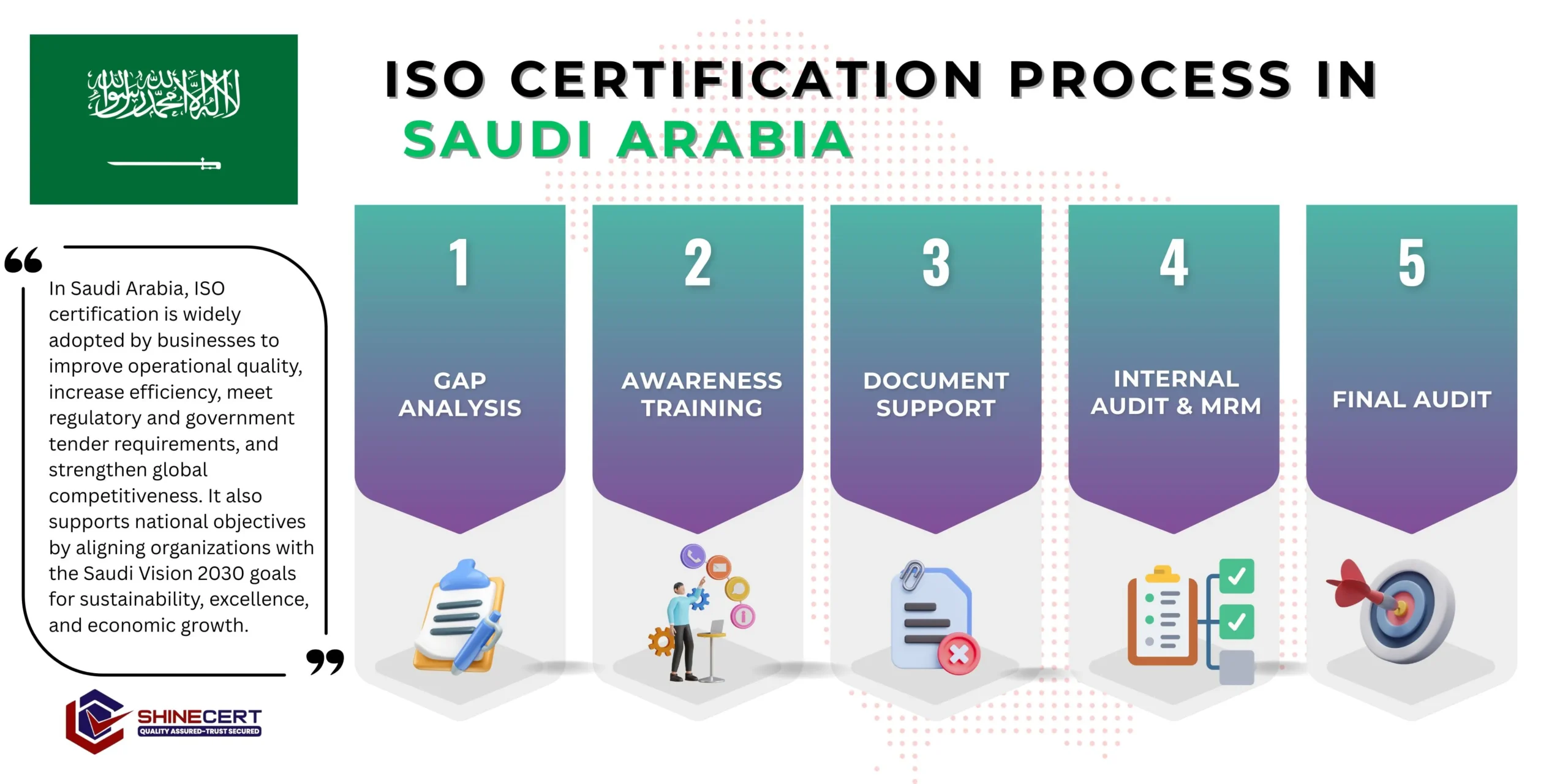
ShineCert’s 5-Step Certification Process for Finance and Banking
Gap Analysis
ShineCert reviews current security, continuity, and anti-bribery practices against your target standards and relevant regulatory expectations.
Integrated gap assessment report.
Documentation and Control Development
Security policy, business continuity plans, and anti-bribery due diligence procedures are developed, mapped to regulatory requirements where relevant.
Complete management system documentation.
Implementation and Testing
Controls are implemented, and business continuity plans undergo genuine tabletop or live testing exercises.
Training records, control implementation evidence, and continuity test results.
Internal Audit
An internal audit and management review evaluate the integrated system across security, continuity, and anti-bribery domains.
Internal audit report and management review minutes.
Certification Audit Support
ShineCert supports Stage 1 and Stage 2 audits with your chosen accredited certification body.
Certificate(s) and surveillance audit schedule.
Gap Analysis
ShineCert reviews current security, continuity, and anti-bribery practices against your target standards and relevant regulatory expectations.
Integrated gap assessment report.
Documentation and Control Development
Security policy, business continuity plans, and anti-bribery due diligence procedures are developed, mapped to regulatory requirements where relevant.
Complete management system documentation.
Implementation and Testing
Controls are implemented, and business continuity plans undergo genuine tabletop or live testing exercises.
Training records, control implementation evidence, and continuity test results.
Internal Audit
An internal audit and management review evaluate the integrated system across security, continuity, and anti-bribery domains.
Internal audit report and management review minutes.
Certification Audit Support
ShineCert supports Stage 1 and Stage 2 audits with your chosen accredited certification body.
Certificate(s) and surveillance audit schedule.
Finance Sector Certification and Regulatory Supervision — How They Connect
Financial regulators typically don’t accept ISO certification as a direct substitute for their own supervisory examination, but increasingly reference these standards as evidence of genuine institutional maturity that informs a more favorable supervisory risk rating, and some regulatory frameworks explicitly cite alignment with international security and continuity standards as expected practice. Institutions that treat certification as purely a supplementary credential, disconnected from their actual regulatory compliance program, miss the genuine efficiency of building both around the same underlying control environment rather than maintaining separate, parallel compliance efforts.
Applicable ISO Standards for Finance and Banking
ISO 27001
Information Security Management System
ISO 27001 — Information Security Management System
Financial data represents one of the highest-value targets for security threats of any sector, and ISO 27001 certification demonstrates a structured, risk-based approach to protecting customer financial data, transaction systems, and core banking infrastructure that regulators increasingly reference directly in their own supervisory expectations. For fintech companies in particular, ISO 27001 certification frequently substitutes for the institutional trust that an established bank's decades-long reputation would otherwise provide, making it less an optional credential and more a genuine precondition for winning enterprise banking partnerships and larger institutional clients.
ISO 22301
Business Continuity Management System
ISO 22301 — Business Continuity Management System
Financial services regulators worldwide have placed increasing emphasis on operational resilience, recognizing that a prolonged service disruption at a bank or payment processor carries systemic risk well beyond the individual institution affected. ISO 22301 certification demonstrates a structured business continuity management system covering business impact analysis, recovery strategies, and tested continuity plans, and financial institutions that can demonstrate genuine, tested recovery capability, not just a documented plan sitting untested on a shelf, increasingly satisfy both regulatory expectations and institutional client due diligence more credibly than those relying on informal disaster recovery arrangements alone.
ISO 37001
Anti-Bribery Management System
ISO 37001 — Anti-Bribery Management System
Financial institutions face distinctive anti-bribery exposure through correspondent banking relationships, cross-border transactions, and lending or investment decisions that can create genuine corruption risk, particularly in emerging market operations or trade finance activities involving intermediaries and agents. ISO 37001 certification demonstrates structured due diligence and anti-bribery controls that increasingly matter for correspondent banking relationships specifically, since international banks conducting their own correspondent due diligence review anti-bribery program maturity as part of broader financial crime risk assessment, alongside anti-money laundering controls.
ISO 9001
Quality Management System
ISO 9001 — Quality Management System
Financial institutions with significant process-driven service delivery, loan processing, claims handling, customer onboarding, sometimes find ISO 9001 valuable for the broader quality management discipline it brings to these processes, complementing security and continuity-focused standards with structured attention to customer experience consistency and service quality, though it tends to matter less to financial sector customers directly than security and continuity certification do.
Right-Sized Certification Matters
The reverse question applies here too: very small financial advisory or brokerage firms with limited technology infrastructure and no correspondent banking relationships sometimes find the full standard combination disproportionate to actual risk exposure, and ShineCert scopes recommendations against your institution's actual regulatory context, customer base, and correspondent relationships rather than defaulting to the broadest possible package.
Common Implementation Challenges in Finance and Banking Certification
- Business continuity plans that exist but were never genuinely tested : A continuity plan that looks complete on paper often reveals significant gaps when a genuine tabletop or live failover exercise is actually conducted.
- Access controls to core banking systems that accumulated inconsistently : Years of ad hoc access grants across departments often don’t reflect current least-privilege access needs, requiring genuine remediation.
- Correspondent banking due diligence is treated as a checkbox exercise : Due diligence on correspondent relationships and intermediaries needs genuine investigation, not a signed declaration accepted at face value.
- Security and continuity systems built as disconnected efforts from existing regulatory compliance : Institutions that implement ISO systems entirely separately from their regulatory compliance function duplicate effort and miss genuine integration efficiency.
Benefits of Certification for Finance & Banking Organizations
- International business and market access benefits : ISO 27001 and ISO 22301 certification together frequently determine whether a financial institution can establish or maintain correspondent banking relationships and institutional client partnerships, since international banks and larger institutional clients increasingly require independently verified security and continuity management as a condition of the relationship, not merely a preference.
- Trust and reputation benefits : For fintech companies and newer financial institutions in particular, certification provides independently verified credibility that helps close the trust gap against established, brand-recognized competitors, while for traditional institutions it reinforces existing trust with an auditable, ongoing verification rather than reputation built purely on historical track record.
- Process improvement and operational benefits : Structured security and continuity implementation frequently surfaces genuine operational gaps, access controls to core banking systems that had accumulated inconsistently, business continuity plans that existed on paper but had never been genuinely tested, incident response processes that varied between departments, and institutions that engage seriously with the improvement cycle typically see measurably fewer security incidents and faster recovery from operational disruptions over time.
- Regulatory and compliance benefits : Certified management systems provide financial institutions with a stronger evidentiary position during regulatory examination, since demonstrating a structured, independently audited approach to security, continuity, and anti-bribery management carries more weight with supervisors than internal assertions of compliance alone.
Finance & Banking Certification Cost: What Actually Drives It
- Institution size and transaction volume : A large bank or payment processor with substantial transaction volume and complex core banking infrastructure faces a bigger security and continuity scope than a smaller advisory or lending firm.
- Nature of the business and cross-border exposure : Institutions with correspondent banking relationships or cross-border lending face materially more anti-bribery due diligence work than those operating purely domestically.
- Number of departments and business lines in scope : Certification covering retail banking, corporate banking, and wealth management as distinct business lines costs more than a narrowly scoped certification.
- Existing regulatory compliance infrastructure : Institutions with mature existing regulatory compliance functions typically integrate ISO requirements faster and at lower incremental cost.
- Standard combination pursued : Adding ISO 22301 or ISO 37001 alongside ISO 27001 adds distinct scope, though integrated implementation reduces combined cost below separate projects.
Testing Business Continuity Under Genuinely Realistic Conditions
- The single most common gap ShineCert finds during financial sector business continuity gap analysis is a continuity plan that reads well on paper but has never been tested under conditions that genuinely resemble a real disruption, a data center failover exercise conducted during a planned maintenance window with full IT staff present bears little resemblance to an actual unplanned outage occurring outside business hours with key personnel unavailable.
- A credible ISO 22301 implementation requires testing recovery capability under realistically adverse conditions, documenting what actually worked and what didn’t, and genuinely updating the plan based on those findings rather than treating the test as a formality to satisfy an audit checkbox. ShineCert works with financial institutions to design testing scenarios that stress the plan meaningfully, since a continuity capability that only survives idealized testing conditions provides limited real protection when an actual disruption inevitably arrives on its own unplanned schedule.
Anti-Bribery Due Diligence in Correspondent Banking and Trade Finance
- Correspondent banking relationships and trade finance transactions create bribery and corruption exposure that’s structurally different from most other sectors, since the institution is often removed from the ultimate underlying transaction and relies on the due diligence and controls of intermediary parties it doesn’t directly control. Genuine ISO 37001 implementation requires risk-tiering correspondent relationships and trade finance counterparties based on jurisdiction, transaction type, and intermediary complexity, applying the most rigorous monitoring to the highest-risk relationships rather than uniform, shallow due diligence applied evenly.
- ShineCert helps financial institutions build anti-bribery due diligence that integrates with existing anti-money laundering and financial crime compliance functions, since these programs address related risks and institutions that run them as separate efforts often duplicate work while missing risk signals visible only when the two functions share information effectively.
Why Choose ShineCert for Finance and Banking Certification?
ShineCert has guided more than 10,000 organizations through international certification from genuine operating offices in Riyadh, Lebanon, and India, with practical experience across banks, fintech companies, insurers, and financial services firms navigating both certification requirements and regulatory expectations.
Finance and Banking Certification Timeline
Phase | Typical Duration |
Gap analysis | 3–5 weeks |
Documentation and control development | 6–10 weeks |
Implementation and testing | 6–10 weeks |
Internal audit and management review | 2–3 weeks |
Certification body Stage 1 + Stage 2 audit | 3–5 weeks |
Total for ISO 27001 certification | 5–7 months |
Choosing an Accredited Certification Body for Finance and Banking
What to Check | Why It Matters |
IAF-recognized accreditation for your target standards | Confirms certificates carry genuine recognition with regulators and correspondent partners |
Financial services audit experience | Auditors familiar with core banking systems and financial crime risk assess your system more effectively |
Recognition by your regulatory supervisor and correspondent banks | Confirms the certificate carries genuine weight in the specific relationships you depend on |
Confidentiality and independence protocols | Relevant given the sensitivity of financial and customer data reviewed during audit |
Start Your Finance and Banking Certification Journey
ShineCert provides end-to-end certification support, from gap analysis through certification audit, for banks, fintech companies, insurers, and financial services firms. Book your free consultation or contact ShineCert directly, and our team will review your regulatory context, correspondent relationships, and current security and continuity maturity before proposing a fixed-scope engagement plan.
Frequently Asked Questions
Most commonly ISO 27001 for information security, ISO 22301 for business continuity, and ISO 37001 for anti-bribery management where correspondent banking or cross-border exposure exists.
Regulators typically don’t accept certification as a direct substitute for supervisory examination, but increasingly reference it as evidence of institutional maturity informing supervisory risk assessment.
It depends on transaction volume, infrastructure complexity, and cross-border exposure. ShineCert provides a fixed quote after gap analysis.
ISO 27001 certification typically takes five to seven months for financial institutions, reflecting the additional regulatory-context rigor involved.
Largely yes, though fintech companies often find ISO 27001 particularly critical for establishing credibility with banking partners and institutional clients who lack an established brand relationship to rely on otherwise.
It matters most for institutions with correspondent banking relationships, cross-border lending, or trade finance exposure; purely domestic retail operations sometimes find it less immediately critical.
Certification bodies review documented test results and evidence of genuine, realistic testing exercises, not merely the existence of a written continuity plan.