
ISO Certification for Logistics, Transportation and Supply Chain
Quick Answer
Logistics providers, freight companies, and supply chain operators most commonly pursue ISO 9001 for quality management as their foundational certification, paired with ISO 45001 given the elevated workplace injury risk in warehousing and transport operations, and ISO 39001 specifically addressing road traffic safety for organizations operating significant vehicle fleets. ISO 22301 matters increasingly for logistics providers whose clients depend on supply chain continuity as a core service commitment. ShineCert typically completes ISO 9001 certification for logistics operators in four to six months.
Why Certification Matters in Logistics, Transportation & Supply Chain?
Logistics and supply chain operations sit at a genuinely exposed intersection of operational risk: a delay, damage event, or safety incident doesn’t just affect the logistics provider itself, it cascades directly into a client’s own customer commitments, making reliability and demonstrable risk management a genuine competitive factor rather than a purely internal operational concern. This pressure shows up differently across the sector: a freight and transport company faces it through road traffic safety given the scale of driving exposure inherent in the business, a warehousing and distribution operator faces it through workplace injury risk from material handling equipment and high-volume, fast-paced operations, and a third-party logistics provider managing multiple clients’ supply chains faces it through the reputational and contractual consequences of a service failure affecting several client relationships simultaneously.
The honest picture: certification doesn’t eliminate every delay, damage event, or road incident, and no credible framework claims otherwise, but it demonstrates a structured, auditable approach to managing quality, safety, and continuity risk that increasingly determines whether a logistics provider is considered credible for larger client contracts, not merely how competitively it prices against similarly capable competitors.
What are the steps to get ISO Certification?
our services
- ISO 9001 Certification
- ISO 14001 Certification
- ISO 27001 Certification
- ISO 22000 Certification
- ISO 45001 Certification
- ISO 13485 Certification
- ISO 17025 Certification
- CE Mark Certification
- GMP Certification
- Halal Certification
- SOC Certification
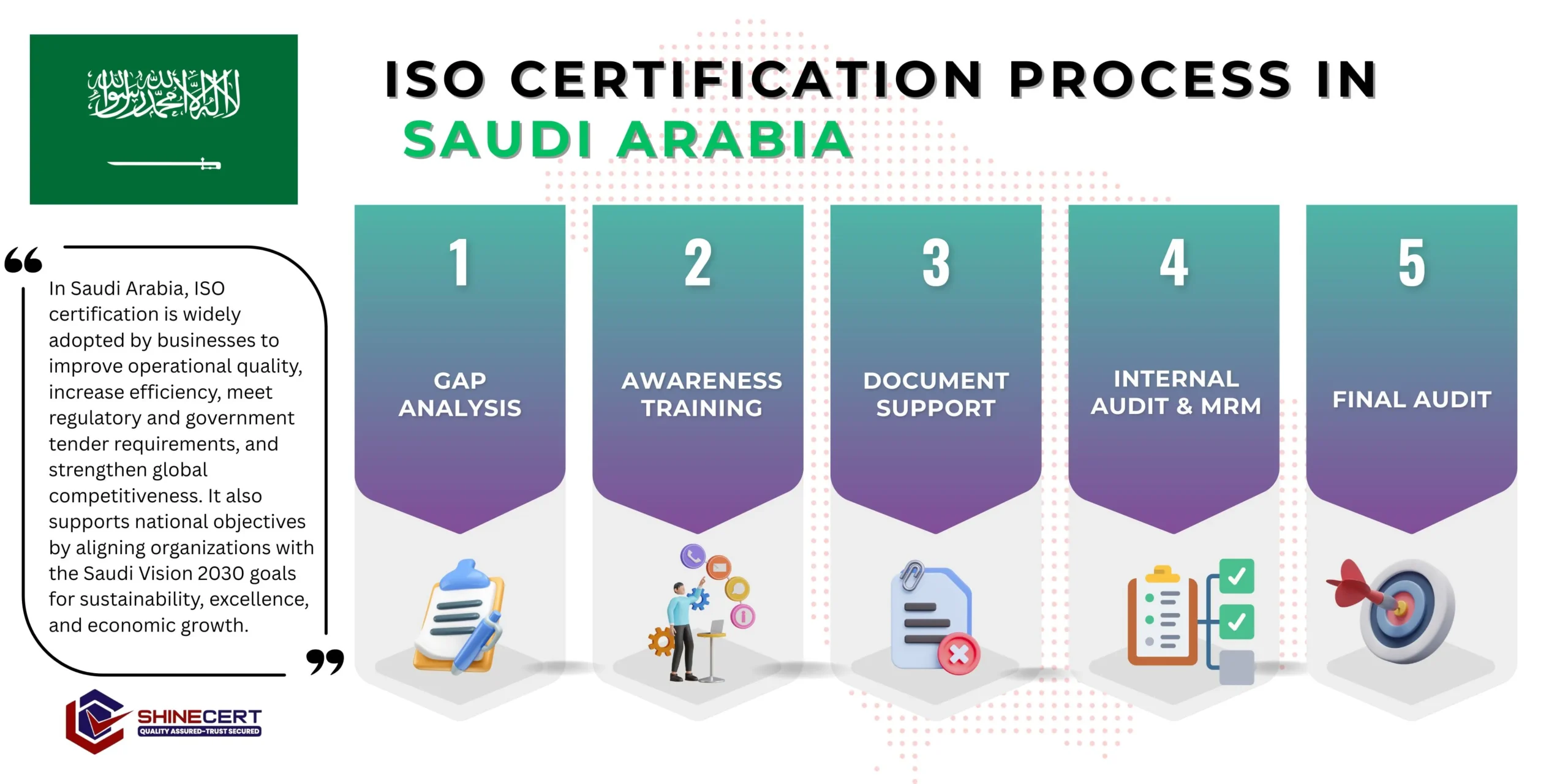
ShineCert’s 5-Step Certification Process for Logistics, Transportation & Supply Chain
Gap Analysis
ShineCert reviews current service quality, safety, and driving practices across your operations against target standard requirements.
Gap assessment report.
Documentation Development
Quality, safety, and, where relevant, road traffic safety and continuity procedures are developed together.
Complete management system documentation.
Implementation and Driver and Staff Training
Warehouse, driver, and operations teams are trained on quality, safety, and journey planning procedures.
Training records and implementation evidence.
Internal Audit
An internal audit and management review evaluate the system across warehousing, transport, and client service operations.
Internal audit report and management review minutes.
Certification Audit Support
ShineCert supports Stage 1 and Stage 2 audits with your chosen accredited certification body.
Certificate(s) and surveillance audit schedule.
Gap Analysis
ShineCert reviews current service quality, safety, and driving practices across your operations against target standard requirements.
Gap assessment report.
Documentation Development
Quality, safety, and, where relevant, road traffic safety and continuity procedures are developed together.
Complete management system documentation.
Implementation and Driver and Staff Training
Warehouse, driver, and operations teams are trained on quality, safety, and journey planning procedures.
Training records and implementation evidence.
Internal Audit
An internal audit and management review evaluate the system across warehousing, transport, and client service operations.
Internal audit report and management review minutes.
Certification Audit Support
ShineCert supports Stage 1 and Stage 2 audits with your chosen accredited certification body.
Certificate(s) and surveillance audit schedule.
Logistics Certification and Client Supply Chain Risk Management — How They Connect
Larger clients increasingly build supplier certification requirements directly into their own supply chain risk management frameworks, recognizing that a logistics partner’s quality, safety, and continuity failures create direct risk to the client’s own operations and customer commitments, not merely an isolated vendor performance issue. Logistics providers that treat certification purely as a marketing credential, disconnected from genuinely functioning day-to-day operations, often find gaps surface when a sophisticated client conducts its own supplementary supply chain risk assessment beyond accepting the certificate at face value.
Applicable ISO Standards for Logistics, Transportation & Supply Chain
ISO 9001
Quality Management System
ISO 9001 — Quality Management System
ISO 9001 establishes the foundational discipline around service consistency, client requirement management, and corrective action that underlies reliable logistics service delivery, addressing the reality that clients depend on a logistics provider's processes being genuinely controlled rather than varying unpredictably between shipments, warehouses, or account teams. For third-party logistics providers managing multiple client relationships simultaneously, ISO 9001 certification frequently becomes a baseline expectation during client procurement review, since logistics failures affect the client's own downstream customer commitments, making service consistency a genuinely shared risk between provider and client.
ISO 45001
Occupational Health and Safety Management
ISO 45001 — Occupational Health and Safety Management
Warehousing, material handling, and transport operations carry elevated injury risk from forklift operation, manual handling, loading dock activity, and the driving exposure inherent in freight and delivery operations, and ISO 45001 certification demonstrates a structured system for hazard identification and genuine incident investigation across these distinct risk categories. Logistics operators increasingly find larger clients evaluating safety management maturity as part of their own supply chain risk assessment, recognizing that a logistics partner's safety failures can create both reputational and, in shared-site scenarios, direct operational risk for the client itself.
ISO 39001
Road Traffic Safety Management System
ISO 39001 — Road Traffic Safety Management System
For logistics and freight operators, road traffic safety represents one of the most significant and consequential risk categories in the entire operation, given the sheer scale of driving exposure across delivery routes, long-haul freight, and last-mile operations, and ISO 39001 certification addresses this specific risk through structured driver competence, journey planning, and vehicle maintenance requirements that a generic occupational safety standard doesn't specifically cover in comparable depth. Organizations with substantial fleets or high-mileage delivery operations find this standard addresses their single largest safety exposure category directly, complementing rather than duplicating ISO 45001's broader occupational safety scope.
ISO 22301
Business Continuity Management System
ISO 22301 — Business Continuity Management System
Clients increasingly depend on logistics and supply chain partners for continuity of their own operations, making a logistics provider's own service disruption a genuine risk to client business continuity, not merely an internal operational inconvenience. ISO 22301 certification demonstrates structured business continuity planning covering alternate routing, backup facility arrangements, and tested recovery capability, and logistics providers serving clients in sectors with their own strict continuity expectations — retail, manufacturing, healthcare supply — increasingly find this certification specifically requested during client due diligence.
Right-Sized Certification Matters
The reverse question applies here too: smaller, single-route or single-service logistics operators serving a limited local client base sometimes find the full standard combination disproportionate to their current scale, and ShineCert scopes recommendations against your actual fleet size, client base, and growth ambitions rather than defaulting to the broadest possible package regardless of fit.
Common Implementation Challenges in Logistics Certification
- Route planning that ignores known high-risk conditions : Generic route planning without accounting for specific high-risk road sections, weather patterns, or peak-traffic timing undermines genuine road safety management.
- Warehouse safety practices are inconsistent across shifts : Different shifts or facilities applying subtly different, unwritten safety practices around material handling equipment undermines company-wide consistency.
- Damage and loss data not systematically analyzed : Individual damage or loss incidents resolved case by case without genuine trend analysis miss recurring root causes that a structured system would catch.
- Subcontracted carrier and driver oversight left incomplete : Logistics operators relying partly on subcontracted carriers or owner-operator drivers often fail to extend genuine quality and safety oversight to this population.
Benefits of Certification for Logistics, Transportation & Supply Chain Organizations
- International business and market access benefits : Certification is frequently the deciding factor when larger clients evaluate competing logistics providers for significant, ongoing contracts, since ISO 9001 and, increasingly, ISO 39001 certification demonstrate a level of process and safety maturity that self-reported service level claims alone can’t replicate with the same credibility.
- Trust and reputation benefits : In a sector where a single significant service failure or safety incident can damage a client relationship irreparably, certified management systems provide independently verified evidence of genuine operational control that builds trust more durably than relationship history or price competitiveness alone.
- Process improvement and operational benefits : Structured quality and safety implementation frequently surfaces genuine operational gaps, route planning that didn’t account for known high-risk road sections, warehouse safety practices that varied significantly between shifts, damage and loss patterns that were never systematically analyzed for root cause, and logistics operators that engage seriously with the improvement cycle typically see measurable reductions in incident rates, damage claims, and service failures over time.
- Risk reduction and continuity benefits : Certified continuity and safety management reduces the frequency and severity of disruptions that would otherwise cascade into client relationships, while also strengthening the logistics provider’s own resilience against the operational risks inherent in the sector’s driving, handling, and multi-site exposure.
Logistics, Transportation & Supply Chain Certification Cost: What Actually Drives It
- Company size and fleet or warehouse scale : A logistics operator running a large fleet or multiple distribution centers faces a bigger certification scope and higher audit man-day requirement than a smaller, single-facility operation.
- Nature of the business and service complexity : Third-party logistics providers managing multiple distinct client accounts with different service requirements face more complex quality management scope than a single-service operator.
- Number of departments and sites in scope : Certification covering multiple warehouses, depots, or distinct service lines as separate units costs more than a single-site, single-service certification.
- Existing safety and quality maturity : Operators with established, even if informal, safety and quality practices typically implement faster and at lower cost than those building systems from scratch.
- Standard combination pursued : Adding ISO 39001 or ISO 22301 alongside ISO 9001 and 45001 adds distinct scope, though integrated implementation reduces combined cost below separate projects.
Managing Quality and Safety Across a Distributed, Multi-Site Network
- Logistics operators running multiple warehouses, distribution centers, or regional depots face a genuine consistency challenge in maintaining the same quality and safety standard across every location, since local site management, workforce composition, and even client mix can vary substantially between facilities.
- A quality or safety practice that works well at an established, mature facility may not transfer directly to a newer or higher-volume site without genuine adaptation, and operators that apply an identical, rigid system across genuinely different site contexts often find either over-documentation at simpler sites or under-control at more complex, higher-volume ones.
- ShineCert helps multi-site logistics operators build a core management system with genuine, structured mechanisms for cross-site consistency in the areas that matter most, incident reporting, corrective action tracking, client service level monitoring, while allowing site-level flexibility in operational details that genuinely need to reflect local conditions.
Third-Party Carrier and Driver Oversight in Extended Supply Chains
- Many logistics providers depend significantly on subcontracted carriers, owner-operator drivers, and partner networks to extend their service coverage beyond what their own directly employed fleet and workforce can reach, and this creates a genuine oversight challenge since the logistics provider’s own quality, safety, and reliability reputation with clients doesn’t distinguish between directly operated and subcontracted legs of a shipment’s journey.
- Building genuine oversight requires verifying subcontracted carrier safety records and insurance coverage before engagement, extending service level and safety expectations into subcontract agreements, and including subcontracted carrier performance data in the same monitoring and corrective action processes used for directly operated fleet and warehouse operations. ShineCert helps logistics providers build this oversight proportionate to how much service delivery depends on subcontracted capacity, since a provider that treats subcontracted legs as outside its own management system scope often discovers this gap becomes client-visible only after a service failure or safety incident.
Why Choose ShineCert for Logistics, Transportation & Supply Chain Certification?
ShineCert has guided more than 10,000 organizations through international certification from genuine operating offices in Riyadh, Lebanon, and India, with practical experience across freight and transport companies, warehousing and distribution operators, and third-party logistics providers.
Logistics, Transportation & Supply Chain Certification Timeline
Phase | Typical Duration |
Gap analysis | 2–4 weeks |
Documentation development | 5–8 weeks |
Implementation and driver and staff training | 5–8 weeks |
Internal audit and management review | 1–2 weeks |
Certification body Stage 1 + Stage 2 audit | 2–4 weeks |
Total for ISO 9001 certification | 4–6 months |
Choosing an Accredited Certification Body for Logistics, Transportation & Supply Chain?
What to Check | Why It Matters |
IAF-recognized accreditation for your target standards | Confirms certificates carry genuine recognition with your client base |
Logistics and transport sector audit experience | Auditors familiar with fleet operations and warehousing assess your system more effectively |
Multi-site audit capability | Relevant for operators running multiple warehouses, depots, or distribution centers |
Recognition among your target client industries | Confirms certification will satisfy the specific supply chain risk requirements your key clients expect |
Start Your Logistics, Transportation & Supply Chain Certification Journey
ShineCert provides end-to-end certification support, from gap analysis through certification audit, for freight and transport companies, warehousing operators, and third-party logistics providers. Book your free consultation or contact ShineCert directly, and our team will review your fleet, facilities, and client base before proposing a fixed-scope engagement plan.
Frequently Asked Questions
Most commonly ISO 9001 for quality, ISO 45001 for workplace safety, and ISO 39001 specifically for organizations with significant driving exposure through their fleet operations.
ISO 39001 addresses road traffic safety specifically; warehousing operators with limited driving exposure typically find ISO 45001 sufficient for their primary risk profile.
It depends on fleet or warehouse scale, service complexity, and existing management system maturity. ShineCert provides a fixed quote after gap analysis.
Core ISO 9001 certification typically takes four to six months; adding ISO 39001 or 45001 extends the timeline moderately given integrated implementation efficiency.
For larger clients with their own supply chain risk management requirements, certification is increasingly a genuine procurement requirement, not merely a competitive differentiator.
No, subcontracted carrier and driver performance needs to be actively overseen and incorporated into the provider’s own management system, not assumed to be automatically covered.
It matters most for providers whose clients depend heavily on supply chain continuity as a core service commitment; smaller operators with less continuity-critical client relationships may find it less immediately necessary.