
ISO Certification in Oman
Quick Answer
Most Omani businesses start with ISO 9001, add ISO 45001 if they’re in oil and gas, construction, or logistics, and pursue ISO 27001 if they handle sensitive data, particularly in Oman’s growing financial and technology sectors. Certification bodies operating in Oman are typically accredited by the Gulf Accreditation Center (GAC), the regional GCC body that Oman’s Ministry of Commerce, Industry and Investment Promotion has worked with directly on strengthening regional accreditation. Budget roughly OMR 800 to OMR 3,500 for a single standard at a small or mid-sized company, and expect three to six months from kickoff to certificate.
Why ISO Certification Is Gaining Ground in Oman ?
Oman Vision 2040, the government’s long-term economic diversification blueprint, has quietly reshaped what “credible” means for an Omani business over the past several years. The plan’s push to reduce oil and gas dependency by growing logistics, tourism, manufacturing, and fisheries has brought a wave of new government-linked investment programs, and those programs increasingly expect the same documented quality and safety standards found in more mature Gulf markets. The Special Economic Zone at Duqm, positioned as a major logistics and industrial hub connecting Oman to global shipping lanes, has been a particularly visible driver of this shift, international investors and shipping partners operating there simply expect ISO-certified suppliers as a baseline, not a differentiator.
Petroleum Development Oman (PDO) and the broader oil and gas supply chain have long required certified suppliers for safety-critical work, but that expectation has started extending into adjacent sectors, logistics, manufacturing, and increasingly professional services, as Vision 2040’s diversification efforts mature.
What are the steps to get ISO Certification in Oman ?
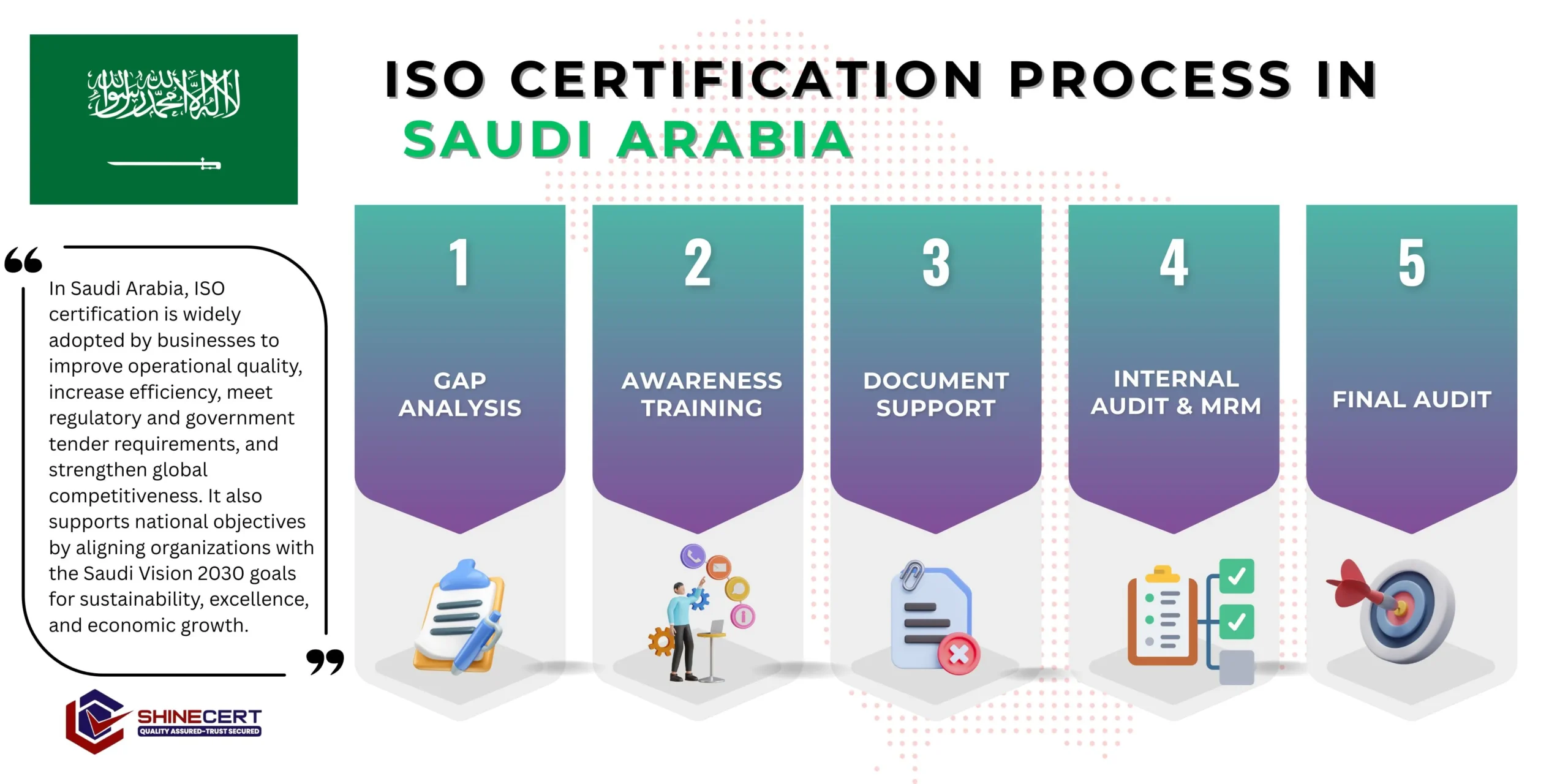
ShineCert’s Certification Process in Oman
We review your operations against your target standard, mapping how OPAZ, Ministry of Health, or PDO supply chain requirements intersect with your specific sector.
We build management system documentation with your team, in English with Arabic available where your Omani workforce or regulator interactions require it.
We train staff through practical sessions tailored to your sector, oil and gas safety training looks very different from logistics or financial services training, and we adapt accordingly.
We run a genuinely rigorous internal audit before certification, followed by formal management review with documented corrective action.
We coordinate Stage 1 and Stage 2 audits with a GAC-accredited or other IAF-recognized certification body, and set up ongoing surveillance to keep your system current.
our services
- ISO 9001 Certification Oman
- ISO 14001 Certification Oman
- ISO 27001 Certification Oman
- ISO 22000 Certification Oman
- ISO 45001 Certification Oman
- ISO 13485 Certification Oman
- ISO 17025 Certification Oman
- CE Mark Certification Oman
- GMP Certification Oman
- Halal Certification Oman
- SOC Certification Oman
Oman’s Accreditation Landscape
- Oman’s Ministry of Commerce, Industry and Investment Promotion oversees the country’s standards and conformity assessment framework, and has worked directly with the Gulf Accreditation Center (GAC) to strengthen regional accreditation recognition, GAC accreditation is the practical benchmark most Omani businesses should look for in a certification body, alongside broader IAF MLA signatory status through bodies like UKAS or DAkkS where relevant. As with Bahrain, Oman doesn’t run an entirely separate standalone national accreditation scheme, so confirming a certification body’s GAC or IAF-recognized backing matters more than checking for a purely domestic credential.
- Sector context matters too: the Public Authority for Special Economic Zones and Free Zones (OPAZ), which oversees Duqm and Oman’s other free zones, increasingly expects certified suppliers for tenant vendor registration, and the Ministry of Health references quality and safety frameworks in healthcare facility licensing.
ISO Standards Most Relevant to Oman
ISO 9001 Quality Management
The default starting point for Omani businesses, checked routinely across government tenders and PDO-linked supply chain vendor registration, well before procurement teams move on to evaluate any other certifications or credentials a prospective vendor might present during the qualification process.
ISO 14001 Environmental Management
“Oman’s fisheries and tourism diversification strategy under Vision 2040, alongside its established oil and gas environmental obligations, have broadened environmental certification demand beyond the traditional industrial base, reaching newer sectors that are only now beginning to face similar compliance expectations.
ISO 45001 Occupational Health and Safety
Oman’s oil and gas sector, and the industrial buildout around Duqm and Sohar, make structured safety management close to a baseline expectation for contractors and suppliers in these sectors, particularly those working on large-scale industrial and energy infrastructure projects across the region.
ISO 27001 Information Security Management
Oman’s growing banking and telecommunications sector, along with increasing government digital services, have made this a rising certification request, particularly for vendors handling customer or financial data, as the country continues expanding its digital infrastructure and modernizing service delivery across both sectors.
ISO 22301 Business Continuity Management
Oman’s logistics sector, positioned as a strategic link in regional supply chains through Duqm and Salalah ports, increasingly values demonstrable operational resilience for larger contracts, as global shippers and regional partners look for reassurance that operations can continue smoothly even during unexpected disruptions or delays.
ISO 22000 Food Safety Management
Oman’s fisheries sector, a named pillar of Vision 2040’s diversification strategy, combined with its food import dependency, makes food safety certification relevant for processors, importers, and hospitality operators seeking to maintain consistent quality and safety standards across increasingly complex, multi-border supply chains.
ISO 13485 Medical Devices Quality Management
As Oman expands its healthcare infrastructure under Vision 2040, device suppliers and healthcare facility vendors are increasingly expected to demonstrate structured quality systems, particularly as the country works to strengthen its medical tourism appeal and modernize care delivery nationwide across both public and private institutions.
ISO 50001 Energy Management
Oman’s energy-intensive industrial base around Sohar and Duqm, alongside national efficiency goals, has started pulling larger industrial energy consumers toward formal energy management certification, as the country looks to balance continued industrial growth with long-term sustainability and resource efficiency commitments.
ISO Certification Cost in Oman
Expect roughly OMR 800 to OMR 3,500 for a single standard at a small or mid-sized company. Oil and gas and industrial clients, given higher safety and environmental documentation requirements, typically sit toward the higher end. Company size and site count remain the primary cost drivers, since audit duration scales with headcount and number of locations, and Duqm or Sohar-based industrial operators managing multiple sites should expect costs to reflect that complexity. Bundling ISO 9001 and 45001 for industrial and oil and gas clients is consistently more cost-efficient than pursuing them separately.
Duqm’s Special Economic Zone: A Closer Look
- Duqm deserves its own mention because it’s genuinely different from a typical Gulf industrial zone. The Special Economic Zone at Duqm spans a deepwater port, dry dock facilities, a refinery complex, and a growing logistics and manufacturing base, positioned specifically to serve as a link between Gulf, East African, and South Asian shipping routes rather than purely as a domestic industrial hub. That international orientation means the certification bar at Duqm often sits higher than in Oman’s more domestically focused industrial areas, tenant companies work alongside international joint venture partners, foreign direct investors, and global shipping and logistics operators who arrive already expecting ISO-certified suppliers as a baseline condition of doing business, not a nice-to-have.
- We’ve found that businesses setting up at Duqm for the first time sometimes underestimate this gap, assuming the certification expectations will mirror what they’ve experienced elsewhere in Oman. In practice, OPAZ’s own tenant vendor standards, combined with the expectations of the international operators anchoring Duqm’s port and refinery operations, mean a new entrant is often better served treating ISO 9001 (and frequently ISO 45001, given the port and industrial safety context) as a pre-condition of operating there rather than something to pursue after establishing initial operations.
Benefits of ISO Certification in Oman
OPAZ-registered free zones increasingly expect certified suppliers, making certification a practical requirement for accessing these growth corridors.
Certification remains close to a baseline requirement for safety-critical contractor work in Oman’s energy sector.
Businesses scaling alongside Vision 2040-linked investment benefit from the operational discipline certification imposes.
Structured management under ISO 45001 reduces both incident rates and associated costs for industrial and oil and gas operators.
Certification increasingly features in eligibility criteria for Vision 2040-aligned incentive and development programs.
A GAC or IAF-recognized certificate reads the same to buyers across the GCC and internationally, supporting Oman’s export diversification goals.
OPAZ, Ministry of Health, and sector-specific requirements fold into one auditable system.
In Oman’s growing logistics and industrial sectors, certification differentiates bidders in an increasingly competitive tender environment.
Industries We Support in Oman

Construction

Manufacturing

Healthcare

IT & Software

Food Industry

Logistics
Construction
Manufacturing
Healthcare
IT & Software
Food Industry
Logistics
Oman’s Tourism Diversification and Certification Demand
- Oman’s approach to tourism has deliberately avoided the mass-market volume strategy some regional neighbors have pursued, favoring instead a higher-value, lower-volume positioning built around Oman’s genuinely distinctive landscape, the Hajar Mountains, the Empty Quarter’s dunes, Salalah’s monsoon-season greenery, and a coastline still relatively undeveloped compared to busier parts of the Gulf. That positioning has real certification implications: boutique resorts, heritage hotels, and adventure tourism operators marketing themselves on authenticity and quality to a more discerning international traveler increasingly find that ISO 9001 and food safety certification under ISO 22000 support the premium positioning their marketing depends on, particularly for properties working with international tour operators and luxury travel platforms that specifically vet operational quality standards before listing a property.
- Oman’s healthcare sector has followed a related trajectory, with Vision 2040’s social development goals driving investment in both public and private hospital infrastructure. Device suppliers and healthcare facility vendors increasingly encounter Ministry of Health expectations that reference internationally recognized quality frameworks, making ISO 13485 relevant for device suppliers and broader quality certification relevant for facility operators supporting Oman’s expanding medical tourism ambitions in Muscat and beyond.
Common Challenges in Oman
- Assuming domestic registration alone is sufficient : Confirming GAC or IAF MLA accreditation matters as much as any local registration for certificates that need to carry weight with international partners.
- Documentation that hasn’t scaled with Duqm or Sohar expansion : Companies growing quickly alongside free zone investment often outgrow processes written for a much smaller operation.
- Underestimating oil and gas safety documentation depth : PDO-linked supply chains often expect more granular safety records than a generic ISO 45001 rollout provides elsewhere.
- Treating fisheries or tourism certification as lower priority : As Vision 2040 diversification matures, buyers in these sectors increasingly expect the same rigor as oil and gas.
Oman’s Manufacturing Localization Push
Oman’s In-Country Value (ICV) program, designed to grow domestic manufacturing and reduce reliance on imported goods and services, has quietly become one of the more consequential drivers of certification demand outside the oil and gas sector itself. Government and PDO-linked procurement increasingly weighs ICV scores directly in vendor selection, and Omani manufacturers competing for that business have found that ISO 9001 certification, alongside genuine ICV compliance, substantially strengthens their position against imported alternatives that might otherwise win purely on price. This has created a steady pipeline of first-time certification clients among Omani manufacturers who previously competed only in smaller domestic markets and are now positioning themselves to bid on larger ICV-weighted government and PDO contracts for the first time, often needing considerable gap analysis support since their existing processes were built for informal domestic sales rather than formal vendor qualification.
Where We Support Clients in Oman ?
We coordinate Oman engagements from ShineCert’s Riyadh and Lebanon offices, with consultants traveling to Muscat, Duqm, Sohar, and Salalah for on-site gap analysis, training, and audit support, ensuring every client receives direct, practical guidance suited to their sector and specific operational needs across the country’s key business hubs.
Why Choose ShineCert in Oman ?
We manage the full certification journey for Omani businesses across oil and gas, logistics, fisheries, tourism, and financial services. Our team has guided more than 10,000 organizations through international certification, with specific familiarity in the OPAZ and PDO vendor requirements that shape certification scope for Oman’s growth sectors.
Choosing a Certification Body in Oman
What to Check | Why It Matters |
GAC or other IAF MLA accreditation | Confirms genuine international recognition for your certificate |
PDO or OPAZ vendor list familiarity | Matters directly for oil and gas or Duqm/Sohar-based clients |
Experience with Omani industrial safety norms | Relevant for ISO 45001 clients in oil, gas, and manufacturing |
Arabic-English bilingual audit capability | Reduces friction for Omani workforces |
ISO Certification Timeline in Oman
Phase | Typical Duration |
Gap analysis | 2–3 weeks |
Documentation development | 4–7 weeks |
Implementation and training | 4–6 weeks |
Internal audit and management review | 1–2 weeks |
Certification audit (Stage 1 + Stage 2) | 3–4 weeks |
Total, single standard | 3–6 months |
Start Your ISO Certification Journey in Oman
ShineCert supports Omani businesses end to end, from gap analysis through certification audit, trusted as the Best ISO Consultants in Oman. Book a free consultation or contact us directly, and we’ll review your sector and target standard before proposing a fixed-scope plan.
Frequently Asked Questions
Typically OMR 800 to OMR 3,500 for a single standard at a small or mid-sized company.
No, it’s voluntary outside specific regulated sectors, though PDO supply chain requirements and OPAZ free zone vendor registration increasingly treat it as a practical necessity.
Oman works closely with the Gulf Accreditation Center (GAC) rather than maintaining an entirely separate standalone national scheme.
Typically three to six months from kickoff to certificate.
Most start with ISO 9001, then add ISO 45001 given the safety expectations tied to PDO-linked contractor work.
We coordinate Oman engagements from our Riyadh and Lebanon offices, with consultants traveling on-site as needed.
Yes, many international tour operators and luxury travel platforms specifically vet operational quality standards before listing smaller boutique or heritage properties.
They’re separate but complementary, ISO 9001 certification strengthens a manufacturer’s competitive position in ICV-weighted government and PDO vendor evaluations alongside genuine ICV compliance.