
ISO Certification in Lebanon
Quick Answer
Lebanese businesses most often pursue ISO 9001 first, especially exporters who need it to satisfy buyers in Europe, the Gulf, and North America. Add ISO 22000 if you’re in Lebanon’s substantial food and beverage export sector, or ISO 27001 if you’re in Beirut’s growing technology and fintech scene. Because Lebanon doesn’t maintain its own IAF-recognized management system accreditation body, look for certification bodies accredited by an internationally recognized signatory such as UKAS, DAkkS, or another IAF MLA member operating in the Lebanese market. Budget roughly $1,500 to $6,000 for a single standard at a small or mid-sized company, and expect three to six months from kickoff to certificate.
Why ISO Certification Matters for Lebanese Businesses?
We work out of Lebanon, so this isn’t a market we’re describing from a distance, it’s one we operate in daily, alongside the same currency volatility, banking sector challenges, and economic uncertainty every Lebanese business owner has navigated over the past several years. Certification matters more, not less, in this environment, because it’s one of the few credibility signals that survives economic instability intact. A Lebanese exporter’s balance sheet or banking relationships might look shakier than they did a decade ago to an overseas buyer doing due diligence, but an ISO 9001 or ISO 22000 certificate says something concrete and internationally verifiable about operational quality regardless of what’s happening with the Lebanese pound.
This matters most acutely for Lebanon’s food and beverage exporters, wine, olive oil, processed foods, who depend on European and Gulf buyers holding food safety standards that assume ISO 22000 or equivalent certification as a baseline. It matters similarly for Lebanon’s resilient professional services, technology, and financial sectors, where Beirut-based firms increasingly serve regional and international clients who never set foot in Lebanon and rely entirely on credentials like ISO 27001 to judge operational trustworthiness.
Lebanon’s Standards and Accreditation Landscape
The Lebanese Standards Institution (LIBNOR), established in 1962, is Lebanon’s national standards body, it develops and publishes Lebanese standards, grants the Lebanese Conformity Mark “NL,” and represents Lebanon at the International Organization for Standardization. LIBNOR itself holds ISO 9001 certification for its own operations, which says something about how seriously the institution treats the standards it promotes.
What Lebanon doesn’t currently maintain is its own separate, internationally recognized accreditation body for management system certification, unlike Saudi Arabia’s SAAC or the UAE’s EIAC. In practice, this means Lebanese businesses pursuing ISO certification work with certification bodies accredited by internationally established IAF MLA signatories such as UKAS (UK), DAkkS (Germany), or ANAB (US), which is a normal and fully valid path, the certificate carries the same international weight regardless of which specific IAF-recognized accreditor stands behind it. What matters is confirming that the accreditation chain exists and is genuine, not that it traces back to a Lebanon-specific body.
What are the steps to get ISO Certification in Lebanon?
our services
- ISO Certification Lebanon
- ISO 9001 Certification Lebanon
- ISO 14001 Certification Lebanon
- ISO 27001 Certification Lebanon
- ISO 22000 Certification Lebanon
- ISO 27701 Certification Lebanon
- ISO 45001 Certification Lebanon
- ISO 20000-1 Certification Lebanon
- ISO 13485 Certification Lebanon
- ISO 17025 Certification Lebanon
- ISO 31000 Certification Lebanon
- ISO 42001 Certification Lebanon
- ISO 37001 Certification Lebanon
- ISO 22301 Certification Lebanon
- ISO 50001 Certification Lebanon
- CE Mark Certification Lebanon
- GDPR Certification Lebanon
- GMP Certification Lebanon
- Halal Certification Lebanon
major citys
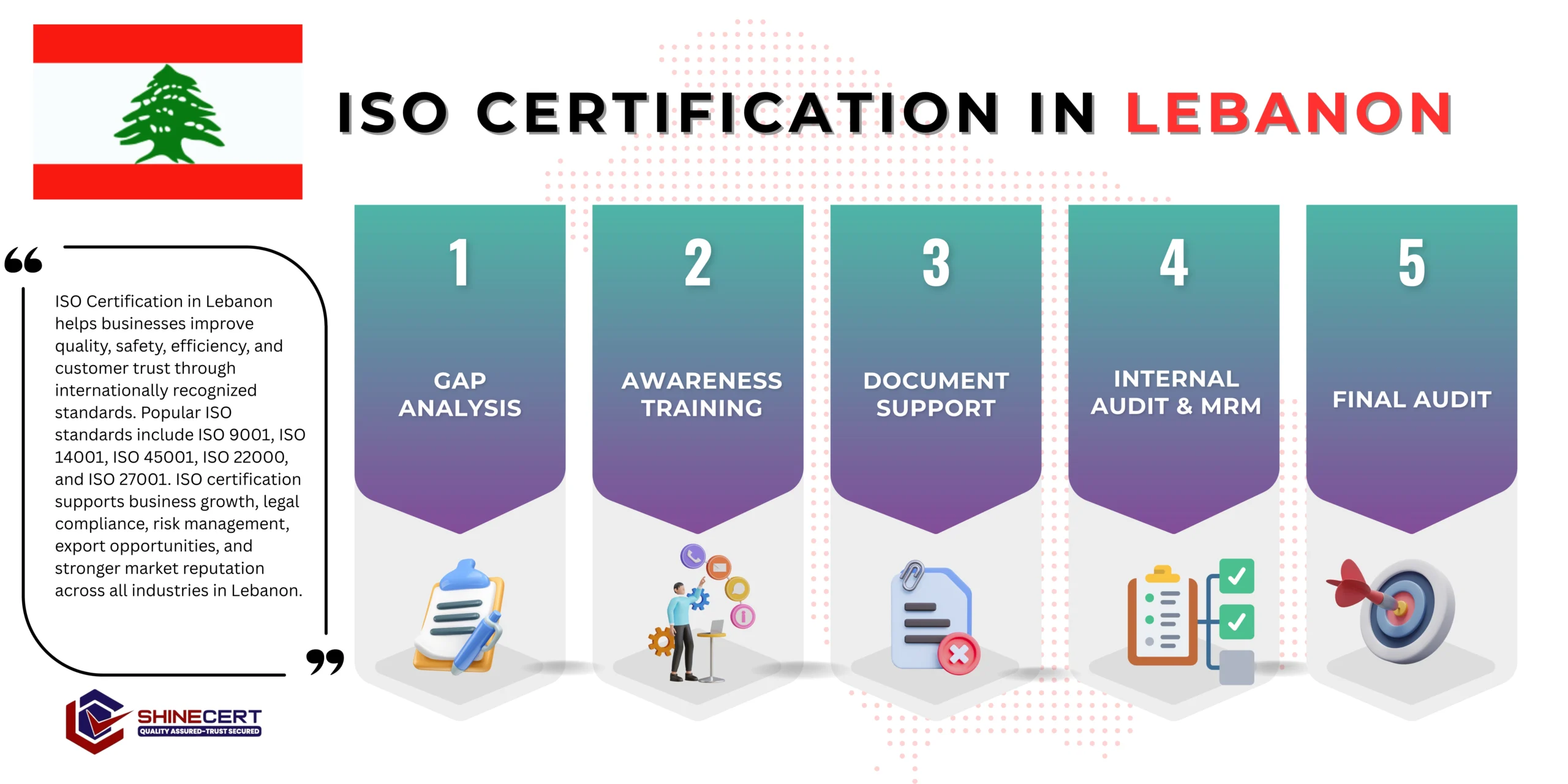
ShineCert’s Certification Process in Lebanon
Gap Analysis
We visit your operations directly, this is where we’re based, so there’s no travel lag or remote-only assessment, and map your processes against your target standard and relevant export market requirements.
Documentation Development
We build your management system documentation with your team, in Arabic, English, or French depending on what actually works for your Lebanese workforce and export market documentation needs.
Implementation and Training
We train staff through hands-on, practical sessions, with particular attention to export-facing teams who need to understand not just the standard but why specific overseas buyers care about it.
Internal Audit and Management Review
We run a genuinely rigorous internal audit before any external certification body is involved, followed by a formal management review with real corrective action commitments.
Certification Audit
We coordinate Stage 1 and Stage 2 audits with an internationally accredited certification body matched to your target export markets, and support your team through the process from our own Lebanon office.
Gap Analysis
We visit your operations directly, this is where we’re based, so there’s no travel lag or remote-only assessment, and map your processes against your target standard and relevant export market requirements.
Documentation Development
We build your management system documentation with your team, in Arabic, English, or French depending on what actually works for your Lebanese workforce and export market documentation needs.
Implementation and Training
We train staff through hands-on, practical sessions, with particular attention to export-facing teams who need to understand not just the standard but why specific overseas buyers care about it.
Internal Audit and Management Review
We run a genuinely rigorous internal audit before any external certification body is involved, followed by a formal management review with real corrective action commitments.
Certification Audit
We coordinate Stage 1 and Stage 2 audits with an internationally accredited certification body matched to your target export markets, and support your team through the process from our own Lebanon office.
ISO Certification Cost in Lebanon
Expect roughly $1,500 to $6,000 for a single standard at a small or mid-sized company, pricing in Lebanon is typically quoted in US dollars given the currency environment, which also makes cost comparisons with international consultancies more straightforward for Lebanese business owners. Export-focused food and beverage businesses pursuing ISO 22000 often see costs toward the middle of this range, given the added complexity of hazard analysis and traceability documentation. Bundling ISO 9001 with a sector-specific standard like ISO 22000 is more cost-efficient than pursuing them as separate projects.
Benefits of ISO Certification for Lebanese Businesses
- Access to export markets regardless of domestic conditions : Certification travels internationally in a way that’s immune to Lebanon’s banking sector or currency challenges, giving exporters a stable credibility anchor.
- Trust rebuilding with overseas buyers : International partners who’ve grown cautious about Lebanese counterparties for macroeconomic reasons respond well to concrete, independently verified operational evidence.
- A genuine edge in competitive export bidding : Lebanese wine, olive oil, and food exporters compete against producers from more economically stable countries; certification narrows that credibility gap.
- Operational resilience during instability : ISO 22301 in particular gives Lebanese businesses a structured way to demonstrate they can maintain operations through infrastructure or economic disruption, a genuinely relevant concern here in a way it isn’t everywhere.
- Access to BPO and outsourcing contracts : Beirut’s technology and business services sector increasingly wins international outsourcing work specifically because ISO 27001 certification closes security due diligence gaps that would otherwise stall a deal.
- A credential that doesn’t depend on Lebanon’s reputation : For businesses tired of explaining away country risk in every sales conversation, an international certificate lets the operational facts speak for themselves.
ISO Standards Most Relevant to Lebanon
ISO 9001 Quality Management
The standard most Lebanese exporters and service providers pursue first, since it’s the credential most international buyers recognize without needing further explanation. It builds immediate trust with overseas partners and smooths the way for new trade relationships.
ISO 14001 Environmental Management
Lebanese manufacturers and agricultural exporters increasingly face environmental expectations from European buyers, particularly as EU deforestation and sustainability regulations tighten import requirements across key sectors.
ISO 45001 Occupational Health and Safety
Lebanon’s construction and industrial sectors, still active despite broader economic headwinds, increasingly need this for insurance purposes and larger contract eligibility. Many major clients and insurers now treat certification as a baseline requirement before awarding contracts.
ISO 27001 Information Security Management
Beirut’s technology, fintech, and business process outsourcing sector, which has grown as a source of resilient export revenue during the broader economic downturn. increasingly needs this to win international client contracts, especially from risk-conscious overseas clients.
ISO 22000 Food Safety Management
Lebanon’s wine, olive oil, and processed food export sectors depend heavily on this certification to access European and Gulf retail and food service buyers who treat it as a baseline import requirement, with no exceptions granted to newcomers.
ISO 22301 Business Continuity Management
Given Lebanon’s recent history of infrastructure and economic disruption, an increasing number of businesses, particularly in banking, logistics, and technology, pursue this specifically to demonstrate genuine operational resilience to partners and clients.
ISO 37001Anti-Bribery Management Systems
As Lebanese firms seek to rebuild trust with international banks, investors, and multinational partners amid governance and corruption challenges, this certification offers a credible way to demonstrate robust anti-bribery controls and rebuild confidence.
ISO 50001 Energy Management
With grid power unreliable and businesses relying on costly private generators and solar installations, this standard has become a practical tool for Lebanese manufacturers to cut energy costs and prove efficient energy management to investors.
Rebuilding Trust With International Buyers
- There’s no point pretending Lebanon’s recent economic history hasn’t affected how overseas buyers evaluate Lebanese counterparties. Currency collapse, banking sector restrictions, and periods of real infrastructure disruption have made international partners more cautious than they were a decade ago, and a Lebanese business owner explaining all of this on a sales call to a first-time European or American buyer faces a genuinely uphill conversation. What we’ve found working with exporters here is that certification does something a verbal reassurance can’t: it hands the buyer a piece of independently verified, internationally recognized evidence that doesn’t require them to take Lebanon’s macroeconomic situation on faith.
- This matters most concretely during due diligence for new buyer relationships, where certification frequently substitutes for the kind of extended in-person relationship-building that used to be how Lebanese exporters won trust before instability made travel and in-person meetings harder to arrange consistently. A wine producer or olive oil exporter with ISO 22000 certification can point to an audited food safety system instead of asking a skeptical new European distributor to simply trust that quality has held up despite everything else happening in the country. That’s a genuinely practical, not just symbolic, function certification serves for Lebanese businesses right now.
Common Challenges in Lebanon
- Assuming any “ISO certificate” carries equal weight : Without LIBNOR-equivalent domestic accreditation, verifying genuine IAF MLA backing matters more in Lebanon than in markets with an obvious national accreditation body.
- Underestimating what European buyers expect from ISO 22000 : EU food safety and traceability expectations have tightened, and gap analysis often reveals more documentation work than exporters initially expect.
- Economic instability disrupting implementation timelines : Currency and infrastructure disruptions can genuinely delay training and audit scheduling in ways more stable markets don’t experience.
- Treating certification as a one-time cost rather than an ongoing investment : Surveillance audits and system maintenance matter as much as the initial certificate, particularly for maintaining export market access consistently.
Industries We Support in Lebanon
Food and beverage export
Wine, olive oil, and processed food producers across the Bekaa Valley and beyond rely on ISO 22000 to access European and Gulf markets.
Read moreTechnology and business process outsourcing
Beirut’s resilient tech and BPO sector increasingly wins international contracts on the strength of ISO 27001 certification.
Read moreConstruction and manufacturing
Lebanon’s construction sector and light manufacturing base pursue ISO 9001 and 45001 for both domestic credibility and export competitiveness.
Read moreFinancial and professional services
Lebanese firms serving regional and diaspora clients use certification to demonstrate operational stability that offsets broader country risk perceptions.
Read moreISO Certification Timeline in Lebanon
Phase | Typical Duration |
Gap analysis | 2–3 weeks |
Documentation development | 4–7 weeks |
Implementation and training | 4–6 weeks |
Internal audit and management review | 1–2 weeks |
Certification audit (Stage 1 + Stage 2) | 3–4 weeks |
Total, single standard | 3–6 months |
Lebanon’s Diaspora Business Network and Certification
- One dynamic that’s fairly unique to Lebanon is the sheer scale of its global diaspora, and the business relationships that diaspora sustains between Lebanese producers and markets in West Africa, the Americas, Europe, and the Gulf. Lebanese-owned import and distribution businesses abroad frequently serve as the first buyers willing to work with a Lebanese exporter, precisely because they already understand the market conditions here.
- But even those diaspora-connected relationships increasingly move toward requiring formal certification once volumes grow past a certain point, since the diaspora buyer themselves usually answers to retail partners, regulators, or downstream customers in their own market who don’t share that same personal understanding of Lebanon’s situation and simply want to see a recognized certificate. We’ve found this pattern especially common in food exports, where a diaspora-run distribution business in a market like Nigeria, Brazil, or France starts as an informal, relationship-based arrangement and matures into one requiring the same ISO 22000 documentation any other international food supplier would need to provide.
Where We’re Actually Based?
Unlike most countries in this guide, Lebanon isn’t somewhere we coordinate from a distance, it’s where we maintain a genuine office and team. That means faster response times, in-person gap analysis and training without travel delays, and a team that lives with the same practical realities, banking hours, currency conversion, infrastructure, that our Lebanese clients navigate every day.
Choosing a Certification Body in Lebanon?
What to Check | Why It Matters |
Genuine IAF MLA accreditation (UKAS, DAkkS, or similar) | Confirms real international recognition, since Lebanon has no separate domestic accreditation body |
Experience with your specific export markets | European, Gulf, and North American buyers can have subtly different documentation expectations |
Arabic, English, and French audit capability | Matches Lebanon’s genuinely trilingual business environment |
A real local presence, not remote-only support | Reduces delays and miscommunication for on-site audits |
Why Choose ShineCert in Lebanon?
We manage the full certification journey for Lebanese businesses, from gap analysis through certification audit and ongoing surveillance, with a genuine local team that understands both the technical requirements and the practical realities of operating a business in Lebanon right now. Our broader team has guided more than 10,000 organizations through international certification, and our Lebanon office specifically focuses on getting export-dependent Lebanese businesses the internationally recognized credentials their overseas buyers require, with ShineCert as the best ISO consultant in Lebanon.
Start Your ISO Certification Journey in Lebanon
ShineCert supports Lebanese businesses end to end, from gap analysis through certification audit, with a genuine local team based right here in Lebanon. Book a free consultation or contact us directly to discuss your export market and certification goals.
Frequently Asked Questions
Typically $1,500 to $6,000 for a single standard at a small or mid-sized company, usually quoted in US dollars.
No, Lebanese certification bodies typically hold accreditation from internationally recognized IAF MLA signatories such as UKAS or DAkkS rather than a separate domestic accreditor.
No, it’s voluntary, though many export markets, particularly for food and beverage products, effectively require it as a condition of doing business.
Typically three to six months, though economic and infrastructure disruptions can occasionally extend this.
Yes, Lebanon is one of ShineCert’s genuine operating offices, alongside Riyadh and India.
ISO 22000, typically alongside ISO 9001, given how consistently European and Gulf food buyers expect both.
Generally yes, as volumes grow, diaspora buyers themselves usually need to show their own downstream partners a recognized certificate, not just a trusted personal relationship.