
ISO 22301 Certification in Lebanon
Quick Answer
ISO 22301 is the international standard for business continuity management systems, and few business environments make its value as immediately obvious as Lebanon’s. Since 2019, Lebanese businesses have navigated banking sector disruption, currency collapse, power and fuel unpredictability, and periods of acute political and security instability, and most have developed real, tested survival instincts. ISO 22301 formalizes those instincts into a documented, repeatable system: identifying which business functions are genuinely critical, planning specifically for their disruption, and testing that plan before an actual crisis forces you to find out if it works. Certification is increasingly relevant for banks, insurers, and any business seeking international partnership or investment where continuity planning has become a real due-diligence question. Budget three to five months for first-time certification. Cost depends on genuine factors, number of critical business functions, organizational complexity, existing continuity maturity, not a flat figure we quote upfront.
ISO 22301, Explained Simply
Most Lebanese businesses that have survived recent years have already improvised real continuity practices, backup generators, cash management workarounds, alternative supplier relationships. What’s usually missing is the structure behind those improvisations: a documented understanding of which functions are truly critical, how long you can survive without them, and a tested plan rather than reactive scrambling each time disruption hits. ISO 22301 turns hard-won survival experience into a formal, repeatable system the whole organization can rely on, not just the handful of people who’ve personally lived through and adapted to each crisis.
Lebanon at a Glance: What Shapes ISO 22301 Demand Here
Genuine, repeated disruption experience : Banking sector restrictions, currency collapse, and periods of acute instability since 2019 mean Lebanese businesses have real, tested exposure to the kinds of disruptions ISO 22301 is designed to address, this isn’t theoretical planning.
Infrastructure unpredictability as an ongoing operational reality : Power supply and fuel access remain genuine continuity risks that most Lebanese businesses manage actively, whether through generators, solar installations, or operational workarounds.
BDL’s regulatory attention on the financial sector : Banks and financial institutions face closer scrutiny around operational resilience given the sector’s central role in the broader crisis, making continuity management a genuine regulatory and reputational priority.
International partnership and investment expectations : Businesses seeking international investment or partnership increasingly find continuity planning treated as a genuine due-diligence question, not an afterthought.
What are the steps to get ISO 22301 Certification in Lebanon?
our services
- ISO Certification Lebanon
- ISO 9001 Certification Lebanon
- ISO 14001 Certification Lebanon
- ISO 27001 Certification Lebanon
- ISO 22000 Certification Lebanon
- ISO 27701 Certification Lebanon
- ISO 45001 Certification Lebanon
- ISO 20000-1 Certification Lebanon
- ISO 13485 Certification Lebanon
- ISO 17025 Certification Lebanon
- ISO 31000 Certification Lebanon
- ISO 42001 Certification Lebanon
- ISO 37001 Certification Lebanon
- ISO 22301 Certification Lebanon
- ISO 50001 Certification Lebanon
- CE Mark Certification Lebanon
- GDPR Certification Lebanon
- GMP Certification Lebanon
- Halal Certification Lebanon
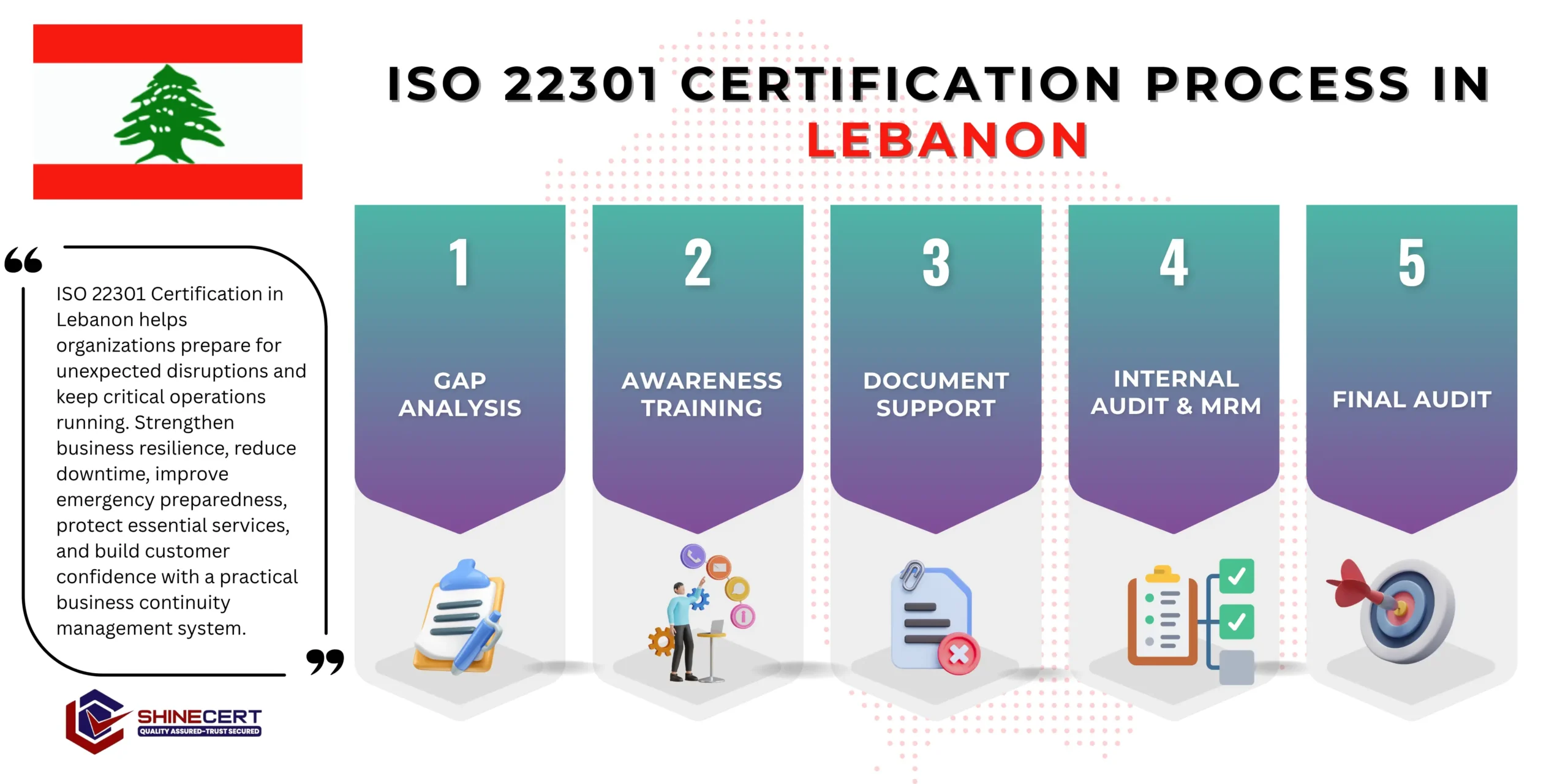
Our Five-Step Certification Process
Gap Assessment
We conduct structured interviews across leadership and operations to understand how your organization has actually handled past disruptions, banking restrictions, power outages, currency shifts, and what worked, informally, versus what didn’t. We map that real history against every ISO 22301 clause.
A clause-by-clause gap assessment identifying your genuine disruption history and where current practices lack formal structure.
Documentation
We build your business impact analysis identifying truly critical functions and recovery time objectives, working directly with the people who’ve personally navigated past disruptions so the plans reflect real, tested knowledge rather than generic templates.
A complete, version-controlled continuity documentation set including your business impact analysis and recovery plans.
Implementation
Recovery plans get tested through structured exercises, not just tabletop discussions, but genuine simulations where possible, and staff get trained on their specific roles during a disruption, since a finance team member and an operations lead face genuinely different continuity responsibilities.
A functioning continuity system with tested recovery plans and a workforce trained on their specific role during disruption.
Internal Audit and Management Review
We run a full internal audit against every clause and test every documented recovery plan, surfacing weaknesses while stakes are low. Findings go to formal management review where leadership makes documented decisions.
An internal audit report, management review minutes with concrete decisions, and refined recovery plans.
Certification Audit
Stage 1 confirms your documentation and business impact analysis are audit-ready; Stage 2 has the auditor verify plans through interviews and exercise records, confirming continuity capability is genuinely operational, not just documented. We stay involved through both stages.
Your ISO 22301 certificate, valid for three years, plus a surveillance audit schedule.
Gap Assessment
We conduct structured interviews across leadership and operations to understand how your organization has actually handled past disruptions, banking restrictions, power outages, currency shifts, and what worked, informally, versus what didn’t. We map that real history against every ISO 22301 clause.
A clause-by-clause gap assessment identifying your genuine disruption history and where current practices lack formal structure.
Documentation
We build your business impact analysis identifying truly critical functions and recovery time objectives, working directly with the people who’ve personally navigated past disruptions so the plans reflect real, tested knowledge rather than generic templates.
A complete, version-controlled continuity documentation set including your business impact analysis and recovery plans.
Implementation
Recovery plans get tested through structured exercises, not just tabletop discussions, but genuine simulations where possible, and staff get trained on their specific roles during a disruption, since a finance team member and an operations lead face genuinely different continuity responsibilities.
A functioning continuity system with tested recovery plans and a workforce trained on their specific role during disruption.
Internal Audit and Management Review
We run a full internal audit against every clause and test every documented recovery plan, surfacing weaknesses while stakes are low. Findings go to formal management review where leadership makes documented decisions.
An internal audit report, management review minutes with concrete decisions, and refined recovery plans.
Certification Audit
Stage 1 confirms your documentation and business impact analysis are audit-ready; Stage 2 has the auditor verify plans through interviews and exercise records, confirming continuity capability is genuinely operational, not just documented. We stay involved through both stages.
Your ISO 22301 certificate, valid for three years, plus a surveillance audit schedule.
What Is ISO 22301, and How Does It Actually Help Your Organization?
- The core value of ISO 22301 for a Lebanese business isn’t teaching resilience, most have already learned it, often the hard way. It’s turning informal, person-dependent survival knowledge into a documented system the whole organization owns. Without that structure, continuity planning tends to live in a few experienced leaders’ heads: they know how to manage a banking restriction, they know which supplier relationships to fall back on during a fuel shortage, but that knowledge doesn’t automatically transfer to new staff, and it isn’t tested systematically before it’s needed for real.
- Practically, this helps in concrete ways. It forces a genuine business impact analysis, identifying which functions truly can’t tolerate downtime and which can, a distinction that often gets blurred in the middle of an actual crisis when everything feels urgent. It creates tested recovery plans, not just written ones, since a plan that’s never been rehearsed tends to reveal its gaps at the worst possible moment. It gives leadership and boards real visibility into recovery time objectives and where the organization’s actual continuity gaps sit. And for businesses pursuing international partnership or lending, it’s independently verified evidence of operational resilience that increasingly factors into due diligence.
- The standard shares the Harmonized Structure with ISO 9001 and ISO 27001, so organizations already holding either certification have real infrastructure, management review, internal audit, risk assessment, to extend into continuity planning rather than building from scratch.
Why This Matters So Much in Lebanon Specifically?
- Lebanese businesses have genuinely lived through the exact disruption categories ISO 22301 addresses, financial system disruption, currency instability, infrastructure unpredictability, and periods of acute security concern. That’s a real advantage when building a continuity system: the risk scenarios aren’t hypothetical, they’re documented organizational history. The gap is almost never awareness of what could go wrong. It’s the structure that makes the response to it repeatable and less dependent on which specific people happen to be present when the next disruption hits.
- We’ve seen this pattern directly: businesses whose continuity response during the 2019-2020 banking crisis and its aftermath was genuinely resourceful, but entirely dependent on two or three individuals improvising under pressure. ISO 22301 implementation takes that improvised competence and turns it into documented, tested, transferable organizational capability, protecting the business from being only as resilient as its most experienced people’s availability on a given day.
What Actually Drives Your Cost?
We don’t quote a flat number, because two Lebanese businesses’ actual critical functions and organizational complexity can look completely different. Here’s what genuinely drives cost.
A business with several functions that genuinely can’t tolerate downtime needs meaningfully more extensive business impact analysis than one with fewer critical dependencies.
Multiple locations, currencies, or business lines each add scope to the continuity planning and testing required.
Businesses with informal but real disruption experience aren’t starting from zero, those with minimal documented practice face more foundational work.
Pursuing ISO 27001 or building alongside an ISO 31000 risk framework shares meaningful implementation infrastructure.
An operations or risk lead who can own documentation and exercise coordination reduces consultant hours needed.
Banks and financial institutions may need more detailed continuity documentation given BDL’s regulatory attention on the sector.
ISO 22301 Benefits Businesses Don't Expect
Rehearsed recovery procedures reveal gaps before a real disruption does, rather than during the worst possible moment to discover them.
Documented plans capture expertise currently concentrated in a few experienced individuals, protecting the organization from depending entirely on their availability.
International partners increasingly treat demonstrable continuity planning as a genuine credibility signal, not a formality.
A tested plan means less improvisation and faster decision-making exactly when speed matters most.
Business impact analysis surfaces dependencies between functions that often go unrecognized until a disruption exposes them.
Insurers increasingly view structured continuity management as a genuine risk-reduction signal affecting terms for business interruption coverage.
Shared structure with ISO 27001 and ISO 31000 makes pursuing information security or risk management certification alongside continuity meaningfully faster.
A documented recovery time objective and tested plan give leadership a clear reference point rather than reactive decision-making under stress.
Applicable Standards by Industry
Banking and financial services
Institutions under BDL’s regulatory attention use ISO 22301 to formalize operational resilience and demonstrate genuine continuity governance.
Read moreInsurance
Companies managing claims and policyholder obligations use certification to build client and regulator trust in continuity capability.
Read moreManufacturing and logistics
Businesses managing supply chain and infrastructure dependencies use certification to formalize recovery planning across operations.
Read moreImport and export trading
Companies managing cross-border operations use continuity planning to address both local infrastructure risk and international supply chain disruption.
Read moreBusiness Continuity Requirements, Clause by Clause, With the Documents Each One Actually Needs
- Context of the Organization (Clause 4) : Understanding your organization’s specific disruption exposure, banking dependency, currency risk, infrastructure reliance, and the interested parties whose continuity expectations matter. Document this clause requires: a documented business continuity management system scope statement identifying which functions and locations are covered.
- Leadership (Clause 5) : Top management commitment to continuity planning, with a documented policy and clearly assigned continuity roles and responsibilities. Document this clause requires: a business continuity policy signed by top management, and a documented continuity team structure.
- Planning (Clause 6) : Risk-based planning addressing your genuine disruption scenarios, plus measurable continuity objectives. Document this clause requires: a business continuity risk assessment and documented continuity objectives.
- Support (Clause 7) : Resources, competence, and awareness training ensuring staff genuinely understand their role during a disruption, plus controlled continuity documentation. Documenting this clause requires: continuity training and exercise records, and a controlled register of continuity plans.
- Operation (Clause 8) : The core of the standard, business impact analysis identifying critical functions and recovery time objectives, risk assessment, and documented, tested recovery strategies and plans. Document this clause requires: a business impact analysis, documented recovery strategies for each critical function, and incident response and recovery plans.
- Performance Evaluation (Clause 9) : Monitoring, exercising, and internal audit testing whether continuity plans genuinely work, not just exist on paper. Document this clause requires: exercise and testing records for continuity plans, an internal audit program and results, and management review minutes.
- Improvement (Clause 10) : Structured post-incident and post-exercise review, driving continual improvement of continuity plans based on what actually happened, not assumptions. Document this clause requires: post-incident and post-exercise review records showing lessons learned and plan updates.
What Happens When a Lebanon Business Operates Without Certification?
- Disruption risk doesn’t disappear without ISO 22301, Lebanese businesses have navigated it for years without formal certification. What’s missing is the structure that makes the response reliable, transferable, and independently verifiable to lenders, partners, and boards who increasingly ask for it. Businesses relying entirely on informal, experience-based continuity practices tend to discover the gap either when the experienced people who’ve always managed disruption leave, or when an international partner’s due diligence process asks for documentation the business simply doesn’t have.
- We generally recommend Lebanese banks, financial institutions, and any business seeking international partnership treat ISO 22301 as protective infrastructure, formalizing resilience the organization has likely already proven it has, before that proof becomes something a partner or lender explicitly requires and you’re building it under pressure.
Common Pitfalls We See in Lebanon ISO 22301 Projects
- Confusing informal resilience with a genuine tested system : Having successfully improvised through past crises isn’t the same as having a documented, rehearsed plan that doesn’t depend on specific individuals being present.
- Business impact analysis that doesn’t distinguish truly critical functions : Treating every function as equally critical dilutes recovery focus away from what actually matters most during a real disruption.
- Recovery plans that have never been exercised : A written plan that’s never been tested through a real or simulated scenario tends to reveal its gaps at the worst possible time.
- Underestimating dependency chains : Businesses sometimes plan for a critical function’s recovery without accounting for the supporting functions or suppliers it actually depends on.
Why ShineCert?
ShineCert brings 10 years of ISO consulting and certification experience to Lebanon, backed by our own dedicated Lebanon office working alongside our Riyadh office. We deliver services remotely or on-site depending on what your project needs, continuity exercises and simulations genuinely benefit from in-person facilitation, while documentation work can run effectively over remote sessions. We’ve guided more than 10,000 organizations through ISO certification globally, and as the best ISO 22301 consultant in Lebanon, we build every Lebanon continuity engagement around your organization’s real disruption history, not a generic template.
Choosing a Certification Body in Lebanon?
What to Check | Why It Matters |
Accreditation under the GAC framework | Confirms genuine, internationally recognized certification |
Experience with Lebanon’s disruption environment | Ensures the auditor understands the genuine continuity risks your organization actually faces |
Sector-specific audit experience | Banking, insurance, and logistics involve genuinely different continuity requirements |
Genuine exercise and testing verification approach | Confirms the auditor checks that plans are actually rehearsed, not just documented |
Ready to Get Started?
Whether you’re formalizing resilience your organization has already proven it has or building continuity planning to satisfy a lender or partner’s due diligence, we’ll walk through your specific critical functions and cost factors before proposing a fixed-scope plan, delivered remotely, on-site, or however genuinely fits your project. Book a free consultation or contact us directly to get started.
Frequently Asked Questions
Yes, surviving informally is exactly the real-world experience a formal continuity plan should be built from, turning what you’ve already learned into something documented and transferable.
It genuinely depends on the number of critical functions, organizational complexity, and existing continuity maturity, we scope every project individually.
Typically three to five months for a first-time certification.
BDL’s regulatory attention on the financial sector increasingly favors demonstrable continuity governance; certification is a recognized way institutions show it, though not a specific blanket legal mandate.
ISO 22301 is certifiable and focuses specifically on continuity planning and disruption recovery; ISO 31000 provides broader, non-certifiable risk management guidance.
Continuity exercises and simulations genuinely benefit from in-person facilitation, but documentation can run remotely, we scope this per project.
Any Lebanese business managing genuine operational, infrastructure, or supply chain disruption risk benefits, which in Lebanon’s environment includes most sectors.
Regularly, a plan that’s never exercised tends to reveal its gaps only when a real disruption forces the issue, which is exactly what certification’s ongoing requirements prevent.
Smaller businesses often have less redundancy to absorb disruption, making structured continuity planning arguably even more valuable relative to their size.
Yes, ShineCert maintains its own dedicated Lebanon office, with services delivered remotely or on-site depending on your project.