
ISO Certification in South Africa
Quick Answer
Most South African businesses start with ISO 9001, add ISO 45001 if they’re in mining, construction, or manufacturing, and pursue ISO 27001 if they’re in Johannesburg or Cape Town’s substantial financial services and technology sectors. Confirm your certification body is accredited by the South African National Accreditation System (SANAS), the sole national accreditation body responsible for conformity assessment in South Africa and one of the most internationally respected accreditation bodies on the African continent. Budget roughly ZAR 25,000 to ZAR 150,000 for a single standard at a small or mid-sized company, and expect three to six months from kickoff to certificate.
Why ISO Certification Matters in South Africa?
South Africa runs the continent’s most developed and diversified economy, with a mining sector still central to national output, a globally significant financial services industry centered in Johannesburg’s Sandton district, and a manufacturing base that supplies both domestic and export markets across the Southern African Development Community. This diversity means certification pressure comes from multiple directions simultaneously. International mining companies operating in South Africa, alongside the broader supply chains feeding Anglo American, Sasol, and other major operators, expect certified contractors and suppliers as standard practice. Financial services firms in Sandton and Cape Town’s growing fintech scene increasingly need ISO 27001 to satisfy both regulators and international partners.
South Africa’s own Broad-Based Black Economic Empowerment (B-BBEE) framework adds a genuinely local dimension to certification conversations that doesn’t exist in most other markets covered in this guide, B-BBEE scorecards and ISO certification are separate systems, but certified businesses often find that demonstrating strong quality and management system maturity strengthens their overall supplier development and enterprise development positioning with larger corporate buyers who weigh both factors during procurement decisions.
South Africa’s Accreditation Landscape
The South African National Accreditation System (SANAS) is the sole national accreditation body responsible for conformity assessment in South Africa, accrediting certification bodies, testing and calibration laboratories, inspection bodies, and other conformity assessment bodies against international standards. SANAS holds full signatory status with both the International Accreditation Forum (IAF) and International Laboratory Accreditation Cooperation (ILAC), giving SANAS-accredited certificates genuine international recognition. SANAS’s standing is strong enough that it also extends recognition services to several neighboring African countries, including renewing Uganda’s national accreditation for ISO management systems certification, a reflection of SANAS’s broader regional influence beyond South Africa’s own borders.
Beyond SANAS, sector regulators shape certification demand directly: the Minerals Council South Africa and the Department of Mineral Resources and Energy maintain safety expectations for the mining sector, and the South African Reserve Bank’s cybersecurity and operational resilience expectations for financial institutions increasingly reference structured security frameworks overlapping with ISO 27001.
What are the steps to get ISO Certification in South Africa?
our services
- ISO Certification South Africa
- ISO 9001 Certification South Africa
- ISO 14001 Certification South Africa
- ISO 27001 Certification South Africa
- ISO 22000 Certification South Africa
- ISO 27701 Certification South Africa
- ISO 45001 Certification South Africa
- ISO 20000-1 Certification South Africa
- ISO 13485 Certification South Africa
- ISO 17025 Certification South Africa
- ISO 31000 Certification South Africa
- ISO 42001 Certification South Africa
- ISO 37001 Certification South Africa
- ISO 22301 Certification South Africa
- ISO 50001 Certification South Africa
- CE Mark Certification South Africa
- GDPR Certification South Africa
- GMP Certification South Africa
- Halal Certification South Africa
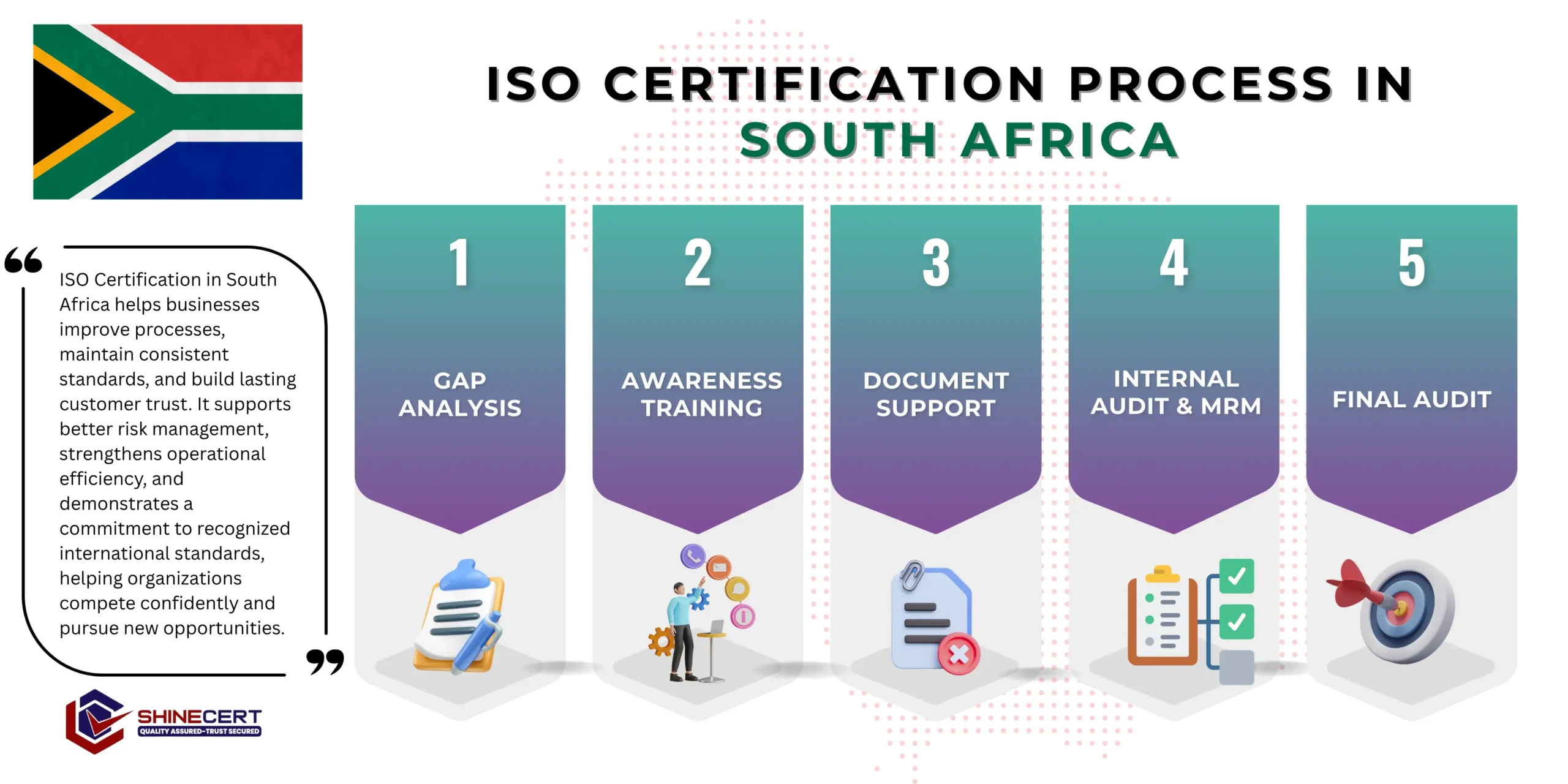
ShineCert’s Certification Process in South Africa
Gap Analysis
We assess your operations against your target standard, with particular attention to mining sector safety expectations or financial services security requirements depending on your sector.
Documentation Development
We build your management system documentation with your team, matched to both your South African workforce and the documentation standards international partners and buyers expect.
Implementation and Training
We train staff through practical, scenario-based sessions tailored to your sector — mining safety training looks very different from financial services security awareness training.
Internal Audit and Management Review
We run a rigorous internal audit before any external certification body is involved, followed by formal management review with documented corrective action.
Certification Audit
We coordinate Stage 1 and Stage 2 audits with a SANAS-accredited certification body, and set up ongoing surveillance to maintain your certification’s value long-term.
ISO Certification Cost in South Africa
Expect roughly ZAR 25,000 to ZAR 150,000 for a single standard at a small or mid-sized company. Mining sector clients often see costs toward the higher end given the depth of safety and environmental documentation required. Company size, site count, and sector risk profile are the main cost drivers. Bundling ISO 9001 with ISO 45001 for mining and industrial clients, or ISO 27001 alongside broader IT governance work for financial services and technology clients, is more cost-efficient than pursuing certifications separately.
Benefits of ISO Certification in South Africa
- Mining supply chain access : Major mining operators and their extensive contractor networks increasingly expect certified suppliers as standard practice, not a differentiator.
- Financial services and fintech credibility : ISO 27001 certification is frequently what satisfies South African Reserve Bank expectations and international partner due diligence for Sandton and Cape Town technology companies.
- SANAS’s strong international standing is working in your favor : Because SANAS holds full IAF and ILAC signatory status and genuine international respect, certificates issued under its accreditation carry real weight without needing supplementary foreign accreditation.
- Continued access to European wine and agricultural export markets : Certification is frequently a hard requirement for South African wine, fruit, and agricultural exporters serving demanding international retail buyers.
- Stronger supplier and enterprise development positioning : While separate from B-BBEE scorecards, certified businesses often find management system maturity strengthens overall positioning with larger corporate buyers weighing both factors.
- Government and state-owned enterprise tender eligibility : South African public procurement increasingly references ISO 9001 as a prequalification factor for construction, supply, and services contracts.
- Reduced governance risk exposure : ISO 37001 alongside ISO 9001 gives South African businesses a structured way to demonstrate anti-bribery controls to multinational partners and increasingly scrutinize state-owned enterprise buyers.
- A genuine regional competitive edge : As the most developed economy in Southern Africa, South African certified companies are well-positioned to lead regional expansion across the SADC bloc.
ISO Standards Most Relevant to South Africa
ISO 9001 Quality Management
The foundational standard across every South African sector, checked routinely by government tenders, mining supply chains, and corporate buyers running formal vendor qualification processes. It proves credibility and compliance, giving your business a competitive edge and access to bigger contracts.
ISO 14001 Environmental Management
South Africa’s mining sector and its broader industrial base face intensifying environmental compliance expectations from both regulators and international partners scrutinizing environmental practices more closely. Certification demonstrates responsible practice.
ISO 45001 Occupational Health and Safety
South Africa’s mining sector, one of the most safety-scrutinized in the world given the country’s mining history, makes structured safety management close to a baseline requirement for contractors and suppliers. Certification proves your commitment to protecting every worker.
ISO 27001 Information Security Management
Johannesburg’s Sandton financial district and Cape Town’s growing fintech and technology scene have made this an increasingly common requirement for vendors handling sensitive data. Certification shows clients you protect their information and consistently meet strict security expectations.
ISO 22000 Food Safety Management
South Africa’s substantial wine, fruit, and broader agricultural export sector depends on this to access demanding European and international retail markets. Certification gives exporters verified proof of quality, helping them win buyer trust and keep supply contracts secure.
ISO 37001 Anti-Bribery Management Systems
South African businesses working with multinational partners or state-owned enterprises increasingly encounter anti-bribery certification expectations given heightened scrutiny of governance and procurement integrity. Certification shows you operate ethically and transparently.
ISO 22301 Business Continuity Management
Load shedding, infrastructure disruptions, and supply chain volatility have made operational resilience a pressing concern for South African organizations. Banks, insurers, and large corporates increasingly expect critical suppliers to show they can keep operating through disruption.
ISO 50001 Energy Management
South Africa’s long-running electricity supply constraints and rising tariffs have made energy efficiency a business priority, particularly for energy-intensive industries like mining, smelting, and manufacturing. Certification also supports eligibility for energy-efficiency tax incentives.
South Africa’s Automotive Manufacturing Sector
- South Africa hosts a substantial automotive manufacturing sector, with major international manufacturers operating assembly plants that supply both the domestic market and export markets across Africa, Europe, and beyond. This automotive sector operates under some of the most rigorous quality management expectations found anywhere in South African manufacturing, since global automotive supply chains have long required certified quality systems as an absolute baseline for supplier participation.
- South African component manufacturers and parts suppliers feeding into this automotive ecosystem find that ISO 9001 certification, often combined with automotive-specific quality frameworks that build on ISO 9001’s foundation, is simply non-negotiable for participating in these supply chains, reflecting the same rigor found in automotive manufacturing hubs anywhere else in the world.
Common Challenges in South Africa
- Underestimating mining sector documentation depth : Contractor qualification for major mining operators often expects more granular safety and environmental records than a generic ISO 45001 rollout provides elsewhere.
- Confusing B-BBEE compliance with ISO certification : These are separate systems serving different purposes, certification supports overall vendor credibility but doesn’t substitute for B-BBEE scorecard requirements.
- Agricultural export documentation gaps : ISO 22000 gap analysis for wine and fruit exporters often reveals more traceability documentation work than expected for demanding European retail buyers.
- Treating certification as a one-time cost : Surveillance audits matter as much as the initial certificate for maintaining mining supply chain or export market access.
South Africa’s Financial Services Sector and Regional Reach
- Johannesburg’s Sandton district anchors not just South Africa’s own substantial financial services industry but functions as a genuine regional financial hub serving business across the SADC bloc and beyond. South African banks, insurers, and increasingly fintech companies operating from Sandton and Cape Town serve clients well beyond South Africa’s own borders, and that regional reach brings international due diligence expectations that a purely domestic-focused financial institution might not otherwise encounter.
- International correspondent banking relationships, cross-border payment partnerships, and increasingly sophisticated South African Reserve Bank oversight have made ISO 27001 certification a genuinely strategic asset for South African financial institutions seeking to maintain and expand their role as a financial gateway for the broader Southern African region.
Industries We Support in South Africa
Mining
South Africa’s globally significant mining sector, spanning gold, platinum, coal, and other minerals, drives consistent demand for ISO 9001 and 45001 among contractors and suppliers.
Read moreFinancial services and technology
Johannesburg’s Sandton financial district and Cape Town’s growing tech scene rely on ISO 27001 to satisfy regulators, investors, and enterprise clients.
Read moreAgriculture and export
South Africa’s wine, fruit, and broader agricultural export sector uses ISO 22000 to access demanding European and international markets.
Read moreManufacturing
South Africa’s diversified manufacturing base, serving both domestic and SADC export markets, increasingly needs ISO 9001 to compete for larger contracts.
Read moreConstruction and infrastructure
Johannesburg, Cape Town, and Durban’s continued urban growth and South Africa’s broader infrastructure investment drive demand for ISO 9001 and 45001 among contractors.
Read moreISO Certification Timeline in South Africa
Phase | Typical Duration |
Gap analysis | 2–4 weeks |
Documentation development | 5–7 weeks |
Implementation and training | 4–7 weeks |
Internal audit and management review | 1–2 weeks |
Certification audit (Stage 1 + Stage 2) | 3–4 weeks |
Total, single standard | 3–6 months |
South Africa’s Mining Sector and Global Safety Standards
- South Africa’s mining industry, with a history stretching back well over a century, has developed some of the world’s most rigorous safety and operational standards, shaped by hard-won lessons from the sector’s own past safety challenges. Major operators like Anglo American, Sasol, and Sibanye-Stillwater now maintain contractor and supplier qualification processes that rival or exceed what’s expected in any other major mining jurisdiction globally, and South African suppliers seeking to participate in these supply chains, whether in equipment, engineering services, logistics, or specialized technical support, find that ISO 9001 and ISO 45001 certification is close to a non-negotiable prerequisite rather than a competitive advantage.
- This rigor has also positioned South African mining service companies well for expansion into other African mining jurisdictions, where the certification and safety standards developed for the domestic South African market often exceed what’s locally required, giving certified South African suppliers a genuine competitive edge when bidding on projects elsewhere on the continent.
Where We Support Clients in South Africa?
We coordinate South Africa engagements from ShineCert’s Riyadh and Lebanon offices, with consultants traveling to Johannesburg, Cape Town, Durban, and South Africa’s broader mining, agricultural, and industrial regions for on-site gap analysis, training, and audit support.
Choosing a Certification Body in South Africa?
What to Check | Why It Matters |
SANAS accreditation | Confirms genuine recognition under one of Africa’s most internationally respected accreditation frameworks |
Mining sector safety experience | Matters directly for contractors and suppliers serving South Africa’s mining industry |
Financial services and fintech security expertise | Relevant for ISO 27001 clients in Johannesburg and Cape Town’s technology and financial ecosystems |
Willingness to audit across multiple South African provinces | Reduces logistical friction for mining and agricultural clients spread across the country |
Why Choose ShineCert in South Africa?
We manage the full certification journey for South African businesses across mining, financial services, agriculture, and manufacturing. Our team has guided more than 10,000 organizations through international certification, with ShineCert as the best ISO consultant in South Africa and specific familiarity in the mining sector safety expectations and financial services security requirements that shape certification scope for South Africa’s most active certification-driven sectors.
Start Your ISO Certification Journey in South Africa
ShineCert supports South African businesses end to end, from gap analysis through certification audit. Book a free consultation or contact us directly, and we’ll review your sector and target standard before proposing a fixed-scope plan.
Frequently Asked Questions
Typically ZAR 25,000 to ZAR 150,000 for a single standard at a small or mid-sized company.
No, it’s voluntary, though mining contractor qualification and financial services regulatory expectations increasingly make it necessary for those sectors.
The South African National Accreditation System is South Africa’s sole national accreditation body, holding full IAF and ILAC signatory status and extending recognition influence to several neighboring African countries.
Typically three to six months from kickoff to certificate.
No, they’re separate systems, certification supports overall vendor credibility but doesn’t substitute for B-BBEE scorecard requirements.
We coordinate South Africa engagements from our Riyadh and Lebanon offices, with consultants traveling on-site as needed.
Yes, South Africa’s rigorous domestic mining safety standards often exceed what’s locally required elsewhere on the continent, giving certified South African suppliers a competitive edge when bidding on projects in other African mining jurisdictions.