
ISO 22000 Certification in South Africa
Quick Answer
ISO 22000 is the world’s most used food safety management standard. It proves a business has a documented system for preventing contamination throughout its food supply chain, checked and confirmed by an independent auditor. In South Africa, food safety sits under a complex framework spanning five national departments, with NRCS compulsory specifications setting legal minimums for specific product categories, and contamination risks like aflatoxins remaining a genuine cause of export rejections across Africa. Certification usually takes three to seven months. Cost depends on your product type, number of production lines, and how much food safety documentation already exists. It’s a near-baseline requirement for supplying major retailers or exporting food products.
What Is ISO 22000?
ISO 22000 is an international standard for food safety management. It sets out what a business needs in place to prevent food safety hazards, biological, chemical, physical, from reaching a customer, at any point from raw material to finished product.
Think of it as a structured way of answering three questions continuously: where could contamination realistically enter our process, what controls actually prevent it, and how do we prove those controls are working. A business becomes “ISO 22000 certified” once an independent, accredited auditor confirms these controls genuinely operate on the production floor.
In South Africa, food legislation is governed jointly by the Department of Health, the Department of Agriculture, Land Reform and Rural Development (DALRRD), and the NRCS, which enforces compulsory specifications turning voluntary standards into mandatory requirements for specific product categories like canned meat, processed meat, and bottled water. ISO 22000 sits above these legal minimums, giving structure to how a business manages food safety across its entire process, not only the specific products NRCS regulates.
Why ISO 22000 Matters in South Africa?
- Major retailers increasingly require it as a condition of supply : South African retail chains routinely ask food suppliers for a recognised food safety certification before listing a product, regardless of whether NRCS specifications apply to that specific item.
- Contamination risk is a genuine, ongoing export concern : Aflatoxins remain one of the most common reasons food shipments are rejected at international borders, with the EU alone rejecting well over a hundred African food shipments in a recent year for exceeding aflatoxin limits.
- The regulatory landscape is genuinely complex : With five different departments and multiple standards bodies involved in food legislation, a structured management system is often the only practical way to stay on top of every applicable requirement.
- It reduces the direct cost of recalls and rejected shipments : A documented hazard control system catches contamination risk before a product reaches a customer or a border inspection.
What are the steps to get ISO 22000 Certification in South Africa?
our services
- ISO Certification South Africa
- ISO 9001 Certification South Africa
- ISO 14001 Certification South Africa
- ISO 27001 Certification South Africa
- ISO 22000 Certification South Africa
- ISO 27701 Certification South Africa
- ISO 45001 Certification South Africa
- ISO 20000-1 Certification South Africa
- ISO 13485 Certification South Africa
- ISO 17025 Certification South Africa
- ISO 31000 Certification South Africa
- ISO 42001 Certification South Africa
- ISO 37001 Certification South Africa
- ISO 22301 Certification South Africa
- ISO 50001 Certification South Africa
- CE Mark Certification South Africa
- GDPR Certification South Africa
- GMP Certification South Africa
- Halal Certification South Africa
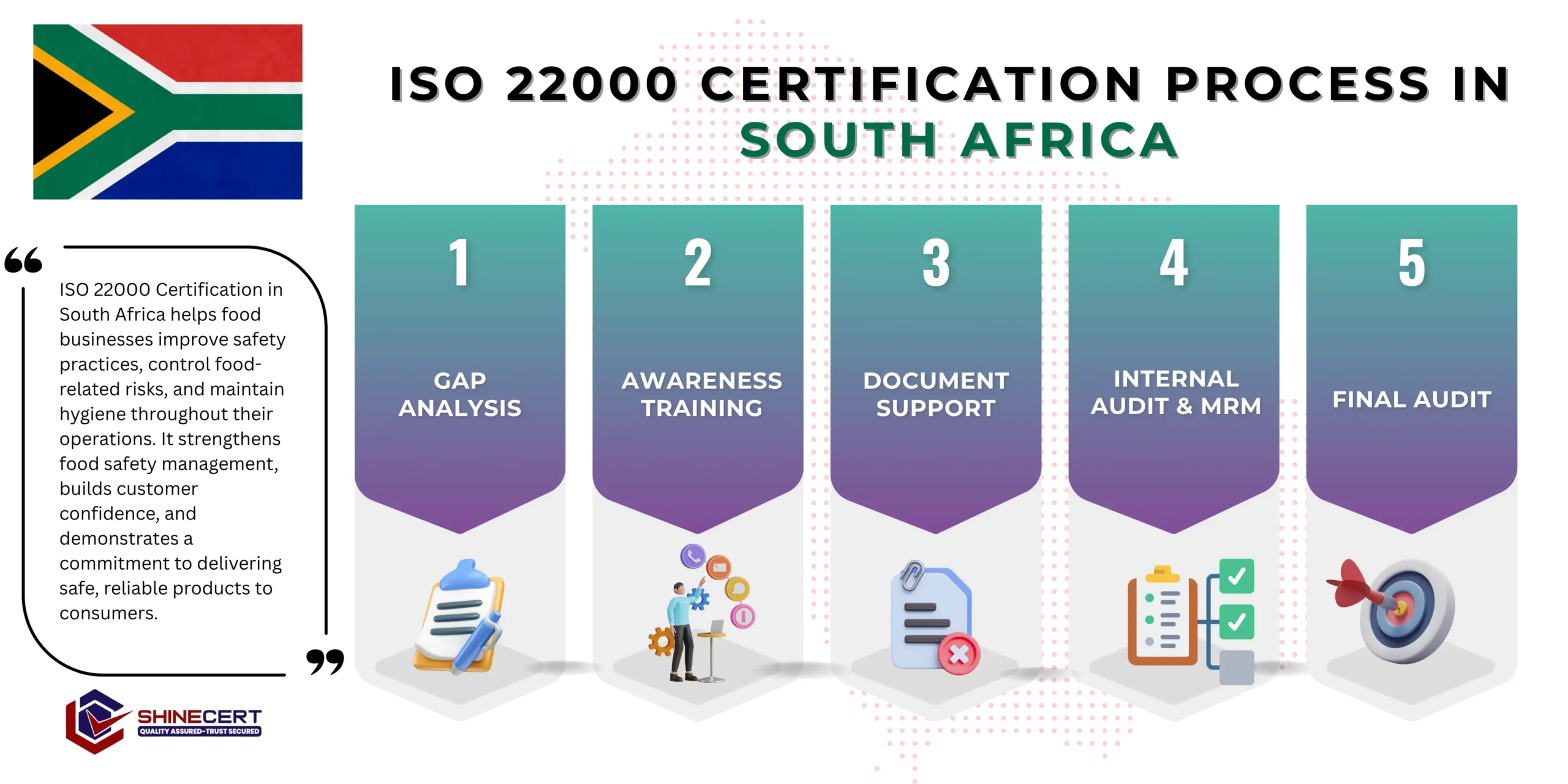
The ISO 22000 Certification Process in South Africa
Getting certified follows five steps. Here’s exactly what happens at each one.
Hazard Analysis
We map your entire process, from raw material intake to dispatch, identifying every point where a biological, chemical, or physical hazard could realistically enter.
A precise picture of your real contamination risk, not a generic industry checklist.
A hazard analysis and critical control point (HACCP) assessment specific to your operation.
Documentation
We help build your food safety policy, HACCP plan, and prerequisite programmes around how your production line actually runs.
Documents your production team can genuinely follow, not paperwork copied from a different product category.
A complete ISO 22000 documentation set.
Implementation and Training
Controls go live, with staff trained on hygiene practices and hazard controls specific to their station.
This phase takes real time, because genuine hygiene behaviour change on a production floor is slower than writing a procedure.
Training records and evidence controls are genuinely operating.
Internal Audit and Management Review
We test whether controls genuinely work, with findings feeding into a management review before the external audit.
Gaps surface here, while there’s still time to close them quietly.
An internal audit report and management review minutes.
Certification Audit
An accredited, independent auditor reviews your documentation and visits your production site to confirm real practice matches your procedures.
Both paperwork and the production floor get checked before certification.
Your ISO 22000 certificate and a surveillance audit schedule.
Benefits of ISO 22000 Certification
- Fewer contaminated products reaching customers : Hazards get identified and controlled at each stage of production, rather than discovered after a customer complaint or recall.
- Easier access to major retail listings : Many retailers require food safety certification as a non-negotiable condition before listing a new supplier’s product.
- Reduced export rejection risk : A working hazard control system directly addresses the contamination issues, like aflatoxins, that most commonly trigger border rejections.
- Lower recall and rework costs : Catching a contamination risk on the production line is far cheaper than managing a recall after distribution.
- Clearer accountability across the supply chain : Everyone from raw material intake to dispatch knows exactly what food safety controls they’re responsible for.
- A foundation for other certifications : Much of the documentation and audit structure overlaps with ISO 9001, making a second certification faster if quality management is also a priority.
What Does ISO 22000 Certification Cost in South Africa?
- Nature of your product : High-risk products like dairy, meat, or ready-to-eat foods need more extensive hazard control than shelf-stable, low-risk products.
- Number of production lines and sites : More lines mean more critical control points to identify and monitor.
- Current food safety practices. Businesses already running basic hygiene and cleaning programmes aren’t starting from nothing, which shortens the work.
- Export market requirements : Businesses exporting to the EU or other strict markets typically need more rigorous documentation to meet buyer-specific requirements.
- Certification body fees : Billed separately by the accredited body, never bundled into our quote.
Case Study: A Cape Town Fruit Export Packer
- A fruit packing and export business near Cape Town came to us after a European buyer flagged food safety documentation gaps during a supplier audit, threatening the loss of a multi-year export contract.
- We ran a hazard analysis and found the company’s actual sorting, washing, and cold-chain practices were sound, but there was no formal HACCP plan, no documented critical control points, and no traceability system linking a pallet back to its originating orchard block.
- Over five months, we built the food safety management system around the company’s existing practices, added a proper traceability procedure, and trained two staff members as internal food safety auditors. The company was certified within the expected timeline.
- The company passed its next European buyer audit without a single major finding and retained the export contract, which it has since used as a reference to win two additional retail export listings requiring ISO 22000 as a baseline condition.
ISO 22000 Certification Across South Africa
ISO 22000 in Johannesburg
ISO 22000 in Cape Town
ISO 22000 in Durban
ISO 22000 in Gqeberha
ISO 22000 in Pretoria
What Documents Do You Need for ISO 22000 in South Africa?
- Context and Scope : Document: Scope of the FSMS Statement. Defines which products, processes, and sites the food safety management system covers.
- Leadership : Document: Food Safety Policy. A signed top-management commitment to food safety and legal compliance.
- Planning : Document: HACCP Plan. Identifies hazards, critical control points, and limits for each stage of production. Document: Legal and Regulatory Register. A record of NRCS specifications, Department of Health requirements, and any export-market rules that apply.
- Support : Document: Hygiene Training Records. Evidence staff understand the specific hygiene practices their role requires. Document: Supplier and Raw Material Verification Records. Evidence raw materials are checked for safety before use.
- Operation : Document: Prerequisite Programmes. Cleaning schedules, pest control, and facility maintenance procedures underpinning food safety. Document: Traceability Procedure. How a product can be traced back through the process if a problem is found.
- Performance Evaluation : Document: Monitoring and Verification Records. Actual measurements at each critical control point, tracked against limits. Document: Internal Audit Records. Proof an internal audit was carried out against every clause.
- Improvement : Document: Corrective Action Log. A functioning record tracking every food safety nonconformity from discovery through to a verified fix.
Why Businesses Choose ShineCert in South Africa?
We’ve spent 10 years helping more than 10,000 businesses worldwide get certified, coordinated through our Riyadh and India offices with work delivered remotely or on-site as needed. As the best ISO 22000 consultant in South Africa, ShineCert quotes based on your real product and process risk, explains food safety requirements in plain language, and builds a system your production team can genuinely run.
How Long Does ISO 22000 Certification Take in South Africa?
| Business Size | Typical Timeline | Why |
|---|---|---|
| Small, single low-risk product line | 3–4 months | Fewer critical control points to document |
| Medium, several product lines | 4–6 months | More hazard points and monitoring across lines |
| Larger, multi-site or high-risk products | 6–7 months | More complexity and higher-risk hazard controls |
Ready to Get Started?
Whether you’re responding to a retailer or export buyer requirement, or reducing your own contamination risk, we’ll walk through your production process and give you a clear, honest quote. Book a free consultation or contact us to get started.
Frequently Asked Questions
No. NRCS compulsory specifications and Department of Health regulations are the legal requirements for specific products. ISO 22000 is a voluntary standard that helps manage food safety more broadly.
It depends on your product type, production complexity, and export ambitions. We quote every business individually.
Usually three to seven months, depending on product and process risk.
Many major South African retailers require it regardless of export plans, as a condition of listing your product.
Documentation can happen remotely. The certification audit requires a production site visit.
No certification eliminates all risk, but a working ISO 22000 system significantly reduces the contamination issues most commonly responsible for border rejections.