
ISO Certification in Kenya
Quick Answer
Most Kenyan businesses start with ISO 9001, add ISO 22000 if they’re in the country’s substantial tea, coffee, or horticultural export sector, and pursue ISO 27001 if they’re part of Nairobi’s well-known mobile money and fintech ecosystem. Confirm your certification body is accredited by the Kenya Accreditation Service (KENAS), established under the Kenya Accreditation Service Act of 2019 and a full signatory to both the IAF Multilateral Recognition Arrangement and the ILAC Mutual Recognition Arrangement. Budget roughly KES 150,000 to KES 900,000 for a single standard at a small or mid-sized company, and expect three to six months from kickoff to certificate.
Why ISO Certification Matters in Kenya?
Kenya has built East Africa’s most developed technology and financial services ecosystem, anchored by Nairobi’s globally recognized mobile money infrastructure, and that reputation has raised the bar for what “credible” looks like across Kenyan business generally. International investors, development finance institutions, and enterprise technology buyers evaluating a Kenyan company increasingly expect the same documented operational maturity they’d find in more established markets, and ISO certification is frequently the fastest way to demonstrate it without a lengthy, expensive custom due diligence process.
Kenya’s agricultural export sector, tea, coffee, cut flowers, and horticultural produce sold into demanding European and other international markets, faces a parallel dynamic. European retailers and food safety regulators increasingly require certified suppliers as a baseline import condition, not a competitive differentiator, and Kenyan exporters who haven’t kept pace risk losing access to their most valuable markets entirely.
Kenya’s Accreditation Landscape
The Kenya Accreditation Service (KENAS) is Kenya’s national accreditation body, established under the Kenya Accreditation Service Act of 2019, replacing an earlier, less formalized accreditation arrangement. KENAS accredits a broad range of conformity assessment bodies, including testing laboratories, calibration laboratories, medical laboratories, inspection bodies, and certification bodies issuing management system certificates for ISO 9001, ISO 14001, ISO 45001, ISO 27001, and other standards. KENAS holds full signatory status to both the International Laboratory Accreditation Cooperation (ILAC) Mutual Recognition Arrangement and the International Accreditation Forum (IAF) Multilateral Recognition Arrangement, meaning certificates issued under KENAS-accredited bodies carry genuine international recognition, not just domestic standing.
The Kenya Bureau of Standards (KEBS) handles national standards development and product conformity separately from KENAS’s accreditation function, KEBS sets and enforces Kenyan standards, while KENAS accredits the bodies that certify against international management system standards like ISO 9001. Beyond these two, the Communications Authority of Kenya’s cybersecurity expectations and the Central Bank of Kenya’s oversight of mobile money and banking increasingly reference structured security frameworks that overlap with ISO 27001’s control set.
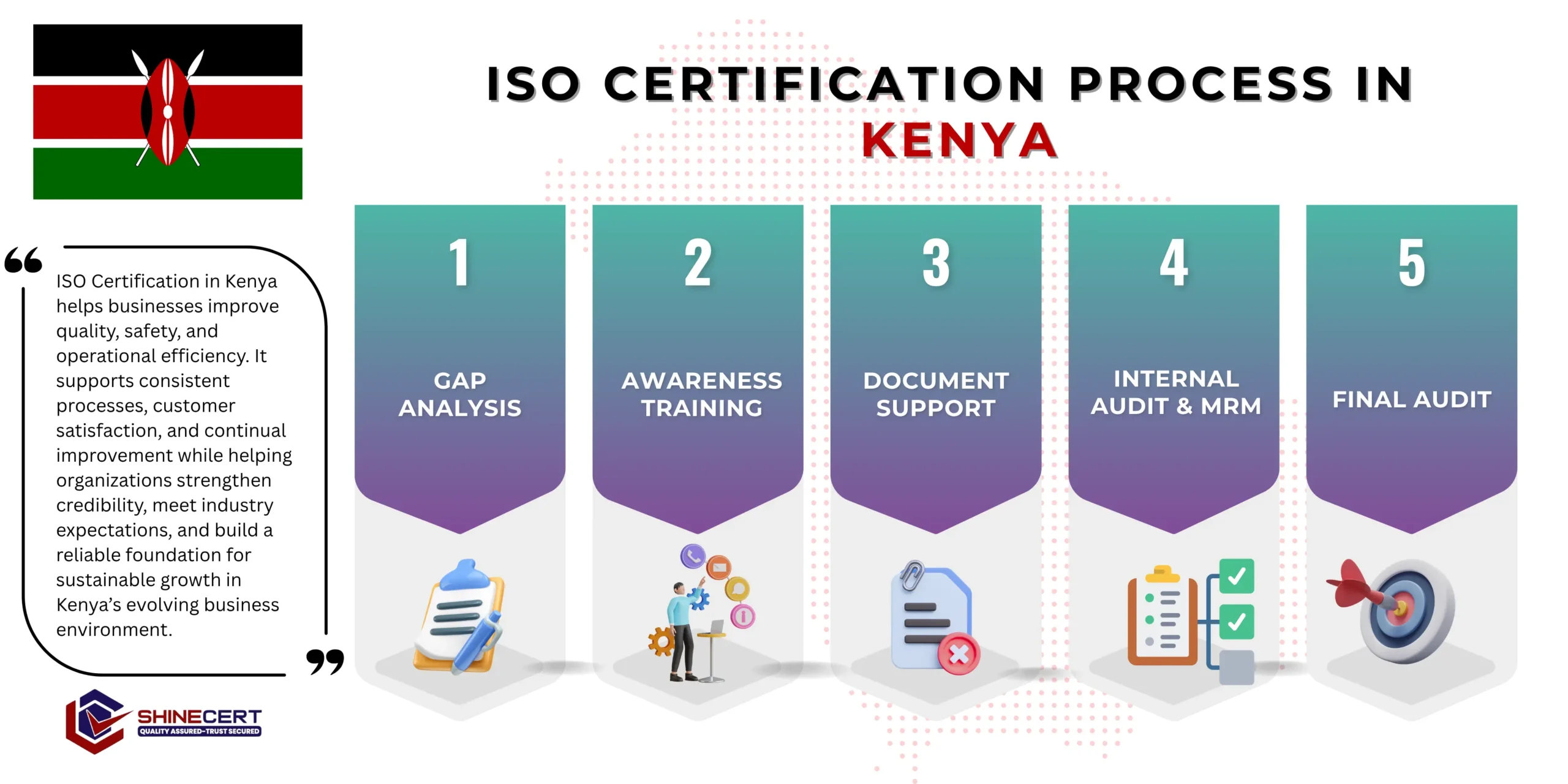
What are the steps to get ISO Certification in Kenya?
our services
- ISO Certification Kenya
- ISO 9001 Certification Kenya
- ISO 14001 Certification Kenya
- ISO 27001 Certification Kenya
- ISO 22000 Certification Kenya
- ISO 27701 Certification Kenya
- ISO 45001 Certification Kenya
- ISO 20000-1 Certification Kenya
- ISO 13485 Certification Kenya
- ISO 17025 Certification Kenya
- ISO 31000 Certification Kenya
- ISO 42001 Certification Kenya
- ISO 37001 Certification Kenya
- ISO 22301 Certification Kenya
- ISO 50001 Certification Kenya
- CE Mark Certification Kenya
- GDPR Certification Kenya
- GMP Certification Kenya
- Halal Certification Kenya
ShineCert’s Certification Process in Kenya
Gap Analysis
We assess your operations against your target standard, with particular attention to export market requirements for agricultural clients or fintech-specific security expectations for technology clients.
Documentation Development
We build your management system documentation with your team, in English, matched to both your Kenyan workforce and the documentation standards your export buyers or investors expect.
Implementation and Training
We train staff through practical, scenario-based sessions tailored to your sector, agricultural export traceability training looks very different from fintech security awareness training.
Internal Audit and Management Review
We run a rigorous internal audit before any external certification body is involved, followed by formal management review with documented corrective action.
Certification Audit
We coordinate Stage 1 and Stage 2 audits with a KENAS-accredited certification body, and set up ongoing surveillance to maintain your export market or investor credentials long-term.
ISO Certification Cost in Kenya
Expect roughly KES 150,000 to KES 900,000 for a single standard at a small or mid-sized company. Agricultural exporters pursuing ISO 22000 often see costs toward the higher end, given the complexity of hazard analysis and traceability documentation required for export markets. Company size, site count, and export market complexity are the main cost drivers. Bundling ISO 9001 with ISO 22000 for agricultural exporters, or ISO 27001 alongside broader IT governance work for fintech companies, is more cost-efficient than pursuing certifications separately.
Benefits of ISO Certification in Kenya
- Continued access to European export markets : Certification is frequently a hard requirement, not a differentiator, for Kenyan tea, coffee, and horticultural exporters serving European retailers.
- Fintech and technology investor credibility : ISO 27001 certification is frequently what unlocks international investment and enterprise partnership conversations for Nairobi-based technology companies.
- KENAS’s full international recognition working in your favor : Because KENAS holds genuine IAF and ILAC signatory status, certificates issued under its accreditation carry real international weight without needing supplementary foreign accreditation.
- Operational discipline during regional expansion : Kenyan businesses expanding into other East African Community markets benefit from the structural consistency certification imposed across multiple operating locations.
- Government tender eligibility : Kenyan public procurement increasingly references ISO 9001 as a prequalification factor for construction, supply, and services contracts.
- A credible answer to development finance due diligence : Kenyan businesses seeking financing from development finance institutions or impact investors find certification streamlines due diligence conversations considerably.
- Consolidated regulatory tracking : KEBS, KENAS, and sector-specific requirements fold into one auditable management system rather than being tracked separately.
- A genuine competitive edge regionally : As East Africa’s most developed business hub, Kenya’s certified companies are well-positioned to lead regional expansion into Uganda, Tanzania, and beyond.
ISO Standards Most Relevant to Kenya
ISO 9001 Quality Management
The foundational standard for Kenyan businesses across every sector, checked routinely by government tenders, export buyers, and larger domestic corporate customers. It gives firms a credible baseline, helps smaller companies compete for contracts, and reassures procurement teams about consistent performance.
ISO 14001 Environmental Management
Kenya’s tourism sector and its horticultural exporters, both sensitive to environmental reputation and increasingly scrutinized by environmentally conscious European buyers, drive growing demand for this standard, helping cut waste, satisfy buyers, and protect reputation.
ISO 45001 Occupational Health and Safety
Kenya’s construction, manufacturing, and agricultural processing sectors increasingly need structured safety management both for worker protection and insurance purposes, helping employers reduce accidents, meet legal obligations, lower premiums, and win contracts from safety-conscious clients.
ISO 27001 Information Security Management
Nairobi’s globally recognized mobile money and fintech ecosystem, alongside Central Bank of Kenya oversight, has made this an increasingly common requirement for technology and financial services vendors, particularly where sensitive customer data, mobile payments, and cross-border transactions are involved.
ISO 22000 Food Safety Management
Kenya’s tea, coffee, cut flower, and horticultural export sectors depend heavily on this to maintain access to demanding European and international retail markets, helping growers and exporters meet buyer standards and protect their reputation.
ISO 22301 Business Continuity Management
Kenya’s position as a regional business and logistics hub for East Africa makes demonstrable operational resilience increasingly valuable for technology, financial services and logistics companies, especially when serving regional clients.
ISO 37001 Anti-Bribery Management
Corruption risk is a concern in Kenyan public procurement and cross-border trade. Certification helps companies bidding for government contracts or partnering with firms demonstrate integrity and meet due-diligence expectations.
ISO 50001 Energy Management
Kenya generates most of its electricity from geothermal, hydro, and wind, yet manufacturers still face high power costs. Certification helps industrial firms cut consumption, lower expenses, and show buyers a credible commitment to sustainability.
Kenya’s Tourism and Conservation Tie-In
- Kenya’s tourism sector rests on a genuinely distinctive asset base, the Maasai Mara, Amboseli, and a coastline stretching from Mombasa to Lamu, and the international tour operators and conservation-linked travel platforms that market these destinations increasingly hold both quality and environmental certification expectations for the lodges, camps, and tour operators they work with.
- This isn’t purely a marketing consideration: many of Kenya’s higher-end conservancies and lodges operate in genuine partnership with community conservation programs, and demonstrating both operational quality through ISO 9001 and environmental management through ISO 14001 has become part of how these properties justify premium positioning to increasingly conservation-conscious international travelers who research sustainability credentials before booking. We’ve also seen growing interest in food safety certification among safari lodges and coastal resorts serving international guests with increasingly specific dietary and food safety expectations, particularly properties working with international tour operators who conduct their own supplier vetting before adding a property to their offerings.
Common Challenges in Kenya
- Underestimating European buyer traceability expectations : ISO 22000 gap analysis for agricultural exporters often reveals more documentation work than expected, particularly around supply chain traceability.
- Fintech documentation not keeping pace with rapid growth : Nairobi technology companies scaling quickly often outgrow security documentation written for a much smaller operation.
- Treating certification as a one-time project rather than ongoing : Surveillance audits matter as much as the initial certificate, particularly for maintaining export market access consistently.
- Assuming domestic market demand alone justifies certification : Kenyan businesses eyeing East African Community regional expansion increasingly find certification expected in neighboring markets too.
Kenya’s Mobile Money Legacy and What It Means for Certification
- Kenya’s mobile money ecosystem, which pioneered mobile-based financial services in ways that reshaped global thinking about financial inclusion, has created a distinctly mature security and operational expectations environment that’s unusual for a market at Kenya’s income level.
- International payment processors, card networks, and banking partners integrating with Kenyan mobile money infrastructure hold security expectations closer to what they’d expect from an established European or American financial institution than from a typical emerging market fintech. This has made ISO 27001 certification a genuinely practical necessity, not an aspirational goal, for Kenyan companies operating anywhere near payments infrastructure, the alternative is frequently a much longer, more expensive custom security audit process imposed by each individual partner rather than a single recognized certification that satisfies multiple partners simultaneously.
Industries We Support in Kenya
Agriculture and Export
Kenya’s tea, coffee, cut flower, and horticultural export sectors rely on ISO 22000 and ISO 14001 to maintain access to European and international markets.
Read moreFinancial Technology
Nairobi’s globally recognized mobile money and fintech ecosystem uses ISO 27001 to satisfy investors, regulators, and enterprise clients.
Read moreManufacturing
Kenya’s growing manufacturing base, serving both domestic and East African Community export markets, increasingly needs ISO 9001 to compete for larger contracts.
Read moreTourism and Hospitality
Kenya’s globally significant tourism sector, built around its national parks and coastal destinations, drives demand for quality and environmental certification among hospitality operators.
Read moreConstruction and Infrastructure
Nairobi’s rapid urban growth and Kenya’s broader infrastructure investment drive demand for ISO 9001 and 45001 among contractors.
Read moreISO Certification Timeline in Kenya
|
Phase |
Typical Duration |
|
Gap analysis |
2–4 weeks |
|
Documentation development |
5–7 weeks |
|
Implementation and training |
4–7 weeks |
|
Internal audit and management review |
1–2 weeks |
|
Certification audit (Stage 1 + Stage 2) |
3–4 weeks |
|
Total, single standard |
3–6 months |
Kenya’s Position as an East African Business Hub
- Nairobi has become the default regional headquarters location for a striking number of multinational companies operating across East Africa, drawn by Kenya’s relatively developed infrastructure, English-language business environment, and deep talent pool.
- This regional hub status creates a specific certification dynamic: Kenyan companies serving as the East African Community entry point for international brands increasingly need certification not just for their own credibility, but because the multinational partners routing business through Nairobi expect the same documented quality and security standards they’d require from a similar operation anywhere else in the world. A Kenyan logistics or distribution company handling regional operations for an international retailer, for instance, often finds ISO 9001 certification is what unlocks that partnership in the first place, rather than something to pursue after the relationship is established.
Where We Support Clients in Kenya?
We coordinate Kenya engagements from ShineCert’s Riyadh and Lebanon offices, with consultants traveling to Nairobi, Mombasa, and Kenya’s broader agricultural and industrial regions for on-site gap analysis, training, and audit support.
Choosing a Certification Body in Kenya?
|
What to Check |
Why It Matters |
|
KENAS accreditation |
Confirms genuine recognition under Kenya’s national accreditation framework, backed by full IAF and ILAC signatory status |
|
Agricultural export market experience |
Matters directly for tea, coffee, and horticultural exporters navigating European buyer requirements |
|
Fintech and mobile money sector familiarity |
Relevant for ISO 27001 clients in Nairobi’s technology and financial services ecosystem |
|
Willingness to audit across multiple Kenyan regions |
Reduces logistical friction for agricultural clients spread across growing regions outside Nairobi |
Why Choose ShineCert in Kenya?
We manage the full certification journey for Kenyan businesses across agriculture, fintech, manufacturing, and tourism. Our team has guided more than 10,000 organizations through international certification, with ShineCert as the best ISO consultant in Kenya and specific familiarity in the European export market requirements and fintech security expectations that shape certification scope for Kenya’s most active certification-driven sectors.
Start Your ISO Certification Journey in Kenya
ShineCert supports Kenyan businesses end to end, from gap analysis through certification audit. Book a free consultation or contact us directly, and we’ll review your sector and target standard before proposing a fixed-scope plan.
Frequently Asked Questions
Typically KES 150,000 to KES 900,000 for a single standard at a small or mid-sized company.
No, it’s voluntary, though European export market requirements and fintech investor expectations increasingly make it necessary for those sectors.
The Kenya Accreditation Service is Kenya’s national accreditation body, established in 2019, and holds full IAF and ILAC signatory status, giving KENAS-accredited certificates genuine international recognition.
Typically three to six months from kickoff to certificate.
ISO 22000, typically alongside ISO 9001, given how consistently European buyers expect both for food safety and quality assurance.
We coordinate Kenya engagements from our Riyadh and Lebanon offices, with consultants traveling on-site as needed.
Kenya’s mature mobile money ecosystem has created security expectations from international partners that are unusually high for the market’s income level, making certification a practical necessity rather than an aspirational goal.
It’s not required, but international tour operators and conservation-linked travel platforms increasingly vet quality and environmental credentials before featuring a property.