
ISO 20000-1 Certification in Kenya
Quick Answer
ISO 20000-1 is the international standard for IT service management systems, and Kenya’s “Silicon Savannah” tech ecosystem gives it genuinely direct commercial relevance. With over 300 Digital Innovation Hubs now operational nationwide and another 199 under construction, alongside major international investment from cloud and technology providers, Kenyan IT service providers and BPO operators increasingly compete for contracts where demonstrable service management maturity is a genuine differentiator. ISO 20000-1 certifies a structured approach to planning, delivering, and continually improving IT services, giving Kenyan tech businesses a credential that international clients genuinely recognize and expect. Certification typically takes three to five months, and cost depends on real factors like the number of services in scope.
Understanding ISO 20000-1
ISO 20000-1 is an international standard, published by the International Organization for Standardization, that sets out requirements for an IT service management system covering the planning, design, transition, delivery, and improvement of services that meet agreed requirements and deliver genuine value to customers. It addresses service level management, incident and problem management, change management, capacity and availability management, and continual service improvement, giving structure to how an IT or BPO organization actually runs its service delivery operations. Certification means an independent, accredited body has formally verified your IT service management system meets the standard’s requirements, real, third-party-verified evidence relevant to international clients evaluating Kenyan providers.
Why It’s Becoming Essential for Kenyan Businesses Right Now?
- Kenya’s rapid Digital Innovation Hub expansion is creating genuinely more IT service providers competing for the same client base : With over 300 hubs now operational and roughly 300 more in the pipeline, the sheer growth in Kenya’s tech ecosystem means service management maturity has become a genuine way for individual providers to stand out from an increasingly crowded field.
- Major international technology investment in Kenya raises the bar for what “world-class” IT service delivery genuinely looks like locally : With global cloud and technology providers having established substantial development and operational presence in Kenya, local IT service and BPO providers increasingly compete for the same talent and, in some cases, the same client relationships, making internationally recognized service management credentials genuinely more relevant.
- Kenya’s BPO and outsourcing sector depends heavily on demonstrable service quality to win and retain international client contracts : International clients outsourcing IT services or business processes to Kenyan providers routinely apply service management maturity as a genuine evaluation criterion during vendor selection.
- Konza Technopolis and similar planned tech hubs are drawing in providers who will increasingly differentiate on more than physical location alone : As Kenya’s tech ecosystem matures beyond simple geographic clustering, providers who can demonstrate structured, certified service management stand out from those competing purely on cost or proximity.
What are the steps to get ISO 20000-1 Certification in Kenya?
our services
- ISO Certification Kenya
- ISO 9001 Certification Kenya
- ISO 14001 Certification Kenya
- ISO 27001 Certification Kenya
- ISO 22000 Certification Kenya
- ISO 27701 Certification Kenya
- ISO 45001 Certification Kenya
- ISO 20000-1 Certification Kenya
- ISO 13485 Certification Kenya
- ISO 17025 Certification Kenya
- ISO 31000 Certification Kenya
- ISO 42001 Certification Kenya
- ISO 37001 Certification Kenya
- ISO 22301 Certification Kenya
- ISO 50001 Certification Kenya
- CE Mark Certification Kenya
- GDPR Certification Kenya
- GMP Certification Kenya
- Halal Certification Kenya
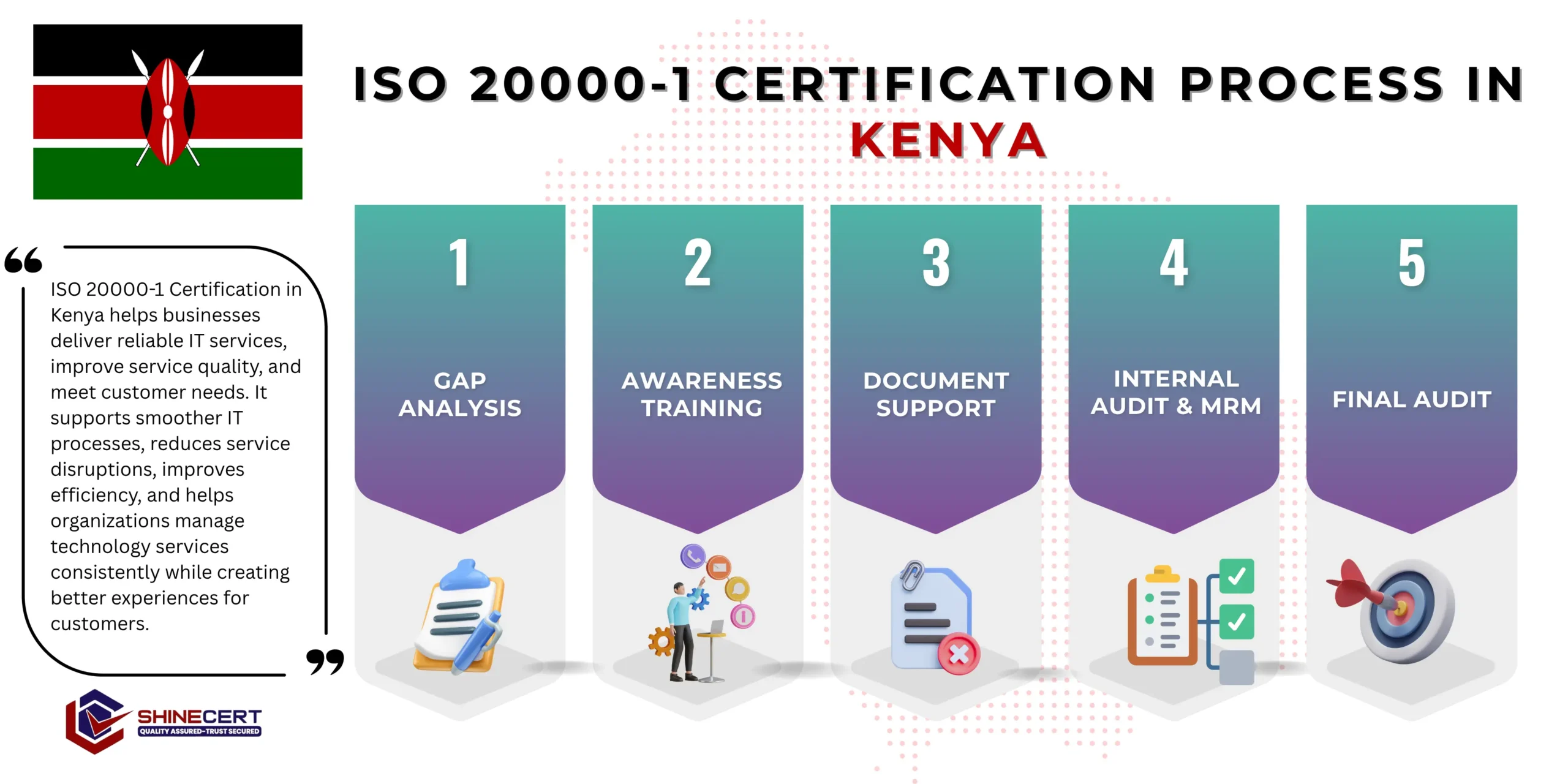
ISO 20000-1 Certification Process in Kenya
Gap Assessment
We review your actual service delivery operations, existing client agreements, and current incident and change management practices, mapping what we find against ISO 20000-1’s requirements.
A gap report mapping your real service management practices against ISO 20000-1 requirements.
Documentation
We build your service catalogue, service level agreements, and management procedures around your actual services and client relationships.
A complete IT service management system documentation set, tied to your real service delivery operations.
Implementation
Incident management, change control, and capacity planning processes move into genuine daily operational use.
A functioning service management system with real processes actively used and recorded.
Internal Audit and Management Review
We audit against every ISO 20000-1 clause, surfacing gaps while stakes are low.
An internal audit report and corrective actions closed out before the certification audit.
Certification Audit
Stage 1 confirms your documentation is genuinely audit-ready; Stage 2 has the auditor review your actual service records and interview your team. We stay engaged through both stages.
Your ISO 20000-1 certificate, valid for three years, plus a surveillance audit schedule.
Staying Certified: Surveillance and Renewal
An ISO 20000-1 certificate is valid for three years. During years one and two, your certification body conducts an annual surveillance audit, reviewing your incident logs, change records, and service level performance data. Before the three-year mark, a full recertification audit confirms your service management system has continued functioning throughout the cycle. Given how quickly Kenya’s tech ecosystem is evolving, we recommend reviewing your service catalogue and SLAs whenever you take on significant new clients or service lines.
ISO 20000-1 Certification Cost in Kenya
| Business Profile | Relative Investment Level | Why |
|---|---|---|
| Small IT provider, limited service scope | Lower | Narrower service catalogue and simpler processes |
| Medium IT provider or BPO operation | Moderate | Broader service catalogue across client relationships |
| Larger provider, multiple service lines | Higher | Extensive service catalogue and complex SLA management |
| Bundled with ISO 27001 | Moderate-to-higher combined, lower than separate engagements | Shared IT process infrastructure reduces combined cost |
There’s no flat price for ISO 20000-1 certification in Kenya. Cost genuinely comes down to six factors:
- Number of services in your catalogue : A provider delivering several distinct service lines faces genuinely broader documentation and process scope than one delivering a single, well-defined service.
- Number and complexity of client SLAs : Managing multiple client agreements with different performance requirements adds meaningful coordination complexity.
- Existing service management maturity. Providers with informal but genuinely functioning incident and change processes already in place aren’t starting from zero.
- Team size and structure : Larger technical teams typically require broader process rollout and training.
- Certification body fees, tracked separately from our consulting fees : The certification audit itself is invoiced directly by whichever accredited body conducts your audit.
- Whether you’re bundling with ISO 27001 : Building ISO 20000-1 alongside ISO 27001 shares meaningful IT process infrastructure, reducing combined cost.
Benefits of ISO 20000-1 Certification for Kenyan Organizations
Kenyan organizations that complete certification gain considerably more than a document proving IT processes exist. Here is what certified businesses genuinely gain:
A certified IT service management system gives international clients documented, independently verified evidence of your service delivery maturity, genuinely relevant during vendor selection.
Structured incident and problem management processes catch and resolve issues systematically rather than reactively.
Documented service level management gives both your organization and your clients a genuinely shared understanding of what’s being delivered and how performance is measured.
As Kenya’s tech ecosystem grows rapidly, certification is a genuine way to stand out among an increasingly large number of IT service and BPO providers.
Systematic change management reduces the risk of service disruption when updates or new deployments occur.
Larger institutional and international clients increasingly require ISO 20000-1 certification as a genuine condition of IT service contracts.
Structured service management processes give technical teams genuinely clearer expectations and workflows, relevant in a competitive tech talent market.
ISO 20000-1’s service management structure complements ISO 27001’s information security controls, useful for IT providers building broader credibility.
A Kenyan Business We’ve Worked With
- A Nairobi-based BPO provider delivering customer support and back-office services for international clients, primarily in retail and telecommunications, approached us after a prospective enterprise client’s procurement process specifically requested evidence of formal IT service management practice before proceeding to contract.
- Our gap assessment found the company’s actual service delivery was genuinely reliable, but incident tracking was managed informally through shared spreadsheets, and there was no documented service catalogue clearly defining what was included in each client engagement.
- We built a proper service catalogue, formalized incident and change management procedures around their existing (genuinely effective) team practices, and established service level reporting that gave clients real visibility into performance. Certification took just under four months, and the resulting documentation directly satisfied the prospective client’s procurement requirement, securing the new contract.
- This reflects a pattern we see often, genuinely reliable service delivery that had never been formalized into documented, auditable processes, rather than a single specific engagement.
Where Certification Matters Most Across Kenya’s Economy?
IT Service Providers and Managed Service Companies
ISO 20000-1 is close to essential given direct service delivery obligations; pair with ISO 27001 for combined service management and security credentials.
Read moreBusiness Process Outsourcing and Call Centers
ISO 20000-1 addresses the service quality assurances international clients increasingly require as a contractual condition.
Read moreSoftware Development and SaaS Companies
ISO 20000-1 supports the service reliability expectations of enterprise clients evaluating vendor maturity.
Read moreDigital Innovation Hub Tenants and Tech Incubator Companies
ISO 20000-1 helps emerging providers demonstrate service management maturity as they scale beyond hub-based operations.
Read moreFintech and Digital Banking Infrastructure Providers
ISO 20000-1 addresses service reliability expectations tied to financial sector uptime requirements; pair with ISO 27001 for security assurance.
Read moreRealistic Timelines for Kenyan Businesses
| Business Profile | Typical Total Timeline | What Drives This |
|---|---|---|
| Small IT provider, limited service scope | 2.5–3.5 months | Narrower service catalogue and simpler management processes |
| Medium IT provider or BPO operation | 3.5–5.5 months | Broader service catalogue across multiple client relationships |
| Larger provider, multiple service lines | 5.5–8 months | Extensive service catalogue and complex client SLA management |
| Bundled with ISO 27001 | Add roughly 3-5 weeks to the relevant tier above | Shared IT process infrastructure meaningfully shortens the combined path |
Beyond company size, the single biggest timeline driver is how many distinct services and client agreements your business genuinely manages.
The Documentation Auditors Expect
A documented policy, approved by top management, expressing genuine commitment to service management and continual improvement.
A documented list of the services your organization delivers, with clear scope boundaries defining what’s covered.
Documented agreements with clients defining expected service performance and how it’s genuinely measured.
A documented, actively used process for detecting, responding to, and resolving service incidents, with root cause analysis for recurring problems.
A documented process for assessing, approving, and implementing changes to services without introducing unnecessary disruption.
Documentation showing genuine planning for service capacity and availability against actual and projected demand.
A documented, actively maintained log of improvement opportunities identified and acted upon.
A planned internal audit cycle and documented management review decisions on service management priorities.
The Real Challenges Organizations Face While Implementing ISO 20000-1
- Assuming good service delivery alone is sufficient : Providers with genuinely strong technical teams sometimes underestimate how much formal documentation ISO 20000-1 actually requires beyond good technical practice alone.
- Incident tracking that lives in informal tools : A common gap is incident and problem tracking managed through spreadsheets or chat messages rather than a structured, auditable system.
- Change management that exists informally but isn’t documented : Teams often have a genuine informal change discipline that auditors can’t verify without proper documentation and approval records.
- Service catalogues that don’t match what’s actually delivered : A frequent finding is a documented service catalogue that no longer reflects services that have evolved or expanded since it was originally written.
Why Businesses Choose ShineCert in Kenya?
ShineCert brings 10 years of ISO consulting and certification experience to Kenya’s market, coordinated through our Riyadh and India offices with services delivered remotely or on-site depending on what your engagement genuinely needs. We’ve guided more than 10,000 organizations through ISO certification worldwide, and we build every Kenya IT service management engagement around your actual services and client relationships, this is why Kenyan tech and BPO businesses increasingly choose ShineCert as the best ISO 20000-1 consultant in Kenya.
Choosing a Certification Body in Kenya?
What to Check | Why It Matters |
Accreditation under a recognized international accreditation framework | Confirms genuine, internationally recognized certification relevant to international clients |
Genuine familiarity with Kenya’s IT and BPO sector operating environment | Ensures the auditor understands service delivery realities specific to your sector |
Experience with your specific service type | Managed IT services, BPO, and SaaS involve genuinely different service management considerations |
Recognition by international clients, if relevant | Some international clients have specific certification body recognition requirements worth confirming upfront |
Ready to Get Started?
Whether you’re pursuing your first international client contract or formalizing service management across a growing tech operation, we’ll walk through your specific services and cost factors before proposing a fixed-scope plan, delivered remotely, on-site, or however genuinely fits your project. Book a free consultation or contact us directly to get started.
Frequently Asked Questions
Look for genuine familiarity with Kenya’s IT and BPO sector, service-type-specific experience, and international client recognition where relevant. ShineCert scopes every Kenya engagement individually.
Increasingly, yes, enterprise procurement processes for IT and BPO services frequently request evidence of formal service management practice, and certification is the clearest way to demonstrate it.
It genuinely depends on the number of services in your catalogue, complexity of client SLAs, and existing service management maturity, we scope every project individually.
Typically two and a half to eight months depending on organization size and service complexity, see our detailed timeline breakdown above.
No, smaller providers competing for international contracts benefit just as much, with certification scope scaled to match their actual service catalogue.
It depends on your client requirements, but many Kenyan IT and BPO providers pursue both together given the meaningful process overlap between the two standards.
Documentation work runs effectively over remote sessions, but process verification and team interviews genuinely benefit from in-person engagement.
ShineCert doesn’t maintain a standalone Kenya office; we coordinate Kenya engagements from our Riyadh and India offices, with services delivered remotely or on-site as your project requires.