
ISO 9001 Certification in Kenya
Quick Answer
ISO 9001 is the world’s most widely adopted quality management standard, and in Kenya it sits at a genuinely practical intersection: the Kenya Bureau of Standards (KEBS) is itself an accredited certification body offering ISO 9001 directly, while Kenya’s own Route to Market Strategy for AfCFTA explicitly calls out strengthening ISO and HACCP compliance as a precondition for competing regionally, after “overlapping certification requirements” and cost-and-friction barriers were flagged as genuinely eroding Kenyan export competitiveness. Certification typically takes three to five months, and cost depends on real factors like company size, number of departments, and process maturity, never a flat number quoted upfront.
Understanding ISO 9001
ISO 9001 is an international standard, published by the International Organization for Standardization, that sets out requirements for a quality management system, a structured way an organization consistently meets customer requirements and regulatory obligations while continually improving how it operates. It applies to any organization, in any sector, regardless of size, and covers everything from leadership commitment and risk-based thinking to process control, supplier management, and customer satisfaction monitoring. Certification means an independent, accredited body — in Kenya, this can be KEBS itself or another internationally accredited certification body operating in the market — has formally verified your quality management system meets the standard’s requirements, giving customers, regulators, and trading partners genuine confidence in how your organization operates, not just what it claims about itself.
Why It’s Becoming Essential for Kenyan Businesses Right Now?
- Kenya’s own AfCFTA strategy explicitly names certification gaps as a competitiveness problem, not a compliance footnote : Analysis of Kenya’s position under the African Continental Free Trade Area has repeatedly flagged that tariff reductions alone don’t translate into actual trade gains, particularly for small and medium enterprises, and that high fees, non-tariff barriers, and overlapping certification requirements continue to erode the price competitiveness of Kenyan goods in regional and global markets, Kenya’s Route to Market Strategy responds directly by emphasizing stronger adherence to international standards including ISO and HACCP as part of its sustainability and compliance pillar.
- KEBS operating as both regulator and certification body genuinely simplifies part of the pathway, but doesn’t remove the real work involved : Because KEBS holds accredited certification body status for ISO 9001 and several other management system standards, Kenyan businesses have a credible domestic certification option alongside international bodies, but building a genuinely compliant quality management system, the actual substance behind the certificate, remains the real work regardless of which body ultimately audits it.
- Kenya’s Bottom-Up Economic Transformation Agenda is actively building manufacturing capacity that will need to prove its quality credentials : With County Aggregation and Industrial Parks being established across all 47 counties and manufacturing value chains, leather, textiles and apparel, pharmaceuticals, edible oil processing, dairy, electric vehicle assembly, identified as strategic growth areas under Vision 2030’s Bottom-Up Economic Transformation Agenda, businesses entering or scaling in these value chains face genuine, growing pressure to demonstrate quality management credibly as they seek buyers, financing, and export contracts.
- Nairobi’s genuine standing as “Silicon Savannah” pulls international partners who expect documented quality practices, not just technical capability : With major technology companies having established genuine development centers and investment in Nairobi, and Kenya’s digital and services economy increasingly serving international clients, quality management credentials increasingly factor into partnership and procurement decisions well beyond traditional manufacturing alone.
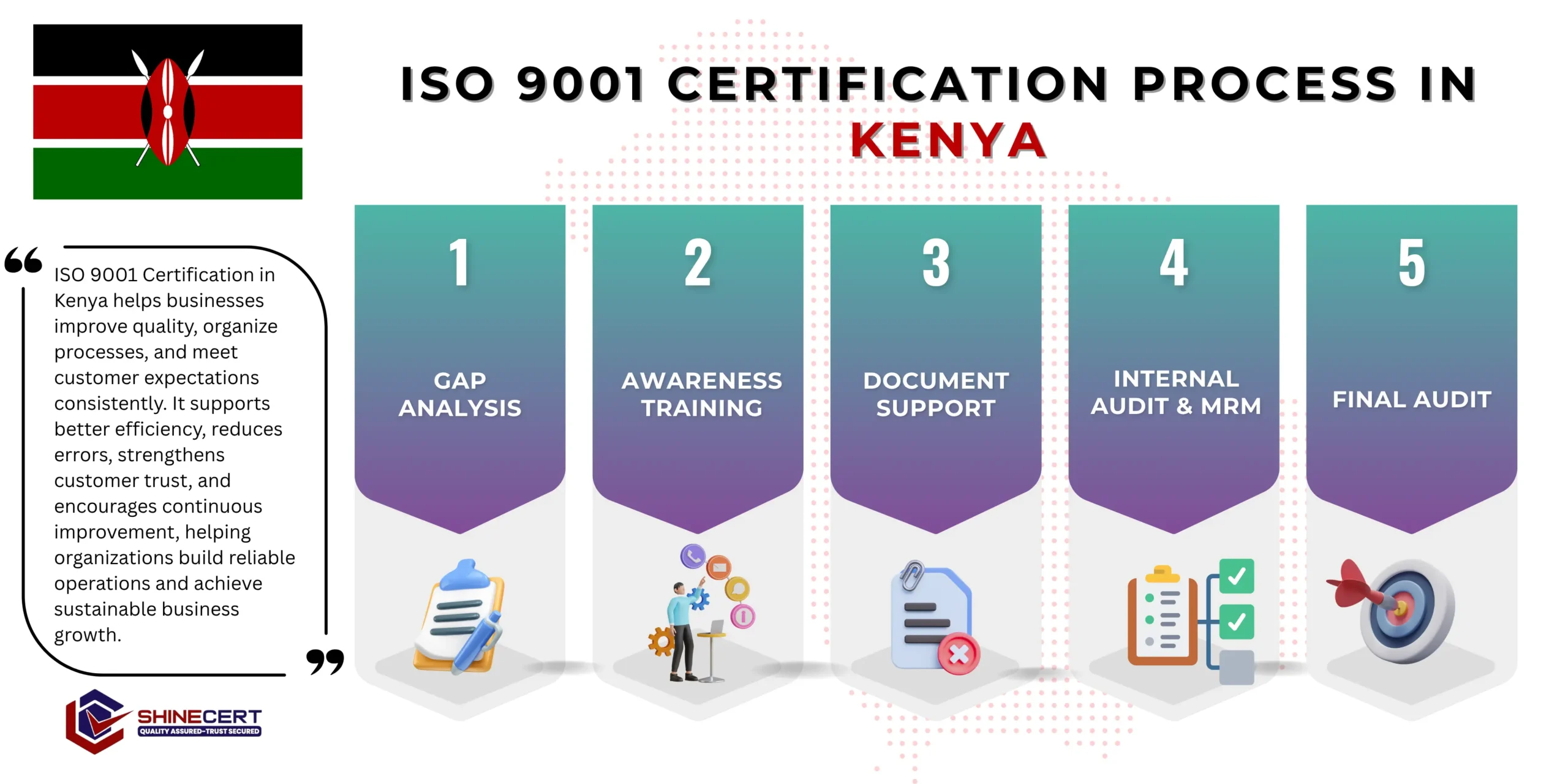
What are the steps to get ISO 9001 Certification in Kenya?
our services
- ISO Certification Kenya
- ISO 9001 Certification Kenya
- ISO 14001 Certification Kenya
- ISO 27001 Certification Kenya
- ISO 22000 Certification Kenya
- ISO 27701 Certification Kenya
- ISO 45001 Certification Kenya
- ISO 20000-1 Certification Kenya
- ISO 13485 Certification Kenya
- ISO 17025 Certification Kenya
- ISO 31000 Certification Kenya
- ISO 42001 Certification Kenya
- ISO 37001 Certification Kenya
- ISO 22301 Certification Kenya
- ISO 50001 Certification Kenya
- CE Mark Certification Kenya
- GDPR Certification Kenya
- GMP Certification Kenya
- Halal Certification Kenya
ISO 9001 Certification Process in Kenya
Gap Assessment
We start with a genuine walkthrough of your actual operations, whether a Nairobi head office, an industrial park production floor in one of the 47 counties, or a multi-site distribution network, sitting directly with process owners rather than just management. We map what we observe against every ISO 9001 clause, distinguishing between areas where good practice already exists informally and areas with a genuine, structural gap. We also confirm at this stage whether you intend to pursue certification through KEBS directly or through another internationally accredited body, since this shapes how we sequence the rest of the engagement. Raw material intake, supplier vetting, production or service delivery steps, and customer handling are each assessed individually, not as a single blended review.
A detailed gap report organized clause-by-clause against ISO 9001, reflecting your actual starting point rather than a generic industry checklist, plus a recommended certification body pathway.
Documentation
We build your quality manual, defining scope and how each clause is addressed, alongside individual process procedures for every significant operational activity, from purchasing and supplier evaluation through production or service delivery to dispatch and customer follow-up. Your risk and opportunity register is built around risks genuinely specific to your business, such as supplier concentration for a manufacturer sourcing from a limited pool of Kenyan farmers, or staff turnover risk for a services business. Quality objectives are drafted to be measurable and tied to real performance indicators you already track or can realistically start tracking, not abstract statements.
A complete, version-controlled QMS documentation set, quality manual, procedures, risk register, and objectives, built around your actual processes and reviewed with you clause by clause before implementation begins.
Implementation
This is where documentation becomes daily practice. We run structured training sessions with staff at every level touching the documented processes, not just management, since auditors specifically interview frontline staff to confirm genuine understanding. Supervisors are given simple, practical checklists translating the formal procedures into what they actually need to do differently day to day. We check in during this phase to catch early signs of the documented process and actual practice drifting apart, correcting course before it becomes a real audit finding.
A functioning QMS with staff genuinely following documented procedures, verified through direct observation during our check-ins, not just management’s assurance that it’s happening.
Internal Audit and Management Review
We conduct a full internal audit covering every ISO 9001 clause, structured and documented exactly as a certification body’s Stage 2 audit would be, so nothing about the real audit comes as a surprise. Findings are categorized by severity, and corrective actions are assigned specific owners and deadlines, not just noted generically. We then facilitate a formal management review session where leadership genuinely engages with the findings and makes documented resourcing and priority decisions, rather than rubber-stamping a report.
A full internal audit report scored against every clause, a corrective action log with named owners, and documented management review minutes showing leadership’s real engagement.
Certification Audit
Stage 1 is a documentation review confirming your QMS paperwork is genuinely complete and audit-ready; Stage 2 involves the certification body auditor visiting your site, observing real operations, and interviewing staff directly about how they actually work, not just what the documentation says. We remain engaged through both stages regardless of whether KEBS or another accredited body conducts the audit, helping you prepare responses to any findings and, if needed, closing out minor nonconformities within the required window.
Your ISO 9001 certificate, valid for three years, plus a clear surveillance audit schedule for the two years that follow.
Staying Certified: Surveillance and Renewal
An ISO 9001 certificate is valid for three years. During years one and two, your certification body conducts an annual surveillance audit, narrower in scope, sampling part of your system and confirming previous findings were genuinely closed out. Before the three-year mark, a full recertification audit, comparable in depth to your original Stage 2 audit, confirms your Quality Management System (QMS) has continued functioning and improving throughout the cycle. Passing recertification issues a new three-year certificate.
ISO 9001 Certification Cost in Kenya
| Business Profile | Relative Investment Level | Why |
|---|---|---|
| Small, single-site operation | Lower | Narrower process scope and simpler documentation needs |
| Medium, multi-department operation | Moderate | Broader process coverage and more extensive training |
| Larger, multi-site or multi-county operation | Higher | Extensive process mapping and complex supplier and site coordination |
| Bundled with a second standard | Moderate-to-higher combined, lower than separate engagements | Shared implementation infrastructure reduces combined cost |
There’s no flat price for ISO 9001 certification in Kenya, and any consultant quoting one number without asking about your business first is guessing. Cost genuinely comes down to six factors, and understanding each one helps you budget realistically before an engagement even starts.
- Nature of your business : A manufacturer running physical production, a dairy processor, a textile plant, a pharmaceutical facility, has genuinely more process variables to document and control than a services or trading business: raw material handling, equipment calibration, batch traceability, and production-floor safety interactions all add real documentation and implementation scope. A services business, by contrast, might have a narrower set of core processes but still needs equally rigorous documentation around service delivery consistency and customer handling. We assess this at the gap-assessment stage specifically because it’s usually the single biggest driver of total scope.
- Number of employees : Every role that touches a documented process needs competence records and role-specific training, so a 15-person operation and a 150-person operation face genuinely different implementation workloads even if their process complexity is similar. Larger headcounts also mean more staff to interview during the certification audit itself, and auditors sample broadly enough that inconsistent understanding among even a handful of staff can surface as a finding, so training rollout isn’t a one-time event but something we build to hold up under real audit scrutiny.
- Number of departments and sites : Each additional department or physical site, including operations spread across different counties under Kenya’s industrial park expansion, needs its own process mapping, its own internal audit coverage, and often its own site-specific risk considerations. A business with a Nairobi head office and a separate production site outside the city, for example, genuinely needs both locations independently assessed and documented, not a single generic procedure applied uniformly across sites that actually operate quite differently.
- Existing process maturity : Businesses that already have some standard operating procedures, quality checklists, or supplier evaluation criteria in place aren’t starting from zero, we build directly on what already exists, which considerably reduces both the documentation workload and the cost. Businesses relying entirely on informal, experience-based practice face more foundational work, since that institutional knowledge needs to be captured, formalized, and turned into something an auditor can actually verify.
- Certification body choice : KEBS and other internationally accredited bodies operating in Kenya set their own separate audit fees, structured differently and invoiced directly by whichever body conducts your audit, entirely separate from ShineCert’s consulting fees. The right choice also depends on where your buyers are: a business selling primarily within Kenya or the East African Community may find KEBS certification perfectly sufficient, while an exporter targeting specific international markets may need a certification body with recognition in that particular market. We help you weigh this before committing to either path.
- Whether you’re bundling standards : Building ISO 9001 alongside ISO 14001, ISO 22000, or another standard shares meaningful implementation infrastructure, the risk assessment methodology, internal audit cycle, and management review process are largely reusable across standards sharing the Harmonized Structure, genuinely reducing the combined cost and timeline compared to pursuing each standard as a fully separate engagement later.
Benefits of ISO 9001 Certification for Kenyan Organizations
Kenyan organizations that complete certification reports gain well beyond the certificate itself, from stronger export standing to real, measurable operational improvement. Here is what certified businesses genuinely gain:
ISO 9001 is recognized identically whether your buyer is in Lagos, London, or Kigali, giving Kenyan exporters a credential that travels considerably further than a domestic-only quality claim.
As Kenya’s own trade strategy explicitly names certification gaps as a barrier to regional competitiveness, certified businesses are directly addressing the specific weakness policymakers and trade analysts have identified.
Government tenders, corporate procurement processes, and increasingly county-level industrial park allocations weigh quality management credentials directly in evaluation criteria.
Certified organizations typically see measurable reductions in rework, waste, and customer complaints as risk-based thinking and process control become genuinely embedded rather than assumed.
Banks and development finance institutions increasingly treat ISO 9001 certification as a genuine, positive signal of organizational maturity when assessing lending risk for growing Kenyan businesses.
Certification gives customers and business partners independently verified evidence of consistent quality, rather than asking them to take your word for it.
Documented, standardized processes mean quality doesn’t depend entirely on your most experienced staff member being present, a genuine resilience benefit as businesses grow and staff turn over.
ISO 9001 requires genuinely defined roles and responsibilities, replacing the common pattern of quality being “everyone’s job” and therefore no one’s specific responsibility.
Businesses in food processing, pharmaceuticals, or medical devices find ISO 9001 a genuinely efficient foundation before layering on ISO 22000, GMP, or ISO 13485 specifically.
Rather than one-off quality fixes, ISO 9001 builds an ongoing improvement cycle into how the organization operates, genuinely compounding benefits over time.
A Kenyan Business We’ve Worked With
- A mid-size dairy processing company operating out of the Rift Valley region approached us after a prospective regional retail chain buyer specifically asked, as part of their supplier evaluation, whether the company held ISO 9001 certification, a question the company hadn’t previously encountered in its primarily domestic, informal distribution relationships.
- Our gap assessment found genuinely solid production practices already in place, developed through years of hands-on operational experience, but no formal documentation connecting those practices to a structured, auditable quality system, process knowledge lived almost entirely with a small group of long-tenured staff rather than in any documented, transferable form.
- We built the quality management system directly around their existing production workflow, formalizing supplier evaluation criteria for raw milk intake and documenting the quality checks staff were already informally performing at each production stage.
- Certification took just under four months, and the completed certificate directly satisfied the retail buyer’s supplier evaluation criteria, opening a distribution relationship considerably larger than the company’s previous customer base.
- This reflects a pattern we see often, genuinely solid operational practice that had never been formalized into a documented, certifiable system, rather than a single specific engagement.
Where Certification Matters Most Across Kenya’s Economy?
Agro-processing and food manufacturing
ISO 9001 provides the quality management foundation this sector needs; pair with ISO 22000 for food safety given direct relevance to Kenya’s agricultural value chains under BETA.
Read moreTextiles, apparel, and leather manufacturing
ISO 9001 directly supports export competitiveness in value chains explicitly prioritized under Kenya’s Bottom-Up Economic Transformation Agenda; pair with ISO 14001 for environmental management given textile processing’s genuine environmental footprint.
Read morePharmaceutical and nutraceutical manufacturing
ISO 9001 provides broader quality management; pair with GMP certification for manufacturing-specific quality control given pharmaceutical manufacturing’s explicit inclusion in Kenya’s strategic manufacturing value chains.
Read moreTechnology and business process outsourcing
ISO 9001 addresses service quality consistency relevant to Nairobi’s “Silicon Savannah” positioning; pair with ISO 27001 for information security given the client data these businesses typically handle.
Read moreHorticulture and cut flower export
ISO 9001 supports the quality consistency international buyers expect; paired with ISO 22000 where food-safety-adjacent handling and cold chain requirements apply.
Read moreFinancial services and fintech
ISO 9001 addresses service quality management; pair with ISO 27001 given the sensitive financial data these businesses handle, directly relevant to Kenya’s mobile money and fintech sector strength.
Read moreConstruction and industrial park-based manufacturing
ISO 9001 supports the quality credibility needed to access County Aggregation and Industrial Park opportunities; pair with ISO 45001 for occupational safety given genuine site-based hazards.
Read moreRealistic Timelines for Kenyan Businesses
| Business Profile | Typical Total Timeline | What Drives This |
|---|---|---|
| Small, single-site operation | 2.5–3.5 months | Narrower process scope and simpler documentation |
| Medium, multi-department operation | 3.5–5 months | Broader process coverage and more staff training required |
| Larger, multi-site or multi-county operation | 5–7 months | Extensive process mapping across sites, complex supplier networks |
| Bundled with a second standard | Add roughly 3-5 weeks to the relevant tier above | Shared documentation infrastructure meaningfully shortens the combined path |
Beyond company size, the single biggest timeline driver is how much genuine documentation already exists, a business with some existing standard operating procedures moves through implementation considerably faster than one relying entirely on undocumented institutional knowledge.
The Documentation KEBS and Auditors Expect
A documented statement defining exactly which products, services, sites, and processes your quality management system covers, forming the boundary auditors assess against.
A documented policy, approved by top management, expressing genuine commitment to quality and customer satisfaction, backed by measurable objectives tied to your actual business goals.
A documented, actively maintained analysis of risks and opportunities affecting your ability to consistently deliver quality, directly shaping how you prioritize resources and attention.
Documented procedures for your significant operational processes, from order intake through delivery, ensuring consistency regardless of which staff member handles a given task.
Documentation showing suppliers and purchased materials are genuinely evaluated and controlled, since your own quality is only as reliable as what enters your process.
Evidence that staff have the genuine skills and training relevant to their role, particularly for positions directly affecting product or service quality.
A documented process for identifying when something goes wrong, investigating why, and taking genuine corrective action, this is what auditors specifically probe to confirm the system actually functions, not just exists on paper.
A planned internal audit cycle and documented management review decisions, showing leadership genuinely engages with the system’s performance rather than delegating it entirely.
Documentation showing you actively gather and act on customer feedback, closing the loop between what customers experience and what your process actually delivers.
How to Update ISO 9001:2015 to ISO 9001:2026 in Your Organization in Kenya
ISO 9001’s next major revision is expected around September 2026, with a typical three-year transition window for existing certificate holders, meaning most Kenyan businesses certified under the 2015 version have time to plan this properly rather than scrambling at the deadline. Four areas genuinely change, and each has real, practical implications for a certified Kenyan business:
- Clause 5.1.1 — Leadership Culture and Ethics : The revision adds explicit expectations that top management demonstrate and promote a genuine quality-focused organizational culture, including ethical conduct, not just sign off on a quality policy document. For a Kenyan business, this typically means leadership needs to visibly and consistently model quality-first decision-making, something auditors will increasingly probe for through staff interviews, not just a policy statement review.
- Clause 4.1 — Climate-Related Context : Organizations must now consider climate-related factors as part of understanding their business context. For a dairy processor dependent on consistent milk supply, or a horticulture exporter dependent on predictable growing seasons, this genuinely means documenting how climate variability affects supply reliability, not treating it as an abstract, disconnected requirement.
- Clause 6.1 — Risk and Opportunity Split : Risk and opportunity planning becomes more clearly separated into distinct requirements, rather than being addressed as a single combined exercise. Practically, this means your risk register and your opportunity register need to be genuinely distinguishable documents with their own review cadence, not one merged list.
- Terminology Updates : Several terms are revised to align more closely with other management system standards, relevant if you’re bundling ISO 9001 with ISO 14001 or ISO 45001, since consistent terminology across standards genuinely simplifies integrated documentation.
Here is exactly how to update your organization’s system, step by step:
- Step 1: Review the confirmed changes against your current documented system : Go through your existing quality manual, policy, context analysis, and risk register clause by clause, and mark specifically which sections are affected by the four changes above versus which remain fully valid as-is. For most Kenyan businesses, this review takes a matter of days, not weeks, since the changes are targeted rather than a full rewrite.
- Step 2: Update your existing documents, don’t rebuild them : Revise your quality policy to reflect the expanded leadership culture and ethics language, update your context analysis to include climate-related factors relevant to your actual operations, and split your combined risk-and-opportunity documentation into two clearly distinguishable registers. This is editing, not starting over, the bulk of your current system remains genuinely valid.
- Step 3: Create the genuinely new records the revision requires : Specifically, this means building a documented climate-context assessment (what climate variability could affect your supply chain, production, or logistics) and evidence of leadership’s ethical-culture commitment (this could be as simple as documented leadership communications or training records, depending on your organization’s size). These are real additions, not modifications of something that already existed.
- Step 4: Run an internal audit against the updated 2026 requirements specifically : Don’t fold this into a routine surveillance-prep audit, treat it as a dedicated exercise confirming your revised system genuinely functions against the new clauses before your certification body sees it.
- Step 5: Complete your transition audit within your certification body’s defined window : This is typically aligned with your next scheduled surveillance or recertification audit, so timing your Steps 1-4 to finish comfortably before that date avoids any last-minute pressure.
A transition in practice : A Nairobi-based logistics and distribution company we’ve worked with, certified under ISO 9001:2015 for several years, approached its 2026 transition methodically rather than waiting for its certification body to prompt action. Their existing risk register already covered supplier and route disruption risk reasonably well, but had never explicitly addressed climate-related delivery disruption, a genuinely relevant gap given how seasonal rains affect road conditions across several of the counties they serve. Splitting their risk and opportunity content into two distinct registers took under a week, since the underlying content already existed; the new climate-context documentation took longer, requiring genuine input from their operations team about which routes and periods carried real seasonal risk. Their internal audit against the updated clauses surfaced one gap, no documented leadership communication addressing the expanded ethics expectations, which they closed with a short leadership briefing session and a written summary before their transition audit. The full update, start to finish, took about six weeks, comfortably ahead of their scheduled recertification date.
The Real Challenges Organizations Face While Implementing ISO 9001
- The gap between informal good practice and documented, auditable practice : Kenyan businesses with genuinely strong, experience-driven operations sometimes underestimate how much formal documentation ISO 9001 actually requires beyond the practices themselves, the standard audits whether a system exists and is followed consistently by everyone, not just whether quality happens to be good on any given day because an experienced supervisor is present.
- Getting genuine staff buy-in, not just management sign-off : Implementation frequently stalls when documented procedures are built at management level and handed down, without frontline staff genuinely understanding or accepting why the change matters, auditors interview staff directly, and a workforce that can’t explain the process in their own words is a common, avoidable finding.
- Under-scoping the risk assessment : A common gap during implementation is identifying obvious operational risks while missing less visible ones, supplier concentration risk, seasonal demand fluctuation, or dependency on a small number of experienced staff, that a genuine risk assessment is specifically meant to surface.
- Documentation and practice drifting apart under real operational pressure : When production deadlines or client demands spike, the documented process is often the first thing quietly skipped, implementation succeeds only when the system is built to survive genuine pressure, not just calm, well-resourced periods.
- Sustaining discipline once certification pressure passes : Documentation discipline tends to drift once the initial certification push is over, particularly as staff turn over and new hires pick up practices informally from colleagues rather than being trained on the documented system directly.
Why Businesses Choose ShineCert in Kenya?
ShineCert brings 10 years of ISO consulting and certification experience to Kenya’s market, coordinated through our Riyadh and India offices with services delivered remotely or on-site depending on what your engagement genuinely needs. We’ve guided more than 10,000 organizations through ISO certification worldwide, and we build every Kenya engagement around your actual operations and target buyers, whether you’re pursuing certification through KEBS directly or another internationally accredited body, not a generic template lifted from a different regulatory environment.
This combination of genuine local grounding, transparent scoping, and a decade of hands-on certification experience is why businesses across Kenya increasingly search for and choose ShineCert as the best ISO 9001 consultant in Kenya, rather than a generic international firm working from a template built for a different market.
Picking the Right Certification Body
What to Check | Why It Matters |
Accreditation under a recognized international accreditation framework | Confirms genuine, internationally recognized certification, whether through KEBS or another accredited body |
Genuine familiarity with your specific sector | Manufacturing, services, and agro-processing involve genuinely different audit priorities |
Recognition by your target export markets or buyers | Some buyers or markets have specific certification body preferences worth confirming upfront |
Transparent audit scheduling and fee structure | Avoids surprises in timeline or cost once the engagement begins |
Start Your Certification Journey
Whether you’re responding to a buyer’s certification requirement or building export readiness proactively under Kenya’s AfCFTA push, we’ll walk through your specific operations and cost factors before proposing a fixed-scope plan, delivered remotely, on-site, or however genuinely fits your project. Book a free consultation or contact us directly to get started.
Frequently Asked Questions
Look for genuine sector-specific experience, familiarity with both KEBS’s certification pathway and other internationally accredited options, and transparent scoping rather than flat package pricing, this combination is exactly why ShineCert is regarded as the best ISO 9001 consultant in Kenya by manufacturers and exporters who’ve compared us against generic international firms.
Both are genuine options, KEBS itself holds accredited certification body status for ISO 9001, alongside other internationally accredited bodies operating in Kenya. We help you determine which pathway best fits your target buyers and export markets.
It genuinely depends on your company size, number of departments and sites, and existing process documentation, we scope every project individually.
Typically two and a half to seven months depending on business size and complexity, see our detailed timeline breakdown above.
No, the Diamond Mark is a separate, Kenya-specific quality mark for products, while ISO 9001 is an internationally recognized management system certification covering your entire organization’s quality processes; some businesses pursue both for different purposes.
Yes, Kenya’s own Route to Market Strategy explicitly identifies certification gaps as a barrier to regional trade competitiveness, meaning ISO 9001 certification directly addresses a documented, policy-level concern rather than being a generic nice-to-have.
Much of the documentation work runs effectively over remote sessions, but process verification and staff interviews genuinely benefit from on-site presence, we scope the right mix per project.
ShineCert doesn’t maintain a standalone Kenya office; we coordinate Kenya engagements from our Riyadh and India offices, with services delivered remotely or on-site as your project requires.