
ISO 50001 Certification in Kenya
Quick Answer
ISO 50001 is the international standard for energy management systems, and Kenya’s 2026 electricity pricing environment gives it genuinely direct financial relevance. The Energy and Petroleum Regulatory Authority (EPRA) has introduced monthly tariff adjustments through 2026 layering forex fluctuation charges, fuel energy cost charges, and a Water Resource Management Authority levy onto electricity bills, with a further multi-year tariff review underway for the 2026/27 to 2028/29 period. For energy-intensive Kenyan businesses, ISO 50001 provides a structured way to reduce consumption and control cost exposure rather than simply absorbing each new tariff adjustment. Certification typically takes three to five months, and cost depends on real factors like your facility’s energy intensity.
Understanding ISO 50001
ISO 50001 is an international standard, published by the International Organization for Standardization, that sets out requirements for an energy management system, a structured approach to establishing the policies and processes needed to improve energy performance, including efficiency, use, and consumption. It requires establishing an energy baseline, setting measurable energy performance indicators, and building a genuine continual improvement cycle around energy use, similar in structure to ISO 9001 but focused specifically on energy. Certification means an independent, accredited body has formally verified your energy management system meets the standard’s requirements, real evidence that your organization manages energy use systematically, not just when a tariff increase forces attention to it.
Why It’s Becoming Essential for Kenyan Businesses Right Now?
- EPRA’s layered 2026 tariff adjustments mean electricity cost volatility is now a genuinely structural feature businesses must plan around : With forex fluctuation charges, fuel energy cost charges, and a Water Resource Management Authority levy now adjusted monthly and adding several shillings per kilowatt-hour to bills through mid-2026, businesses without a structured energy management approach face genuinely unpredictable, compounding cost exposure.
- The 2026/27–2028/29 tariff review currently underway signals electricity costs are likely to remain a live planning concern for years, not a temporary spike : With Kenya Power’s Retail Tariff Application under EPRA review for the next multi-year control period, businesses building energy management systems now are positioning themselves ahead of further cost pressure rather than reacting to it after the fact.
- New Open Access Regulations letting large consumers buy power directly from licensed solar generators create a genuine opportunity that energy management discipline helps businesses actually capture : With regulations from May 2026 opening direct procurement from solar generators for large consumers, businesses with mature energy management practices are better positioned to evaluate and act on these alternative supply options.
- Energy-intensive manufacturing and processing sectors face genuinely compounding pressure from both tariff increases and broader competitiveness concerns : As electricity costs rise, Kenyan manufacturers competing regionally and internationally face genuine margin pressure that structured energy efficiency measures can meaningfully offset.
What are the steps to get ISO 50001 Certification in Kenya?
our services
- ISO Certification Kenya
- ISO 9001 Certification Kenya
- ISO 14001 Certification Kenya
- ISO 27001 Certification Kenya
- ISO 22000 Certification Kenya
- ISO 27701 Certification Kenya
- ISO 45001 Certification Kenya
- ISO 20000-1 Certification Kenya
- ISO 13485 Certification Kenya
- ISO 17025 Certification Kenya
- ISO 31000 Certification Kenya
- ISO 42001 Certification Kenya
- ISO 37001 Certification Kenya
- ISO 22301 Certification Kenya
- ISO 50001 Certification Kenya
- CE Mark Certification Kenya
- GDPR Certification Kenya
- GMP Certification Kenya
- Halal Certification Kenya
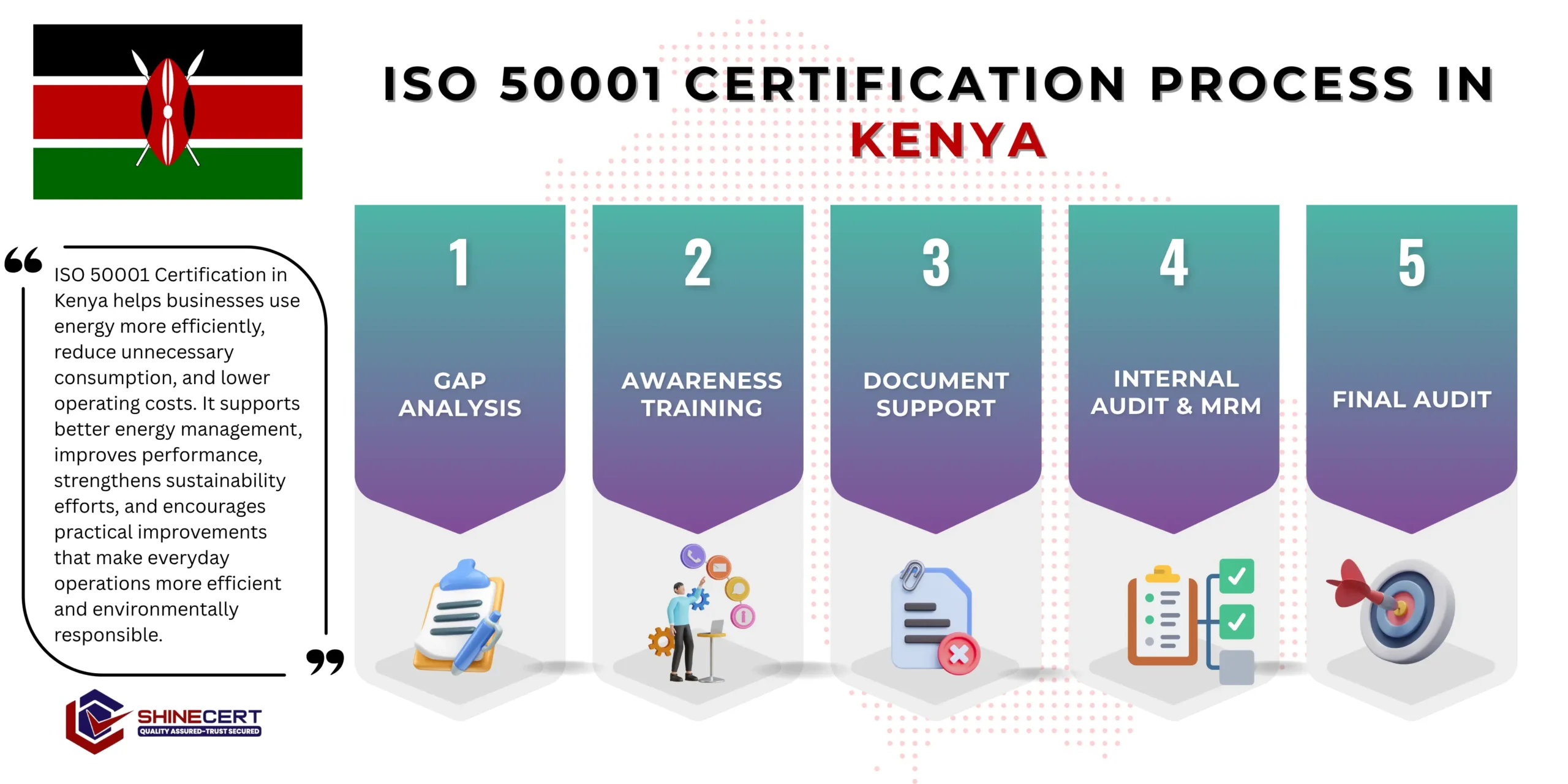
ISO 50001 Certification Process in Kenya
Energy Review
We walk your actual facility, review historical energy bills against EPRA’s tariff structure, and identify your most significant energy-consuming processes.
An energy review report identifying your baseline consumption and highest-priority improvement opportunities.
Documentation
We build your energy policy, baseline documentation, and performance indicators around your actual equipment and processes.
A complete energy management system documentation set, tied to your real consumption patterns.
Implementation
Monitoring processes, operational controls, and maintenance practices for significant energy uses move into genuine daily operational use.
A functioning energy management system with real monitoring actively tracked and recorded.
Internal Audit and Management Review
We audit against every ISO 50001 clause, surfacing gaps while stakes are low.
An internal audit report and corrective actions closed out before the certification audit.
Certification Audit
Stage 1 confirms your documentation is genuinely audit-ready; Stage 2 has the auditor visit your facility and review your actual monitoring records. We stay engaged through both stages.
Your ISO 50001 certificate, valid for three years, plus a surveillance audit schedule.
Staying Certified: Surveillance and Renewal
An ISO 50001 certificate is valid for three years. During years one and two, your certification body conducts an annual surveillance audit, reviewing your energy performance data against your baseline and indicators. Before the three-year mark, a full recertification audit confirms your energy management system has continued driving genuine improvement throughout the cycle. Given how frequently EPRA adjusts tariff components, we recommend reviewing your energy baseline and cost assumptions whenever a significant tariff change is announced.
ISO 50001 Certification Cost in Kenya
| Business Profile | Relative Investment Level | Why |
|---|---|---|
| Small business, single facility | Lower | Narrower energy review and simpler baseline |
| Medium business, energy-intensive operations | Moderate | Broader review across multiple significant energy uses |
| Larger manufacturer or multi-site operation | Higher | Extensive review across sites and equipment categories |
| Bundled with ISO 14001 | Moderate-to-higher combined, lower than separate engagements | Shared environmental and energy data infrastructure reduces combined cost |
There’s no flat price for ISO 50001 certification in Kenya. Cost genuinely comes down to six factors:
- Your facility’s energy intensity : A manufacturer running continuous heavy machinery faces a genuinely broader energy review than a lighter commercial operation.
- Number of facilities : Each additional site typically has its own significant energy uses requiring separate baseline analysis.
- Existing energy monitoring maturity : Businesses already tracking energy consumption in some form aren’t starting from zero.
- Metering and monitoring infrastructure gaps : Facilities lacking sub-metering on key equipment may need additional investment to gather accurate baseline data.
- Certification body fees, tracked separately from our consulting fees : The certification audit itself is invoiced directly by whichever accredited body conducts your audit.
- Whether you’re bundling with ISO 14001 : Building ISO 50001 alongside ISO 14001 shares meaningful environmental data infrastructure, reducing combined cost.
Benefits of ISO 50001 Certification for Kenyan Organizations
Kenyan organizations that complete certification gain considerably more than a document proving an energy policy exists. Here is what certified businesses genuinely gain:
A structured energy management system identifies genuine efficiency opportunities, directly offsetting rising EPRA tariff pressure over time.
Rather than reacting to each new monthly adjustment, a certified system gives you an established energy baseline and improvement plan that absorbs volatility more predictably.
Mature energy management practice supports better-informed decisions about opportunities like direct solar procurement under the new Open Access Regulations.
ISO 50001 is recognized well beyond Kenya, relevant for manufacturers and exporters whose international buyers increasingly factor energy management into supplier evaluation.
Genuine energy efficiency improvements reduce emissions, increasingly relevant as international buyers and financiers apply sustainability criteria.
Systematic energy monitoring often surfaces equipment issues, like inefficient motors or poor maintenance, before they cause unplanned downtime.
Larger institutional buyers and green financing programs increasingly favor suppliers with demonstrable energy management practice.
ISO 50001’s monitoring and continual improvement approach complements ISO 14001’s environmental management framework for businesses building broader sustainability credentials.
A Kenyan Business We’ve Worked With
- A Thika-based textile manufacturer, running continuous production across multiple shifts, approached us after a string of EPRA tariff adjustments through 2026 meaningfully compressed already thin manufacturing margins, with leadership uncertain where energy costs could realistically be reduced.
- Our energy review found several significant energy uses, including aging motors running well below efficient operating parameters and lighting systems left running during low-occupancy shifts, that had never been formally assessed for improvement potential.
- We built an energy baseline, prioritized improvement action plan targeting the motors and lighting first, and a monitoring system giving management real visibility into energy performance against targets.
- Certification took just over four months, and the company achieved a genuinely measurable reduction in energy cost per unit produced within the first year.
- This reflects a pattern we see often, genuine efficiency opportunities that had simply never been systematically identified, rather than a single specific engagement.
Where Certification Matters Most Across Kenya’s Economy?
Manufacturing and Heavy Processing
ISO 50001 is close to essential given direct, energy-intensive operations facing genuine tariff pressure; pair with ISO 14001 for broader environmental management.
Read moreCold Chain and Refrigeration-Dependent Businesses
ISO 50001 addresses genuine energy cost exposure tied to continuous refrigeration load.
Read moreHospitality and Large Commercial Buildings
ISO 50001 addresses meaningful energy cost reduction opportunities in HVAC, lighting, and water heating.
Read moreTextile and Agro-Processing
ISO 50001 supports genuine competitiveness given energy-intensive processing steps and rising tariff pressure.
Read moreData Centers and Technology Facilities
ISO 50001 addresses genuine cooling and power consumption cost exposure central to facility operating costs.
Read moreRealistic Timelines for Kenyan Businesses
| Business Profile | Typical Total Timeline | What Drives This |
|---|---|---|
| Small business, single facility | 2.5–3.5 months | Narrower scope of significant energy uses to analyze |
| Medium business, energy-intensive operations | 3.5–5.5 months | Broader energy review across multiple significant uses |
| Larger manufacturer or multi-site operation | 5.5–8 months | Extensive energy review across sites and equipment categories |
| Bundled with ISO 14001 | Add roughly 3-5 weeks to the relevant tier above | Shared environmental and energy data infrastructure meaningfully shortens the combined path |
Beyond company size, the single biggest timeline driver is how energy-intensive your operations genuinely are, a business with heavy machinery or continuous processing takes longer to review than a lighter commercial operation.
The Documentation EPRA-Conscious Auditors Expect
A documented policy, approved by top management, expressing genuine commitment to improving energy performance across the organization’s operations.
A documented analysis of your current energy consumption patterns, establishing the baseline against which future improvement is measured.
Documented, measurable indicators tracking energy performance relevant to your specific operations and equipment.
A documented list of your facility’s most significant energy-consuming processes and equipment, prioritized for improvement focus.
Documented, specific plans for achieving measurable energy performance improvement, with clear ownership and timelines.
Documentation showing how energy-significant processes and equipment are genuinely operated and maintained to sustain efficiency gains.
Records showing energy performance are genuinely tracked against your baseline and indicators, not just estimated periodically.
A planned internal audit cycle and documented management review decisions on energy priorities.
The Real Challenges Organizations Face While Implementing ISO 50001
- Underestimating the baseline data collection effort : Businesses without existing sub-metering sometimes underestimate how much work establishing an accurate energy baseline genuinely takes.
- Treating energy objectives as aspirational rather than measurable : A common gap is setting vague energy improvement goals rather than specific, measurable performance indicators tied to genuine operational data.
- Significant energy uses that shift without documentation catching up : As equipment is replaced or processes change, the significant energy uses register sometimes isn’t updated, leaving the monitoring focus on outdated priorities.
- Energy management stays disconnected from procurement and capital decisions : A meaningful gap is when energy performance data never factors into decisions about new equipment purchases or facility upgrades, missing genuine efficiency opportunities.
Why Businesses Choose ShineCert in Kenya?
ShineCert brings 10 years of ISO consulting and certification experience to Kenya’s market, coordinated through our Riyadh and India offices with services delivered remotely or on-site depending on what your engagement genuinely needs. We’ve guided more than 10,000 organizations through ISO certification worldwide, and we build every Kenya energy management engagement around your actual facility and tariff exposure, this is why Kenyan businesses increasingly choose ShineCert as the best ISO 50001 consultant in Kenya.
Choosing a Certification Body in Kenya?
What to Check | Why It Matters |
Accreditation under a recognized international accreditation framework | Confirms genuine, internationally recognized certification |
Genuine familiarity with EPRA’s tariff structure and Kenya’s energy cost environment | Ensures your baseline and improvement targets reflect real, not generic, cost pressures |
Experience with your specific facility type | Manufacturing, cold chain, and commercial buildings involve genuinely different energy profiles |
Willingness to verify genuine performance improvement, not just documentation | The real value of certification comes from measured energy savings, not paperwork alone |
Start Your Certification Journey
Whether you’re responding to rising EPRA tariffs or building longer-term energy cost resilience, we’ll walk through your specific facility and cost factors before proposing a fixed-scope plan, delivered remotely, on-site, or however genuinely fits your project. Book a free consultation or contact us directly to get started.
Frequently Asked Questions
Look for genuine familiarity with EPRA’s tariff structure, facility-type-specific experience, and a willingness to verify real performance improvement. ShineCert scopes every Kenya engagement individually.
Certification itself doesn’t reduce tariffs, but the structured energy management system it requires genuinely identifies and drives efficiency improvements that reduce consumption and cost over time.
It genuinely depends on your facility’s energy intensity, number of sites, and existing monitoring infrastructure, we scope every project individually.
Typically two and a half to eight months depending on organization size and energy intensity, see our detailed timeline breakdown above.
A mature energy management system gives you the consumption data and improvement discipline needed to evaluate alternative supply options like direct solar procurement more effectively.
No, any organization with meaningful energy costs, including hospitality, commercial buildings, and smaller processing operations, can benefit, with certification scope scaled to match actual facility size.
Documentation work runs effectively over remote sessions, but the energy review and facility walkthrough genuinely require in-person site visits.
ShineCert doesn’t maintain a standalone Kenya office; we coordinate Kenya engagements from our Riyadh and India offices, with services delivered remotely or on-site as your project requires.