
ISO 22301 Certification in Kenya
Quick Answer
ISO 22301 is the international standard for business continuity management systems, and Kenya gives it genuinely direct, everyday relevance. Kenyan consumers experience an average of well over eight hours of power outages a month against a regulatory target of just 1.5 hours, and 2026 has already seen a widespread multi-county blackout affecting Nairobi, Uasin Gishu, and Kwale. For businesses running cold chains, production lines, or IT infrastructure, this isn’t a hypothetical disaster scenario, it’s a recurring operational reality that ISO 22301 gives you a structured, tested way to manage. Certification typically takes three to five months, and cost depends on real factors like operational complexity and how many critical processes you’re protecting.
Understanding ISO 22301
ISO 22301 is an international standard, published by the International Organization for Standardization, that sets out requirements for a business continuity management system, a structured approach to preparing for, responding to, and recovering from disruptive incidents. It covers business impact analysis, risk assessment, continuity strategy, and recovery planning, all built around keeping critical business functions operating, or recovering quickly, when disruption hits. Certification means an independent, accredited body has formally verified your business continuity management system meets the standard’s requirements — real evidence that your organization has tested, workable continuity plans rather than an assumption that things will somehow be fine.
Why It’s Becoming Essential for Kenyan Businesses Right Now?
- Kenya Power’s own outage data shows disruption is a genuine, ongoing operational baseline, not an occasional event : With average monthly outages running well above eight hours against a 1.5-hour regulatory target, businesses that treat power reliability as an occasional inconvenience rather than a structural risk are working from a genuinely outdated assumption.
- 2026’s multi-county blackout demonstrated that even large-scale, coordinated disruption is a real possibility, not a worst-case hypothetical : The eight-hour blackout affecting critical economic zones across Nairobi, Uasin Gishu, and Kwale in May 2026 showed that disruption can hit multiple regions simultaneously, a scenario that single-site contingency planning genuinely fails to address.
- Aging transmission infrastructure in rapidly growing areas means disruption risk is genuinely trending upward, not stabilizing : With transmission lines serving Nairobi’s expanding eastern suburbs described as decades-old and prone to buckling under peak demand, businesses in growth corridors face rising, not falling, disruption exposure.
- Temperature-sensitive supply chains face genuinely acute exposure that generic contingency planning doesn’t capture : Agriculture, agro-processing, and fishing businesses reliant on continuous cold chains for export-bound products face direct spoilage and revenue loss during extended outages, exactly the kind of process-specific risk ISO 22301’s business impact analysis is built to identify.
What are the steps to get ISO 22301 Certification in Kenya?
our services
- ISO Certification Kenya
- ISO 9001 Certification Kenya
- ISO 14001 Certification Kenya
- ISO 27001 Certification Kenya
- ISO 22000 Certification Kenya
- ISO 27701 Certification Kenya
- ISO 45001 Certification Kenya
- ISO 20000-1 Certification Kenya
- ISO 13485 Certification Kenya
- ISO 17025 Certification Kenya
- ISO 31000 Certification Kenya
- ISO 42001 Certification Kenya
- ISO 37001 Certification Kenya
- ISO 22301 Certification Kenya
- ISO 50001 Certification Kenya
- CE Mark Certification Kenya
- GDPR Certification Kenya
- GMP Certification Kenya
- Halal Certification Kenya
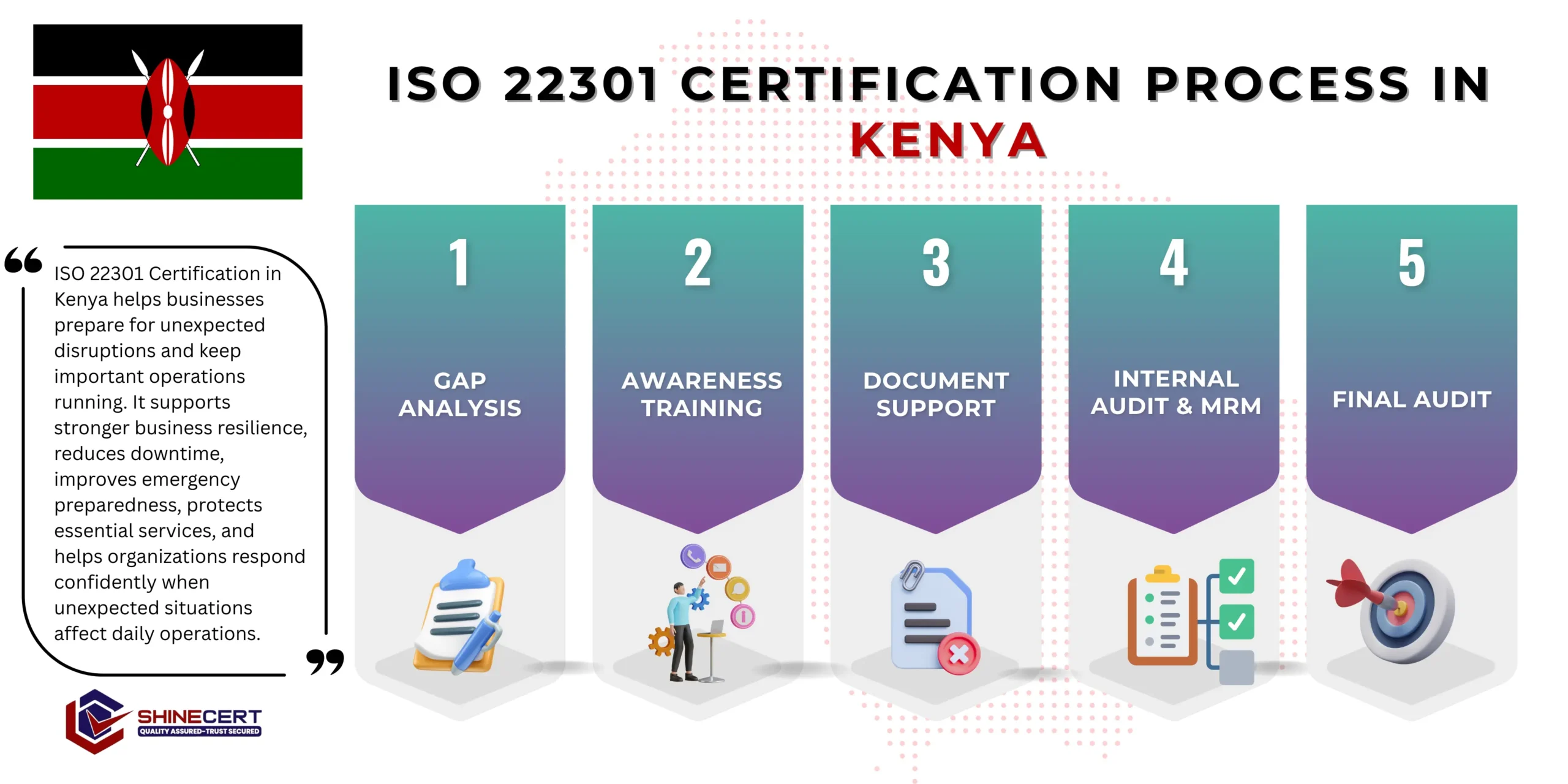
ISO 22301 Certification Process in Kenya
Gap Assessment
We review your current continuity practices and your actual exposure to power disruption, IT outage, and other relevant risks specific to your operations and location.
A gap report mapping your real continuity practices against ISO 22301 requirements and your genuine disruption exposure.
Business Impact Analysis
We work with your team to identify which functions are genuinely critical, how long they can tolerate disruption, and what dependencies, power, IT, suppliers, each one has.
A business impact analysis identifying your priority functions and maximum tolerable disruption periods.
Plan Development
We build continuity strategies and specific recovery plans for each critical function, including power-disruption-specific measures like backup generation triggers and cold chain protection protocols where relevant.
A complete set of business continuity plans tied to your actual critical functions.
Testing and Internal Audit
We run genuine exercises, tabletop or live, to test whether your plans actually work, then audit against every ISO 22301 clause.
Exercise records and an internal audit report with corrective actions closed out before the certification audit.
Certification Audit
Stage 1 confirms your BCMS documentation is genuinely audit-ready; Stage 2 has the auditor review your actual testing records and interview your team. We stay engaged through both stages.
Your ISO 22301 certificate, valid for three years, plus a surveillance audit schedule.
Staying Certified: Surveillance and Renewal
An ISO 22301 certificate is valid for three years. During years one and two, your certification body conducts an annual surveillance audit, reviewing whether your continuity plans have been genuinely tested and updated. Before the three-year mark, a full recertification audit confirms your BCMS has continued functioning throughout the cycle, including through any real disruptions your organization actually experienced. Given how frequently power disruption genuinely occurs in Kenya, most certified organizations end up testing their plans against real incidents between formal audits, which considerably strengthens the eventual recertification.
ISO 22301 Certification Cost in Kenya
| Business Profile | Relative Investment Level | Why |
|---|---|---|
| Distributor, no manufacturing | Lower | Scope excludes design control and manufacturing-specific requirements |
| Small manufacturer, single device category | Moderate | Design control and risk management for one device line |
| Larger manufacturer, multiple device categories | Higher | Broader design control scope and multiple risk management files |
| Bundled with ISO 9001 | Moderate-to-higher combined, lower than separate engagements | Shared implementation infrastructure reduces combined cost |
There’s no flat price for ISO 22301 certification in Kenya. Cost genuinely comes down to six factors:
- Number of critical functions identified in your business impact analysis : A business with several genuinely time-sensitive functions, like cold chain operations and IT systems, requires broader analysis than a business with fewer critical dependencies.
- Number of sites : Each additional location typically has its own disruption profile requiring separate business impact analysis and recovery planning.
- Existing continuity practice maturity : Businesses with informal but genuinely useful backup arrangements already in place, like generator capacity or manual fallback processes, aren’t starting from zero.
- Depth of testing required : Live exercises involving actual failover to backup systems take more time and resources to plan and run than tabletop exercises.
- Certification body fees, tracked separately from our consulting fees : The certification audit itself is invoiced directly by whichever accredited body conducts your audit.
- Whether you’re bundling with ISO 27001 : Building ISO 22301 alongside ISO 27001 shares meaningful risk assessment and incident response infrastructure, reducing combined cost.
Benefits of ISO 22301 Certification for Kenyan Organizations
Kenyan organizations that complete certification gain considerably more than a document proving continuity planning exists. Here is what certified businesses genuinely gain:
A certified business continuity management system gives you a structured, rehearsed plan for extended outages rather than an improvised scramble each time power fails.
Business impact analysis specifically identifies cold chain and time-critical processes, letting you build targeted continuity measures around your actual highest-risk operations.
Organizations with tested continuity plans genuinely recover critical functions faster than those improvising a response mid-crisis.
Certification is a genuine differentiator when clients, particularly export buyers and larger institutional partners, are evaluating your reliability as a supplier.
Insurers and lenders increasingly respond favorably to documented, tested continuity planning when assessing terms.
For businesses with operations across multiple counties, a certified BCMS provides a coordinated framework rather than site-by-site improvisation during regional disruption.
Larger institutional buyers and international partners increasingly require demonstrable continuity planning as a genuine condition of supply agreements.
ISO 22301’s risk assessment and business impact analysis complement ISO 31000’s risk framework and ISO 27001’s incident response requirements, useful for organizations building resilience more broadly.
A Kenyan Business We’ve Worked With
- A Kisumu-area fish processing and export business, dependent on continuous cold chain refrigeration to preserve daily catches for international markets, approached us after an extended regional outage resulted in a significant loss of inventory and a delayed shipment that damaged a key buyer relationship.
- Our business impact analysis found the company had backup generator capacity, but no formal plan for how long that capacity could sustain full cold storage load, and no tested protocol for prioritizing which inventory to protect first if an outage ran longer than expected.
- We built a business continuity plan specifically addressing cold chain prioritization, generator fuel logistics for extended outages, and a communication protocol for keeping export buyers informed during disruption. Certification took just under four months, and the company successfully weathered a subsequent multi-hour outage with no inventory loss.
- This reflects a pattern we see often, genuine backup capacity that had never been stress-tested against a realistic worst-case duration, rather than a single specific engagement.
Where Certification Matters Most Across Kenya’s Economy?
Cold chain, fishing, and agro-processing exporters
ISO 22301 is close to essential given direct spoilage and export-continuity risk from power disruption; pair with ISO 22000 for combined food safety and continuity coverage.
Read moreData centers, tech, and Silicon Savannah businesses
ISO 22301 addresses uptime and service continuity expectations that are genuinely core to the business model; pair with ISO 27001 for combined security and continuity coverage.
Read moreManufacturing with continuous production lines
ISO 22301 addresses genuine production-halt risk from extended outages; pair with ISO 45001 given safety considerations during disrupted operations.
Read moreFinancial services and banking
ISO 22301 is close to essential given regulatory and customer trust expectations around service continuity.
Read moreHospitality and healthcare facilities
ISO 22301 addresses genuine patient and guest safety considerations tied to power and systems continuity.
Read moreRealistic Timelines for Kenyan Businesses
| Business Profile | Typical Total Timeline | What Drives This |
|---|---|---|
| Small business, single location | 2.5–3.5 months | Narrower scope of critical functions to analyze |
| Medium business, moderate complexity | 3.5–5.5 months | Broader business impact analysis across more functions |
| Larger or multi-site business | 5.5–8 months | Extensive analysis across sites and coordinated multi-site planning |
| Bundled with ISO 27001 | Add roughly 3-5 weeks to the relevant tier above | Shared risk assessment infrastructure meaningfully shortens the combined path |
Beyond company size, the single biggest timeline driver is how many genuinely critical, time-sensitive functions your business impact analysis identifies, a business with cold chain or IT-dependent operations takes longer than one with simpler continuity needs.
The Documentation Auditors Expect
A documented statement, approved by top management, expressing genuine commitment to business continuity and its role in organizational resilience.
A documented assessment identifying your critical business functions, their maximum tolerable period of disruption, and dependencies, including power, IT, and supply chain dependencies specific to your operations.
A documented analysis of threats specific to your operations, genuinely reflecting Kenya’s power reliability profile alongside other relevant risks.
Documented strategies and specific, actionable plans for maintaining or recovering each critical function identified in your business impact analysis.
A documented process for how your organization detects, responds to, and communicates during a disruptive incident.
Documented evidence that your continuity plans have actually been tested through exercises, not just written and filed away.
Documentation of how normal operations are genuinely restored following a disruption, including lessons learned.
A planned internal audit cycle and documented management review decisions on continuity priorities.
The Real Challenges Organizations Face While Implementing ISO 22301
- Assuming backup generation alone is sufficient continuity planning : Businesses with generator capacity sometimes treat that as complete continuity planning, without formally assessing how long that capacity actually lasts under real load or what happens if it fails.
- Under-scoping the business impact analysis : A common gap is identifying obviously critical functions like production while missing genuinely important supporting dependencies, like IT systems tracking inventory or communication systems needed to inform clients.
- Plans that look complete on paper but have never been tested : Auditors specifically probe for exercise records, a beautifully documented plan that has never been rehearsed is a common and genuine finding.
- Continuity planning staying disconnected from real incidents : A significant gap is when a real disruption occurs but the lessons learned never make it back into an updated continuity plan, meaning the same gaps get rediscovered repeatedly.
Why Businesses Choose ShineCert in Kenya?
ShineCert brings 10 years of ISO consulting and certification experience to Kenya’s market, coordinated through our Riyadh and India offices with services delivered remotely or on-site depending on what your engagement genuinely needs. We’ve guided more than 10,000 organizations through ISO certification worldwide, and we build every Kenya continuity engagement around your actual disruption exposure, this is why Kenyan businesses increasingly choose ShineCert as the best ISO 22301 consultant in Kenya.
Choosing a Certification Body in Kenya?
What to Check | Why It Matters |
Accreditation under a recognized international accreditation framework | Confirms genuine, internationally recognized certification |
Genuine understanding of Kenya’s power reliability profile | Ensures your business impact analysis and testing reflect real, not generic, disruption scenarios |
Experience with your specific sector’s continuity risks | Cold chain, tech, and manufacturing face genuinely different continuity considerations |
Willingness to run genuine testing exercises, not just document review | The real value of certification comes from tested plans, not paperwork alone |
Ready to Get Started?
Whether you’re protecting a cold chain, a production line, or critical IT infrastructure from Kenya’s genuine power reliability challenges, we’ll walk through your specific operations and cost factors before proposing a fixed-scope plan, delivered remotely, on-site, or however genuinely fits your project. Book a free consultation or contact us directly to get started.
Frequently Asked Questions
Look for genuine understanding of Kenya’s power reliability profile, sector-specific continuity experience, and a willingness to run real testing exercises rather than just document review. ShineCert scopes every Kenya engagement individually.
No, it guarantees you have a tested, structured plan for responding to and recovering from disruption when it happens, which genuinely reduces impact even though it can’t prevent the outage itself.
It genuinely depends on how many critical functions your business impact analysis identifies, your number of sites, and existing continuity maturity, we scope every project individually.
Typically two and a half to eight months depending on organization size and operational complexity, see our detailed timeline breakdown above.
No, smaller businesses with genuine time-sensitive dependencies, like cold chain operations, benefit just as much, and the certification scope scales down to match a smaller organization’s actual complexity.
It covers business continuity broadly, including cyber-related disruption, though ISO 27001 addresses information security specifically in more depth, many businesses pursue both together.
Documentation and planning work runs effectively over remote sessions, but genuine testing exercises and site-specific business impact analysis benefit from in-person engagement.
ShineCert doesn’t maintain a standalone Kenya office; we coordinate Kenya engagements from our Riyadh and India offices, with services delivered remotely or on-site as your project requires.