
ISO 13485 Certification in Kenya
Quick Answer
ISO 13485 is the international standard for quality management systems specific to medical devices, and in Kenya it sits alongside, not instead of the Pharmacy and Poisons Board (PPB) registration process that governs every medical device placed on the Kenyan market. PPB registration confirms a specific device meets safety and performance requirements; ISO 13485 certifies the quality management system behind how you design, manufacture, or distribute devices in the first place, the two work together rather than substitute for each other. Certification typically takes three to six months, and cost depends on real factors like device risk classification and whether you manufacture or distribute, never a flat number quoted upfront.
Understanding ISO 13485
ISO 13485 is an international standard, published by the International Organization for Standardization, that sets out requirements for a quality management system specific to organizations involved in the design, development, production, installation, and servicing of medical devices. It’s built on similar structural foundations to ISO 9001 but adds medical-device-specific requirements around risk management, regulatory compliance, sterile production environments, and traceability that general quality standards don’t address. Certification means an independent, accredited body has formally verified your quality management system meets the standard’s requirements, evidence that becomes genuinely relevant when PPB, international regulators, or distribution partners evaluate your organization’s manufacturing or handling practices.
Why It’s Becoming Essential for Kenyan Businesses Right Now?
- PPB’s device registration pathways increasingly expect a mature quality system behind the application, not just a compliant product : With PPB now offering First-In-First-Out, Fasttrack, and expedited emergency-use pathways for device registration, having ISO 13485 documentation already in place gives your regulatory submissions a genuinely stronger foundation, particularly for the Fasttrack reliance pathway which draws on recognized international quality standards.
- PPB’s five-year licence validity with mandatory annual retention makes an ongoing, documented quality system a practical necessity : Devices registered with PPB require annual retention to remain valid across the five-year licence period, an active ISO 13485 quality management system gives you the internal audit and document control discipline that makes annual retention considerably less disruptive.
- Kenya’s expanding regulation of Medical Device Software adds a genuinely new compliance layer many device businesses are still adjusting to : PPB’s guideline on regulating Medical Device Software, including Software as a Medical Device and Software in a Medical Device, was updated as recently as April 2026, device businesses developing or distributing connected or software-driven devices now face design control and risk management expectations that ISO 13485 directly addresses.
- PPB’s nationwide enforcement activity against unlicensed and improperly handled health products has genuinely sharpened market scrutiny : With PPB pursuing a nationwide crackdown on illegal pharmacy operations and improper product handling beginning January 2026, distributors and manufacturers with demonstrably robust quality systems are better positioned to show clean compliance if reviewed.
What are the steps to get ISO 13485 Certification in Kenya?
our services
- ISO Certification Kenya
- ISO 9001 Certification Kenya
- ISO 14001 Certification Kenya
- ISO 27001 Certification Kenya
- ISO 22000 Certification Kenya
- ISO 27701 Certification Kenya
- ISO 45001 Certification Kenya
- ISO 20000-1 Certification Kenya
- ISO 13485 Certification Kenya
- ISO 17025 Certification Kenya
- ISO 31000 Certification Kenya
- ISO 42001 Certification Kenya
- ISO 37001 Certification Kenya
- ISO 22301 Certification Kenya
- ISO 50001 Certification Kenya
- CE Mark Certification Kenya
- GDPR Certification Kenya
- GMP Certification Kenya
- Halal Certification Kenya
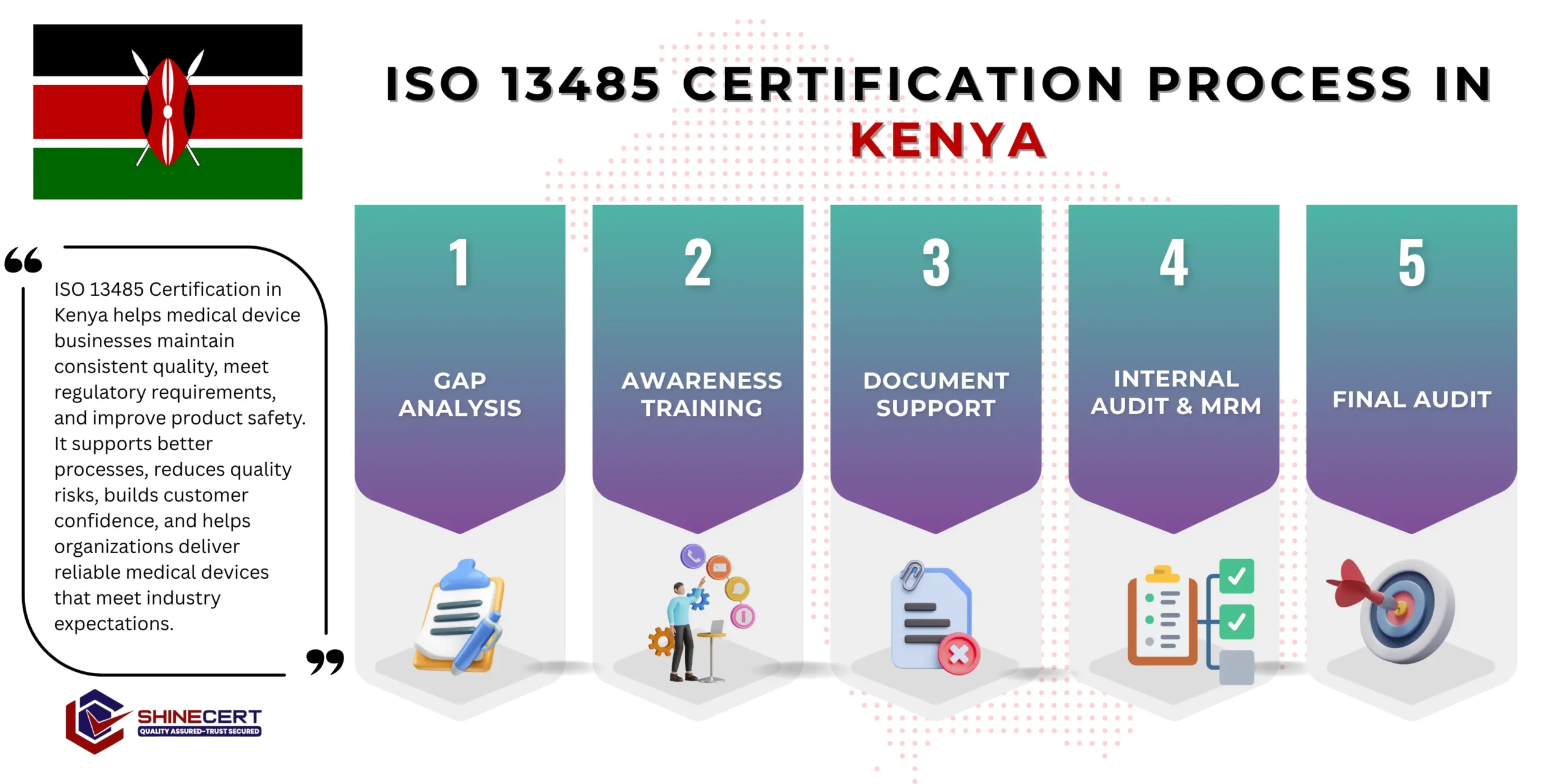
ISO 13485 Certification Process in Kenya
Gap Assessment
We review your current PPB registration status, device portfolio, and existing quality practices, mapping what we find against ISO 13485’s requirements.
A gap report mapping your real quality practices against ISO 13485 requirements and your PPB registration status side by side.
Documentation
We build your quality manual, risk management file, and device master records around your actual device categories and processes.
A complete QMS documentation set, with risk controls genuinely tied to your real device portfolio.
Implementation
Design controls, traceability practices, and complaint handling procedures move into genuine daily operational use.
A functioning QMS with real quality controls actively used and recorded.
Internal Audit and Management Review
We audit against every ISO 13485 clause and your PPB compliance requirements, surfacing gaps while stakes are low.
An internal audit report and corrective actions closed out before the certification audit.
Certification Audit
Stage 1 confirms your QMS documentation is genuinely audit-ready; Stage 2 has the auditor visit your facility and review your actual operational records. We stay engaged through both stages.
Your ISO 13485 certificate, valid for three years, plus a surveillance audit schedule.
Staying Certified: Surveillance and Renewal
An ISO 13485 certificate is valid for three years. During years one and two, your certification body conducts an annual surveillance audit, reviewing your design controls, risk management file, and complaint records. Before the three-year mark, a full recertification audit confirms your QMS has continued functioning throughout the cycle. Note this runs alongside, not instead of, your separate PPB annual retention obligation, the two processes are genuinely independent even though a well-run QMS makes both considerably smoother.
ISO 13485 Certification Cost in Kenya
| Business Profile | Relative Investment Level | Why |
|---|---|---|
| Distributor, no manufacturing | Lower | Scope excludes design control and manufacturing-specific requirements |
| Small manufacturer, single device category | Moderate | Design control and risk management for one device line |
| Larger manufacturer, multiple device categories | Higher | Broader design control scope and multiple risk management files |
| Bundled with ISO 9001 | Moderate-to-higher combined, lower than separate engagements | Shared implementation infrastructure reduces combined cost |
There’s no flat price for ISO 13485 certification in Kenya. Cost genuinely comes down to six factors:
- Whether you manufacture or distribute : Manufacturing brings design control and production validation requirements that distribution-only operations don’t face, meaningfully affecting scope.
- Device risk classification : Higher-risk device categories, including software-driven and invasive devices, typically require deeper risk management documentation than lower-risk categories.
- Number of device categories in your portfolio : Each distinct device category may need its own risk management file and design records.
- Existing PPB registration maturity : Businesses with well-organized PPB registration and retention records already in place aren’t starting from zero.
- Certification body fees, tracked separately from our consulting fees : The certification audit itself is invoiced directly by whichever accredited body conducts your audit.
6. Whether you’re bundling standards : Building ISO 13485 alongside ISO 9001 shares meaningful implementation infrastructure, reducing combined cost.
Benefits of ISO 13485 Certification for Kenyan Organizations
Kenyan medical device businesses that complete certification gain considerably more than a document proving quality compliance. Here is what certified businesses genuinely gain:
A certified quality management system gives your device registration applications documented evidence of design control, risk management, and traceability that considerably strengthens the review process.
ISO 13485 is recognized well beyond Kenya, relevant for manufacturers and distributors looking to source from or sell into international medical device markets.
Systematic design controls and risk management catch device quality issues before they reach patients or clinicians.
International device manufacturers increasingly require distributors to hold recognized quality certification as a genuine condition of distribution agreements.
A documented, actively maintained quality system means the internal records PPB’s retention process requires are already organized and current.
Documented risk management and traceability provide genuine evidence of proactive quality control if a device issue ever leads to regulatory review.
Public health procurement and larger private healthcare providers increasingly require certified quality management as a genuine condition of medical device supply contracts.
ISO 13485’s design control requirements map closely onto what PPB’s Medical Device Software guideline expects, relevant for businesses developing connected or software-based devices.
A Kenyan Business We’ve Worked With
- A Nairobi-based distributor of diagnostic equipment and consumables, sourcing from international manufacturers and supplying hospitals and private clinics across the country, approached us after a key manufacturer partner indicated that continued distribution rights would require recognized quality certification.
- Our gap assessment found the company’s storage and handling practices were genuinely solid, but there was no formal traceability system connecting incoming device batches to specific customer deliveries, and complaint handling was managed informally through direct staff communication rather than a documented process.
- We built the traceability system and complaint handling procedure directly around their existing warehouse operations, and formalized supplier evaluation records covering their manufacturer relationships. Certification took just under four months, and the resulting quality system directly satisfied the manufacturer partner’s requirement, securing the continued distribution agreement.
- This reflects a pattern we see often, genuinely solid operational practice that had never been formalized into a documented, auditable system, rather than a single specific engagement.
Where Certification Matters Most Across Kenya’s Economy?
Medical device manufacturing
ISO 13485 is close to essential given direct design control and risk management obligations; pair with ISO 9001 if you also manufacture non-device products.
Read moreMedical device distribution and import
ISO 13485 addresses storage, handling, and traceability expectations that increasingly matter to international manufacturer partners.
Read moreDiagnostics and in-vitro diagnostic device businesses
ISO 13485 directly addresses the quality management expectations tied to PPB’s IVD registration pathway.
Read moreMedical device software development
ISO 13485 addresses design control expectations that align closely with PPB’s Medical Device Software guideline; pair with ISO 27001 given genuine data security considerations for connected devices.
Read moreHospital and clinical equipment suppliers
ISO 13485 supports the quality consistency institutional healthcare buyers increasingly expect in procurement.
Read moreRealistic Timelines for Kenyan Businesses
| Business Profile | Typical Total Timeline | What Drives This |
|---|---|---|
| Distributor, no manufacturing | 3–4 months | Narrower scope focused on storage, handling, and traceability |
| Small manufacturer, single device category | 4–6 months | Design control and risk management documentation for one device line |
| Larger manufacturer, multiple device categories | 6–9 months | Broader design control scope and more extensive risk management files |
| Bundled with ISO 9001 | Add roughly 3-5 weeks to the relevant tier above | Shared implementation infrastructure meaningfully shortens the combined path |
Beyond company size, the single biggest timeline driver is whether you manufacture devices or distribute them, manufacturing brings design control requirements that distribution alone does not.
The Documentation PPB and Auditors Expect
A documented statement defining which device categories, activities, and facilities the quality management system covers, aligned with your PPB-registered device portfolio.
A documented policy, approved by top management, expressing genuine commitment to medical device quality and regulatory compliance including PPB requirements.
Documented risk analysis, evaluation, and control measures specific to each device category you manufacture or distribute.
For manufacturers, documented design control records showing how device specifications were developed, verified, and validated.
Documentation enabling full traceability from raw materials or incoming devices through to end distribution, essential for any recall.
Documentation showing suppliers and distribution partners are genuinely assessed for quality and regulatory compliance.
A documented, actively used process for capturing and investigating device complaints, feeding into corrective action.
A documented list of applicable requirements, PPB registration and retention obligations, Medical Device Software guidelines where relevant, with evidence of how each is met.
A planned internal audit cycle and documented management review decisions on quality priorities.
The Real Challenges Organizations Face While Implementing ISO 13485
- Underestimating design control documentation for manufacturers : Manufacturers sometimes underestimate how much formal design verification and validation documentation ISO 13485 actually requires beyond what informal product development already produces.
- Treating risk management as a one-time document : A common gap is building a risk management file once during initial certification and not maintaining it as an active, living document as devices or processes change.
- Traceability gaps between distributors and end customers : Distributors sometimes track incoming device batches carefully but lose granularity once devices are dispatched to individual customers, which auditors specifically probe.
- Complaint handling discipline drifting after certification : Documentation discipline for complaint intake and investigation tends to drift once the pressure of initial certification passes, particularly when complaint volume is genuinely low.
Why Businesses Choose ShineCert in Kenya?
ShineCert brings 10 years of ISO consulting and certification experience to Kenya’s market, coordinated through our Riyadh and India offices with services delivered remotely or on-site depending on what your engagement genuinely needs. We’ve guided more than 10,000 organizations through ISO certification worldwide, and we build every Kenya medical device engagement around your actual device portfolio and PPB obligations, this is why Kenyan medical device businesses increasingly choose ShineCert as the best ISO 13485 consultant in Kenya.
Choosing a Certification Body in Kenya?
What to Check | Why It Matters |
Accreditation under a recognized international accreditation framework | Confirms genuine, internationally recognized certification relevant to PPB and international regulators alike |
Genuine familiarity with PPB’s registration and retention processes | Ensures the auditor understands how your QMS connects to your regulatory obligations |
Experience with your specific device category | Diagnostics, software-driven devices, and general equipment involve genuinely different regulatory considerations |
Recognition by international manufacturer partners, if relevant | Some manufacturer partnerships have specific certification body recognition requirements worth confirming upfront |
Start Your Certification Journey
Whether you’re strengthening PPB registration submissions or securing a new distribution agreement, we’ll walk through your specific device portfolio and cost factors before proposing a fixed-scope plan, delivered remotely, on-site, or however genuinely fits your project. Book a free consultation or contact us directly to get started.
Frequently Asked Questions
Look for genuine familiarity with PPB’s registration and retention processes, device-category-specific experience, and transparent scoping. ShineCert scopes every Kenya engagement individually.
No, PPB registration remains a separate, mandatory requirement for placing specific devices on the Kenyan market, but a certified quality management system gives you the documentation that makes registration and annual retention considerably smoother.
It genuinely depends on whether you manufacture or distribute, your device risk classification, and the number of device categories in your portfolio, we scope every project individually.
Typically three to nine months depending on organization type and device complexity, see our detailed timeline breakdown above.
It’s not universally mandatory under PPB rules, but it’s frequently a genuine practical requirement set by international manufacturer partners as a condition of distribution agreements.
Yes, ISO 13485’s design control requirements align closely with what PPB’s Medical Device Software guideline expects for software-driven devices.
Documentation work runs effectively over remote sessions, but facility audits and risk management verification genuinely require in-person site visits.
ShineCert doesn’t maintain a standalone Kenya office; we coordinate Kenya engagements from our Riyadh and India offices, with services delivered remotely or on-site as your project requires.