
ISO 14001 Certification in Kenya
Quick Answer
ISO 14001 is the international standard for environmental management systems, and Kenya’s regulatory environment has genuinely tightened around it: the National Environment Management Authority (NEMA) is actively enforcing Extended Producer Responsibility regulations under the Sustainable Waste Management (EPR) Regulations, 2024, requiring an EPR import certificate through the National Electronic Single Window System since March 2026, alongside draft e-waste regulations under national validation. A certified environmental management system gives your organization a structured way to meet these obligations systematically rather than reactively. Certification typically takes three to five months, and cost depends on real factors like facility scale and environmental impact, never a flat number quoted upfront.
Understanding ISO 14001
ISO 14001 is an international standard, published by the International Organization for Standardization, that sets out requirements for an environmental management system, a structured way an organization identifies its environmental impacts, controls them, and continually improves its environmental performance. It covers everything from resource use and waste management to legal compliance and emergency preparedness for environmental incidents, applying to any organization regardless of sector, including businesses whose environmental footprint might not seem obvious at first glance. Certification means an independent, accredited body has formally verified your environmental management system meets the standard’s requirements, giving regulators, customers, and investors genuine confidence your organization manages environmental impact systematically, not just when NEMA happens to be inspecting.
Why It’s Becoming Essential for Kenyan Businesses Right Now?
- NEMA’s Extended Producer Responsibility enforcement has moved from policy to genuinely active compliance obligation : Since March 2026, importers have been required to obtain an EPR import certificate through the National Electronic Single Window System under the Sustainable Waste Management (EPR) Regulations, 2024, a concrete, transactional requirement now embedded directly into import processes, not an abstract environmental aspiration businesses can defer indefinitely.
- Kenya’s plastic waste crisis is severe enough to be driving genuinely urgent regulatory attention : With roughly 20% of Kenya’s total waste being plastic and over 75% of it mismanaged, ending up in landfills, open dumpsites, or the environment rather than being properly recycled, NEMA’s push on Extended Producer Responsibility and the Kenya Producer Responsibility Organisation’s fee structure reviews reflect a genuinely serious, ongoing regulatory response businesses in plastic-adjacent supply chains need to track closely.
- Draft e-waste regulations signal the compliance perimeter is actively expanding, not staying fixed : NEMA’s March 2026 national validation meeting on Draft E-Waste Management Regulations, introducing strict Extended Producer Responsibility specifically for manufacturers, importers, and distributors of electronic items, shows the regulatory scope genuinely growing, businesses that build a systematic environmental management system now are considerably better positioned to absorb the next regulatory expansion than those managing compliance issue by issue as each new regulation lands.
- NEMA’s environmental audit and inspection regime is genuinely active, not theoretical : NEMA reviews annual environmental audit reports and conducts routine facility inspections under the Environmental Impact Assessment/Audit Regulations, 2003, with EIA licenses issued within a defined 45-90 day window, meaning businesses face real, recurring regulatory touchpoints, not a one-time approval they never revisit.
What are the steps to get ISO 14001 Certification in Kenya?
our services
- ISO Certification Kenya
- ISO 9001 Certification Kenya
- ISO 14001 Certification Kenya
- ISO 27001 Certification Kenya
- ISO 22000 Certification Kenya
- ISO 27701 Certification Kenya
- ISO 45001 Certification Kenya
- ISO 20000-1 Certification Kenya
- ISO 13485 Certification Kenya
- ISO 17025 Certification Kenya
- ISO 31000 Certification Kenya
- ISO 42001 Certification Kenya
- ISO 37001 Certification Kenya
- ISO 22301 Certification Kenya
- ISO 50001 Certification Kenya
- CE Mark Certification Kenya
- GDPR Certification Kenya
- GMP Certification Kenya
- Halal Certification Kenya
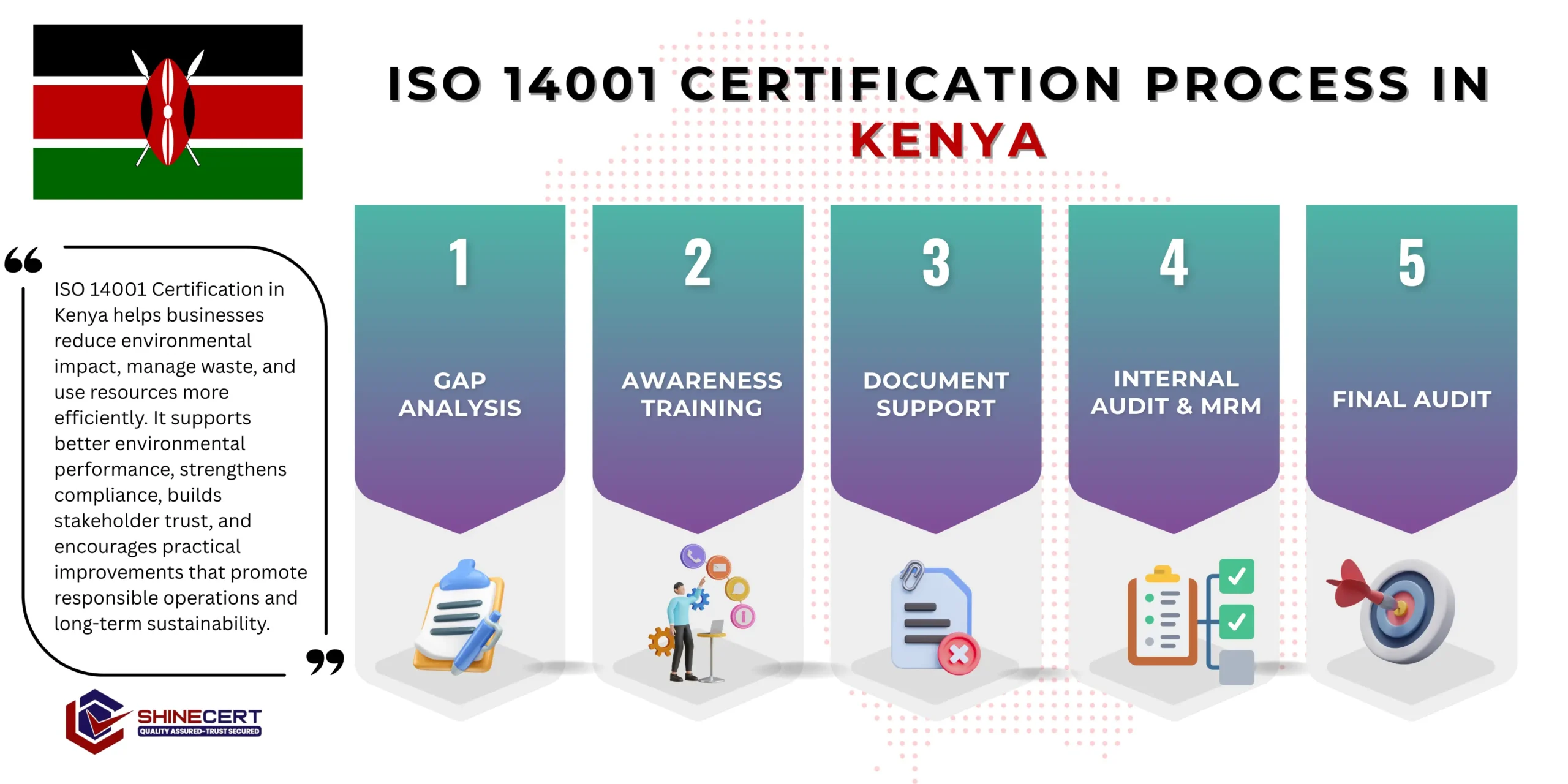
ISO 14001 Certification Process in Kenya
Gap Assessment
We walk your actual facility, production floor, warehouse, or office operations, and review your current NEMA compliance status, including EIA licensing and EPR obligations where relevant, mapping what we find against ISO 14001’s requirements together with your genuine legal obligations.
A gap report identifying your real environmental practices against ISO 14001 requirements and your NEMA compliance status side by side.
Documentation
We build your environmental policy, aspects and impacts register, and legal register around your actual operations, a plastics manufacturer facing direct EPR obligations has a meaningfully different environmental profile than a services business, and the documentation reflects that specifically.
A complete, version-controlled EMS documentation set, with your aspects register genuinely tied to your real environmental footprint.
Implementation
Operational controls for waste management, resource use, and emergency preparedness move into real daily practice, with staff trained on their specific environmental responsibilities.
A functioning EMS with real environmental controls in active use.
Internal Audit and Management Review
We audit against every ISO 14001 clause and your applicable NEMA requirements, surfacing gaps while stakes are low. Findings go to formal management review with documented decisions on environmental priorities and resourcing.
An internal audit report, management review minutes, and corrective actions closed out before the certification audit.
Certification Audit
Stage 1 confirms your EMS documentation is genuinely audit-ready; Stage 2 has the auditor visit your site, observe environmental controls in practice, and review your actual monitoring records. We stay engaged through both stages, whichever certification body conducts them.
Your ISO 14001 certificate, valid for three years, plus a surveillance audit schedule.
Staying Certified: Surveillance and Renewal
An ISO 14001 certificate is valid for three years. During years one and two, your certification body conducts an annual surveillance audit, narrower in scope, sampling part of your environmental controls and confirming previous findings were genuinely closed out. Before the three-year mark, a full recertification audit, comparable in depth to your original Stage 2 audit, confirms your EMS has continued functioning throughout the cycle. Passing recertification issues a new three-year certificate.
ISO 14001 Certification Cost in Kenya
| Business Profile | Relative Investment Level | Why |
|---|---|---|
| Small, low-environmental-impact operation | Lower | Narrower aspects register and simpler operational controls |
| Medium, moderate-impact manufacturing operation | Moderate | Broader aspects coverage and more extensive controls |
| Larger, multi-site or high-impact operation | Higher | Extensive aspects mapping and complex waste management obligations |
| Bundled with a second standard | Moderate-to-higher combined, lower than separate engagements | Shared implementation infrastructure reduces combined cost |
There’s no flat price for ISO 14001 certification in Kenya. Cost genuinely comes down to six factors:
- Nature and scale of your environmental impact : A plastics manufacturer or chemical processor faces a genuinely broader aspects register and more extensive operational controls than a low-impact services business.
- Number of facilities : Each additional site typically has its own distinct environmental aspects requiring separate assessment and documentation.
- Existing environmental compliance maturity : Businesses with established NEMA compliance practices, including existing EIA licenses and EPR registration, aren’t starting from zero, those with informal environmental practice face more foundational work.
- Certification body fees, tracked separately from our consulting fees : The certification audit itself is conducted and invoiced directly by an independently accredited certification body, separate from ShineCert’s implementation work.
- Whether you’re bundling standards : Building ISO 14001 alongside ISO 9001 shares meaningful implementation infrastructure, reducing combined cost.
- Internal capacity to contribute : An environmental or facilities officer who can genuinely own documentation, monitoring, and internal audit coordination reduces the consulting hours required.
Benefits of ISO 14001 Certification for Kenyan Organizations
Kenyan organizations that complete certification gain considerably more than a document proving environmental compliance. Here is what certified businesses genuinely gain:
A certified environmental management system gives you the structured tracking and documentation that makes EPR import certification, annual environmental audit reporting, and NEMA inspections considerably more manageable.
ISO 14001 is understood and trusted by international buyers, investors, and partners, giving Kenyan exporters a credential recognized well beyond domestic NEMA compliance alone.
Systematic environmental management catches compliance gaps before they become NEMA findings, penalties, or reputational incidents.
Certified organizations often uncover genuine savings in energy, water, and materials use as a byproduct of the systematic review ISO 14001 requires.
Government tenders and larger corporate procurement processes increasingly weigh environmental management credentials directly in evaluation criteria.
As Kenya’s EPR regulatory framework expands into e-waste and other categories, a certified system positions your organization to adapt considerably faster than one without any formal environmental management structure.
Demonstrable, independently verified environmental management is a genuine differentiator with increasingly environmentally conscious buyers and investors.
ISO 14001 requires genuinely identifying environmental risks specific to your actual operations, waste generation, water use, emissions, chemical handling, and building real, documented controls around each one.
ISO 14001 shares meaningful structural overlap with ISO 9001 and ISO 45001, making combined pursuit considerably more efficient for manufacturers building broader management system credentials.
A genuine environmental management program often improves staff morale and engagement, particularly among younger employees who increasingly value employer environmental responsibility.
A Kenyan Business We’ve Worked With
- A packaging manufacturer based in the Nairobi metropolitan area approached us after the March 2026 EPR import certificate requirement took effect, realizing their existing environmental practices, genuinely reasonable in substance, had never been formalized into a system capable of supporting the new documentation NEMA and the National Electronic Single Window System now required.
- Our gap assessment found the company was already segregating and managing waste reasonably well on the production floor, but had no formal aspects and impacts register, no documented legal compliance tracking connecting their operations to specific NEMA and EPR obligations, and no structured way to demonstrate ongoing compliance beyond the paperwork submitted at the point of import.
- We built the environmental management system directly around their existing waste handling practices, formalizing the aspects register and legal compliance tracking specifically around their EPR obligations. Certification took just under four months, and the resulting documentation considerably streamlined their ongoing EPR certificate renewals.
- This reflects a pattern we see often, genuinely reasonable environmental practice that had never been formalized into a documented, auditable system, rather than a single specific engagement.
Where Certification Matters Most Across Kenya’s Economy?
Plastics and packaging manufacturing
ISO 14001 is close to essential given direct EPR obligations under the Sustainable Waste Management (EPR) Regulations, 2024; pair with ISO 9001 for overall quality management.
Read moreElectronics importing and manufacturing
ISO 14001 addresses genuine e-waste obligations under NEMA’s expanding regulatory framework; pair with ISO 27001 if the business also handles customer data.
Read moreAgro-processing and food manufacturing
ISO 14001 addresses water use and effluent management relevant to this sector; pair with ISO 22000 for food safety.
Read moreTextile and leather manufacturing
ISO 14001 addresses genuine chemical and water discharge considerations; pair with ISO 9001 for export quality credibility.
Read moreConstruction and industrial park-based manufacturing
ISO 14001 supports EIA compliance for construction and industrial activity; pair with ISO 45001 for occupational safety.
Read moreHospitality and tourism
ISO 14001 addresses genuine resource use and waste management expectations from increasingly eco-conscious travelers; pair with ISO 9001 for service quality.
Read moreRealistic Timelines for Kenyan Businesses
| Business Profile | Typical Total Timeline | What Drives This |
|---|---|---|
| Small, low-environmental-impact operation | 2.5–3.5 months | Narrower aspects register and simpler operational controls |
| Medium, moderate-impact manufacturing operation | 3.5–5 months | Broader aspects coverage and more extensive operational controls |
| Larger, multi-site or high-impact operation | 5–7 months | Extensive aspects mapping across sites, complex EPR and waste management obligations |
| Bundled with a second standard | Add roughly 3-5 weeks to the relevant tier above | Shared implementation infrastructure meaningfully shortens the combined path |
Beyond company size, the single biggest timeline driver is how directly your operations are affected by EPR obligations, businesses importing or manufacturing goods subject to Extended Producer Responsibility face genuinely more extensive documentation than those with limited environmental touchpoints.
The Documentation NEMA and Auditors Expect
A documented statement defining which facilities, activities, and processes your environmental management system covers.
A documented policy, approved by top management, expressing genuine commitment to environmental protection and compliance with applicable requirements including NEMA regulations.
A documented, actively maintained analysis of your environmental aspects, waste generation, resource consumption, emissions, and their genuine impact, forming the foundation the rest of the system builds on.
A documented list of applicable environmental legal requirements, NEMA EIA/EA regulations, EPR obligations, sector-specific environmental rules, along with evidence of how each is being met.
Measurable environmental objectives set at relevant functions and levels, with documented, actionable plans for achieving them.
Documented procedures controlling significant environmental aspects, waste segregation and disposal, chemical storage, water discharge, genuinely tailored to your operations.
Documentation showing your organization has planned for genuine environmental emergencies, spills, contamination incidents, and has tested that plan through real drills.
Records showing your environmental performance is actually being measured against your objectives, not just assumed to be adequate.
A planned internal audit cycle and documented management review decisions on environmental priorities and resourcing.
The Real Challenges Organizations Face While Implementing ISO 14001
- Treating environmental compliance as a paperwork exercise rather than an operational one : Businesses sometimes build environmental documentation disconnected from how operations actually run, when the real value comes from genuinely embedding environmental controls into daily production and procurement decisions.
- Under-scoping the aspects register : A common gap is capturing obvious environmental aspects, visible waste, water use, while missing less visible ones, like indirect environmental impact from suppliers or transportation, that a genuine aspects assessment is meant to surface.
- Keeping pace with an expanding regulatory perimeter : NEMA’s regulatory scope is genuinely growing, from EPR on packaging to draft e-waste rules, a system built for today’s requirements needs a genuine process for absorbing new obligations, not a static one-time build.
- Sustaining monitoring discipline after initial certification : Environmental monitoring records tend to become inconsistent once the pressure of certification passes, particularly when responsibility isn’t clearly assigned to a specific role.
Why Businesses Choose ShineCert in Kenya?
ShineCert brings 10 years of ISO consulting and certification experience to Kenya’s market, coordinated through our Riyadh and India offices with services delivered remotely or on-site depending on what your engagement genuinely needs. We’ve guided more than 10,000 organizations through ISO certification worldwide, and we build every Kenya engagement around your actual operations and NEMA compliance status, not a generic template lifted from a different regulatory environment. This is why businesses navigating Kenya’s tightening EPR and environmental regulatory landscape increasingly choose ShineCert as the best ISO 14001 consultant in Kenya.
Choosing a Certification Body in Kenya?
|
What to Check |
Why It Matters |
|
Accreditation under a recognized international accreditation framework |
Confirms genuine, internationally recognized certification, whether through KEBS or another accredited body |
|
Genuine familiarity with NEMA’s regulatory framework |
Ensures the auditor understands how your EMS connects to your actual NEMA and EPR obligations |
|
Experience with your specific sector’s environmental profile |
Manufacturing, agro-processing, and services involve genuinely different environmental priorities |
|
Transparent audit scheduling and fee structure |
Avoids surprises in timeline or cost once the engagement begins |
Ready to Get Started?
Whether you’re responding to new EPR obligations or building environmental management proactively, we’ll walk through your specific operations and cost factors before proposing a fixed-scope plan, delivered remotely, on-site, or however genuinely fits your project. Book a free consultation or contact us directly to get started.
Frequently Asked Questions
Look for genuine familiarity with NEMA’s EPR regulations and your specific sector’s environmental profile, and transparent scoping rather than flat package pricing. ShineCert scopes every Kenya engagement individually.
No, EPR import certification remains a separate, mandatory regulatory requirement, but a certified EMS gives you the systematic tracking and documentation that makes ongoing EPR compliance considerably more manageable.
It genuinely depends on your environmental impact scale, number of facilities, and existing NEMA compliance maturity, we scope every project individually.
Typically two and a half to seven months depending on business size and environmental impact, see our detailed timeline breakdown above.
Yes, while the aspects register looks different from a manufacturer’s, ISO 14001 applies to any organization, and even office environments have real resource use and waste considerations.
A certified EMS gives you a structured process for absorbing new regulatory obligations as they’re finalized, considerably faster than building compliance from scratch each time a new regulation lands.
Much of the documentation work runs effectively over remote sessions, but facility-level environmental assessment genuinely requires on-site presence, we scope the right mix per project.
ShineCert doesn’t maintain a standalone Kenya office; we coordinate Kenya engagements from our Riyadh and India offices, with services delivered remotely or on-site as your project requires.