
ISO Certification in Saudi Arabia
ISO Certification Saudi Arabia assists organizations to get their certifications done quickly through expert consultation, process optimization, and compliance services.
Quick Answer
Most businesses in Saudi Arabia pursue ISO 9001 first, then add ISO 45001 if they’re in construction, industrial, or giga-project work, and ISO 27001 if they handle personal or financial data under the Personal Data Protection Law. A valid certificate needs to come from a body accredited by the Saudi Accreditation Center (SAAC) or another International Accreditation Forum (IAF) member SAAC itself only secured IAF Multilateral Recognition Arrangement status for management system certification in January 2024, so checking this box matters more in Saudi Arabia right now than in markets where accreditation has been settled for decades. Budget roughly 20,000 to 80,000 SAR for a small or mid-sized company pursuing a single standard, and expect four to seven months from kickoff to certificate. ShineCert runs this process from a genuine Riyadh office, not a fly-in consulting arrangement.
Why ISO Certification Matters in Saudi Arabia Right Now?
Ten years ago, a construction firm or trading company in Riyadh could win work almost entirely on relationships and price. That’s changed, and Vision 2030 is the reason. The giga-projects NEOM, the Red Sea Project, Qiddiya — are financed and partly owned by international investors who expect the same quality and safety documentation they’d demand from a contractor in London or Singapore, and that expectation has cascaded down through every tier of the supply chain feeding those projects. The same shift shows up in government procurement: the Etimad platform increasingly treats ISO 9001 as a pass/fail gate for tender eligibility rather than a nice-to-have on a scorecard, and Saudi conglomerates building out their own approved-vendor lists have adopted the same logic.
None of this makes certification a legal requirement it remains voluntary outside a handful of regulated sectors. But “voluntary” is doing less work than it used to. We regularly meet Saudi business owners who assumed certification was optional right up until a specific contract or tender made it a hard prerequisite with a deadline attached, at which point the conversation shifts from “should we” to “how fast can we.”
What are the steps to get ISO Certification in Saudi Arabia?
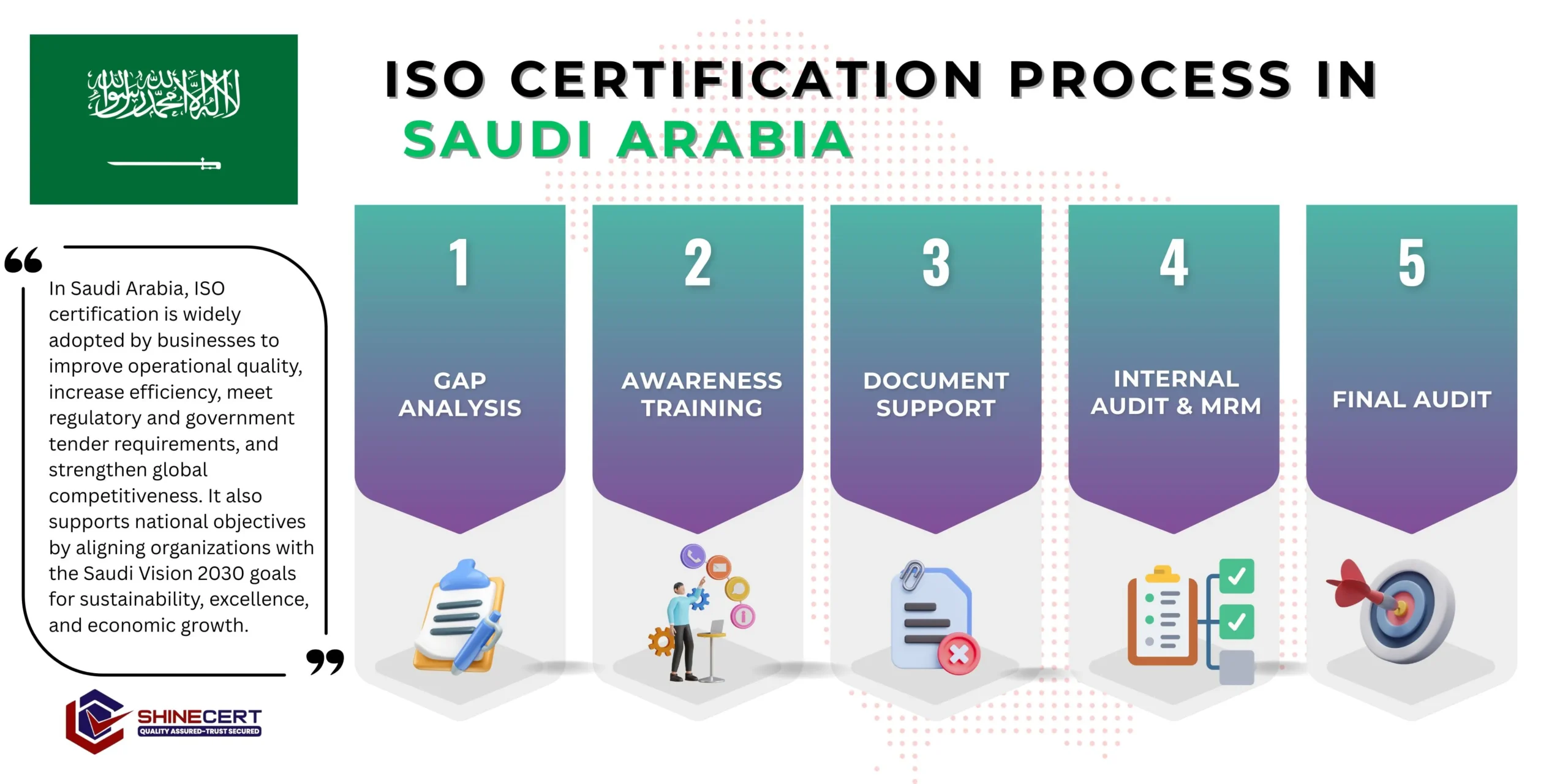
ShineCert’s Certification Process in Saudi Arabia
We start on-site, not with a checklist emailed over. Our consultants review your actual policies, processes, and records against your target standard, and separately map how your operations intersect with SASO, NCA, SFDA, or MHRSD requirements depending on sector, so we’re not duplicating compliance work you’ve already done. Output: a prioritized gap report and a realistic roadmap.
We build your actual management system documentation with your team, not a generic template with your logo swapped in. For Saudi clients this typically means bilingual Arabic-English documentation, since it needs to work for your day-to-day Saudi workforce and for international auditors or partners reviewing it. Output: a complete, organization-specific documentation set your leadership has actually reviewed and approved.
Documentation becomes daily practice here, and it’s usually the phase that takes the most sustained effort. We train staff at every level using scenario-based methods rather than a policy read-through, and for organizations spread across multiple Saudi cities or project sites, we make sure training reaches every location rather than assuming it’ll propagate from head office on its own. Output: complete training records and evidence the new controls are genuinely running, not just documented.
Before any external body sees your system, we run a genuinely rigorous internal audit designed to find real problems, including independent staff interviews and, where relevant, practical tests like a mock safety drill. Findings go to a formal management review where leadership commits to corrective action. Output: an internal audit report and management review minutes that demonstrate real leadership engagement, which certification bodies specifically check for.
We coordinate your Stage 1 and Stage 2 audits with a SAAC-accredited or other IAF-recognized certification body matched to your target buyers, sit with your team through auditor questions, and help close any nonconformities efficiently. Output: your certificate, plus a surveillance audit schedule so the system doesn’t quietly decay in year two.
our services
- ISO 9001 Certification Saudi Arabia
- ISO 14001 Certification Saudi Arabia
- ISO 27001 Certification Saudi Arabia
- ISO 22000 Certification Saudi Arabia
- ISO 45001 Certification Saudi Arabia
- ISO 13485 Certification Saudi Arabia
- ISO 17025 Certification Saudi Arabia
- CE Mark Certification Saudi Arabia
- GMP Certification Saudi Arabia
- Halal Certification Saudi Arabia
- SOC Certification Saudi Arabia
major citys
- ISO Certification Riyadh
- ISO Certification Jeddah
- ISO Certification Dammam
- ISO Certification Al Madinah
- ISO Certification Mecca
- ISO Certification Yanbu
- ISO Certification Buraydah
- ISO Certification KAFD
Saudi Arabia’s Regulatory and Accreditation Landscape
- Get the accreditation question right first, because a technically valid certificate from an unrecognized body is close to worthless for the buyers who actually matter here. The Saudi Standards, Metrology and Quality Organization (SASO) sets national product and quality standards, and the Saudi Accreditation Center (SAAC) formed in 2019 when the government restructured the former National Accreditation Committee into an independent body accredits the certification bodies, testing labs, and inspection bodies operating in the Kingdom. SAAC is a full member of both the International Accreditation Forum and the International Laboratory Accreditation Cooperation, and as of January 2024 holds IAF Multilateral Recognition Arrangement status specifically for management system certification under ISO/IEC 17021-1, including ISO 9001 meaning a SAAC-accredited certificate is now mutually recognized across other IAF signatory countries, not just domestically.
- Beyond SASO and SAAC, several sector regulators shape how certification actually gets used. The National Cybersecurity Authority (NCA) publishes Essential Cybersecurity Controls that map closely to ISO 27001’s control set, and the Saudi Data and AI Authority (SDAIA) enforces the Personal Data Protection Law (PDPL), which increasingly determines how an ISO 27001 scope should be drawn for any organization handling Saudi residents’ personal data. The Saudi Food and Drug Authority (SFDA) references ISO 22000 and ISO 13485 directly in its own food and medical device registration processes. The Ministry of Human Resources and Social Development, through the Qiwa and Mudad platforms and the Nitaqat Saudization program, shapes the labor compliance context ISO 45001 has to sit alongside rather than ignore. And government procurement runs through Etimad, where vendor prequalification increasingly checks certification status directly rather than treating it as supplementary evidence.
Most Relevant ISO Standards for Saudi Arabia
ISO 9001 Quality Management
This is where nearly every Saudi organization starts, since it’s the standard Etimad tenders and Vision 2030 vendor registrations check first. Uncertified bidders often get filtered out before evaluation. It’s also the foundation other standards build on, given its clauses on corrective action.
ISO 14001 Environmental Management
The Saudi Green Initiative and NEOM’s marketing have pushed environmental expectations through giga-project supply chains in a way that didn’t happen a decade ago. Contractors near the Red Sea’s sensitive zones, and operators in Jubail and Yanbu, feel this most directly.
ISO 45001 Occupational Health and Safety
With NEOM, the Red Sea Project, and Qiddiya all under active construction, safety has become one of the most scrutinized areas of Saudi project management. Certification is close to a baseline requirement for giga-project-adjacent contractors, tying into MHRSD compliance and Nitaqat status.
ISO 27001 Information Security Management
Between NCA’s Essential Cybersecurity Controls and SDAIA’s PDPL enforcement, Saudi regulators increasingly want data security demonstrated through a real management system, not just asserted in policy. Riyadh’s fintech sector makes this a standard vendor requirement.
ISO 42001 AI Management
SDAIA’s national AI strategy is pushing both government entities and private companies toward wider AI adoption, and ISO 42001 addresses how organizations govern AI risk and human oversight. It matters most for vendors bidding on smart-city and digital transformation work tied to giga-projects, where AI governance now factors into evaluation.
ISO 22000 Food Safety Management
SFDA’s food registration process increasingly references internationally recognized food safety frameworks, and the tourism boom around AlUla and the Red Sea has grown the hospitality supply chain. Halal certification runs alongside ISO 22000 separately food safety versus religious dietary compliance.
ISO 13485 Medical Devices Quality Management
Vision 2030’s healthcare transformation program has driven real investment in hospital infrastructure and device access, and SFDA’s device registration requirements frequently reference this standard’s expectations around design, manufacturing, and post-market surveillance directly.
ISO 31000, Risk Management
Not a certifiable standard, but larger Saudi conglomerates, financial institutions, and giga-project developers managing genuinely complex multi-year capital programs increasingly build their enterprise risk frameworks around its principles, particularly for board-level governance and strategic risk reporting.
ISO Certification Cost in Saudi Arabia
Most published cost ranges you’ll find for Saudi Arabia sit between roughly 20,000 and 80,000 SAR for a single standard at a small or mid-sized company, and that range is wide because the variables genuinely move the number a lot, not because pricing is arbitrary.
- Consultancy fees versus audit fees. Total cost breaks into two separate line items: what a consultancy like ShineCert charges to prepare your management system, and what the certification body charges to audit it. These are paid to different parties for different work, and a quote that only shows one of them isn’t a complete picture.
- Company size and site count. Certification bodies calculate audit duration partly from employee headcount per site, so a 20-person Riyadh office and a 400-person operation spread across three cities are not comparable audits, even for the same standard.
- Hazard and complexity profile. A petrochemical supplier or a contractor running multiple active giga-project sites faces materially more risk documentation than a low-risk professional services firm, and that difference shows up directly in consulting hours and audit time.
- Existing documentation maturity. A company that’s been informally following good practice for years moves faster and cheaper through gap closure than one starting from a blank page, regardless of size.
- Standards bundled together. Pursuing ISO 9001 and 45001 as one integrated project is consistently cheaper than running them as two separate engagements, since the shared Harmonised Structure across ISO management standards means a meaningful share of the documentation and audit work overlaps.
Benefits of ISO Certification in Saudi Arabia
An Etimad-based government buyer or Vision 2030 vendor evaluating an unfamiliar supplier has limited ways to judge genuine operational maturity certification gives them a recognized, independent signal.
ISO standards force structured attention to customer requirements rather than hoping quality holds steady by default, and customers notice the difference when it doesn’t depend on which staff member handles their account.
Implementation surfaces redundant steps and inconsistent handoffs that had simply become normal, and Saudi businesses scaling fast under Vision 2030-driven demand often need this discipline exactly when informal processes stop holding up.
Government agencies, large conglomerates, and international giga-project operators increasingly restrict approved-vendor status to certified organizations, so certification is frequently what gets a smaller Saudi business considered at all.
In construction, food and beverage, and technology services, certification is a visible, demonstrable commitment that tips close evaluations against otherwise similar competitors.
SASO, NCA, SFDA, and MHRSD requirements all get folded into one system instead of being tracked ad hoc, reducing the odds an overlooked requirement becomes a costly surprise later.
For contractors managing tight margins on competitive tenders, this discipline can be the difference between a project that’s profitable and one that erodes value despite winning the bid.
For Saudi organizations with export ambitions, ISO certification reads identically to a buyer in Europe or elsewhere in the Gulf, without having to explain and justify a purely local quality claim from scratch.
Industries ShineCert Supports Across Saudi Arabia

Construction

Manufacturing

Healthcare

IT & Software

Food Industry

Logistics
Construction
Manufacturing
Healthcare
IT & Software
Food Industry
Logistics
Where ShineCert Operates in Saudi Arabia
Our office is in Riyadh, so this regulatory context isn’t secondhand for us it’s where we work daily. We also support certification across Jeddah’s trading economy, the Eastern Province’s Dammam-Khobar industrial corridor near Jubail and Yanbu, and giga-project zones like NEOM and the Red Sea, where demand is growing as these projects move into construction.
A Pattern We See Often
A recurring pattern: a Riyadh subcontractor with ~80 employees, profitable for a decade without ISO, wins a giga-project subcontract requiring ISO 9001 and 45001 within six months. Most of it already happens informally the real work is documenting and standardizing across sites. Four to five months to certificate is realistic with real leadership buy-in.
Vision 2030 and Where This Is Heading
Vision 2030 has changed what “credible” means for Saudi businesses. Giga-projects now import certification expectations once uncommon here. A contractor that won on price a decade ago is now measured against international benchmarks. We help businesses adapt to that shift.
Why Work With ShineCert in Saudi Arabia
We handle ISO consulting, implementation, and certification support across construction, industrial, healthcare, food and beverage, and technology sectors in Saudi Arabia. Our consultants work from Riyadh, alongside colleagues in Lebanon and India, and have guided over 10,000 organizations through certification.
Choosing an Accredited Certification Body in Saudi Arabia
What to Check | Why It Matters |
SAAC accreditation, or another IAF member body | Confirms genuine recognition with Saudi government tenders and private buyers |
Familiarity with NCA, SDAIA, and SFDA overlap | Auditors who understand local regulatory context assess your system faster and more accurately |
Track record with Vision 2030 vendors or giga-project contractors | Signals real experience with the specific prequalification standards these buyers impose |
Common Certification Challenges in Saudi Arabia
- Not checking accreditation recognition before committing. A certificate from a body without genuine IAF-recognized accreditation can look valid on paper while carrying little real weight with government tenders or larger buyers.
- Growth outpacing documentation. Fast-scaling businesses riding Vision 2030 demand often find their real operations have outgrown documentation written when the company was a third the size.
- Treating PDPL as someone else’s problem. Organizations sometimes assume data protection law applies to bigger companies or foreign entities, then discover their own data handling is squarely in scope when ISO 27001 scoping begins.
- Underestimating giga-project safety expectations. Contractors used to older domestic safety norms are frequently surprised by how much more rigorous NEOM, Red Sea Project, or Qiddiya prequalification actually is.
Start Your ISO Certification Journey in Saudi Arabia
Best ISO Consultants in Saudi Arabia, ShineCert handles ISO certification end to end, from gap analysis through certification audit, for organizations across Riyadh, Jeddah, the Eastern Province, and the Kingdom’s giga-project zones. Book a free consultation or contact us directly, and our Riyadh-based team will review your sector, target contracts, and current management system maturity before proposing a fixed-scope engagement plan.
Frequently Asked Questions
Expect roughly 20,000 to 80,000 SAR for a single standard at a small or mid-sized company, covering both consultancy and certification body audit fees; a fixed quote follows gap analysis once your actual scope is clear.
No, it’s voluntary outside specific regulated sectors, though Etimad government tenders and giga-project supply chains increasingly treat it as a hard prerequisite rather than a scoring preference.
Look for SAAC accreditation or another IAF member body SAAC only gained IAF Multilateral Recognition Arrangement status for management system certification in January 2024, so this is worth double-checking with any certification body you’re considering.
ISO 27001 gives you a structured security framework that supports demonstrating PDPL compliance, but the certification and direct legal compliance with PDPL are related, not identical, obligations.
Generally yes, contractors on NEOM, the Red Sea Project, or Qiddiya face materially more rigorous safety and quality prequalification than the broader domestic market, usually requiring ISO 45001 alongside ISO 9001.
We maintain a genuine operating office in Riyadh, so support is on-the-ground, not purely remote.
Typically four to seven months, depending on company size, sector complexity, and how mature your existing processes already are.