
ISO 22000 Certification in Saudi Arabia
Quick Answer
ISO 22000 is the international standard for food safety management systems, and in Saudi Arabia it’s increasingly relevant given the Saudi Food and Drug Authority’s (SFDA) tightening food safety oversight and the Kingdom’s growing food security and export ambitions under Vision 2030. Certification should come from a body accredited by the Saudi Accreditation Center (SAAC) or another IAF-recognized national accreditation body. ISO 22000 builds on HACCP principles already familiar to most Saudi food businesses but embeds them within a full management system framework. Budget roughly SAR 16,000 to SAR 80,000 depending on company size and production complexity, and expect three to six months from kickoff to certificate.
Why ISO 22000 Matters for Businesses in Saudi Arabia?
The Saudi Food and Drug Authority (SFDA) has substantially strengthened food safety regulatory oversight in recent years, reflecting both growing consumer expectations and Saudi Arabia’s ambitions around food security given the Kingdom’s historical reliance on food imports. The Saudi Agricultural and Livestock Investment Company (SALIC) and broader government investment in domestic food production and processing capacity mean Saudi food manufacturers face increasing scrutiny not just from SFDA but from investors and government partners evaluating food safety management maturity as part of the Kingdom’s food security strategy. ISO 22000 certification gives Saudi food businesses a structured, internationally recognized way to demonstrate food safety management maturity to SFDA, investors, and increasingly, international trading partners as Saudi Arabia pursues food export diversification.
For Saudi food exporters specifically, ISO 22000 certification is frequently a practical prerequisite for entering international markets, since many international food retailers and distributors require it as a baseline supplier qualification standard, distinct from and often in addition to local SFDA compliance.
ISO 22000 and Saudi Arabia’s Food Security Strategy
- Saudi Arabia’s food security strategy, driven by historical dependence on food imports and accelerated by global supply chain disruptions in recent years, has made domestic food production and processing capacity a genuine national priority, with SALIC and related government investment vehicles actively building out agricultural and food manufacturing capability.
- In this context, we’ve found that ISO 22000 certification increasingly functions as more than a compliance or export requirement for Saudi food businesses, it’s becoming a genuine signal of alignment with national food security priorities that government-linked investors and partners actively look for during due diligence. Food manufacturers positioning themselves for government-linked investment or strategic partnership opportunities benefit from treating ISO 22000 implementation as part of a broader food safety and quality narrative aligned with Saudi Arabia’s food security direction, not simply a certification pursued reactively in response to a specific customer request.
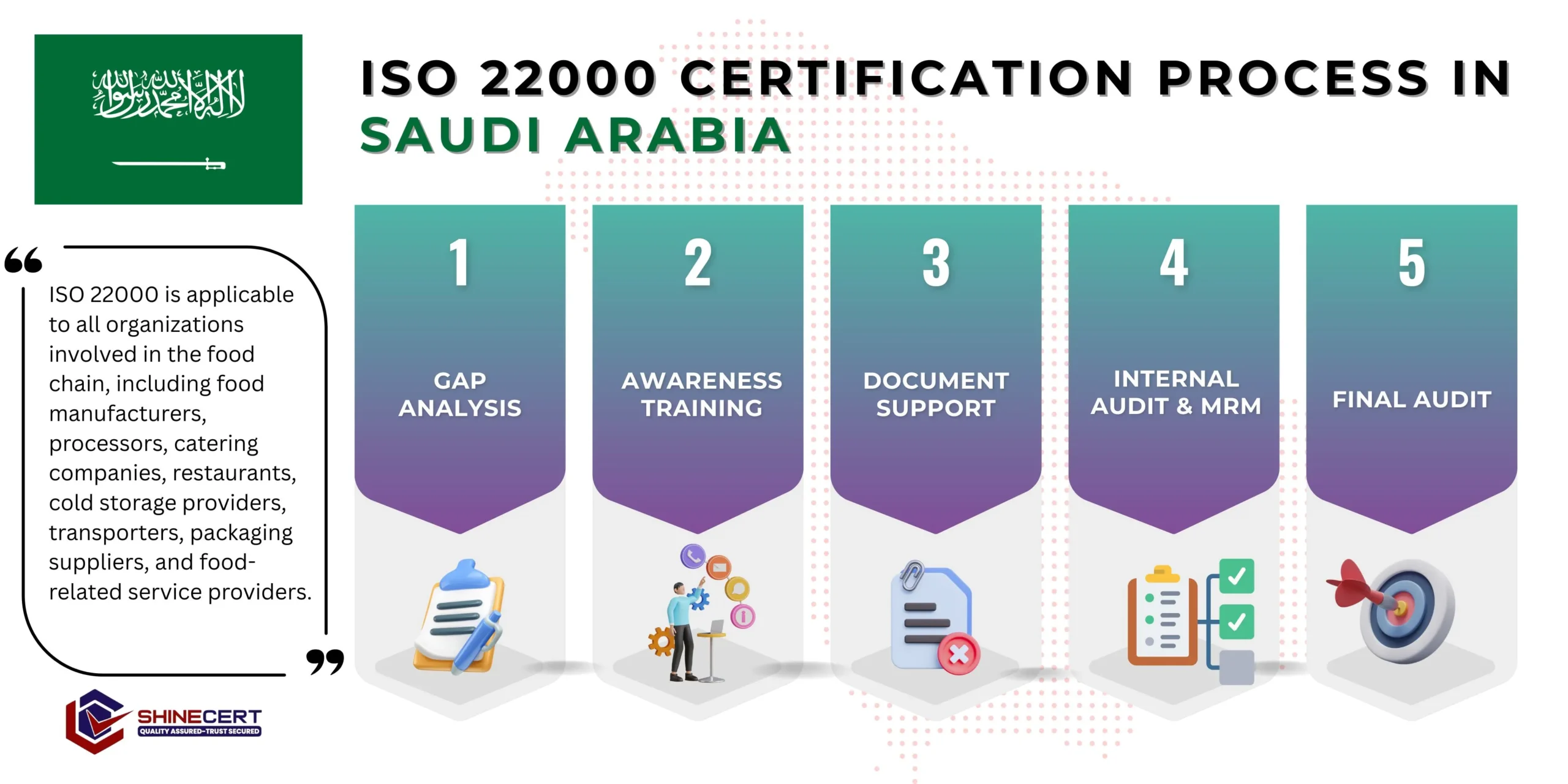
What are the steps to get ISO 22000 Certification in Saudi Arabia?
our services
- ISO Certification Saudi Arabia
- ISO 9001 Certification Saudi Arabia
- ISO 14001 Certification Saudi Arabia
- ISO 27001 Certification Saudi Arabia
- ISO 22000 Certification Saudi Arabia
- ISO 27701 Certification Saudi Arabia
- ISO 45001 Certification Saudi Arabia
- ISO 20000-1 Certification Saudi Arabia
- ISO 13485 Certification Saudi Arabia
- ISO 17025 Certification Saudi Arabia
- ISO 31000 Certification Saudi Arabia
- ISO 42001 Certification Saudi Arabia
- ISO 37001 Certification Saudi Arabia
- ISO 22301 Certification Saudi Arabia
- ISO 50001 Certification Saudi Arabia
- CE Mark Certification Saudi Arabia
- GDPR Certification Saudi Arabia
- GMP Certification Saudi Arabia
- Halal Certification Saudi Arabia
- SOC Certification Saudi Arabia
major citys
ShineCert’s ISO 22000 Certification Process in Saudi Arabia
Gap Analysis and Hazard Analysis
We assess your current food safety practices against ISO 22000's requirements and conduct a structured hazard analysis covering your specific products and processes, identifying critical control points genuinely relevant to your operations.
A documented gap analysis and hazard analysis scoped to your specific product lines and facilities.
Documentation Development
We build your food safety policy, prerequisite programs, and HACCP plan collaboratively with your team, ensuring SFDA requirements and any export market obligations are explicitly addressed.
A complete food safety management system documentation set, including your HACCP plan and traceability procedures.
Implementation and Training
We roll out prerequisite programs and critical control point monitoring, training food handlers and production staff on hygiene and food safety practices specific to your facility.
Documented training records and evidence of functioning critical control point monitoring.
Internal Audit and Management Review
We conduct a rigorous internal audit covering food safety performance and compliance evaluation, then facilitate a management review addressing verification results and food safety objective progress.
A documented internal audit report and management review minutes demonstrating leadership engagement with food safety performance.
Certification Audit
We coordinate Stage 1 and Stage 2 audits with a SAAC-accredited or IAF-recognized certification body, supporting you through any resulting corrective actions, then help establish your surveillance audit schedule.
Your ISO 22000 certificate and a documented surveillance audit plan.
Gap Analysis and Hazard Analysis
We assess your current food safety practices against ISO 22000's requirements and conduct a structured hazard analysis covering your specific products and processes, identifying critical control points genuinely relevant to your operations.
A documented gap analysis and hazard analysis scoped to your specific product lines and facilities.
Documentation Development
We build your food safety policy, prerequisite programs, and HACCP plan collaboratively with your team, ensuring SFDA requirements and any export market obligations are explicitly addressed.
A complete food safety management system documentation set, including your HACCP plan and traceability procedures.
Implementation and Training
We roll out prerequisite programs and critical control point monitoring, training food handlers and production staff on hygiene and food safety practices specific to your facility.
Documented training records and evidence of functioning critical control point monitoring.
Internal Audit and Management Review
We conduct a rigorous internal audit covering food safety performance and compliance evaluation, then facilitate a management review addressing verification results and food safety objective progress.
A documented internal audit report and management review minutes demonstrating leadership engagement with food safety performance.
Certification Audit
We coordinate Stage 1 and Stage 2 audits with a SAAC-accredited or IAF-recognized certification body, supporting you through any resulting corrective actions, then help establish your surveillance audit schedule.
Your ISO 22000 certificate and a documented surveillance audit plan.
What Is ISO 22000?
ISO 22000 is the international standard for food safety management systems, published by the International Organization for Standardization to help organizations across the food supply chain systematically control food safety hazards. It integrates Hazard Analysis and Critical Control Points (HACCP) principles, already widely recognized in food safety circles, within a broader management system framework that also addresses prerequisite programs, interactive communication across the supply chain, and continual system improvement. The standard applies to any organization in the food chain, from primary producers and processors to packaging manufacturers and food service operations, making it considerably more universally applicable than sector-specific food safety schemes. Certification means an accredited auditor has verified your food safety management system genuinely controls hazards throughout your operations, not just that HACCP documentation exists.
ISO 22000 Certification Cost in Saudi Arabia
Quick answer: ISO 22000 certification in Saudi Arabia typically costs between SAR 16,000 and SAR 80,000, depending on company size, product complexity, and number of production facilities, with complex multi-product manufacturers generally costing more than simpler single-product operations.
- Product and process complexity drives cost significantly : Manufacturers with multiple product lines and complex hazard profiles need more extensive hazard analysis work.
- Existing HACCP implementation reduces consultant hours : Organizations already operating HACCP programs need less foundational work than those starting from scratch.
- Certification body fees are separate from consulting fees : The accredited certification body’s audit fee is distinct from ShineCert’s implementation support.
- Multi-facility operations increase cost : Certification bodies sample multiple production sites, each typically needing its own hazard analysis.
- Export market requirements can add scope : Certification aligned with specific destination market or retailer requirements sometimes needs additional documentation work.
Mandatory Documents for ISO 22000
Quick answer: ISO 22000 requires documented information including a food safety policy, hazard analysis and HACCP plan, prerequisite program documentation, traceability procedures, and records covering critical control point monitoring, internal audits, and management review.
- Food Safety Policy : A documented, top-management-issued policy establishing genuine food safety commitments.
- Hazard Analysis and HACCP Plan : A documented assessment of food safety hazards and the critical control points established to manage them.
- Prerequisite Program Documentation : Records covering facility hygiene, pest control, supplier approval, and cleaning and sanitation programs.
- Traceability Procedures : Documented, genuinely testable systems for tracing products from raw material through to finished goods.
- Critical Control Point Monitoring Records : Evidence of ongoing monitoring at each identified critical control point.
- Verification and Validation Records : Documentation confirming the food safety management system genuinely functions as designed.
- Internal Audit and Management Review Records : Documented audit findings and management review minutes addressing food safety performance.
Key Requirements of ISO 22000
ISO 22000 follows the Harmonised Structure shared with other modern ISO management system standards, with substantive requirements centered on food safety:
- Context of the Organization (Clause 4). Requires identifying food safety issues relevant to your operations and interested parties whose requirements matter, including SFDA, customers with specific food safety requirements, and for exporters, the destination market’s food safety authorities and any retailer-specific requirements. Saudi food processors operating multiple production lines need a scope statement clearly defining which products and processes the food safety management system covers.
- Leadership (Clause 5). Top management must establish a food safety policy and ensure a designated food safety team leader has genuine authority to make food safety decisions, including production stoppage authority when safety is at risk. We’ve found that Saudi food manufacturers sometimes underestimate this requirement, assuming a technical quality assurance manager can hold this role without genuine organizational authority, which auditors specifically probe during Stage 2 audits.
- Planning (Clause 6). Requires identifying food safety risks and opportunities and setting measurable food safety objectives. For Saudi food exporters, this planning should explicitly address destination market requirements alongside SFDA obligations, since a product safe for domestic Saudi distribution may face additional requirements for GCC or international export markets.
- Support (Clause 7). Covers resources, competence, and infrastructure specific to food safety, including documented evidence that food handlers have appropriate hygiene training and that production infrastructure genuinely supports food safety control, particularly relevant given Saudi Arabia’s climate, where cold chain integrity requires robust, verified infrastructure rather than assumed compliance.
- Operation (Clause 8). This is where ISO 22000’s most distinctive food safety content lives: hazard analysis, establishing prerequisite programs (covering facility hygiene, pest control, and supplier control), determining critical control points, and establishing traceability systems. Saudi food manufacturers need documented, genuinely tested traceability systems that can trace a product from raw material to finished goods, a capability SFDA increasingly expects to see demonstrated, not just described, during inspections and audits.
- Performance Evaluation (Clause 9). Requires monitoring critical control points, verification activities confirming the food safety management system functions as intended, and systematic evaluation of compliance with SFDA and any export market food safety requirements.
- Improvement (Clause 10). Requires structured response to food safety incidents, including product recall procedures where necessary, and continual improvement of food safety controls based on verification results, customer complaints, and any regulatory findings.
Benefits of ISO 22000 in Saudi Arabia
Certification is frequently a practical prerequisite for Saudi food exporters seeking international retail and distribution partnerships.
A well-built food safety management system provides structured evidence of genuine food safety maturity during regulatory interactions.
Certification supports Saudi Arabia’s broader food security ambitions by demonstrating robust domestic food safety management capacity.
Systematic hazard analysis and traceability genuinely reduce the likelihood and severity of food safety incidents.
SALIC and other food sector investors increasingly evaluate food safety management maturity as part of investment due diligence.
ISO 22000’s shared structure with ISO 9001 makes combined certification more efficient for food businesses pursuing both.
ISO 22000 Certification Timeline in Saudi Arabia
Phase | Typical Duration |
Gap analysis and hazard analysis | 3–4 weeks |
Documentation development | 4–6 weeks |
Implementation and training | 3–5 weeks |
Internal audit and management review | 1–2 weeks |
Certification audit (Stage 1 + Stage 2) | 3–4 weeks |
Total | 3–6 months |
Industries in Saudi Arabia That Need ISO 22000
Food manufacturing and processing
Direct applicability given the standard's design for production and processing operations across Saudi Arabia's growing domestic food industry.
Read moreFood export
Companies pursuing GCC and international export markets need certification as a practical prerequisite for many retail and distribution partnerships.
Read moreAgriculture and primary production
Saudi Arabia's push to expand domestic agricultural capacity under food security initiatives increasingly involves ISO 22000-aligned practices.
Read moreFood packaging manufacturing
Packaging materials in direct food contact fall within ISO 22000's supply chain scope.
Read moreFood service and catering
Large-scale catering operations, including those supporting Vision 2030 giga-project workforces, increasingly adopt ISO 22000 for food safety assurance.
Read moreWhy Choose ShineCert for ISO 22000 Certification in Saudi Arabia?
We’re headquartered in Riyadh, giving us direct familiarity with SFDA’s food safety expectations and Saudi Arabia’s food security strategy direction. Our team has guided more than 10,000 organizations through ISO certification globally, with specific depth in Saudi Arabia’s growing food manufacturing and export sectors.
Choosing an Accredited Certification Body for ISO 22000 in Saudi Arabia?
What to Check | Why It Matters |
SAAC accreditation, or accreditation from another IAF-recognized body | Confirms genuine international recognition |
Food sector audit experience relevant to your product category | Matters given how differently hazard profiles vary across meat, dairy, packaged goods, and other food categories |
Familiarity with SFDA expectations | Helps ensure your system genuinely supports regulatory interactions |
Export market certification recognition | Relevant for exporters needing certification recognized by specific destination markets |
Common Challenges with ISO 22000 in Saudi Arabia
- Underestimating traceability system testing : A traceability system that exists on paper but hasn’t been genuinely tested through mock recall exercises often reveals gaps during actual audits.
- Treating the food safety team leader role as purely technical : This role requires genuine organizational authority, including production stoppage authority, not just food safety technical knowledge.
- Insufficient prerequisite program documentation : Facility hygiene and supplier approval programs need documented evidence of consistent implementation, not just written procedures.
- Overlooking export market-specific requirements : Certification alone doesn’t guarantee acceptance by every international retailer or destination market without confirming their specific requirements.
Get ISO 22000 Certified in Saudi Arabia
ShineCert supports Saudi food businesses end to end, from hazard analysis through certification audit, with direct experience across the Kingdom’s food manufacturing and export sectors. Book a free consultation or contact us directly, and we’ll review your products and processes before proposing a fixed-scope plan.
Frequently Asked Questions
Typically SAR 16,000 to SAR 80,000, depending on company size and product complexity.
No, it’s voluntary, though export market access and SFDA compliance positioning increasingly make it a practical necessity.
Typically three to six months from kickoff to certificate.
No, it complements them with a systematic management approach, but legal compliance obligations must still be met independently.
No, ISO 22000 incorporates HACCP principles within a broader management system framework covering prerequisite programs, leadership, and continual improvement.
Yes, both share compatible structures, making combined certification efficient for food businesses pursuing both.
Yes, Riyadh is one of ShineCert’s genuine physical offices, alongside Lebanon and India.