
ISO 13485 Certification in Saudi Arabia
Quick Answer
ISO 13485 is the international standard for medical device quality management systems, and in Saudi Arabia it’s effectively a practical necessity given the Saudi Food and Drug Authority’s (SFDA) Medical Devices Sector registration requirements, which reference ISO 13485 directly for manufacturer quality system evidence. Certification should come from a body accredited by the Saudi Accreditation Center (SAAC) or another IAF-recognized national accreditation body. Saudi Arabia’s Health Sector Transformation Program under Vision 2030 has meaningfully expanded the domestic medical device market, increasing both opportunity and regulatory scrutiny for manufacturers and distributors. Budget roughly SAR 22,000 to SAR 100,000 depending on device classification and company size, and expect four to seven months from kickoff to certificate.
Why ISO 13485 Matters for Businesses in Saudi Arabia?
The Saudi Food and Drug Authority’s Medical Devices Sector (SFDA MDS) governs medical device registration and market access in Saudi Arabia, and its registration framework directly references ISO 13485 as evidence of manufacturer quality system maturity, making certification a practical prerequisite for most medical device manufacturers and many distributors seeking to register products for the Saudi market. Saudi Arabia’s Health Sector Transformation Program, a core pillar of Vision 2030, has driven substantial investment in healthcare infrastructure and domestic medical device manufacturing capacity, creating genuine opportunity for companies entering or expanding within the Saudi medical device market, alongside correspondingly increased regulatory expectations.
For international medical device companies entering the Saudi market, and for the growing number of domestic Saudi medical device manufacturers emerging alongside the Kingdom’s healthcare sector development, ISO 13485 certification provides both the direct SFDA registration support and the internationally recognized credential increasingly expected by healthcare providers, distributors, and international partners operating in Saudi Arabia’s expanding healthcare ecosystem.
ISO 13485 and Saudi Arabia’s Healthcare Transformation
- Saudi Arabia’s Health Sector Transformation Program has driven one of the region’s most significant healthcare infrastructure investment waves, creating substantial opportunity for medical device manufacturers and distributors while simultaneously raising the regulatory bar through SFDA’s increasingly rigorous MDS registration process.
- We’ve found that medical device companies treating ISO 13485 certification and SFDA MDS registration as a single, coordinated project rather than sequential, disconnected efforts achieve considerably faster and smoother market entry than those pursuing certification first and only later engaging with registration-specific requirements. This integrated approach matters particularly for international medical device companies entering the Saudi market for the first time, where local regulatory nuance around SFDA MDS expectations can differ meaningfully from other markets’ medical device registration frameworks, even when the underlying ISO 13485 quality system requirements remain internationally consistent.
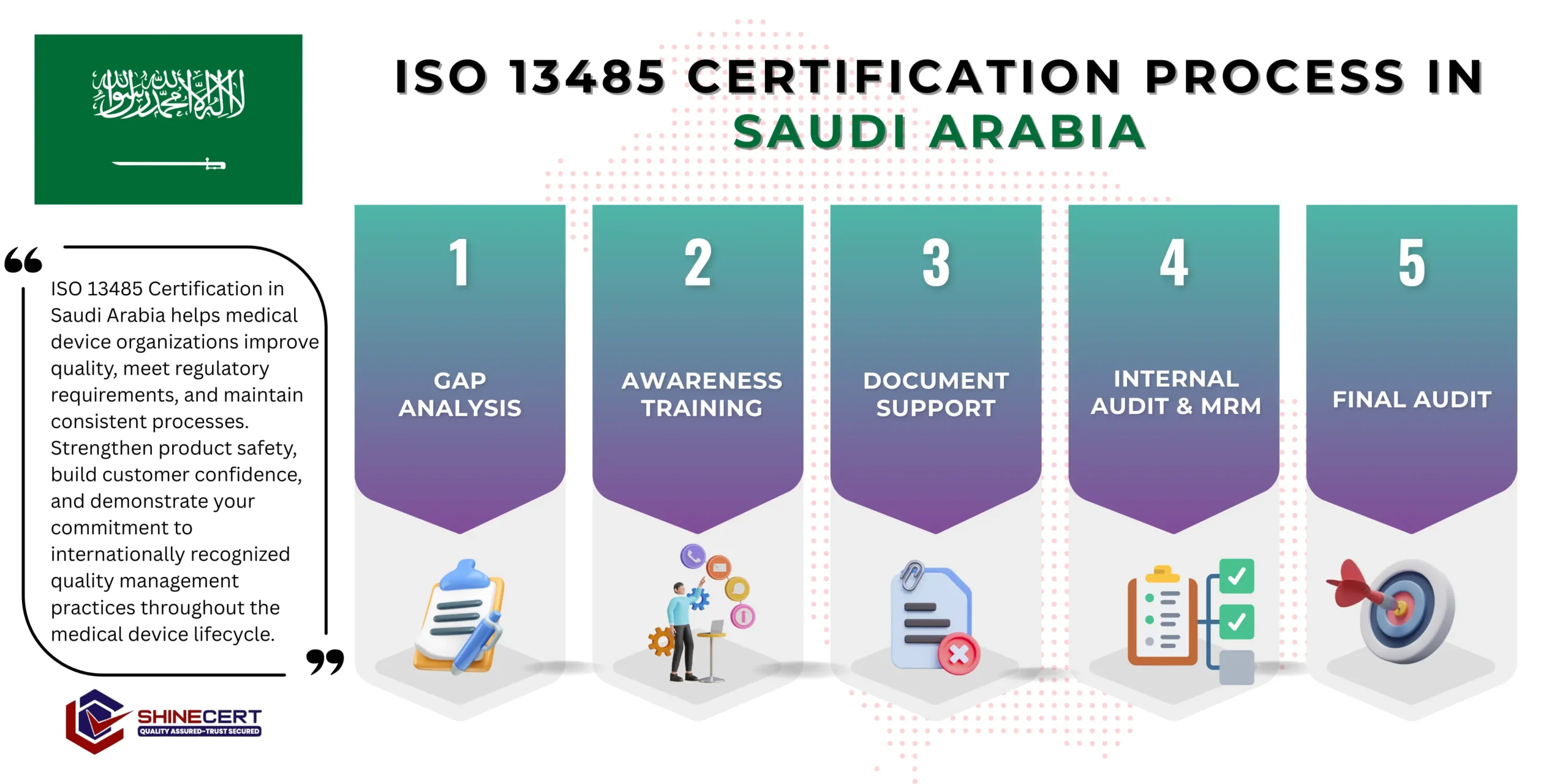
What are the steps to get ISO 13485 Certification in Saudi Arabia?
our services
- ISO Certification Saudi Arabia
- ISO 9001 Certification Saudi Arabia
- ISO 14001 Certification Saudi Arabia
- ISO 27001 Certification Saudi Arabia
- ISO 22000 Certification Saudi Arabia
- ISO 27701 Certification Saudi Arabia
- ISO 45001 Certification Saudi Arabia
- ISO 20000-1 Certification Saudi Arabia
- ISO 13485 Certification Saudi Arabia
- ISO 17025 Certification Saudi Arabia
- ISO 31000 Certification Saudi Arabia
- ISO 42001 Certification Saudi Arabia
- ISO 37001 Certification Saudi Arabia
- ISO 22301 Certification Saudi Arabia
- ISO 50001 Certification Saudi Arabia
- CE Mark Certification Saudi Arabia
- GDPR Certification Saudi Arabia
- GMP Certification Saudi Arabia
- Halal Certification Saudi Arabia
- SOC Certification Saudi Arabia
major citys
ShineCert’s ISO 13485 Certification Process in Saudi Arabia
Gap Analysis and Regulatory Mapping
We assess your current quality practices against ISO 13485's requirements and map them directly against SFDA MDS registration requirements relevant to your device classification.
A documented gap analysis and regulatory mapping scoped to your specific device category and SFDA registration status.
Documentation Development
We build your quality manual, design control procedures, and risk management documentation collaboratively, ensuring design history file requirements meet both ISO 13485 and SFDA MDS expectations.
A complete medical device quality management system documentation set, including design history file templates and risk management files.
Implementation and Training
We roll out design controls, production controls, and complaint handling processes, training relevant staff on medical device-specific quality requirements including adverse event reporting.
Documented training records and evidence of functioning design control and complaint handling processes.
Internal Audit and Management Review
We conduct a rigorous internal audit covering product realization and regulatory compliance, then facilitate a management review addressing quality objectives and any complaint or adverse event trends.
A documented internal audit report and management review minutes demonstrating leadership engagement with medical device quality performance.
Certification Audit
We coordinate Stage 1 and Stage 2 audits with a SAAC-accredited or IAF-recognized certification body experienced in medical device audits, supporting you through any resulting corrective actions, then help align certification timing with your SFDA MDS registration process.
Your ISO 13485 certificate and a documented surveillance audit plan aligned with SFDA registration renewal cycles.
Gap Analysis and Regulatory Mapping
We assess your current quality practices against ISO 13485's requirements and map them directly against SFDA MDS registration requirements relevant to your device classification.
A documented gap analysis and regulatory mapping scoped to your specific device category and SFDA registration status.
Documentation Development
We build your quality manual, design control procedures, and risk management documentation collaboratively, ensuring design history file requirements meet both ISO 13485 and SFDA MDS expectations.
A complete medical device quality management system documentation set, including design history file templates and risk management files.
Implementation and Training
We roll out design controls, production controls, and complaint handling processes, training relevant staff on medical device-specific quality requirements including adverse event reporting.
Documented training records and evidence of functioning design control and complaint handling processes.
Internal Audit and Management Review
We conduct a rigorous internal audit covering product realization and regulatory compliance, then facilitate a management review addressing quality objectives and any complaint or adverse event trends.
A documented internal audit report and management review minutes demonstrating leadership engagement with medical device quality performance.
Certification Audit
We coordinate Stage 1 and Stage 2 audits with a SAAC-accredited or IAF-recognized certification body experienced in medical device audits, supporting you through any resulting corrective actions, then help align certification timing with your SFDA MDS registration process.
Your ISO 13485 certificate and a documented surveillance audit plan aligned with SFDA registration renewal cycles.
What Is ISO 13485?
ISO 13485 is the international standard for quality management systems specific to medical devices, published by the International Organization for Standardization to ensure medical device manufacturers consistently meet both customer and regulatory requirements throughout the device lifecycle. Unlike ISO 9001, which is a generic quality management standard, ISO 13485 is purpose-built for the medical device industry’s specific regulatory and risk management demands, incorporating requirements around risk management, design controls, and regulatory traceability that reflect the direct patient safety implications of medical device quality failures. The standard applies across the medical device supply chain, from manufacturers to distributors and service providers, with requirements scaled appropriately to each organization’s role. Certification means an accredited auditor has verified your quality management system meets these medical device-specific requirements.
ISO 13485 Certification Cost in Saudi Arabia
Quick answer: ISO 13485 certification in Saudi Arabia typically costs between SAR 22,000 and SAR 100,000, depending on device classification, design complexity, and company size, with higher-risk device classifications generally costing more given more extensive design control and risk management requirements.
- Device risk classification drives cost significantly : Higher-risk device categories require more extensive design history file and risk management documentation.
- Existing design control maturity affects implementation effort : Companies with established design and development processes need less foundational work than those building controls from scratch.
- Certification body fees are separate from consulting fees : The accredited certification body’s audit fee, particularly for medical device-experienced auditors, is distinct from ShineCert’s implementation support.
- Multiple device families increase scope : Companies manufacturing several distinct device types typically need separate design history files and risk assessments for each.
- SFDA MDS registration alignment adds coordination value : Aligning certification timing with registration submission can streamline both processes but requires careful project coordination.
Mandatory Documents for ISO 13485
Quick answer: ISO 13485 requires documented information including a quality policy, design history files for each device, a risk management file, and records covering purchasing controls, complaint handling, and internal audits.
- Quality Manual and Policy : Documentation establishing your quality management system scope and top management’s genuine quality commitments.
- Design History File : A comprehensive record documenting the design and development process for each medical device, essential for both certification and SFDA MDS registration.
- Risk Management File : Documentation of risk analysis, evaluation, and control measures for each device, integrated throughout the product lifecycle.
- Purchasing and Supplier Control Records : Documentation of supplier evaluation and control for components and materials affecting device safety and performance.
- Production and Process Validation Records : Evidence that manufacturing and, where relevant, sterilization processes are validated and controlled.
- Complaint and Adverse Event Records : Documentation of customer complaints, adverse events, and corrective actions, integrated with SFDA MDS reporting obligations.
- Internal Audit and Management Review Records : Documented audit findings and management review minutes addressing quality system performance.
Key Requirements of ISO 13485
ISO 13485 follows a structure related to but distinct from ISO 9001’s Harmonised Structure, with substantive requirements addressing medical device-specific risks:
- Quality Management System (Clause 4). Requires establishing a documented quality management system with a clearly defined scope covering your specific role in the medical device supply chain, whether manufacturing, distribution, or servicing. Saudi medical device companies need this scope statement to align precisely with their SFDA MDS registration category, since misalignment between certified scope and registered activities creates genuine regulatory friction.
- Management Responsibility (Clause 5). Requires top management to establish a quality policy and ensure a management representative has clear authority over the quality management system, including regulatory compliance responsibility. We’ve found that Saudi medical device distributors sometimes underestimate this requirement, assuming quality management responsibility can remain informally distributed, when SFDA MDS registration processes increasingly expect a clearly identified, accountable quality management authority.
- Resource Management (Clause 6). Covers competence, infrastructure, and work environment requirements specific to medical device quality, including documented evidence that personnel involved in device handling, storage, or servicing have appropriate training, and that storage and distribution infrastructure genuinely maintains device integrity, particularly relevant given Saudi Arabia’s climate conditions for temperature-sensitive medical devices.
- Product Realization (Clause 7). This is where ISO 13485’s most distinctive medical device content lives: design and development controls with formal risk management integration, purchasing controls for components and materials, and production and service provision controls including sterilization validation where relevant. For medical device manufacturers, this clause requires genuinely rigorous design history file documentation that SFDA MDS registration reviewers increasingly scrutinize closely during product registration.
- Measurement, Analysis, and Improvement (Clause 8). Requires monitoring customer feedback, conducting internal audits, and maintaining a documented process for handling complaints, adverse events, and corrective actions, including specific requirements around reporting to regulatory authorities where applicable. Saudi medical device companies need documented processes for SFDA MDS adverse event reporting integrated directly into this clause’s complaint handling requirements, not maintained as an entirely separate regulatory process.
Benefits of ISO 13485 in Saudi Arabia
Certification provides the quality system evidence SFDA’s registration framework directly references, streamlining the medical device registration process.
Certification positions medical device companies favorably as Saudi Arabia’s healthcare infrastructure investment continues expanding under Vision 2030.
ISO 13485 is recognized across major international medical device regulatory frameworks, supporting export ambitions alongside Saudi market access.
Rigorous design controls and risk management genuinely reduce the likelihood of medical device quality failures affecting patients.
Saudi hospitals and distributors increasingly require ISO 13485 certification as a supplier qualification baseline.
The standard’s design history file and risk management documentation provide genuine audit-ready evidence for both certification and SFDA MDS interactions.
ISO 13485 Certification Timeline in Saudi Arabia
Phase | Typical Duration |
Gap analysis and regulatory mapping | 3–5 weeks |
Documentation development | 6–8 weeks |
Implementation and training | 4–6 weeks |
Internal audit and management review | 1–2 weeks |
Certification audit (Stage 1 + Stage 2) | 4–5 weeks |
Total | 4–7 months |
Industries in Saudi Arabia That Need ISO 13485
Medical device manufacturing
Direct applicability for companies designing and manufacturing devices for the Saudi and international markets.
Read moreMedical device distribution
SFDA MDS registration requirements increasingly extend quality system expectations to distributors, not just manufacturers.
Read moreHealthcare technology
Companies developing connected medical devices and health technology products face growing quality system scrutiny.
Read moreDental and diagnostic equipment
Specialized device categories within Saudi Arabia's expanding healthcare infrastructure require the same rigorous quality management.
Read moreMedical device servicing and maintenance
Companies providing device servicing and calibration increasingly need demonstrated quality management maturity.
Read moreWhy Choose ShineCert for ISO 13485 Certification in Saudi Arabia?
We’re headquartered in Riyadh, giving us direct familiarity with SFDA MDS registration requirements and Saudi Arabia’s healthcare sector transformation direction. Our team has guided more than 10,000 organizations through ISO certification globally, with specific depth in coordinating ISO 13485 certification alongside SFDA medical device registration.
Choosing an Accredited Certification Body for ISO 13485 in Saudi Arabia?
What to Check | Why It Matters |
SAAC accreditation, or accreditation from another IAF-recognized body | Confirms genuine international recognition |
Genuine medical device sector audit experience | Essential given the specialized technical knowledge required to assess design controls and risk management meaningfully |
Familiarity with SFDA MDS registration requirements | Helps ensure certification genuinely supports your registration process, not just a standalone credential |
Device classification-specific experience | Matters given how significantly requirements scale with device risk classification |
Common Challenges with ISO 13485 in Saudi Arabia
- Underestimating design history file rigor : SFDA MDS reviewers increasingly scrutinize design history files closely, and incomplete documentation creates registration delays beyond just certification audit findings.
- Treating risk management as a one-time design exercise : Risk management files need active maintenance throughout the device lifecycle, not just completion during initial design.
- Disconnecting complaint handling from SFDA adverse event reporting : These processes should be integrated, not maintained as separate systems that create reporting gaps.
- Underestimating distributor-level quality system expectations : Distributors sometimes assume quality management responsibility rests entirely with manufacturers, when SFDA MDS increasingly expects distributor-level quality system evidence too.
Get ISO 13485 Certified in Saudi Arabia
ShineCert supports Saudi medical device manufacturers and distributors end to end, from design control implementation through certification audit and SFDA registration alignment. Book a free consultation or contact us directly, and we’ll review your device classification and regulatory status before proposing a fixed-scope plan.
Frequently Asked Questions
Typically SAR 22,000 to SAR 100,000, depending on device classification and company size.
It’s not legally mandatory in isolation, but SFDA MDS registration requirements reference it directly, making it a practical necessity for most manufacturers and many distributors.
Typically four to seven months from kickoff to certificate.
No, certification supports registration by providing required quality system evidence, but registration remains a separate SFDA process.
Yes, it’s purpose-built for medical devices with specific risk management and design control requirements beyond ISO 9001’s generic quality management scope.
Increasingly yes, as SFDA MDS registration expectations extend quality system requirements to distributors as well.
Yes, Riyadh is one of ShineCert’s genuine physical offices, alongside Lebanon and India.