
ISO 9001 Certification in UAE
Quick Answer
If you’re running a business in the UAE and weighing whether ISO 9001 is worth the investment, here’s the short version: it’s not legally required, but it’s become close to an unwritten cost of doing serious business here, particularly if you’re bidding on government contracts, working with DP World or JAFZA-based supply chains, or trying to win trust with international buyers who’ve never heard of your company before. Look for a certification body accredited by the Emirates International Accreditation Centre (EIAC), Dubai’s governmental accreditation body, or another IAF-recognized national accreditation body, anything less doesn’t carry real weight. Expect to pay somewhere between AED 15,000 and AED 70,000 depending on your company size, and budget three to six months from your first gap analysis to the certificate landing in your hands.
What Is ISO 9001, Really?
Strip away the acronym and ISO 9001 is essentially a globally recognized answer to one question: can this company consistently deliver what it promises? It’s the world’s most widely adopted quality management standard, used by well over a million certified organizations, and it works by requiring you to build a genuine system around how you plan, control, and improve the processes that touch your customers, rather than dictating exactly what you sell or how you sell it. The standard rests on seven principles, customer focus, leadership, people engagement, a process-based approach, continual improvement, evidence-based decisions, and relationship management, and certification means an independent, accredited auditor has actually verified your system works, not just that someone wrote a policy document and filed it away.
Why UAE Businesses Are Pursuing ISO 9001?
- The UAE’s economy runs on trust between parties who often haven’t worked together before, a Dubai-based trading company sourcing from a manufacturer in another country, a free zone logistics operator handling cargo for clients it’s never met in person, a construction contractor bidding against dozens of competitors for the same government tender. In an environment like that, ISO 9001 certification functions as a shortcut: it tells a potential partner or buyer that you’ve already been independently checked, so they don’t have to take your word for it. Dubai’s Economic Agenda D33, which aims to double the size of the emirate’s economy over the coming decade, has put renewed emphasis on attracting international trade and investment, and certification increasingly shows up as an expectation in vendor prequalification for government-linked entities and major private buyers alike.
- Free zone companies face a slightly different calculus. DMCC, JAFZA, and DIFC-based businesses often serve international clients exclusively, and for many of them, ISO 9001 isn’t about impressing local regulators, it’s about having a credential that means something to a buyer in Europe or Asia who has no other way of judging whether a Dubai-registered company is reliable.
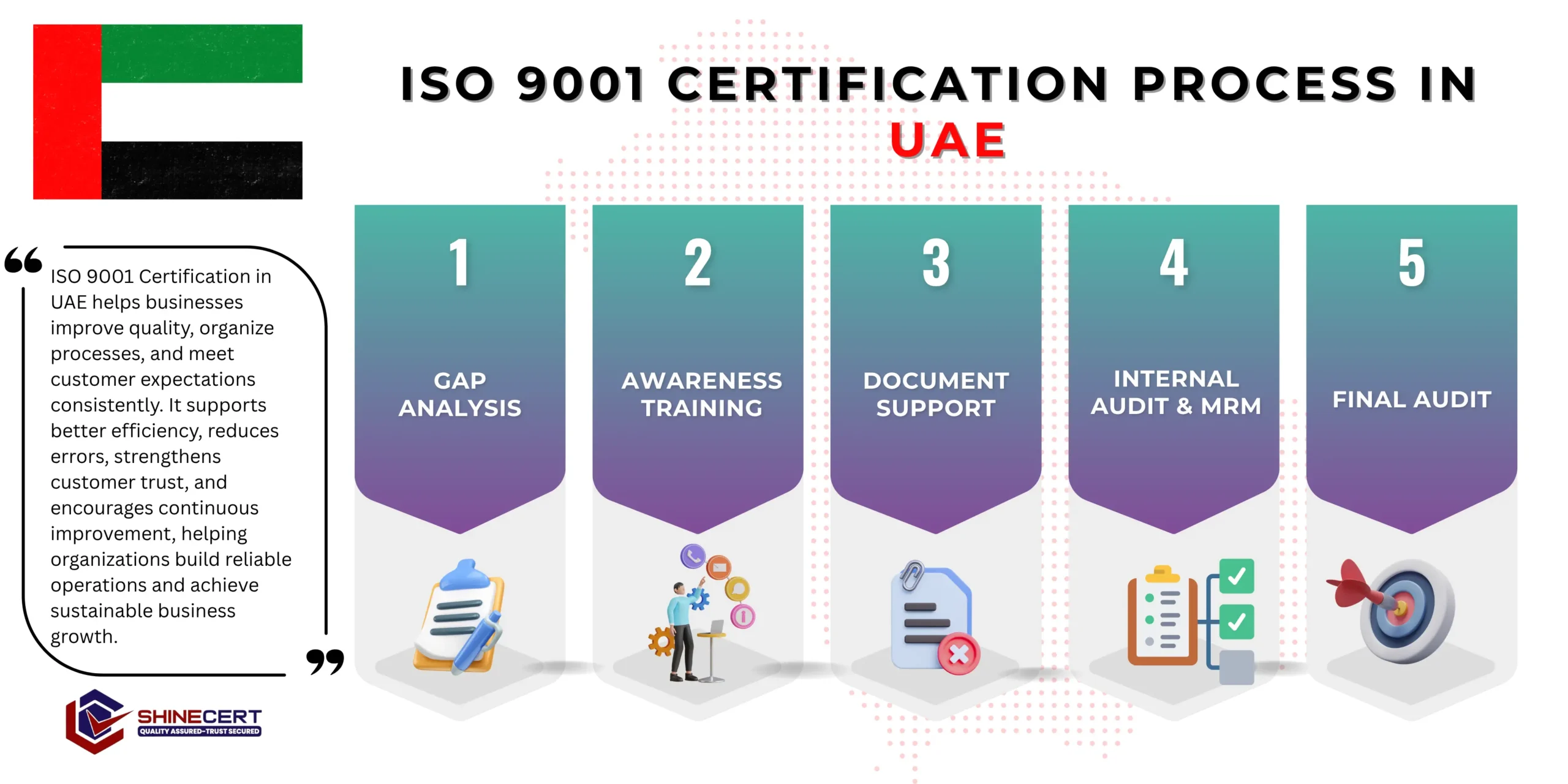
What are the steps to get ISO 9001 Certification in UAE?
our services
- ISO Certification UAE
- ISO 9001 Certification UAE
- ISO 14001 Certification UAE
- ISO 27001 Certification UAE
- ISO 22000 Certification UAE
- ISO 27701 Certification UAE
- ISO 45001 Certification UAE
- ISO 20000-1 Certification UAE
- ISO 13485 Certification UAE
- ISO 17025 Certification UAE
- ISO 31000 Certification UAE
- ISO 42001 Certification UAE
- ISO 37001 Certification UAE
- ISO 22301 Certification UAE
- ISO 50001 Certification UAE
- CE Mark Certification UAE
- GDPR Certification UAE
- GMP Certification UAE
- Halal Certification UAE
How ShineCert Gets You There?
Gap Analysis
We look at what you’re actually doing today against what the standard requires, and we don’t assume you’re starting from zero, most established businesses already have some of this in place informally.
A gap report specific to your business, not a generic checklist.
Building the documentation with you, not for you
Your quality manual and procedures get built collaboratively with the people who actually run your processes, in English or Arabic depending on your team, so the end result reflects reality rather than an idealized version of your operations.
A complete, version-controlled documentation set covering your policy, scope, and required procedures.
Rolling it out and training your team
We train staff using your actual documentation and real scenarios from your operations, then give the system a settling-in period before we move to internal audit, so any friction gets caught early.
Training records plus evidence the new processes are genuinely operating, not just described.
Internal audit and management review
A genuinely independent internal audit covering every clause, followed by a management review meeting that hits every input and output the standard requires.
A documented internal audit report and management review minutes showing leadership actually engaged.
Certification audit
We coordinate Stage 1 and Stage 2 with an EIAC-accredited or other IAF-recognized certification body, help you prepare for auditor interviews, and support you through any corrective actions if nonconformities come up, which happens even to well-prepared companies.
Your ISO 9001 certificate and a surveillance audit schedule so renewal doesn’t sneak up on you.
Where ISO 9001 Actually Pays Off for UAE Companies?
- Winning government and semi-government tenders gets meaningfully easier once certification removes one of the standard prequalification questions from the table.
- Free zone companies gain a credential that international buyers recognize instantly, something a UAE trade license alone doesn’t provide.
- Rework and internal waste tend to drop once you’re forced to actually document and fix root causes instead of firefighting the same problems repeatedly.
- Customer complaints get handled more systematically, which matters in a market where word-of-mouth reputation moves fast between competing buyers.
- Multinational partners and joint venture structures increasingly list ISO 9001 as a baseline supplier requirement before they’ll even discuss terms.
- Once you’re certified to 9001, adding ISO 14001 or ISO 27001 later is considerably cheaper and faster thanks to the shared Harmonised Structure across these standards.
What It Actually Costs?
Quick answer: ISO 9001 certification in the UAE typically runs AED 15,000 to AED 70,000, with the biggest swing factors being company size, number of licenses or sites, and how much documentation already exists.
A small single-site free zone company might land near AED 15,000-20,000; larger multi-site or multi-license operations can run well past AED 70,000.
If you’ve already got some process documentation in place, consultant hours drop accordingly.
The audit itself, billed by the accredited body, isn’t the same line item as ShineCert’s implementation support.
Certification bodies sample across sites, so more locations means more audit time.
Doing ISO 9001 alongside ISO 14001 or 45001 together costs less than certifying each one separately down the line.
Where UAE Companies Usually Go Wrong
- Building documentation that describes an idealized process nobody follows : Auditors notice the gap between paper and reality fast.
- Assuming leadership involvement is optional : Clause 5 gets tested directly through interviews, and disengaged owners get caught.
- Skipping a genuinely rigorous internal audit : It’s the cheapest place to catch problems before the real audit finds them.
- Not planning for ISO 9001’s upcoming revision : More on that below.
Industries Where ISO 9001 Shows Up Most in the UAE
Trade and Logistics
DP World, JAFZA, and DMCC-based operators lean on certification to reassure international clients they’ve never met face to face.
Read moreConstruction and Contracting
Government infrastructure tenders and Dubai’s ongoing development pipeline increasingly treat certification as a baseline qualifier.
Read moreFinancial and Professional Services
DIFC and ADGM-based firms use certification to signal operational maturity to institutional clients.
Read moreManufacturing
UAE’s push to build domestic industrial capacity under broader economic diversification goals has made quality credentials more relevant to manufacturers seeking both local and export contracts.
Read moreHealthcare
ISO 9001 frequently sits alongside Dubai Health Authority and DOH Abu Dhabi requirements rather than replacing them.
Read moreISO 9001 vs. Free Zone-Specific Quality Expectations
We get asked fairly often by UAE clients whether ISO 9001 is even necessary if their free zone authority or a specific client already has its own quality requirements. Almost always, the answer is yes, and here’s why: free zone or sector-specific requirements tend to be narrower and more transactional, addressing a particular relationship or licensing condition, while ISO 9001 gives you a globally portable credential that means something to a buyer who’s never heard of DMCC or JAFZA and has no reason to trust a local-only requirement. We generally tell clients to treat ISO 9001 as the foundation and layer anything sector- or client-specific on top of it, not the other way around, since it’s the certification international partners actually recognize on sight.
What ISO 9001 Actually Requires?
The current edition, ISO 9001:2015, has ten clauses, but the real substance sits in seven of them:
- Context of the Organization (Clause 4) : Before you build anything, you’re required to map out what’s actually going on around your business, market pressures, regulatory considerations, and who the interested parties are, which for a UAE company might include free zone authorities, DED licensing requirements, or specific client contractual obligations. You then write a precise scope statement defining exactly what the certification covers. For companies operating across multiple emirates or holding both mainland and free zone licenses, getting this scope right matters, because auditors will only ever check what you’ve declared, and vague scoping is one of the fastest ways to end up with a certificate that doesn’t actually cover the work you’re doing.
- Leadership (Clause 5) : This clause exists because too many companies treat quality management as something the “quality guy” handles while leadership stays uninvolved. Real commitment means the owner or MD is setting the quality policy, allocating actual budget, and showing up to management review meetings. We’ve seen UAE SMEs get tripped up here specifically, the paperwork looks fine, but the moment an auditor asks the owner a direct question about a recent corrective action, it becomes obvious they’ve never engaged with the system beyond signing off on it once.
- Planning (Clause 6) : You need to identify risks and opportunities tied to your quality objectives and then set targets that are actually measurable, not aspirational fluff. A Dubai freight forwarder, for instance, might formally flag customs clearance delays at specific ports as a risk requiring documented mitigation, then set a concrete target for reducing shipment delays over the certification period.
- Support (Clause 7) : Covers whether your organization has the resources, competence, and information access it actually needs to run the system day to day. For UAE businesses with a genuinely international workforce, this means training records need to demonstrate real competence regardless of where an employee is from or how recently they joined, and document control needs to work reliably across however many offices or warehouses you operate.
- Operation (Clause 8) : This is the operational core, how you review customer requirements before taking on work, how you control suppliers and outsourced processes, and how you actually deliver. UAE trading and distribution companies relying on a network of overseas suppliers need supplier evaluation records that show genuine ongoing monitoring, not a one-time approval checklist from when the relationship started.
- Performance Evaluation (Clause 9) : Requires monitoring, internal audit, and management review, the mechanisms that tell you whether the system is actually working rather than just existing. Internal audits need real independence, which is a genuine challenge for small UAE businesses where one or two people handle quality across the whole operation.
- Improvement (Clause 10) : A structured, documented approach to nonconformity and corrective action, applied consistently, not just when something goes badly wrong, but to the smaller recurring issues too.
The ISO 9001 Revision Nobody’s Talking About Yet
Here’s something worth knowing if you’re starting certification now: ISO 9001 is currently undergoing its first substantive revision since 2015, with the updated edition expected for publication later in 2026. The scope of changes won’t be locked in until it’s actually published, but based on how other recent revisions have gone, ISO 14001’s own 2026 update, for instance, expects closer alignment with risk-based thinking and the Harmonised Structure shared across modern ISO standards. If you’re certifying now, ask your certification body directly what the transition process will look like once the new edition lands, rather than finding out about a deadline after the fact. Past ISO 9001 and 14001 revisions have typically given existing certificate holders a multi-year window to transition, but confirm this with your body directly as 2026 progresses.
How Long It Takes?
Quick answer: Most UAE companies land their ISO 9001 certificate within three to six months of starting, assuming reasonable internal availability to work through the process.
Phase | Typical Duration |
Gap analysis | 2–3 weeks |
Documentation development | 4–6 weeks |
Implementation and training | 3–5 weeks |
Internal audit and management review | 1–2 weeks |
Certification audit (Stage 1 + Stage 2) | 3–4 weeks |
Total | 3–6 months |
The Documents You’ll Actually Need?
Quick answer: ISO 9001:2015 requires documented information covering your quality policy, objectives, scope, and a set of records around competence, monitoring, internal audit, and management review, though it no longer forces a rigid quality manual format the way older editions did.
Precisely defines which sites, products, and processes are covered, especially important if you hold both mainland and free zone licenses.
A real policy from leadership, plus measurable targets that actually get tracked, not filed and forgotten.
Evidence your quality-critical staff are genuinely qualified, regardless of nationality or tenure.
Documentation covering customer requirement reviews, supplier evaluation, and production or service delivery controls.
Evidence you’re actually checking conformity, not assuming it.
A documented schedule and findings from audits with genuine independence.
Covering the specific inputs and outputs Clause 9.3 requires, customer feedback, audit results, resourcing decisions.
What went wrong, why, and what you did about it.
UAE companies working with government or semi-government clients should keep at least a summary of the quality policy available in Arabic, even if the working documentation is maintained in English.
Why Work with ShineCert on This?
We coordinate UAE engagements from ShineCert’s Riyadh and Lebanon offices, with consultants traveling to Dubai, Abu Dhabi, and Sharjah for on-site work. Our team has taken more than 10,000 organizations through ISO certification globally, and as the best ISO 9001 consultant in UAE, we know the practical difference between certifying a mainland company and a free zone one, which matters more than most consultants let on.
Picking the Right Certification Body
What to Check | Why It Matters |
EIAC accreditation, or another IAF-recognized body | Confirms the certificate carries genuine international weight, not just a local stamp |
Free zone and multi-license experience | Matters if you’re navigating DMCC, JAFZA, DIFC, or ADGM structures |
Sector-specific audit background | Relevant for logistics, construction, or financial services with specialized risks |
Transparent pricing | Avoids surprise fees tied to multi-site sampling |
Ready to Get Certified?
ShineCert supports UAE businesses from gap analysis through certification audit, with practical experience across mainland and free zone structures alike. Book a free consultation or contact us directly, and we’ll review your setup before proposing a fixed-scope plan.
Frequently Asked Questions
Typically AED 15,000 to AED 70,000, depending on company size and number of sites or licenses.
No, it’s voluntary, though government tenders and free zone client relationships increasingly treat it as a practical necessity.
Usually three to six months from kickoff to certificate.
EIAC accreditation or accreditation from another IAF-recognized national accreditation body.
Later in 2026; existing certificate holders will likely get a multi-year transition window based on past revision patterns.
Yes, it shares a Harmonised Structure with ISO 14001 and ISO 45001, making combined certification more efficient than doing them separately.
We coordinate UAE engagements from our Riyadh and Lebanon offices, with consultants traveling on-site as needed.