
GMP Certification in UAE
Quick Answer
Good Manufacturing Practice (GMP) certification demonstrates that a facility consistently produces products meeting quality standards through controlled processes, validated equipment, and rigorous documentation, and it functions as a genuine prerequisite for pharmaceutical manufacturers seeking MOHAP registration in the UAE. For food, cosmetics, and nutraceutical manufacturers, GMP certification increasingly supports both regulatory registration and export market access, particularly given the UAE’s positioning as a regional manufacturing and re-export hub. Get certified through a body accredited to assess against relevant GMP standards (WHO GMP, PIC/S-aligned frameworks, or product-specific GMP standards). Budget AED 20,000 to AED 85,000 depending on facility complexity and product category, and plan for three to six months from kickoff to certificate.
What This Standard Actually Covers?
GMP certification verifies that a manufacturing facility maintains the controlled conditions, validated processes, and rigorous documentation needed to consistently produce products meeting their intended quality specifications, batch after batch. This spans facility design and cleanliness, equipment qualification and calibration, raw material and supplier controls, in-process quality controls, batch documentation and release procedures, and personnel training and hygiene practices. Unlike a general quality management standard, GMP places particularly heavy emphasis on process validation, genuine, documented proof that a manufacturing process consistently produces the intended result, not just a description of how the process is supposed to work.
Why This Matters So Much Here Specifically?
- The UAE’s Ministry of Health and Prevention (MOHAP) requires GMP compliance as a foundational element of pharmaceutical manufacturing registration, and this expectation increasingly extends to nutraceutical and certain cosmetics manufacturers as well, given the overlapping regulatory scrutiny these product categories face. Dubai Science Park and other UAE life sciences free zones have specifically attracted pharmaceutical and nutraceutical manufacturers partly because of the country’s genuine investment in building credible regulatory infrastructure, and GMP certification is central to that credibility. For UAE-based manufacturers pursuing export markets, particularly across the Gulf, Africa, and parts of Asia, GMP certification recognized under internationally aligned frameworks provides a manufacturing quality credential that destination-market regulators and importers actively look for.
- Beyond pharmaceuticals specifically, the UAE’s growing nutraceutical and cosmetics manufacturing sector increasingly treats GMP certification as a genuine market differentiator, particularly for products marketed on quality and safety credentials to increasingly sophisticated regional consumers.
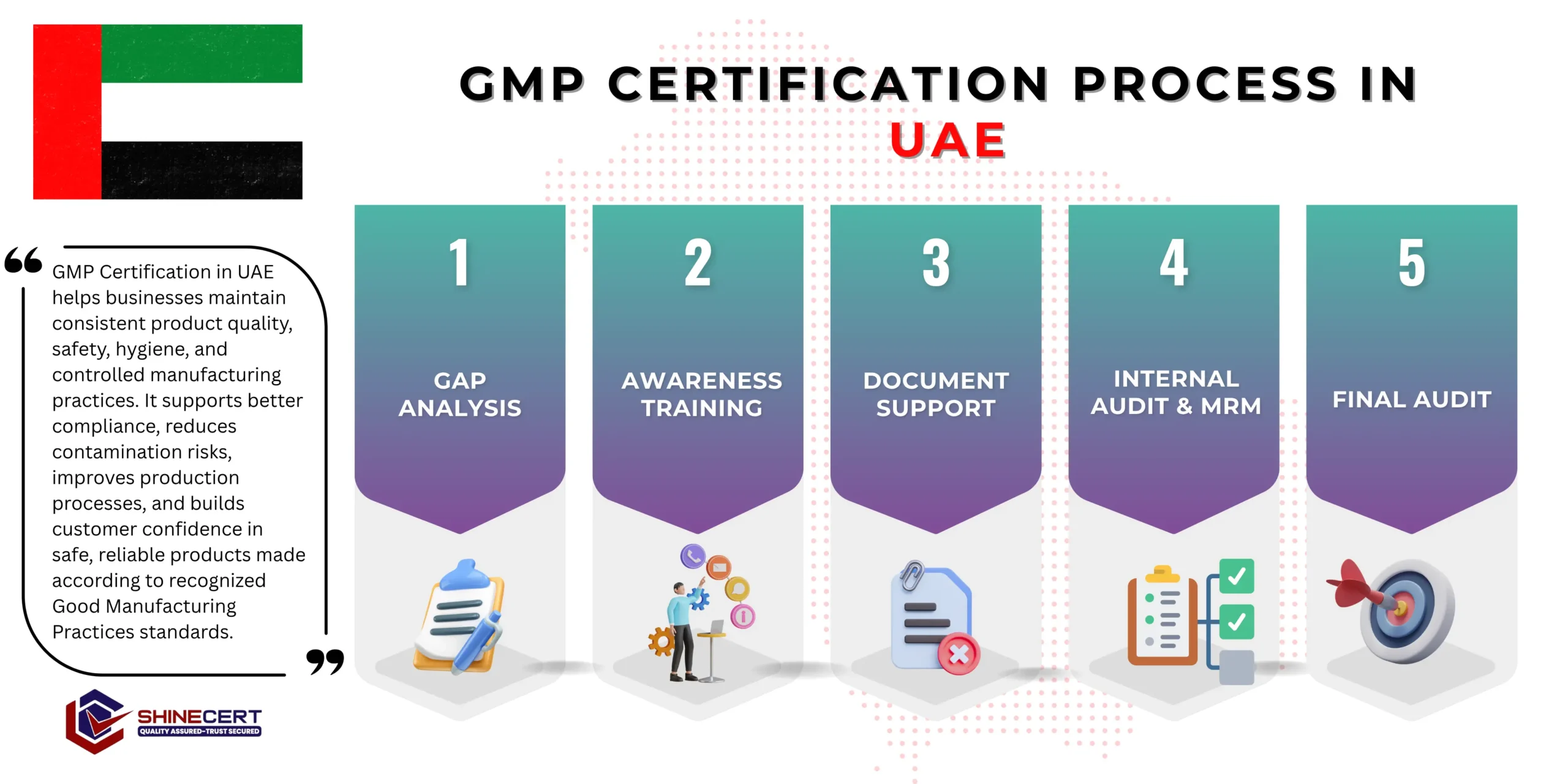
What are the steps to get GMP Certification in UAE?
our services
- ISO Certification UAE
- ISO 9001 Certification UAE
- ISO 14001 Certification UAE
- ISO 27001 Certification UAE
- ISO 22000 Certification UAE
- ISO 27701 Certification UAE
- ISO 45001 Certification UAE
- ISO 20000-1 Certification UAE
- ISO 13485 Certification UAE
- ISO 17025 Certification UAE
- ISO 31000 Certification UAE
- ISO 42001 Certification UAE
- ISO 37001 Certification UAE
- ISO 22301 Certification UAE
- ISO 50001 Certification UAE
- CE Mark Certification UAE
- GDPR Certification UAE
- GMP Certification UAE
- Halal Certification UAE
How We Handle This?
Gap analysis and facility assessment
We assess your current manufacturing practices against relevant GMP requirements, calibrated to your specific product category and regulatory pathway.
A gap analysis report identifying specific facility, process, and documentation gaps.
Documentation
Your quality manual, standard operating procedures, and batch documentation templates get built around your actual manufacturing processes.
A complete GMP documentation set aligned with MOHAP and relevant export market expectations.
Process validation support
We support the genuine process validation work required to demonstrate consistent manufacturing performance, not just documentation of intended procedures.
Process validation reports demonstrating consistent, documented manufacturing performance.
Implementation and training
Facility controls, equipment qualification, and personnel training get rolled out across your manufacturing operation.
Training records and evidence of functioning quality controls throughout the manufacturing process.
Certification audit
We coordinate the certification audit with an appropriately accredited body assessing against the relevant GMP framework for your product category.
Your GMP certificate and a surveillance audit schedule.
What You Actually Get?
- Direct support for MOHAP pharmaceutical manufacturing registration, since GMP compliance is a foundational registration requirement rather than an optional enhancement.
- Stronger positioning for Dubai Science Park and other UAE life sciences free zone tenancy and partnership opportunities, where GMP compliance is increasingly expected infrastructure.
- Access to export markets requires recognized GMP certification, particularly relevant given the UAE’s role as a regional manufacturing and trading hub.
- Reduced product recall and quality incident risk, since validated processes and rigorous batch documentation genuinely reduce the likelihood of quality failures reaching the market.
- Credibility with distributors and retail partners increasingly scrutinizing manufacturing quality credentials before entering supply agreements.
GMP Certification and the UAE’s Life Sciences Manufacturing Ambitions
The UAE’s investment in Dubai Science Park and broader life sciences infrastructure reflects deliberate government strategy to build genuine regional pharmaceutical and nutraceutical manufacturing capacity, not just distribution and trading activity. We’ve generally recommended that UAE manufacturers pursuing this positioning treat GMP certification as core infrastructure investment from the outset, since retrofitting genuine process validation and quality systems into an already-operating facility is considerably more disruptive and costly than building them in from the beginning. Manufacturers that get this right from the start tend to find MOHAP registration and export market entry processes go considerably more smoothly than those that treat GMP compliance as an afterthought.
What It Costs?
Quick answer: GMP certification in the UAE typically runs AED 20,000 to AED 85,000, with product category and facility complexity as the main cost drivers.
More extensive process validation and documentation requirements apply.
Overlapping quality infrastructure reduces some foundational work.
Environmental control upgrades or layout changes can represent significant investment beyond consulting fees.
Each product line or category may need its own process validation work.
Certification body fees are separate, and typically scale with facility complexity and product risk category.
Where Companies Usually Trip Up?
- Treating documentation as a substitute for genuine process validation : Auditors look for real evidence processes consistently work, not just well-written procedures.
- Underestimating equipment qualification requirements : Owning appropriate equipment isn’t the same as having documented proof it’s properly qualified.
- Weak supplier qualification for raw materials : A manufacturing process is only as reliable as its input materials, and this often gets underinvested.
- Incomplete batch records that can’t withstand genuine audit scrutiny : Gaps in batch documentation are among the most common audit findings.
Where This Shows Up Most?
Pharmaceutical Manufacturing
GMP compliance is a foundational MOHAP registration requirement, making this the most consequential category.
Read moreNutraceuticals and Dietary Supplements
A growing UAE manufacturing category facing increasing regulatory scrutiny similar to pharmaceuticals.
Read moreCosmetics Manufacturing
GMP certification increasingly differentiates quality-focused cosmetics manufacturers in a competitive regional market.
Read moreMedical Device Component Manufacturing
Overlapping quality requirements with ISO 13485, particularly for components requiring validated manufacturing processes.
Read moreContract Manufacturing Organizations
UAE-based CMOs serving pharmaceutical and nutraceutical brands face direct client expectations for GMP compliance.
Read moreCold Chain Validation: The GMP Requirement UAE Manufacturers Can’t Treat as Standard
- Temperature-sensitive pharmaceutical and nutraceutical products carry cold chain validation requirements everywhere, but the UAE’s climate raises the practical stakes considerably higher than in more temperate manufacturing environments. A cold chain validation approach that works reliably in a European or North American facility can fail in genuinely consequential ways in the UAE if it wasn’t specifically designed around extreme ambient heat, both within the manufacturing and storage facility itself and across the transportation and distribution chain that follows, particularly given how much UAE pharmaceutical manufacturing serves onward export to other regional markets across similarly hot climates.
- We’ve generally recommended that UAE pharmaceutical and nutraceutical manufacturers validate their cold chain processes against genuinely worst-case UAE summer conditions, not average or typical conditions, and extend that validation through the full distribution chain rather than stopping at the facility’s own loading dock.
- This means documented temperature mapping studies covering actual peak ambient conditions, backup power and refrigeration contingency planning that accounts for genuine regional grid reliability, and transportation validation that reflects real UAE and regional export logistics rather than theoretical best-case shipping conditions. Manufacturers that validate rigorously against these genuinely demanding conditions tend to face considerably fewer product quality incidents during actual peak summer operations than those relying on validation data collected under more moderate testing conditions.
What Certification Actually Requires?
- Facility Design and Controls : Manufacturing environments designed to prevent contamination and cross-contamination, with appropriate separation between different product lines or processing stages, and environmental controls (temperature, humidity, air quality) validated and continuously monitored, not just assumed adequate.
- Equipment Qualification : Documented evidence that manufacturing and testing equipment is properly installed, operates correctly, and performs consistently, this goes considerably further than simply owning appropriate equipment; it requires genuine, documented qualification.
- Process Validation : The technical heart of GMP: documented proof, through actual production runs, that your manufacturing process consistently produces product meeting specifications, not just a theoretical description of how it should work.
- Raw Material and Supplier Controls : Verified, documented control over incoming materials, including supplier qualification and incoming material testing, since a manufacturing process is only as reliable as the materials feeding into it.
- Batch Documentation and Release : Comprehensive batch records for every production run, with formal quality release procedures confirming each batch meets specifications before it ships, genuinely traceable, not reconstructed after the fact.
- Personnel Training and Hygiene : Documented, role-specific training on GMP requirements and hygiene practices, with particular attention to personnel working in critical production areas.
- Deviation and Complaint Handling : Structured investigation of manufacturing deviations and customer complaints, feeding into genuine corrective action rather than isolated incident handling.
GMP vs ISO 22000
These serve related but distinct purposes, and food manufacturers in particular benefit from understanding the difference. ISO 22000 certifies a food safety management system built around hazard analysis and critical control points, applicable broadly across the food supply chain from producers through distributors. Good Manufacturing Practice (GMP) focuses specifically and more intensively on manufacturing process control and validation, the discipline of consistently producing product meeting specification, batch after batch, with less emphasis on the broader supply chain hazard analysis ISO 22000 addresses. Many UAE food and nutraceutical manufacturers pursue both, since GMP’s manufacturing process rigor and ISO 22000’s food safety hazard analysis address genuinely complementary risk areas, and substantial documentation infrastructure can be shared between the two.
Timeline
Quick answer: GMP certification in the UAE typically takes three to six months, longer than many management system standards given the process validation work involved.
Phase | Typical Duration |
Gap analysis and facility assessment | 3–4 weeks |
Documentation development | 5–7 weeks |
Process validation | 4–8 weeks |
Implementation and training | 3–5 weeks |
Certification audit | 2–3 weeks |
Total | 3–6 months |
Documentation You’ll Need
Quick answer: GMP certification requires a quality manual, facility and equipment qualification records, process validation reports, batch manufacturing records, and deviation and complaint handling procedures.
Genuine leadership commitment to manufacturing quality, specific to your product category.
Documented evidence facilities and equipment meet and maintain required specifications.
Documented proof, through actual production runs, that processes consistently meet specifications.
Detailed, specific procedures covering every stage of manufacturing.
Complete, traceable documentation for every production batch.
Documented evaluation and ongoing monitoring of raw material suppliers.
Evidence of structured investigation and corrective action.
Why ShineCert?
We coordinate UAE engagements from ShineCert’s Riyadh and Lebanon offices, with direct familiarity with MOHAP registration requirements and UAE life sciences manufacturing standards. Our team has guided more than 10,000 organizations through ISO and GMP certification globally, with ShineCert as the best GMP consultant in UAE, bringing specific depth in Gulf pharmaceutical and nutraceutical manufacturing.
Choosing a Certification Body?
What to Check | Why It Matters |
Accreditation relevant to your product category | Pharmaceutical, food, and cosmetics GMP frameworks differ, and the right accreditation matters |
Familiarity with MOHAP requirements | Helps ensure certification genuinely supports your registration submissions |
Process validation technical expertise | GMP audits require genuine manufacturing process understanding, not just document review |
Export market recognition | Important for manufacturers targeting specific destination markets with their own GMP recognition requirements |
Ready to Get Certified?
ShineCert supports UAE pharmaceutical, nutraceutical, and cosmetics manufacturers end to end, from gap analysis through certification audit, with direct experience navigating MOHAP registration requirements. Book a free consultation or contact us directly, and we’ll review your manufacturing operation before proposing a fixed-scope plan.
Frequently Asked Questions
UAE summer ambient conditions are considerably more extreme than in temperate manufacturing environments, so cold chain validation needs to reflect genuine worst-case conditions across the full facility-to-distribution chain, not average conditions.
Typically AED 20,000 to AED 85,000, depending on product category and facility complexity.
Yes, in practice, since MOHAP registration for pharmaceutical manufacturing requires demonstrated GMP compliance as a foundational element.
Typically three to six months, given the process validation work involved.
No, GMP focuses specifically on manufacturing process control and validation, while ISO 22000 certifies a broader food safety management system.
Yes, it’s increasingly pursued as a quality differentiator, particularly for cosmetics manufacturers targeting quality-conscious regional markets.
Process validation typically requires the most time and resources, since it demands genuine documented proof through actual production runs, not just procedural descriptions.
We coordinate UAE engagements from our Riyadh and Lebanon offices, with consultants traveling on-site as needed.