
ISO 42001 Certification in UAE
Quick Answer
The UAE was one of the first countries in the world to appoint a government minister dedicated specifically to artificial intelligence, and that early institutional focus has carried through into a genuinely ambitious national AI strategy aiming to position the country as a global AI hub by 2031. ISO 42001 is the world’s first international standard for AI management systems, and it’s still a genuinely new certification landscape, most certification bodies globally, including in the UAE, are only beginning to build out accredited scope for it. Look carefully at whether a certification body actually holds accredited scope for ISO 42001 specifically before committing, since this varies more than it does for older, more established standards. Budget roughly AED 25,000 to AED 120,000 depending on your AI system complexity, and expect four to eight months from kickoff to certificate.
What This Standard Is Actually Trying to Do?
ISO 42001 isn’t about regulating specific algorithms or telling you which AI models to use. It’s a management system standard requiring organizations to build genuine governance around how they develop, deploy, and monitor AI systems, assessing risks like bias and lack of transparency, building human oversight into consequential AI decisions, and maintaining accountability throughout an AI system’s lifecycle rather than treating responsible AI as a marketing slogan disconnected from actual engineering practice. It covers issues including data governance, fairness testing, and third-party AI component risk, which matters increasingly given how many companies now build products on top of foundation models they didn’t develop themselves rather than training everything in-house.
Why This Is Worth Taking Seriously in the UAE Right Now?
- The UAE’s National Strategy for Artificial Intelligence, aiming for global AI leadership by 2031, has driven substantial investment in AI infrastructure and talent across both Dubai and Abu Dhabi, with major UAE-based AI companies now operating at genuinely significant scale on the global stage. As this ecosystem matures, we’re seeing something that tends to happen everywhere AI adoption accelerates quickly: enterprise customers, investors, and increasingly government partners start asking pointed questions about AI governance that a purely technical answer doesn’t satisfy. A UAE AI company that can point to an accredited ISO 42001 certificate has a genuinely differentiated answer to those questions right now, precisely because relatively few companies in the region have pursued it yet.
- There’s also a practical timing argument here that’s easy to miss: certification infrastructure for ISO 42001 is still building out globally, meaning UAE companies moving now are positioned as early adopters in a way that simply won’t be true once accredited AI management certification becomes as commonplace as ISO 27001 already is.
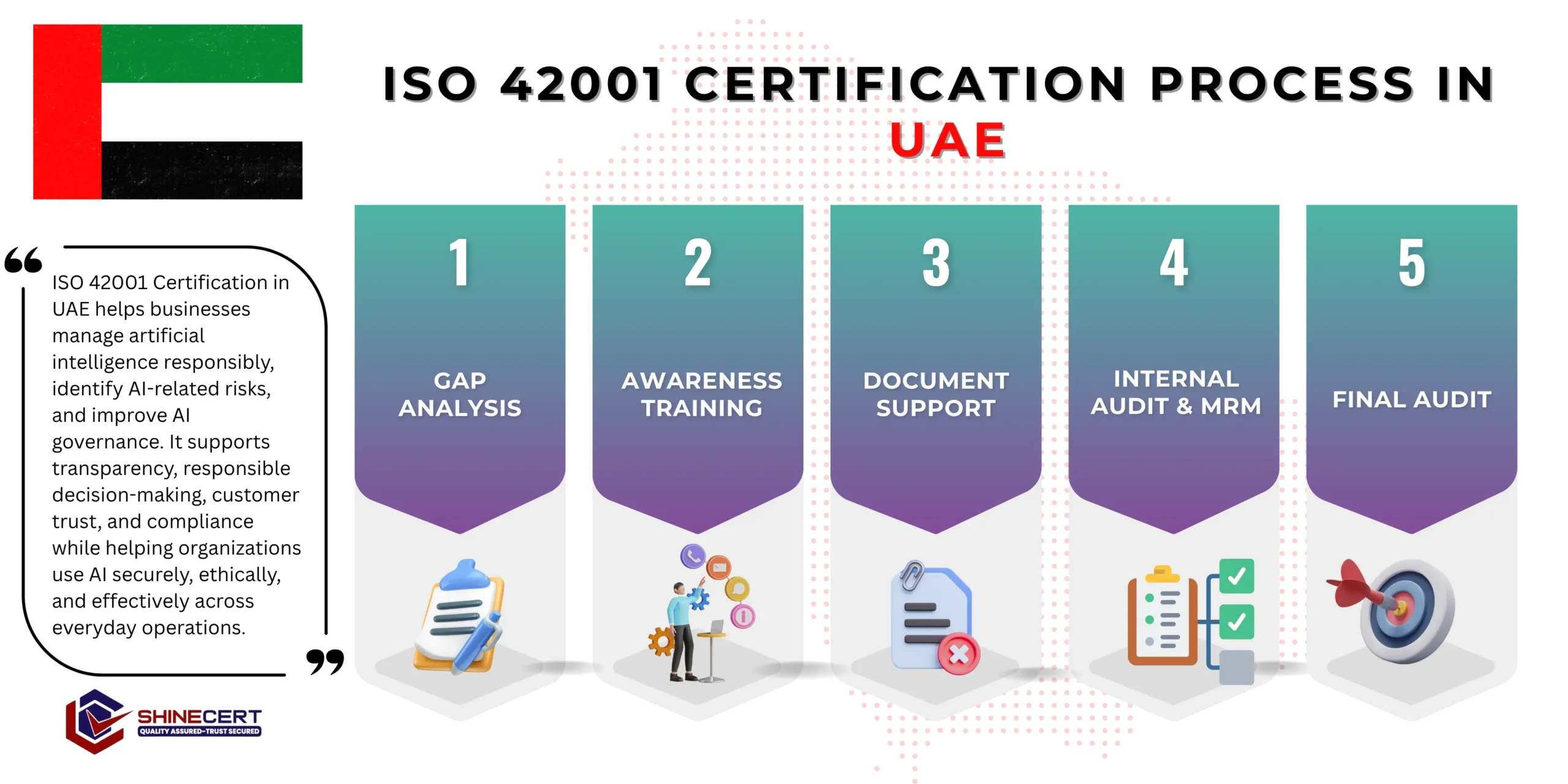
What are the steps to get ISO 42001 Certification in UAE?
our services
- ISO Certification UAE
- ISO 9001 Certification UAE
- ISO 14001 Certification UAE
- ISO 27001 Certification UAE
- ISO 22000 Certification UAE
- ISO 27701 Certification UAE
- ISO 45001 Certification UAE
- ISO 20000-1 Certification UAE
- ISO 13485 Certification UAE
- ISO 17025 Certification UAE
- ISO 31000 Certification UAE
- ISO 42001 Certification UAE
- ISO 37001 Certification UAE
- ISO 22301 Certification UAE
- ISO 50001 Certification UAE
- CE Mark Certification UAE
- GDPR Certification UAE
- GMP Certification UAE
- Halal Certification UAE
How We Approach This?
Gap analysis and AI system inventory
We assess your current governance practices and build a genuine inventory of your AI systems, their purposes, and their risk profiles.
A gap analysis and risk-classified AI system inventory specific to your organization.
Documentation
Your AI policy, governance procedures, and risk assessments get built with UAE’s national AI direction explicitly in view where relevant to your sector.
A complete AI management system documentation set, including system-level risk assessments.
Implementation and training
Governance controls including bias testing and human oversight mechanisms get rolled out, with training specific to the AI systems your teams actually build.
Training records and evidence governance controls genuinely function throughout your AI lifecycle.
Internal audit and management review
A rigorous internal audit covering governance effectiveness, followed by management review addressing emerging AI risks.
An internal audit report and management review minutes showing real leadership engagement with AI governance.
Certification audit
We help you verify a certification body’s genuine accredited scope for ISO 42001 specifically before proceeding, this is not a step to skip given how new the accreditation landscape still is, then coordinate Stage 1 and Stage 2 audits.
Your ISO 42001 certificate and a surveillance audit plan.
What You Actually Get From This?
- Genuine early-mover differentiation, since relatively few UAE AI companies currently hold this certification.
- A credible, verifiable answer to increasingly sophisticated enterprise customer and investor questions about AI governance, rather than a marketing claim nobody can independently check.
- Alignment with the UAE’s own national AI ambitions, positioning your company favorably as formal AI regulation continues developing.
- Reduced risk of harmful AI outcomes through systematic bias testing and human oversight, which matters for the business itself independent of certification.
- A structural head start for adapting quickly once more formal AI regulatory requirements emerge, since the underlying governance work supports whatever comes next.
What It Costs?
Quick answer : ISO 42001 certification in the UAE typically runs AED 25,000 to AED 120,000, generally higher than more established standards given the specialized expertise still required for genuine AI governance assessment.
Multiple high-risk AI systems mean more extensive impact assessment work.
Genuine ISO 42001 expertise remains more specialized than for established standards.
Given limited accredited capacity globally as of 2026.
Companies with strong data governance already in place need less foundational work.
Meaningful overlap between AI governance and information security controls.
Where Companies Usually Trip Up?
- Assuming any certification body can issue ISO 42001 certificates : Accredited scope remains genuinely limited; always verify before committing.
- Treating AI governance as a purely technical machine learning problem : The standard requires real business-level accountability, not just technical bias testing disconnected from governance structure.
- Overlooking third-party AI component risk : Companies building on external foundation models often underestimate the governance requirements this creates.
- Building documentation disconnected from local AI strategy direction : Generic frameworks that don’t reference the UAE’s specific AI governance direction miss an opportunity to demonstrate genuinely contextual maturity.
Where This Shows Up Most?
AI and Technology Startups
Companies building AI products for enterprise or government customers increasingly need certification to satisfy buyer due diligence.
Read moreFintech
AI-driven credit scoring and fraud detection face particularly close scrutiny given the consequential nature of financial decisions.
Read moreGovernment and Smart City Initiatives
UAE’s substantial investment in AI-driven government services and smart city applications needs robust governance frameworks.
Read moreHealthcare Technology
AI-assisted diagnostic tools require rigorous governance given direct patient impact.
Read moreTelecommunications
AI-driven network optimization and customer service applications benefit from structured governance as deployment scales.
Read moreGetting Ahead of Where This Is Heading
We consistently tell UAE AI companies the same thing: the window where ISO 42001 certification functions as a genuine differentiator, rather than a baseline expectation, is real but temporary. We’ve watched this exact pattern play out with ISO 27001 over the past decade, an early differentiator that gradually became table stakes as adoption spread and enterprise buyers stopped accepting anything less. AI governance certification is following a similar trajectory, just compressed into a much shorter timeframe given how quickly AI adoption itself is accelerating. UAE companies moving on this now, while the certified competitor set remains genuinely small, are positioning themselves considerably better than those waiting for AI governance certification to become an unavoidable cost of doing business rather than a competitive choice.
What the Standard Actually Covers?
The current edition, ISO 9001:2015, has ten clauses, but the real substance sits in seven of them:
- Context of the Organization : You need to identify the issues genuinely relevant to your AI systems and who’s affected by them, customers experiencing AI-driven decisions, regulators as UAE’s AI governance framework continues developing, and internally, whichever teams actually build and deploy your AI products. Get specific about scope: a fintech company using AI for both credit decisioning and a customer service chatbot faces very different risk profiles that shouldn’t be governed identically.
- Leadership : Someone needs to genuinely own AI governance outcomes, not have accountability diffused across engineering teams with no clear business-level ownership. We consistently see UAE AI companies with genuinely strong technical talent but a real gap between that technical capability and formal governance structure connecting AI decisions to business risk accountability, which is exactly what this clause is designed to close.
- Planning : A structured risk assessment covering bias, fairness, transparency, and potential harm from AI outputs, with documented objectives for responsible development. This planning work benefits considerably from referencing the UAE’s own AI governance direction explicitly, rather than importing a generic international risk framework wholesale without any local grounding.
- Support : Resources, competence, and awareness specific to AI governance, meaning staff building and deploying AI systems need genuine training in responsible AI practices, not just deep technical machine learning skill on its own.
- Operation : Implementing controls across the AI lifecycle: data quality management, bias testing, human oversight for consequential decisions, and evaluation processes for any third-party AI components you’re building on top of, which is increasingly the norm rather than the exception.
- Performance Evaluation : Monitoring AI system performance against defined objectives, including fairness and accuracy metrics where relevant, plus internal audit and management review addressing governance effectiveness as both the technology and the regulatory landscape around it keep shifting.
- Improvement : A structured response when something goes wrong, identified bias, unexpected harmful outputs, plus genuine continual improvement as AI governance practices mature alongside the technology itself.
G42, Sovereign AI, and What It Means for Smaller UAE AI Companies
- The UAE’s position in global AI has been shaped substantially by large, well-capitalized national champions building sovereign AI infrastructure and large language models at genuinely significant scale, and it’s worth understanding how this affects smaller UAE AI companies and startups thinking about their own governance posture. Rather than being crowded out, we’ve found that smaller companies operating in this ecosystem actually benefit from a kind of halo effect: enterprise customers and international partners evaluating a UAE-based AI vendor increasingly expect a baseline level of governance sophistication, precisely because the country’s most visible AI players have set that expectation at the top of the market.
- This creates a genuine opportunity for smaller, more nimble AI companies to differentiate through formal governance certification specifically, since matching the infrastructure scale of national champions isn’t realistic, but matching or even exceeding their formal governance maturity through a genuine ISO 42001 implementation absolutely is achievable, and arguably easier for a smaller, more agile organization to execute quickly and thoroughly than for a much larger one.
Timeline
Quick answer : ISO 42001 certification in the UAE typically takes four to eight months, longer than most established standards given the newness of the standard and limited accredited certification body capacity.
Phase | Typical Duration |
Gap analysis and AI system inventory | 3–5 weeks |
Documentation development | 6–8 weeks |
Implementation and training | 4–6 weeks |
Internal audit and management review | 2–3 weeks |
Certification audit (Stage 1 + Stage 2) | 4–6 weeks |
Total | 4–8 months |
Documentation You’ll Need
Quick answer : ISO 42001 requires an AI policy, an AI system inventory with risk classifications, impact assessments for consequential AI systems, and records covering monitoring, internal audits, and management review.
Genuine leadership commitment to responsible AI development, not boilerplate.
A register of your AI systems with risk levels assigned by potential impact.
Documented risk assessments, particularly for systems making or supporting consequential decisions affecting individuals.
Records addressing data quality and provenance for training and operational data.
How human oversight actually gets maintained for systems with significant autonomy or consequential outputs.
Evidence of ongoing testing, not a one-time check at launch.
The evidence trail showing genuine governance engagement.
Why ShineCert?
We coordinate UAE engagements from ShineCert’s Riyadh and Lebanon offices, with direct familiarity with the UAE’s national AI strategy direction. Our team has guided more than 10,000 organizations through ISO certification globally, and as the best ISO 42001 consultant in UAE, we bring growing depth in the emerging AI governance certification landscape.
Choosing a Certification Body?
What to Check | Why It Matters |
Genuine accredited scope for ISO 42001 specifically | Many certification bodies don’t yet hold this; confirm directly rather than assuming |
EIAC accreditation, or another IAF-recognized body | Confirms genuine international recognition once accredited scope is confirmed |
AI and machine learning technical literacy among auditors | Essential for a meaningful assessment of genuinely technical governance controls |
Familiarity with UAE’s national AI strategy direction | Helps ensure certification genuinely supports your broader positioning |
Ready to Get Certified?
ShineCert supports UAE companies building responsible AI governance frameworks, from risk assessment through certification audit. Book a free consultation or contact us directly, and we’ll review your AI systems before proposing a fixed-scope plan.
Frequently Asked Questions
Typically AED 25,000 to AED 120,000, depending on AI system complexity.
No, it’s voluntary, though enterprise customer due diligence and alignment with national AI direction increasingly make it a practical advantage.
Typically four to eight months.
No, accredited scope remains limited globally; always verify current accreditation before choosing a provider.
Yes, it addresses governance for AI systems you deploy or rely on, including third-party components.
We coordinate UAE engagements from our Riyadh and Lebanon offices, with consultants traveling on-site as needed.
Yes, matching infrastructure scale isn’t realistic, but a smaller company can often match or exceed larger players’ formal governance maturity through a genuinely thorough ISO 42001 implementation.