
ISO 20000-1 Certification in UAE
Quick Answer
The UAE government has pursued an aggressive digital transformation agenda across federal and emirate-level entities, and IT service providers supporting government digital services increasingly need to demonstrate structured, internationally recognized service management practices rather than informal, ad hoc IT support arrangements. ISO 20000-1 is the international IT service management system standard, giving UAE technology companies and IT departments a framework for delivering consistent, measurable, continually improving IT services. Get certified through a body accredited by the Emirates International Accreditation Centre (EIAC) or another IAF-recognized body. Budget AED 16,000 to AED 65,000 depending on service scope and organizational complexity, and plan for two to five months from kickoff to certificate.
What This Standard Actually Does?
ISO 20000-1 provides a structured framework for planning, delivering, monitoring, and continually improving IT services, covering the full service lifecycle from understanding what your customers actually need, through service design and transition, into ongoing service operation and problem management. It’s built around service level management, incident and problem management, change management, and capacity and availability management, all working together as an integrated system rather than isolated IT functions operating independently of each other. For organizations providing IT services to internal or external customers, it demonstrates that service delivery is managed as a genuine discipline, not handled reactively as issues arise.
Why This Matters So Much Here Specifically?
- The UAE’s digital government ambitions, spanning federal initiatives and emirate-specific programs across Dubai and Abu Dhabi, depend on a genuinely functioning ecosystem of IT service providers capable of delivering reliable, well-managed services at scale. Government entities and government-linked organizations increasingly specify structured IT service management practices when evaluating technology vendors and outsourcing partners, particularly for services touching citizen-facing digital platforms or critical government infrastructure. The UAE’s broader position as a regional technology and innovation hub also means UAE-based IT service providers frequently compete for contracts serving customers well beyond the UAE itself, where ISO 20000-1 certification provides internationally recognized credibility.
- For IT outsourcing and managed service providers specifically, a genuinely significant category given how much UAE enterprise IT is delivered through outsourced arrangements, certification demonstrates that service levels, incident response, and change management are handled with the discipline enterprise customers expect.
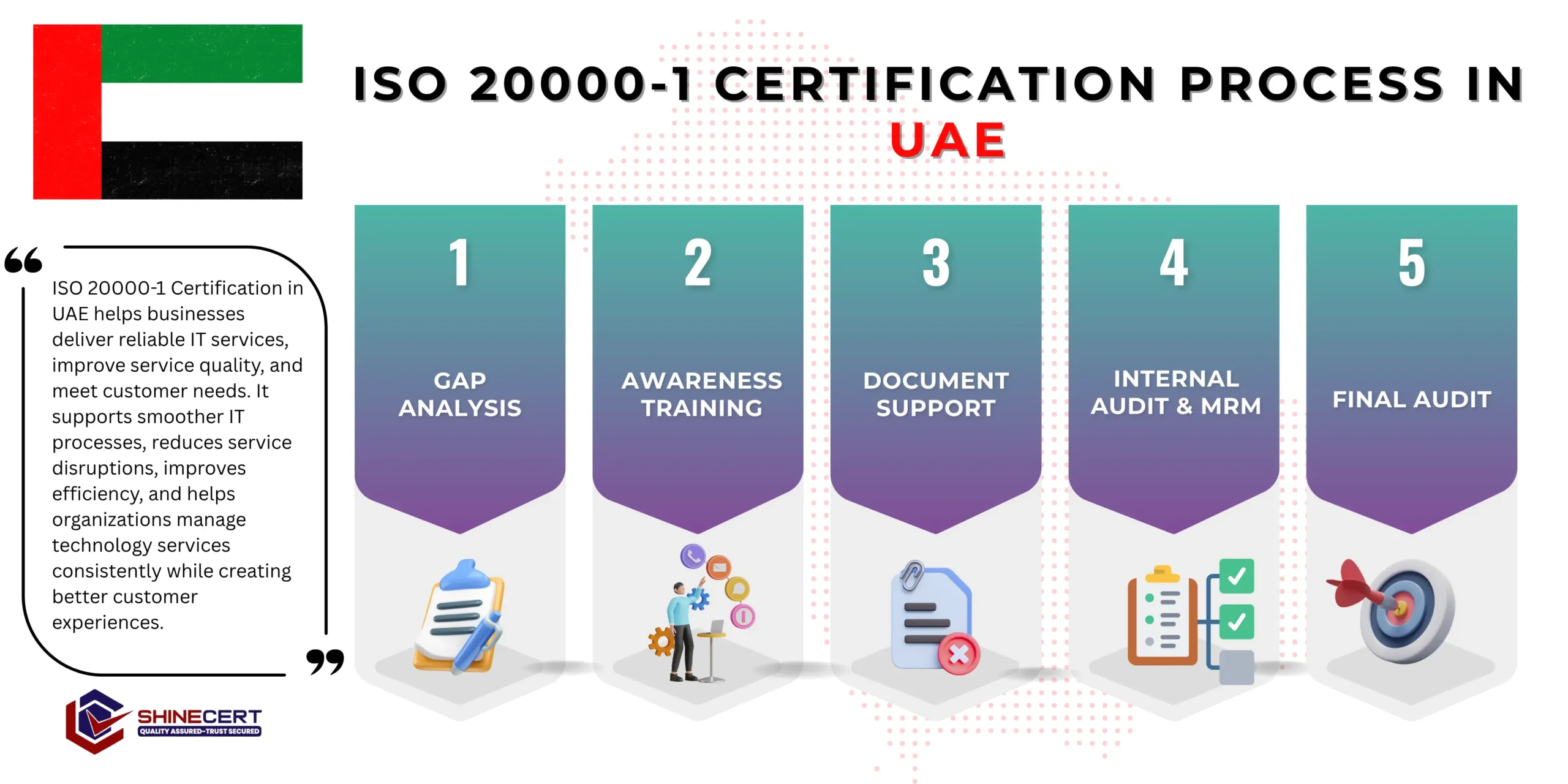
What are the steps to get ISO 20000-1 Certification in UAE?
our services
- ISO Certification UAE
- ISO 9001 Certification UAE
- ISO 14001 Certification UAE
- ISO 27001 Certification UAE
- ISO 22000 Certification UAE
- ISO 27701 Certification UAE
- ISO 45001 Certification UAE
- ISO 20000-1 Certification UAE
- ISO 13485 Certification UAE
- ISO 17025 Certification UAE
- ISO 31000 Certification UAE
- ISO 42001 Certification UAE
- ISO 37001 Certification UAE
- ISO 22301 Certification UAE
- ISO 50001 Certification UAE
- CE Mark Certification UAE
- GDPR Certification UAE
- GMP Certification UAE
- Halal Certification UAE
How We Handle This?
Gap analysis and service scoping
We assess current IT service management practices and define a clear certification scope covering your actual service portfolio.
A gap analysis report and defined certification scope.
Documentation
Your service management policy, service catalog, and core process procedures (incident, problem, change, configuration management) get built around your actual service delivery model.
A complete IT service management documentation set aligned with your service portfolio.
Implementation and tooling
Service management processes get rolled out, with service desk and monitoring tools configured to support genuine incident and service level tracking.
Evidence of functioning incident management, change management, and service level tracking.
Internal audit and management review
A rigorous internal audit covering service management process effectiveness, followed by a management review addressing service performance.
An internal audit report and management review minutes demonstrating genuine leadership oversight.
Certification audit
We coordinate Stage 1 and Stage 2 with an EIAC-accredited or IAF-recognized body.
Your ISO 20000-1 certificate and a surveillance audit schedule.
What You Actually Get?
- Stronger positioning for government and government-linked technology contracts, where structured IT service management increasingly factors into vendor evaluation.
- Credibility with enterprise customers evaluating outsourced or managed IT services, who increasingly specify certified service management as a baseline expectation.
- Reduced service disruption and faster incident resolution, since structured incident and problem management genuinely improves response consistency.
- A functioning platform for scaling service delivery, since documented, repeatable processes matter considerably more as an IT service provider grows beyond a handful of customers.
- International credibility supporting UAE-based providers competing for contracts serving customers and markets beyond the UAE itself.
ISO 20000-1 and the UAE’s Digital Government Ambitions
The UAE’s sustained investment in digital government services, spanning federal platforms and emirate-specific initiatives across Dubai and Abu Dhabi, creates genuine, growing demand for IT service providers capable of demonstrating structured, reliable service delivery at scale. We’ve generally recommended that UAE technology companies pursuing government contracts treat ISO 20000-1 certification as core infrastructure for this positioning, particularly given how consistently government procurement processes now reference structured service management practices as an evaluation factor. Companies that build genuine service management discipline ahead of pursuing government work tend to find the resulting contracts easier to win and, more importantly, easier to deliver against without service failures that damage the broader relationship.
What It Costs?
Quick answer: ISO 20000-1 certification in the UAE typically runs AED 16,000 to AED 65,000, with service scope and organizational complexity as the main cost drivers.
Broader service portfolios need more extensive process documentation.
Shared management system structure and overlapping security controls reduce duplicated work.
Additional documentation often needed to demonstrate alignment with specific government service expectations.
Organizations with mature service desk and monitoring systems need less foundational investment.
Certification body fees are separate, and typically scale with service scope.
Where Companies Usually Trip Up?
- Defining certification scope too broadly or too vaguely : A clear, specific service catalog scope makes implementation and audit considerably more manageable.
- Treating incident management as purely reactive : The standard expects proactive problem management addressing root causes, not just closing tickets.
- Weak configuration management : Without accurate configuration records, change management and incident resolution both suffer.
- Underestimating the documentation burden for multi-client managed service providers : Each client relationship often needs its own service level tracking within the broader system.
Where This Shows Up Most?
IT Outsourcing and Managed Service Providers
A particularly large category given how much UAE enterprise IT is delivered through outsourced arrangements.
Read moreGovernment Technology Vendors
Companies serving federal or emirate-level digital government initiatives face direct expectations for structured service delivery.
Read moreSoftware and SaaS Companies
Platforms delivering ongoing services to enterprise customers benefit from demonstrated service management discipline.
Read moreData Centers and Cloud Service Providers
Infrastructure providers where service reliability is the core value proposition.
Read moreInternal IT Departments of Large Enterprises
Organizations formalizing internal IT service delivery to internal business units.
Read moreISO 20000-1 vs ISO 27001
These are complementary but distinct, and IT service providers frequently pursue both together. ISO 27001 certifies your information security management system, how you protect information assets from confidentiality, integrity, and availability risks. ISO 20000-1 certifies your IT service management system, how you plan, deliver, and continually improve the IT services themselves. A UAE managed service provider might have excellent security controls under ISO 27001 while still delivering services inconsistently due to weak incident management or unclear service levels, or vice versa. We generally recommend UAE IT service providers serving enterprise or government customers pursue both, since customers in these segments increasingly expect both security and service delivery discipline to be independently verified, not just one or the other.
What the Standard Actually Requires?
- Context of the Organization : Define the scope of IT services covered by your management system clearly, which services, which customers, which infrastructure, since a vague scope statement creates real ambiguity during both implementation and audit.
- Leadership : Genuine executive commitment to service management as an organizational discipline, with resources allocated to service management functions, not just technical delivery staff.
- Planning : Service management objectives tied to specific, measurable service levels, informed by genuine understanding of what your customers actually need from the services you provide.
- Support : Competent staff across service management functions, plus the tools and systems needed to actually track incidents, changes, and service levels in a way that produces genuine, auditable data.
- Operation : This is the substantial core: service level management, service catalog management, incident and problem management, change management, configuration management, and capacity and availability management, all functioning as an integrated system. For UAE providers serving government clients specifically, this needs to address the particular reliability and security expectations that citizen-facing digital services carry.
- Performance Evaluation : Monitoring service levels against defined targets and tracking incident resolution times, customer satisfaction, and service availability with genuine data, not estimated impressions.
- Improvement : A structured continual service improvement process, incorporating lessons from incidents, customer feedback, and performance trends into ongoing service enhancement.
Multi-Vendor Smart City Ecosystems and Where Service Ownership Gets Blurry
- Dubai’s smart city initiatives, connecting services across transport, utilities, and government platforms, are rarely delivered by a single IT provider, they typically involve a genuine multi-vendor ecosystem, with different companies responsible for different layers of infrastructure, applications, and integration. This creates a specific service management challenge that a simpler, single-vendor IT environment doesn’t face: when something breaks in a smart city platform touching multiple vendors’ systems, establishing clear incident ownership and coordinated resolution can become genuinely complicated if each vendor’s service management processes weren’t designed with multi-vendor coordination in mind.
- We’ve generally recommended that UAE technology companies participating in these multi-vendor government and smart city ecosystems build ISO 20000-1’s incident and problem management processes with explicit escalation and coordination procedures for cross-vendor incidents, rather than assuming their own internal processes will naturally interface well with partner vendors’ systems during an actual live incident. This means documented handoff points, shared incident classification standards where practical, and clear internal ownership of the coordination role when an issue spans multiple vendors’ infrastructure. Companies that build this explicitly tend to perform considerably better during actual multi-vendor incidents than those relying on ad hoc coordination worked out for the first time under live pressure.
Timeline
Quick answer: ISO 20000-1 certification in the UAE typically takes two to five months.
Phase | Typical Duration |
Gap analysis and service scoping | 3–4 weeks |
Documentation development | 4–6 weeks |
Implementation and tooling | 3–5 weeks |
Internal audit and management review | 1–2 weeks |
Certification audit (Stage 1 + Stage 2) | 3–4 weeks |
Total | 2–5 months |
Documentation You’ll Need
Quick answer: ISO 20000-1 requires a service management policy, a defined service catalog, incident and problem management procedures, change management procedures, and service level records.
Genuine leadership commitment addressing your specific service scope.
A documented, clear inventory of the IT services you actually provide.
Documented, tested processes for handling service disruptions.
Structured control over changes to services and infrastructure.
Documented commitments and performance tracking against them.
Evidence services are proactively managed, not reactively firefought.
The evidence trail showing genuine oversight.
Why ShineCert?
We coordinate UAE engagements from ShineCert’s Riyadh and Lebanon offices, with direct familiarity with UAE digital government initiatives and enterprise IT service expectations. Our team has guided more than 10,000 organizations through ISO certification globally, with ShineCert as the best ISO 20000-1 consultant in UAE, bringing specific depth in Gulf technology and IT outsourcing sectors.
Choosing a Certification Body?
What to Check | Why It Matters |
EIAC accreditation, or another IAF-recognized body | Confirms genuine international recognition |
Genuine IT service management technical competence | ISO 20000-1 audits require understanding of ITIL-aligned service practices, not just management system knowledge |
Familiarity with UAE digital government expectations | Helps ensure certification genuinely supports government contracting positioning |
Experience with outsourcing and managed service provider audits | Matters given how prevalent this delivery model is in the UAE |
Ready to Get Certified?
ShineCert supports UAE IT service providers and technology companies end to end, from gap analysis through certification audit, with direct experience across government contracting and enterprise service delivery. Book a free consultation or contact us directly, and we’ll review your service portfolio before proposing a fixed-scope plan.
Frequently Asked Questions
It should include explicit escalation and coordination procedures for cross-vendor incidents, since Dubai’s smart city platforms typically involve multiple vendors whose service management processes need to interface during live incidents.
Typically AED 16,000 to AED 65,000, depending on service scope and organizational complexity.
Not universally mandatory, but it’s increasingly factored into vendor evaluation for digital government and citizen-facing technology contracts.
Typically two to five months.
No, ISO 27001 covers information security management, while ISO 20000-1 covers IT service delivery and management, and they’re often pursued together.
Both can benefit, internal IT departments serving internal business units increasingly formalize service delivery using the same framework external providers use.
No, ISO 20000-1 is a management system standard independently certifiable, though its practices align closely with ITIL principles and many organizations use both together.
We coordinate UAE engagements from our Riyadh and Lebanon offices, with consultants traveling on-site as needed.