
ISO 50001 Certification in UAE
Quick Answer
The UAE has committed to the UAE Net Zero by 2050 Strategic Initiative, and Dubai has its own parallel Dubai Clean Energy Strategy targeting a substantial share of the emirate’s energy from clean sources, commitments that translate into real, growing pressure on energy-intensive UAE businesses to demonstrate genuine energy performance improvement, not just good intentions. ISO 50001 is the international energy management system standard, giving UAE organizations a structured, internationally recognized way to reduce energy costs, cut emissions, and demonstrate alignment with national sustainability commitments. Get certified through a body accredited by the Emirates International Accreditation Centre (EIAC) or another IAF-recognized body. Budget AED 15,000 to AED 60,000 depending on facility complexity and energy consumption profile, and plan for two to five months from kickoff to certificate.
What This Standard Actually Does?
ISO 50001 provides a structured framework for establishing an energy baseline, identifying significant energy uses, setting measurable energy performance improvement targets, and building the systems needed to actually hit them, not through one-off efficiency projects, but through an ongoing management discipline that keeps finding and capturing savings over time. It borrows the same high-level management system structure as ISO 9001 and ISO 14001, but its core technical requirement is distinctive: genuine energy performance indicators and energy baselines that let you prove, with real data, that energy performance is actually improving rather than simply asserting that it is.
Why This Matters So Much Here Specifically?
- The UAE’s climate creates genuinely significant energy demand, particularly for cooling, which represents a substantial share of total energy consumption across commercial, residential, and industrial buildings alike. DEWA (Dubai Electricity and Water Authority) has actively promoted energy efficiency initiatives and demand-side management programs, and Dubai’s Clean Energy Strategy sets ambitious targets that inevitably translate into expectations, formal and informal, for large energy consumers to demonstrate genuine management of their energy footprint. The UAE Net Zero by 2050 Strategic Initiative sets the national direction, and government-linked entities and major developers increasingly build energy performance expectations into how they evaluate suppliers and tenants, particularly for large-scale real estate and industrial projects.
- For UAE manufacturers specifically, energy costs represent a genuinely material input cost, and ISO 50001’s structured approach to identifying and capturing efficiency gains has direct bottom-line relevance well beyond its sustainability positioning value.
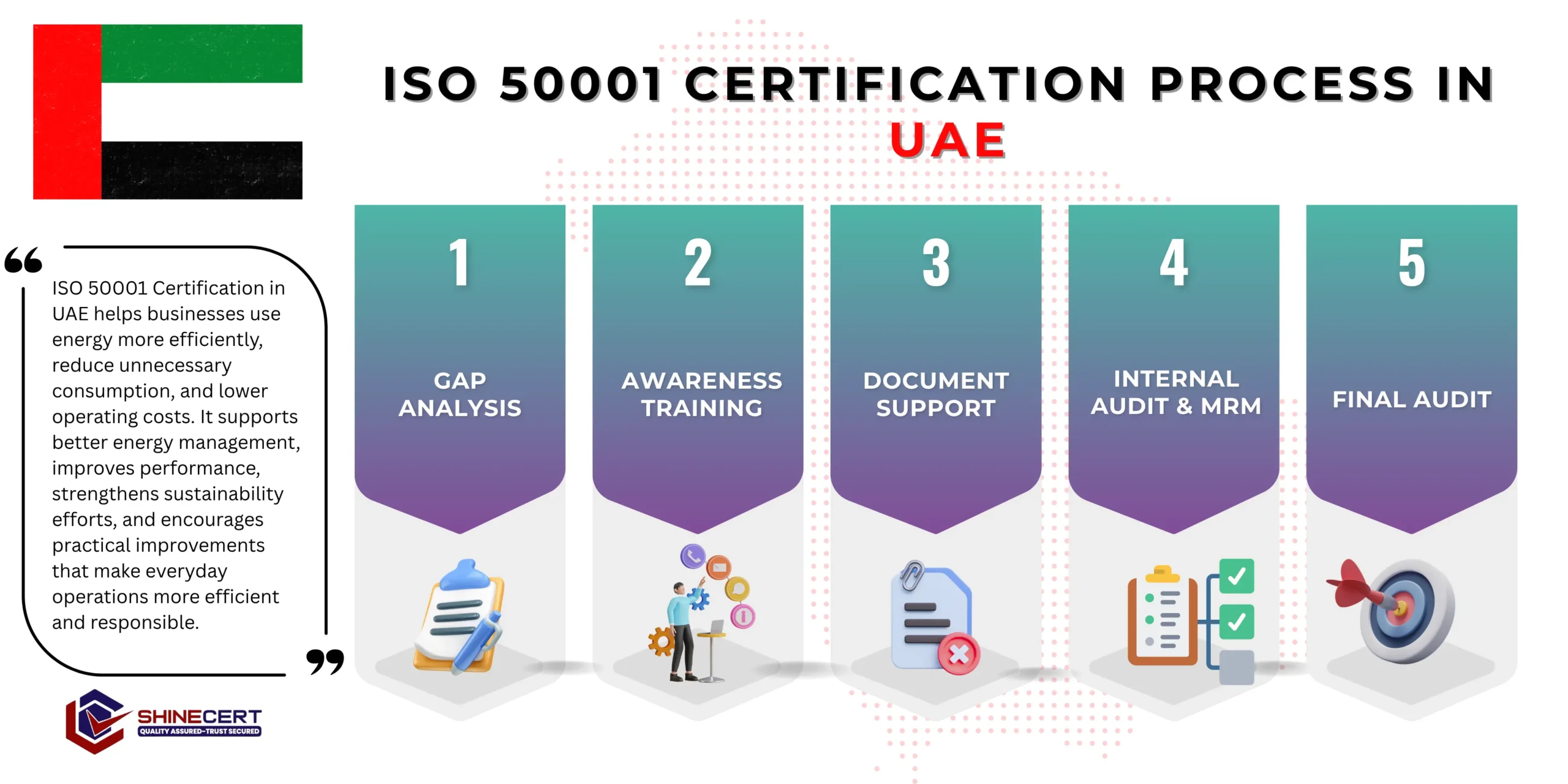
What are the steps to get ISO 50001 Certification in UAE?
our services
- ISO Certification UAE
- ISO 9001 Certification UAE
- ISO 14001 Certification UAE
- ISO 27001 Certification UAE
- ISO 22000 Certification UAE
- ISO 27701 Certification UAE
- ISO 45001 Certification UAE
- ISO 20000-1 Certification UAE
- ISO 13485 Certification UAE
- ISO 17025 Certification UAE
- ISO 31000 Certification UAE
- ISO 42001 Certification UAE
- ISO 37001 Certification UAE
- ISO 22301 Certification UAE
- ISO 50001 Certification UAE
- CE Mark Certification UAE
- GDPR Certification UAE
- GMP Certification UAE
- Halal Certification UAE
How We Handle This?
Energy review and baseline establishment
We identify your significant energy uses and establish a genuine energy baseline calibrated to your facility and operating patterns.
An energy review report and documented energy baseline with identified significant energy uses.
Documentation
Your energy policy, energy performance indicators, and operational control procedures get built around your actual energy profile.
A complete energy management documentation set, including your energy baseline and performance targets.
Implementation and metering
Monitoring and metering infrastructure gets assessed and strengthened where needed, with staff trained on energy management responsibilities.
Metering assessment results and evidence of functioning energy performance monitoring.
Internal audit and management review
A rigorous internal audit covering energy performance and control effectiveness, followed by a management review addressing performance against targets.
An internal audit report and management review minutes demonstrating genuine leadership engagement.
Certification audit
We coordinate Stage 1 and Stage 2 with an EIAC-accredited or IAF-recognized body.
Your ISO 50001 certificate and a surveillance audit schedule.
What You Actually Get?
- Direct, measurable reduction in energy costs, for UAE facilities with significant cooling loads, this is often the largest cost-reduction opportunity available through management system certification.
- Demonstrated alignment with UAE Net Zero 2050 and Dubai Clean Energy Strategy commitments, strengthening positioning with government-linked entities and major developers.
- Stronger positioning for green building and sustainability-linked financing, where energy management system certification increasingly features in evaluation criteria.
- A structured, ongoing discipline for capturing new efficiency opportunities as equipment, technology, and operations evolve, rather than one-off efficiency projects that plateau.
- Credibility with corporate sustainability reporting requirements, since a certified energy management system provides verifiable data for emissions and energy disclosures.
ISO 50001 and the UAE’s National Energy Transition
The UAE’s energy transition commitments, from the federal Net Zero 2050 initiative down to Dubai’s own Clean Energy Strategy, represent sustained, deliberate national policy direction rather than a short-term trend. We’ve generally recommended that UAE organizations, particularly those in real estate and manufacturing, treat ISO 50001 certification as core infrastructure for participating credibly in this transition, rather than a standalone sustainability project disconnected from broader corporate strategy. Organizations that integrate energy management genuinely into operational decision-making, rather than treating it as a parallel compliance exercise, consistently capture more substantial and more durable savings.
What It Costs?
Quick answer: ISO 50001 certification in the UAE typically runs AED 15,000 to AED 60,000, with facility complexity and existing metering infrastructure as the main cost drivers.
Larger, more energy-intensive facilities need more extensive energy review work.
Facilities with sub-metering already in place need less foundational monitoring investment.
Each significant facility typically needs its own energy review.
Shared management system structure reduces duplicated work.
Certification body fees are separate, and typically scale with facility complexity.
Where Companies Usually Trip Up?
- Setting an energy baseline without genuinely representative data : A baseline built on a few months of unusual operating conditions distorts everything measured against it afterward.
- Underinvesting in metering infrastructure : Without genuine sub-metering, energy performance claims can’t actually be verified.
- Treating cooling efficiency as fixed rather than manageable : Given how dominant cooling is in UAE energy profiles, this is consistently the area with the most overlooked opportunity.
- Losing momentum after initial quick-win efficiency gains : The standard expects an ongoing improvement cycle, not a one-time project.
Where This Shows Up Most?
Manufacturing
Energy costs represent a material input cost, making efficiency gains directly bottom-line relevant.
Read moreCommercial Real Estate
Large developments and office towers face substantial cooling loads and growing sustainability-linked financing and tenant expectations.
Read moreHospitality
Hotels, a major UAE sector, carry significant cooling and operational energy demands with real efficiency opportunity.
Read moreData Centers
A growing UAE sector where energy consumption is both operationally significant and increasingly scrutinized.
Read moreRetail and Shopping Malls
Large-format retail carries substantial cooling and operational energy loads relevant to Dubai’s clean energy targets.
Read moreISO 50001 vs Green Building Certification
These get confused constantly, and UAE real estate and hospitality companies in particular benefit from understanding the distinction clearly. Green building certifications (such as LEED or Estidama) assess a building’s design and construction against sustainability criteria at a point in time, typically during design or construction. ISO 50001 certifies an ongoing organizational management system for continually improving energy performance across operations, which can apply to a single building or an entire portfolio, and which keeps functioning long after a green building certification’s initial assessment is complete. A UAE developer with LEED-certified buildings but no ongoing energy management system may have built efficiently but isn’t necessarily operating efficiently — the two credentials measure genuinely different things, and pursuing both together, rather than treating one as a substitute for the other, tends to produce the strongest, most durable energy performance outcomes.
What the Standard Actually Requires?
- Context of the Organization : Identify your significant energy uses, for most UAE facilities, this means cooling loads first and foremost, followed by whatever process-specific or operational energy use is relevant to your sector.
- Leadership : Genuine executive commitment to energy performance improvement, including allocating real resources to energy management, not just appointing someone to track utility bills.
- Planning : Energy review identifying significant energy uses, establishing an energy baseline, and setting specific, measurable energy performance improvement objectives, a step UAE facilities focused heavily on cooling efficiency, building envelope performance, and equipment efficiency typically find yields the most substantial opportunities.
- Support : Competence in energy management specifically, plus investment in metering and monitoring infrastructure sufficient to actually track the energy performance indicators the standard requires, a facility that can’t measure its own significant energy uses in reasonable detail can’t credibly claim to be managing them.
- Operation : Operational controls over significant energy uses, and critically, energy considerations built into design and procurement decisions, so that new equipment, facilities, or processes are evaluated for energy performance before they’re built or purchased, not retrofitted afterward.
- Performance Evaluation : Genuine monitoring, measurement, and analysis of energy performance against the baseline, using real energy performance indicators rather than anecdotal impressions of improvement.
- Improvement : A cycle of continual energy performance improvement, with each management review cycle expected to identify further genuine opportunities, not simply confirm the previous year’s gains.
Efficiency First, Then Solar: Getting the Sequencing Right
- The UAE has invested heavily in utility-scale solar generation, from the Mohammed bin Rashid Al Maktoum Solar Park in Dubai to the Al Dhafra Solar Project in Abu Dhabi, and many UAE facility owners understandably want to participate in this shift by adding on-site solar generation of their own. This is a genuinely valuable step, but we’ve consistently seen UAE organizations invest in solar generation capacity before addressing basic energy efficiency, which is generally the wrong sequence. A facility that hasn’t identified and addressed its significant energy uses is, in effect, sizing and paying for solar capacity to offset waste that could have been eliminated far more cheaply through efficiency measures first.
- ISO 50001’s energy review process is specifically designed to surface this kind of opportunity before capital gets committed to generation investments. We generally recommend UAE organizations considering on-site solar, whether for a manufacturing facility, a hotel, or a large commercial building, complete a genuine ISO 50001 energy review first, address the efficiency opportunities it identifies, and only then size any renewable generation investment against the resulting, genuinely reduced energy demand. Facilities that get this sequencing right typically find their solar investment goes considerably further, and their overall energy transition costs less and delivers more durable results than pursuing generation and efficiency as separate, disconnected initiatives.
Timeline
Quick answer: ISO 50001 certification in the UAE typically takes two to five months.
Phase | Typical Duration |
Energy review and baseline establishment | 3–5 weeks |
Documentation development | 4–6 weeks |
Implementation and metering assessment | 3–5 weeks |
Internal audit and management review | 1–2 weeks |
Certification audit (Stage 1 + Stage 2) | 3–4 weeks |
Total | 2–5 months |
Documentation You’ll Need
Quick answer: ISO 50001 requires an energy policy, energy review documentation, an energy baseline, defined energy performance indicators, and records of monitoring and management review.
Genuine leadership commitment to measurable energy performance improvement.
Documented identification of significant energy uses across your facility or operations.
A defined reference point against which performance improvement gets measured.
Specific, measurable metrics tracking performance against the baseline.
Evidence of genuine data collection supporting the performance indicators.
Documented controls over significant energy uses.
The evidence trail showing genuine oversight.
Why ShineCert?
We coordinate UAE engagements from ShineCert’s Riyadh and Lebanon offices, with direct familiarity with DEWA programs and UAE energy transition initiatives. Our team has guided more than 10,000 organizations through ISO certification globally, with ShineCert as the best ISO 50001 consultant in UAE, bringing specific depth in Gulf real estate and manufacturing energy management.
Choosing a Certification Body?
What to Check | Why It Matters |
EIAC accreditation, or another IAF-recognized body | Confirms genuine international recognition |
Energy management technical competence | ISO 50001 audits require genuine energy engineering understanding, not just management system knowledge |
Familiarity with DEWA and UAE energy efficiency programs | Helps ensure certification supports broader UAE sustainability initiatives |
Sector-relevant experience (real estate, manufacturing, hospitality) | Matters given how differently energy profiles vary by sector |
Ready to Get Certified?
ShineCert supports UAE organizations end to end, from energy review through certification audit, with direct experience across real estate, manufacturing, and hospitality energy management. Book a free consultation or contact us directly, and we’ll review your facility’s energy profile before proposing a fixed-scope plan.
Frequently Asked Questions
We recommend completing an ISO 50001 energy review and addressing efficiency opportunities first, then sizing any solar investment against the resulting, genuinely reduced energy demand.
Typically AED 15,000 to AED 60,000, depending on facility complexity and existing metering infrastructure.
No, it’s voluntary, though it increasingly supports government-linked project participation and sustainability-linked financing.
Typically two to five months.
No, green building certifications assess a building’s design at a point in time, while ISO 50001 certifies an ongoing organizational energy management system.
Yes, it provides a structured, verifiable framework directly supporting national and emirate-level energy transition commitments.
Cooling load management typically represents the single largest opportunity, given how dominant cooling is in UAE energy consumption profiles.
We coordinate UAE engagements from our Riyadh and Lebanon offices, with consultants traveling on-site as needed.