
ISO 22301 Certification in UAE
Quick Answer
The UAE has built a genuinely sophisticated national resilience apparatus, from the National Emergency Crisis and Disaster Management Authority (NCEMA) at the federal level down to sector-specific resilience expectations from regulators like the Dubai Financial Services Authority (DFSA) and the Financial Services Regulatory Authority (FSRA) in the financial free zones. ISO 22301 is the international standard for business continuity management systems, and it gives UAE organizations, particularly those in financial services, logistics, and critical infrastructure, a structured, internationally recognized way to demonstrate they can keep operating, or recover quickly, through disruption. Get certified through a body accredited by the Emirates International Accreditation Centre (EIAC) or another IAF-recognized body. Budget AED 16,000 to AED 68,000 depending on organizational complexity, and plan for two to five months from kickoff to certificate.
What This Standard Actually Does?
ISO 22301 provides a structured framework for identifying what would actually disrupt your organization, determining which functions genuinely cannot go down without serious consequence, and building tested plans to keep those functions running or recover them within an acceptable timeframe. It’s built around business impact analysis and risk assessment rather than generic disaster planning, the standard forces genuinely specific thinking about recovery time objectives, recovery point objectives, and the resources needed to hit them, rather than a vague continuity policy that sounds reassuring but hasn’t actually been tested against a realistic scenario.
Why This Matters So Much Here Specifically?
- The UAE’s economy runs on sectors where disruption carries outsized consequences, global logistics through Jebel Ali Port and Dubai’s airports, financial services concentrated in DIFC and ADGM, and increasingly digital infrastructure supporting the country’s broader economic diversification. NCEMA’s national framework sets expectations for critical infrastructure resilience at the federal level, while DFSA and FSRA both maintain specific business continuity expectations for regulated financial firms operating within DIFC and ADGM respectively. A DIFC-based asset manager or an ADGM-regulated fintech firm operating without a tested business continuity plan is operating with a genuine regulatory gap, not just an operational one.
- Beyond direct regulatory expectations, the UAE’s role as a regional logistics and trade hub means that disruption to a UAE-based operation can cascade well beyond the country’s own borders, a point that increasingly features in how large multinational partners and government-linked entities evaluate UAE suppliers and service providers.
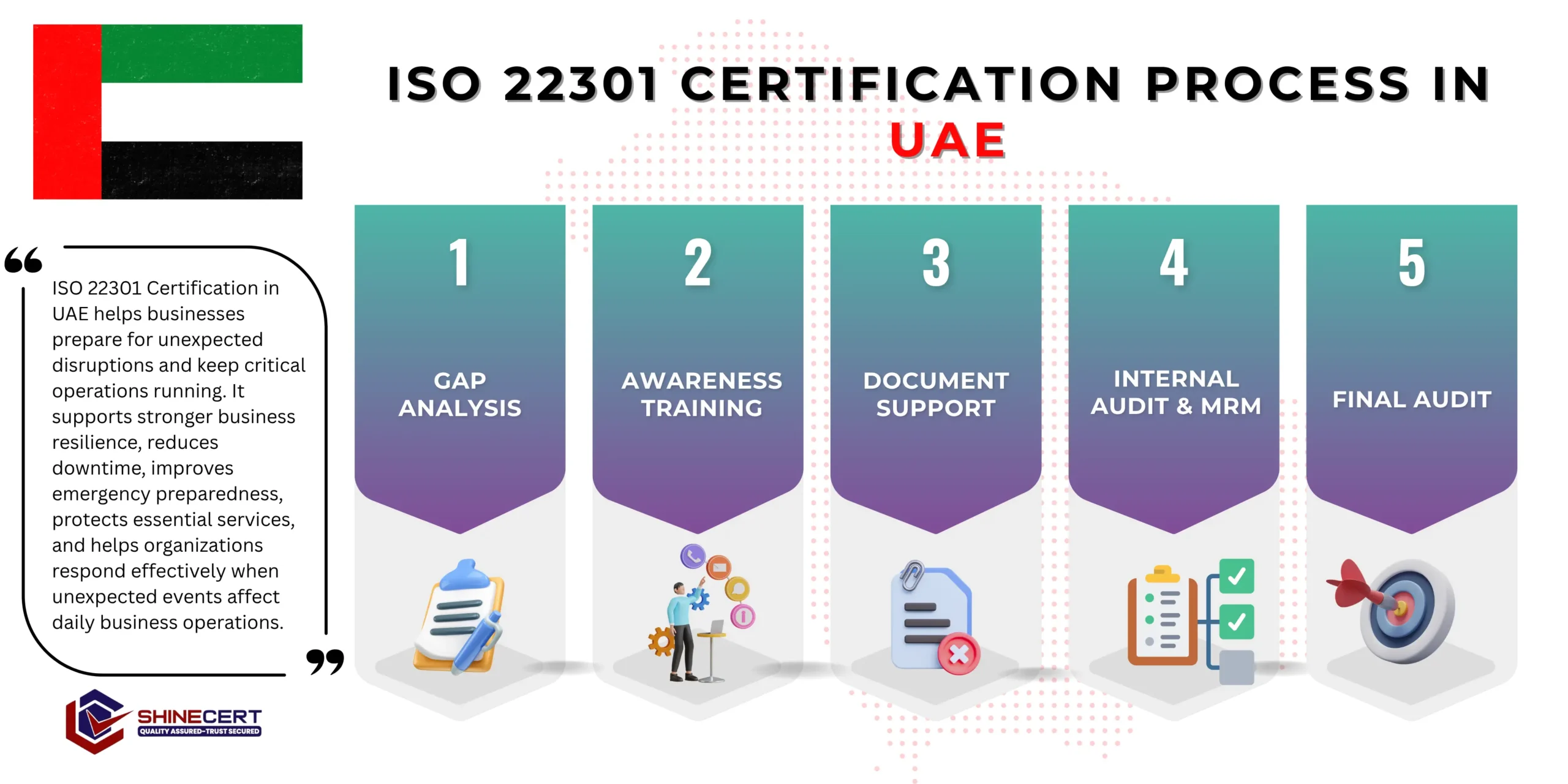
What are the steps to get ISO 22301 Certification in UAE?
our services
- ISO Certification UAE
- ISO 9001 Certification UAE
- ISO 14001 Certification UAE
- ISO 27001 Certification UAE
- ISO 22000 Certification UAE
- ISO 27701 Certification UAE
- ISO 45001 Certification UAE
- ISO 20000-1 Certification UAE
- ISO 13485 Certification UAE
- ISO 17025 Certification UAE
- ISO 31000 Certification UAE
- ISO 42001 Certification UAE
- ISO 37001 Certification UAE
- ISO 22301 Certification UAE
- ISO 50001 Certification UAE
- CE Mark Certification UAE
- GDPR Certification UAE
- GMP Certification UAE
- Halal Certification UAE
How We Handle This?
Business impact analysis and risk assessment
We identify your genuinely critical functions and the risks most likely to disrupt them, calibrated to your specific sector and UAE operating context.
A business impact analysis and risk assessment report identifying your critical functions and recovery targets.
Documentation
Your business continuity policy, strategies, and plans get built around your actual critical functions and DFSA, FSRA, or NCEMA-relevant expectations where applicable.
A complete business continuity management documentation set, including recovery plans for each critical function.
Implementation and exercising
Plans get rolled out and genuinely tested through structured exercises, not just discussed.
Exercise records and evidence of functioning recovery capability.
Internal audit and management review
A rigorous internal audit covering plan effectiveness, followed by a management review addressing exercise results and improvement actions.
An internal audit report and management review minutes showing genuine leadership engagement with resilience.
Certification audit
We coordinate Stage 1 and Stage 2 with an EIAC-accredited or IAF-recognized body.
Your ISO 22301 certificate and a surveillance audit schedule.
What You Actually Get?
- Direct support for DFSA and FSRA regulatory expectations if you’re operating within DIFC or ADGM, reducing regulatory risk and easing routine compliance reviews.
- Stronger positioning with multinational partners and government-linked entities who increasingly specify continuity certification as a supplier requirement, particularly in logistics and critical infrastructure sectors.
- A genuinely tested capability to keep operating, or recover quickly, through disruptions ranging from supply chain interruption to regional infrastructure incidents.
- Reduced insurance costs in some cases, since certified continuity management demonstrates lower operational risk to underwriters.
- Credibility that extends beyond the UAE itself, given the standard’s international recognition across the markets many UAE-based logistics and financial firms serve.
ISO 22301 vs Disaster Recovery Planning
These get conflated constantly, and the distinction matters. Disaster recovery typically refers narrowly to restoring IT systems and data after an incident, servers, backups, failover infrastructure. ISO 22301’s business continuity scope is considerably broader: it covers the entire organization’s ability to keep functioning, including people, facilities, suppliers, and communication, not just technology. A UAE logistics company with an excellent IT disaster recovery plan but no plan for what happens if a key port operation is disrupted, or if key personnel can’t reach a facility, doesn’t have genuine business continuity, it has disaster recovery wearing a continuity label. ISO 22301 certification requires the fuller scope, and organizations that already have solid disaster recovery in place typically find it forms a useful component of, rather than a substitute for, the broader continuity management system the standard requires.
What It Costs?
Quick answer: ISO 22301 certification in the UAE typically runs AED 16,000 to AED 68,000, with organizational complexity and the number of critical functions as the main cost drivers.
More critical functions mean more business impact analysis and plan development work.
Firms need documentation that explicitly maps to DFSA or FSRA expectations.
Less foundational work if formal risk assessment already exists.
Each site typically needs its own business impact analysis.
Certification body fees are separate, and typically scale with organizational size.
Where Companies Usually Trip Up?
- Treating continuity planning as purely an IT recovery exercise : Real business continuity spans supply chain, personnel, and facilities, not just data systems.
- Never actually exercising the plan. A plan that exists only on paper is an untested hypothesis, and auditors test for this directly.
- Underestimating cross-border supply chain disruption scenarios : Especially relevant given the UAE’s role as a logistics and trade hub.
- Communication plans that depend on infrastructure the disruption itself would take down : Redundancy needs to be genuine, not assumed.
Where This Shows Up Most?
Financial Services
DIFC and ADGM-regulated firms face direct DFSA and FSRA continuity expectations.
Read moreLogistics and Trade
Companies operating through Jebel Ali Port, Dubai’s airports, or cross-border supply chains face genuine disruption exposure.
Read moreCritical Infrastructure
Utilities, telecommunications, and infrastructure operators aligned with NCEMA’s national resilience framework.
Read moreTechnology and Data Centers
Providers whose downtime cascades directly to customer operations.
Read moreGovernment-Linked Entities and Their Major Suppliers
Increasingly expected to demonstrate certified continuity management as standard practice.
Read moreISO 22301 in a Region Defined by Its Resilience Ambitions
The UAE has invested heavily and deliberately in national resilience infrastructure, and NCEMA’s framework reflects a genuine, sustained government priority rather than a reactive response to a single incident. We’ve generally recommended that UAE organizations pursuing ISO 22301 build their business impact analysis around realistic regional scenarios, supply chain disruption through key ports, extreme heat events affecting outdoor and logistics operations, and cross-border dependency risk, rather than generic global templates that don’t reflect the specific operating environment. Organizations that do this well tend to find their continuity plans hold up considerably better under genuine testing, and their DFSA or FSRA regulatory conversations go more smoothly as a direct result.
What the Standard Actually Requires?
- Context of the Organization : Identify what your organization actually depends on to function, critical suppliers, infrastructure, and personnel, and which regulatory bodies (DFSA, FSRA, or sector-specific regulators) hold specific continuity expectations over your operations.
- Leadership : Genuine executive ownership of continuity planning, not delegation to an IT department alone. We’ve seen UAE organizations, particularly in logistics, treat business continuity as primarily a technology recovery issue, when auditors expect evidence that leadership actively owns continuity decisions across the whole organization, including supply chain and personnel dimensions.
- Planning : Objectives tied to specific recovery time and recovery point targets for genuinely critical functions, informed by a real business impact analysis rather than an assumption-based one.
- Support : Resources, competence, and communication systems that would actually function during a disruption, including redundant communication channels, since a continuity plan that depends entirely on infrastructure that might itself be affected by the disruption isn’t a functioning plan.
- Operation : Business impact analysis, risk assessment, and business continuity strategies and plans, this is the core of the standard. For UAE logistics and trade-dependent organizations specifically, this needs to explicitly address port, airport, and cross-border supply chain disruption scenarios, not just internal IT failure scenarios.
- Performance Evaluation : Exercising and testing the plans you’ve built, a continuity plan that has never been tested against a realistic scenario is, in practical terms, an untested hypothesis. Auditors specifically look for evidence of genuine exercises, not just tabletop discussions.
- Improvement : Incorporating lessons from actual disruptions and exercises into plan updates, and demonstrating this happens as an ongoing discipline rather than a one-time documentation exercise.
Extreme Heat as a Business Continuity Risk, Not Just a Safety Issue
- UAE summer temperatures regularly exceed 45 degrees Celsius, and while this is well understood as an occupational safety issue under MOHRE’s mandatory midday work break rules, it’s less consistently treated as the genuine business continuity risk it actually represents. Extended extreme heat events can affect outdoor logistics operations, construction schedules, port handling capacity, and even the reliability of certain infrastructure and equipment, in ways that ripple through supply chains well beyond the immediately affected site. A UAE logistics operator whose port handling capacity slows during an extreme heat event, or whose delivery fleet faces mandatory operational restrictions, is experiencing a genuine continuity-relevant disruption, even though it’s a predictable, recurring, seasonal one rather than a sudden crisis.
- We’ve generally recommended that UAE organizations, particularly those with outdoor or logistics-heavy operations, build seasonal extreme heat scenarios explicitly into their business impact analysis rather than treating heat purely as an occupational health topic addressed elsewhere. This means realistic recovery time objectives for functions that slow predictably each summer, and contingency staffing or scheduling plans that account for mandatory heat-related operational restrictions rather than being caught by them each year as if they were unexpected. Organizations that model this properly tend to build continuity plans that are considerably more realistic than ones built around purely sudden-onset disaster scenarios, since seasonal heat disruption is, if anything, more predictable and more certain to occur than most other risks in a typical UAE risk register.
Timeline
Quick answer: ISO 22301 certification in the UAE typically takes two to five months.
Phase | Typical Duration |
Business impact analysis and risk assessment | 3–5 weeks |
Documentation development | 4–6 weeks |
Implementation and exercising | 3–5 weeks |
Internal audit and management review | 1–2 weeks |
Certification audit (Stage 1 + Stage 2) | 3–4 weeks |
Total | 2–5 months |
Documentation You’ll Need
Quick answer: ISO 22301 requires a business continuity policy, business impact analysis, risk assessment, documented continuity plans for critical functions, and exercise and testing records.
Genuine leadership commitment, not a generic statement.
Documented assessment of critical functions and their recovery time and recovery point objectives.
Threats and vulnerabilities specific to your operations and the UAE operating environment.
Documented, specific recovery procedures for each critical function.
Evidence plans have been genuinely tested, not just written.
Redundant communication procedures for use during a disruption.
The evidence trail showing genuine oversight.
Why ShineCert?
We coordinate UAE engagements from ShineCert’s Riyadh and Lebanon offices, with direct familiarity with DFSA, FSRA, and NCEMA resilience expectations. Our team has guided more than 10,000 organizations through ISO certification globally, and as the best ISO 22301 consultant in UAE, we bring specific depth in Gulf financial services and logistics continuity planning.
Choosing a Certification Body?
What to Check | Why It Matters |
EIAC accreditation, or another IAF-recognized body | Confirms genuine international recognition |
Financial services or logistics sector audit experience | Matters given the sector concentration of UAE continuity risk |
Familiarity with DFSA and FSRA expectations | Relevant for DIFC and ADGM-regulated firms specifically |
Regional and international recognition | Important for firms serving customers or regulators beyond the UAE |
Ready to Get Certified?
ShineCert supports UAE organizations end to end, from business impact analysis through certification audit, with direct experience across financial services, logistics, and critical infrastructure. Book a free consultation or contact us directly, and we’ll review your operations before proposing a fixed-scope plan.
Frequently Asked Questions
Yes, extreme heat affects outdoor logistics, construction, and port handling capacity predictably each summer, and we recommend building it explicitly into business impact analysis rather than treating it purely as a workplace safety topic.
Typically AED 16,000 to AED 68,000, depending on organizational complexity.
Not always formally mandatory as a certification, but DFSA and FSRA both maintain business continuity expectations that certification directly supports demonstrating.
Typically two to five months.
No, disaster recovery typically covers IT systems specifically, while ISO 22301 covers the entire organization’s continuity, including people, facilities, and suppliers.
No, it complements national resilience frameworks with an internationally recognized management system, but sector-specific regulatory requirements still apply independently.
The standard requires regular exercising, and we generally recommend at minimum annual testing of critical function recovery plans, with more frequent testing for the highest-priority functions.
We coordinate UAE engagements from our Riyadh and Lebanon offices, with consultants traveling on-site as needed.