
ISO 31000 Certification in UAE
Quick Answer
ISO 31000 is a guidance standard for risk management principles and frameworks, it is not an accredited management system standard, and no legitimate accredited certification body can issue “ISO 31000 certification.” If a consultant offers you ISO 31000 certification, that’s a meaningful red flag worth being skeptical of. What ShineCert provides instead is structured ISO 31000 risk management framework implementation: helping UAE organizations build genuine, principle-based risk management practices using ISO 31000’s guidance, without the false promise of a certificate that doesn’t legitimately exist. Budget AED 12,000 to AED 50,000 depending on organizational complexity, and plan for two to four months for a genuine implementation.
What This Standard Actually Does?
ISO 31000 provides principles, a framework, and a process for managing risk that organizations can apply across any type of risk, strategic, operational, financial, compliance, reputational, rather than focusing on one specific risk domain the way ISO 27001 focuses on information security or ISO 22301 focuses on business continuity. It’s deliberately written as guidance rather than a set of auditable, checkable requirements, which is precisely why it isn’t structured for third-party certification the way management system standards with an Annex SL “shall” structure are. This isn’t a limitation of the standard, it reflects a genuine, deliberate choice in how ISO built it, recognizing that risk management principles need to be adapted to each organization’s specific context rather than checked against a universal requirements list.
Why This Matters So Much Here Specifically?
- The UAE’s rapid economic diversification, from real estate and financial services concentrated in DIFC and ADGM to the country’s expanding technology and logistics sectors, creates genuinely complex, fast-evolving risk environments that boards and senior leadership increasingly need structured frameworks to navigate. Government-linked entities, major developers, and financial institutions across the UAE increasingly expect formal enterprise risk management practices, and ISO 31000’s framework provides the internationally recognized reference point most UAE risk committees and boards are already familiar with.
- We regularly see UAE companies asked by boards, investors, or DFSA and FSRA-adjacent regulatory expectations to demonstrate “ISO 31000-aligned” risk management, and it’s important that this alignment is built honestly, through genuine framework implementation, rather than through a claimed certification that doesn’t legitimately exist.
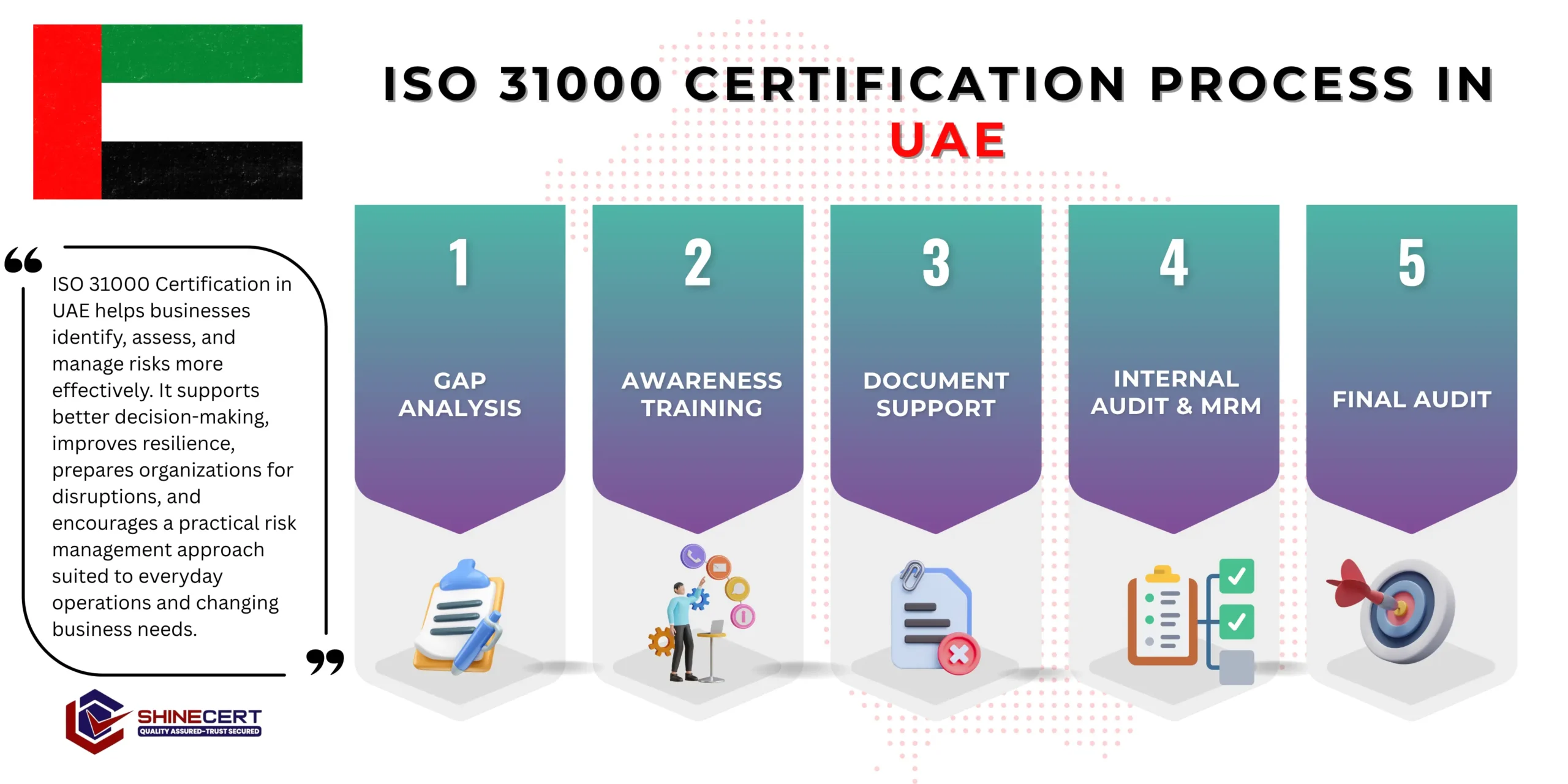
What are the steps to get ISO 31000 Certification in UAE?
our services
- ISO Certification UAE
- ISO 9001 Certification UAE
- ISO 14001 Certification UAE
- ISO 27001 Certification UAE
- ISO 22000 Certification UAE
- ISO 27701 Certification UAE
- ISO 45001 Certification UAE
- ISO 20000-1 Certification UAE
- ISO 13485 Certification UAE
- ISO 17025 Certification UAE
- ISO 31000 Certification UAE
- ISO 42001 Certification UAE
- ISO 37001 Certification UAE
- ISO 22301 Certification UAE
- ISO 50001 Certification UAE
- CE Mark Certification UAE
- GDPR Certification UAE
- GMP Certification UAE
- Halal Certification UAE
How We Handle This?
Context and design
We assess your specific UAE regulatory environment, sector risks, and existing governance structures to design a framework that genuinely fits your organization.
A risk management framework design document tailored to your organizational context.
Framework documentation
Your risk management policy, risk appetite statement, and risk assessment methodology get built around your actual decision-making processes.
A complete risk management framework documentation set.
Implementation and embedding
The framework gets embedded into real business processes, strategic planning, project approval, investment decisions, with relevant staff trained on how to use it in practice.
Evidence of the framework functioning within actual business decisions, not just existing on paper.
Evaluation and refinement
We assess framework effectiveness and refine it based on genuine performance, not just documentation completeness.
A framework evaluation report and refined risk management documentation.
Ongoing support
Unlike a one-time certification audit, genuine risk management benefits from ongoing advisory support as your organization and its risk environment evolve.
An ongoing advisory relationship supporting your framework’s continued relevance and effectiveness.
What You Actually Get?
- A genuine, board-level risk management framework that supports real strategic decision-making, rather than a compliance artifact that exists mainly to satisfy an audit.
- Honest positioning with investors, boards, and regulators who ask about ISO 31000 alignment, you can accurately describe genuine framework implementation rather than an unearned certification claim that could damage credibility if scrutinized.
- A structured way to demonstrate risk management maturity to DIFC and ADGM-adjacent stakeholders and government-linked partners increasingly interested in this area.
- A framework flexible enough to complement, rather than duplicate, any risk-specific management systems you already have or pursue, such as ISO 27001 for information security risk or ISO 22301 for continuity risk.
- Reduced likelihood of costly strategic surprises, since a genuinely functioning risk management framework catches emerging risks earlier than ad hoc, reactive risk discussions.
ISO 31000 vs ISO 27001’s Risk Assessment Requirements
These are often confused, and the distinction is genuinely useful to understand. ISO 27001 includes its own specific, mandatory risk assessment process focused narrowly on information security risk, and that risk assessment is a certifiable requirement within ISO 27001’s broader management system. ISO 31000 provides much broader risk management guidance applicable across any risk domain, and is not itself certifiable. A UAE organization with ISO 27001 certification already has a functioning, narrowly scoped risk assessment process for information security specifically; implementing ISO 31000’s broader framework extends that same risk-thinking discipline across strategic, financial, operational, and other risk categories the narrower ISO 27001 process doesn’t touch. Organizations often find their existing ISO 27001 risk assessment experience genuinely accelerates broader ISO 31000 framework implementation, since the underlying risk assessment skills transfer well.
What It Costs?
Quick answer: Genuine ISO 31000 framework implementation in the UAE typically runs AED 12,000 to AED 50,000, with organizational complexity and the breadth of risk domains covered as the main cost drivers.
Larger, multi-business-unit organizations need more extensive framework design work.
Frameworks spanning strategic, operational, financial, and compliance risk together need more development than a narrower scope.
Organizations with functioning board risk committees need less foundational governance work.
Organizations with ISO 27001 or ISO 22301 already in place can leverage existing risk assessment work.
since no accredited certification exists for this standard, a genuine cost advantage over certifiable standards.
Where Companies Usually Trip Up?
- Being sold “ISO 31000 certification” by a consultant : No accredited body can legitimately issue this, treat any such offer as a serious red flag.
- Building a risk register that nobody actually consults during real decisions : A framework needs to genuinely influence strategic and operational choices, not sit disconnected from them.
- Treating risk appetite as an abstract statement rather than an operational boundary : It needs to genuinely shape which decisions get approved and which don’t.
- Building the framework once and never evaluating whether it’s actually working : Risk environments evolve, and the framework needs ongoing evaluation to stay relevant.
Where This Shows Up Most?
Financial Services
DIFC and ADGM-regulated firms increasingly build formal enterprise risk management frameworks into governance structures.
Read moreReal Estate and Large Developers
Major UAE developers managing genuinely complex project, markets, and financing risk benefit from structured frameworks.
Read moreGovernment-Linked Entities
Organizations navigating public accountability expectations alongside commercial objectives.
Read moreTechnology and AI Companies
Firms managing novel, fast-evolving risk categories that benefit from a structured, adaptable framework rather than a narrow, static checklist.
Read moreFamily Businesses and Conglomerates
UAE’s substantial family business sector increasingly formalizes governance and risk oversight as part of succession and institutionalization efforts.
Read moreBeing Straightforward About What ISO 31000 Is (and Isn’t)
We think it’s worth being genuinely direct about this, since it protects you from a fairly common piece of misinformation in the ISO consulting space: ISO 31000 has no accredited certification scheme, and any consultant or certification body claiming otherwise either doesn’t understand the standard or isn’t being straightforward with you. This matters practically, if a board member, investor, or regulator ever asks to see your “ISO 31000 certificate,” you want to be able to explain accurately that you’ve implemented a genuine, ISO 31000-aligned risk management framework, rather than discovering during that conversation that a certificate you were sold doesn’t actually mean what you were told it meant. We’ve found that UAE organizations that understand this distinction from the outset build considerably more credible risk management positioning with boards and regulators than those that later have to walk back an inaccurate certification claim.
What Genuine ISO 31000 Implementation Actually Involves?
- Mandate and Commitment : Genuine board and senior leadership commitment to risk management as a strategic discipline, with clear accountability for risk oversight built into governance structures, not delegated entirely to a risk department operating in isolation.
- Design : Understanding your organization’s specific context, UAE regulatory environment, sector-specific risks, and stakeholder expectations, and designing a risk management framework that fits your actual organizational structure and decision-making processes, rather than adopting a generic template.
- Implementation : Embedding risk management into actual business processes and decision-making, including strategic planning, project approval, and investment decisions, a framework that exists only in a risk register nobody consults during real decisions isn’t functioning.
- Evaluation : Regularly assessing whether the risk management framework is genuinely effective, whether risks are being identified early enough, whether risk appetite is being respected in practice, and whether the framework is influencing real decisions.
- Improvement : Continual refinement of the framework based on evaluation results, emerging risks, and organizational learning from both near-misses and actual risk events.
- The Risk Management Process Itself : Risk identification, analysis, evaluation, and treatment, applied consistently across whatever risk domains matter to your organization and, critically, genuine monitoring and review to confirm treatments are working as intended, not just documented as complete.
Family Businesses and the Risk That Doesn’t Show Up on a Standard Register
- The UAE’s economy runs substantially on family-owned businesses and conglomerates, many now navigating their first or second generational transition, and this creates a category of risk that a generic risk framework template often misses entirely: succession and governance risk. A family business with excellent operational risk management but no clear, documented succession plan, or with governance structures that blur family relationships and business decision-making, carries genuine strategic risk that conventional risk registers focused on market, credit, and operational categories simply don’t capture.
- We’ve generally recommended that UAE family businesses implementing an ISO 31000-aligned framework explicitly include succession, governance, and family-business-specific risk categories alongside the more conventional risk domains, rather than treating governance and succession planning as a separate, disconnected exercise handled by family members informally.
- This means genuinely assessing questions like what happens to strategic decision-making authority during a leadership transition, whether key person dependency has been identified and addressed, and whether family governance structures (family councils, shareholder agreements) are actually functioning as intended rather than existing only on paper. Family businesses that integrate this into their broader risk framework tend to navigate transitions considerably more smoothly than those that treat succession planning as a separate legal exercise disconnected from day-to-day risk governance.
Timeline
Quick answer: Genuine ISO 31000 framework implementation in the UAE typically takes two to four months.
Phase | Typical Duration |
Context assessment and framework design | 3–5 weeks |
Framework documentation | 3–5 weeks |
Implementation and embedding | 4–6 weeks |
Evaluation and refinement | 2–3 weeks |
Total | 2–4 months |
Documentation You’ll Typically Build
Quick answer: A genuine ISO 31000 implementation typically includes a risk management policy, a risk appetite statement, a risk assessment methodology, a risk register, and framework evaluation records, not a certificate, since none legitimately exists.
Genuine board-level commitment to specific risk management principles.
Documented, specific boundaries defining acceptable risk levels across relevant domains.
A consistent, documented approach to identifying, analyzing, and evaluating risk.
A living document reflecting actual, current organizational risks, not a static compliance artifact.
Documented actions addressing significant risks, with clear ownership.
Evidence the framework’s effectiveness gets genuinely assessed and refined over time.
Why ShineCert?
We coordinate UAE engagements from ShineCert’s Riyadh and Lebanon offices, and we believe strongly in being straightforward about what ISO 31000 is and isn’t. Our team has guided more than 10,000 organizations through ISO certification and framework implementation globally, with ShineCert as the best ISO 31000 consultant in UAE, bringing specific depth in Gulf enterprise risk management.
Choosing a Risk Management Advisor?
What to Check | Why It Matters |
Honesty about certifiability | A genuinely reputable advisor tells you upfront that ISO 31000 certification doesn’t exist |
Genuine risk management, not just documentation, experience | Framework design requires real understanding of governance and decision-making, not just template-writing |
Familiarity with UAE regulatory and governance expectations | Helps ensure the framework genuinely supports board and regulator conversations |
Sector-relevant experience | Risk profiles vary enormously between financial services, real estate, and technology |
Ready to Get Certified?
ShineCert supports UAE organizations end to end with genuine ISO 31000-aligned risk management framework implementation, built honestly and designed to function in real board and strategic decisions. Book a free consultation or contact us directly, and we’ll review your risk environment before proposing a fixed-scope plan.
Frequently Asked Questions
Yes, succession, governance, and key person dependency risk are genuinely distinct categories that conventional risk registers often miss, and we recommend integrating them explicitly rather than treating succession planning separately.
No, ISO 31000 is a guidance standard with no accredited certification scheme. Any consultant claiming to offer “ISO 31000 certification” should be treated with real skepticism.
Typically AED 12,000 to AED 50,000, depending on organizational complexity and risk domain breadth.
Typically two to four months for a genuine, embedded framework.
ISO 27001’s risk assessment is a certifiable, mandatory component focused narrowly on information security risk. ISO 31000 provides broader, non-certifiable guidance applicable across all risk domains.
Usually either genuine confusion about the standard, or a deliberate misrepresentation by a consultant. We recommend asking any consultant offering it to name the specific accreditation body issuing the certificate, since none legitimately exists.
Yes, genuine framework implementation delivers real governance and decision-making value regardless of certifiability, and increasingly matters to boards, investors, and regulators evaluating UAE organizations.
We coordinate UAE engagements from our Riyadh and Lebanon offices, with consultants traveling on-site as needed.