
GDPR Certification in UAE
Quick Answer
GDPR is European Union law, not a UAE regulation, but it applies to UAE businesses that offer goods or services to individuals in the EU, or that monitor the behavior of individuals located in the EU, regardless of where the business itself is based. This extraterritorial reach means a genuinely significant number of UAE companies, e-commerce sellers shipping to Europe, SaaS platforms with European users, professional services firms with EU clients, fall within GDPR’s scope even though they have no physical presence in the EU. ShineCert helps UAE businesses assess genuine GDPR applicability and build compliant data practices distinct from, though often complementary to, UAE’s own PDPL framework. Budget AED 14,000 to AED 60,000 depending on data processing complexity, and plan for two to five months from kickoff to a compliant program.
What GDPR Actually Requires?
General Data Protection Regulation (GDPR) establishes comprehensive requirements for how organizations collect, process, store, and share personal data of individuals in the EU: a documented legal basis for every processing activity, clear and specific consent where consent is the chosen basis, data subject rights including access, correction, deletion, and data portability, breach notification within 72 hours of becoming aware of a qualifying incident, and, for many organizations, formal data protection impact assessments for higher-risk processing activities. It also requires organizations without an EU establishment, but who fall within GDPR’s territorial scope, to appoint an EU-based representative in most circumstances, a requirement UAE businesses frequently overlook entirely.
Why This Matters So Much for UAE Businesses Specifically?
- Dubai and the UAE more broadly have built a genuinely substantial e-commerce, SaaS, and professional services sector that increasingly serves customers well beyond the Gulf region, and European customers represent a meaningful, growing share of that international business for many UAE companies. GDPR’s extraterritorial applicability test doesn’t depend on where a company is incorporated or headquartered, it depends on whether the company offers goods or services to people in the EU or monitors their behavior, which catches a considerably broader set of UAE businesses than most realize, including companies that never intended to specifically target European customers but ended up serving them anyway through organic international growth.
- This creates a genuinely distinct compliance obligation running alongside UAE’s own PDPL framework (Federal Decree-Law No. 45 of 2021), a separate law entirely, enforced by a separate authority (the UAE Data Office), with its own separate requirements. A UAE company can be fully PDPL-compliant domestically while still being in breach of GDPR for how it handles EU customers’ data, since the two laws, while structurally similar, are not the same law and don’t automatically satisfy each other.
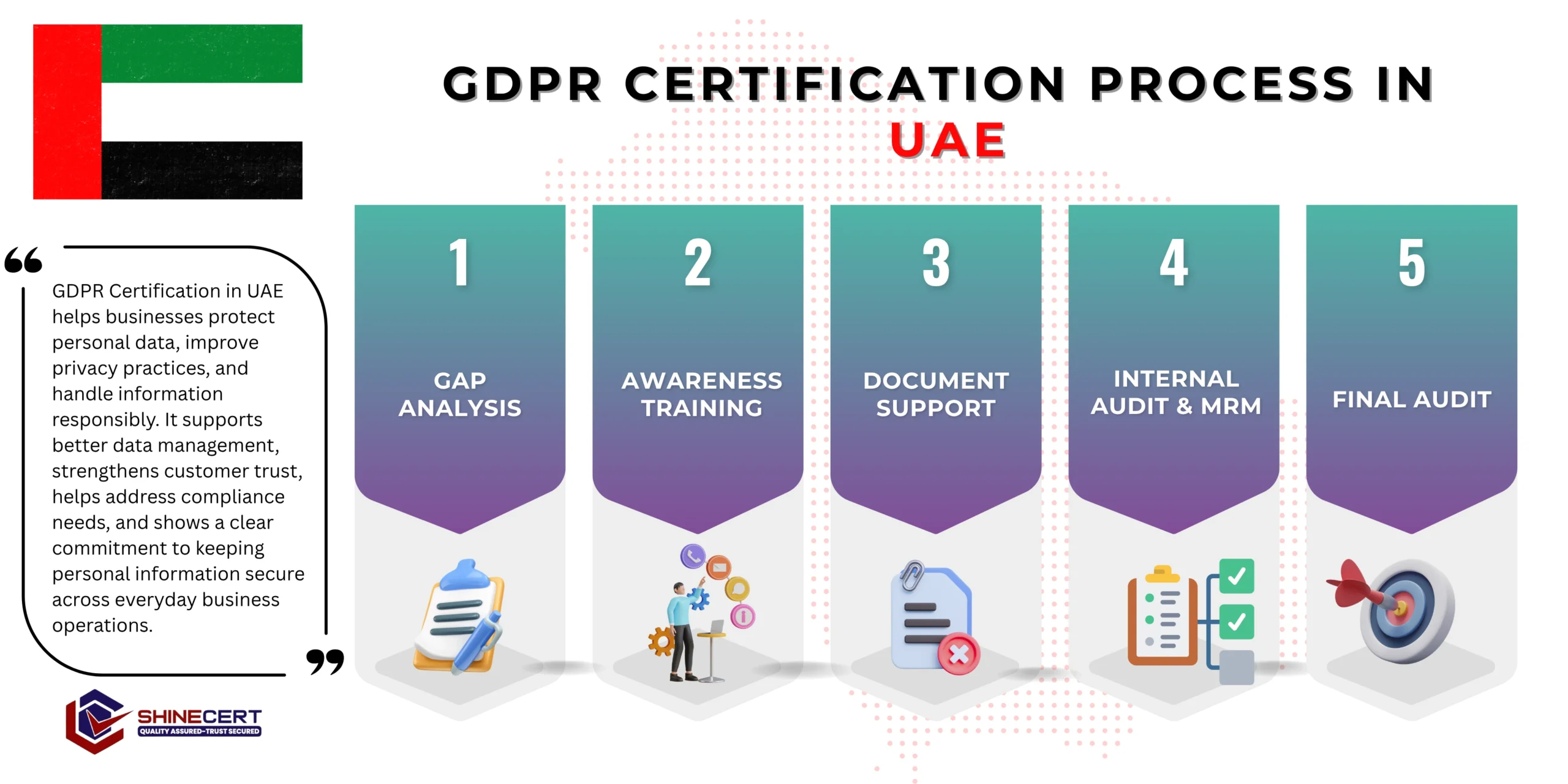
What are the steps to get GDPR Certification in UAE?
our services
- ISO Certification UAE
- ISO 9001 Certification UAE
- ISO 14001 Certification UAE
- ISO 27001 Certification UAE
- ISO 22000 Certification UAE
- ISO 27701 Certification UAE
- ISO 45001 Certification UAE
- ISO 20000-1 Certification UAE
- ISO 13485 Certification UAE
- ISO 17025 Certification UAE
- ISO 31000 Certification UAE
- ISO 42001 Certification UAE
- ISO 37001 Certification UAE
- ISO 22301 Certification UAE
- ISO 50001 Certification UAE
- CE Mark Certification UAE
- GDPR Certification UAE
- GMP Certification UAE
- Halal Certification UAE
How We Handle This?
Applicability and gap assessment
We assess whether GDPR genuinely applies to your business and identify specific compliance gaps relative to your actual EU-facing activities.
A GDPR applicability determination and gap analysis specific to your business.
Legal basis and documentation
Your data processing inventory, legal basis documentation, and privacy notices get built around your actual EU-facing data processing activities.
A complete GDPR compliance documentation set distinct from, and complementary to, your UAE PDPL documentation.
EU representative and transfer mechanisms
We help you appoint an EU representative where required and establish valid international transfer mechanisms for EU personal data.
EU representative appointment and documented, valid data transfer mechanisms.
Implementation and training
Data subject rights procedures and breach notification processes get rolled out, with relevant staff trained on the specific GDPR obligations distinct from PDPL.
Training records and evidence of functioning data subject rights and breach response processes.
Ongoing compliance support
GDPR compliance benefits from ongoing monitoring as your EU-facing business and data processing activities evolve.
An ongoing advisory relationship supporting continued GDPR compliance as your business grows.
What You Actually Get?
- Genuine legal compliance for the EU portion of your business, reducing exposure to GDPR’s substantial penalty structure (up to 4% of global annual turnover or €20 million, whichever is higher, for the most serious violations).
- Credibility with EU customers and business partners, who increasingly expect demonstrated GDPR compliance before entering data-sharing relationships or contracts.
- A structured framework that, properly built, complements rather than duplicates your UAE PDPL compliance work, since the underlying privacy principles overlap substantially even though the specific legal requirements differ.
- Reduced risk of losing EU market access or facing supervisory authority action, which can include processing bans that would directly cut off EU customer relationships.
- Clarity on a genuinely complex, easily misunderstood area of law that many UAE businesses either wrongly assume doesn’t apply to them, or wrongly assume their UAE PDPL compliance already covers.
GDPR Compliance as UAE Businesses Scale Internationally
As UAE e-commerce, SaaS, and professional services businesses increasingly pursue genuine international growth beyond the Gulf region, European customers represent a natural, substantial market opportunity that many UAE companies enter organically, sometimes without fully realizing the specific compliance obligations that come with it. We’ve generally recommended that UAE businesses seeing meaningful EU customer growth conduct a genuine GDPR applicability assessment proactively, rather than waiting until a European customer, partner, or regulator specifically raises the question, since building compliant data practices takes real time and can’t be assembled reactively once a formal inquiry or complaint has already arrived.
What It Costs?
Quick answer: General Data Protection Regulation (GDPR) compliance for UAE businesses typically runs AED 14,000 to AED 60,000, with the volume and sensitivity of EU personal data processed as the main cost driver.
Businesses with substantial EU customer bases need more extensive compliance infrastructure.
Shared privacy infrastructure and risk assessment work lowers foundational costs.
Establishing valid transfer mechanisms requires specific documentation work.
This typically involves an ongoing service relationship, not just a one-time fee.
since GDPR compliance isn’t a certifiable standard in the way ISO management systems are, a genuine cost distinction worth understanding upfront.
Where UAE Businesses Usually Trip Up?
- Assuming UAE PDPL compliance automatically covers GDPR : They’re separate laws with separate requirements, even though the underlying principles overlap.
- Missing the EU representative requirement entirely : This is one of the most commonly overlooked GDPR obligations for non-EU businesses.
- Underestimating the 72-hour breach notification timeframe : This requires tested readiness in advance, not improvised response during an actual incident.
- Assuming GDPR doesn’t apply just because the business is UAE-based : Extraterritorial applicability depends on genuine EU targeting or monitoring activity, not company location.
Where This Shows Up Most?
E-commerce and Retail
UAE-based online sellers shipping to or marketing toward EU customers face direct GDPR applicability.
Read moreSaaS and Technology Platforms
Software companies with European users or customers, regardless of where the company itself is based.
Read moreProfessional and Consulting Services
Firms serving EU clients directly, including law firms, consultancies, and agencies.
Read moreMarketing and Advertising Technology
Companies processing behavioral data of EU individuals for targeting purposes face particularly direct scrutiny.
Read moreHospitality and Travel
UAE hotels, tour operators, and travel platforms handling EU visitors’ booking and personal data.
Read moreGDPR vs UAE PDPL
These are structurally similar but legally distinct, and understanding the difference matters practically for any UAE business operating internationally. UAE PDPL (Federal Decree-Law No. 45 of 2021) is UAE federal law, enforced by the UAE Data Office, applying to data processing activities connected to the UAE. GDPR is EU law, enforced by EU supervisory authorities, applying based on its own separate extraterritorial test tied to EU individuals and EU-directed activity, regardless of where the processing organization is based. A UAE company processing UAE customers’ data needs PDPL compliance; the same company also serving EU customers needs General Data Protection Regulation (GDPR) compliance for that portion of its business, as a genuinely separate legal obligation. We generally recommend UAE businesses build a single, coherent privacy program addressing both frameworks together, since the underlying data mapping and rights-handling infrastructure can largely be shared, even though the specific legal triggers and penalty structures differ.
What Genuine GDPR Compliance Actually Involves?
- Applicability Assessment : Honestly determining whether GDPR actually applies to your business, do you offer goods or services to people in the EU, or monitor EU individuals’ behavior? This isn’t automatic just because your website is technically accessible from Europe; it depends on genuine targeting or monitoring activity.
- Legal Basis Mapping : For each processing activity involving EU individuals’ data, a documented, defensible legal basis, consent, contract necessity, legitimate interest, or others, not an assumed justification.
- Data Subject Rights Procedures : Documented, tested processes for handling access, correction, deletion, and portability requests within GDPR’s specific timeframes, which are considerably shorter and more rigid than many non-EU businesses initially expect.
- EU Representative Appointment : For UAE businesses without an EU establishment falling within GDPR’s territorial scope, formal appointment of an EU-based representative is typically required, a step frequently missed entirely by companies focused primarily on domestic UAE compliance.
- Breach Notification Readiness : A tested capability to detect, assess, and notify relevant EU supervisory authorities within 72 hours of becoming aware of a qualifying breach, a genuinely tight timeframe that requires advance preparation, not improvisation during an actual incident.
- International Transfer Mechanisms : Documented, legally valid mechanisms for any transfer of EU personal data back to the UAE or onward to other jurisdictions, since the UAE does not currently hold an EU adequacy decision, meaning transfers require Standard Contractual Clauses or another valid transfer mechanism.
Dubai’s Free Zones Add Another Layer Worth Understanding
- UAE businesses operating out of DIFC or ADGM face a genuinely three-layered privacy compliance picture when they also serve EU customers: their own free zone’s data protection law (DIFC or ADGM each maintain separate regimes from federal PDPL), federal UAE PDPL if any part of their operations touches mainland UAE activity, and GDPR for any EU-facing processing. This isn’t a hypothetical edge case, DIFC and ADGM host a disproportionate share of UAE’s internationally facing financial services and technology companies, exactly the businesses most likely to have genuine EU customer relationships.
- We’ve generally recommended that UAE businesses in this position build a single privacy governance structure capable of demonstrating compliance across all applicable layers simultaneously, mapping which specific data processing activities trigger which specific legal obligation, rather than maintaining separate, disconnected compliance efforts for each framework. Businesses that get this integration right tend to handle regulator inquiries and customer due diligence requests considerably more smoothly than those juggling three parallel, poorly coordinated compliance programs, since a genuine data subject request from an EU customer, for instance, still needs to be evaluated against whichever specific UAE framework also applies to the underlying business relationship.
Timeline
Quick answer: GDPR compliance for UAE businesses typically takes two to five months, often faster with existing UAE PDPL infrastructure in place.
Phase | Typical Duration |
Applicability and gap assessment | 2–3 weeks |
Legal basis and documentation | 4–6 weeks |
EU representative and transfer mechanisms | 2–4 weeks |
Implementation and training | 3–5 weeks |
Total | 2–5 months |
Documentation You’ll Need
Quick answer: GDPR compliance requires a data processing inventory, legal basis documentation, privacy notices addressed to EU individuals, data subject rights procedures, and, where applicable, EU representative appointment and transfer mechanism documentation.
Documented mapping of what EU individuals’ personal data you process and why.
A defensible justification for each processing activity involving EU data.
Clear, GDPR-compliant notices specifically addressing EU data subjects’ rights.
Documented, tested processes meeting GDPR’s specific response timeframes.
Formal documentation where your business falls within GDPR’s territorial scope without an EU establishment.
Standard Contractual Clauses or another valid mechanism for UAE-EU data transfers.
Tested processes meeting the 72-hour notification requirement.
Why ShineCert?
We coordinate UAE engagements from ShineCert’s Riyadh and Lebanon offices, with direct familiarity with both GDPR’s extraterritorial requirements and UAE’s domestic PDPL framework. Our team has guided more than 10,000 organizations through ISO certification and international compliance globally, with ShineCert as the best GDPR consultant in UAE, bringing specific depth in cross-border data protection for Gulf businesses.
Choosing a GDPR Advisor?
What to Check | Why It Matters |
Genuine EU data protection law expertise | GDPR is complex EU legislation, and advisors need real, current familiarity with it, not just general privacy knowledge |
Honest applicability assessment | A reputable advisor tells you accurately whether GDPR actually applies, rather than overselling scope |
Understanding of UAE PDPL alongside GDPR | Helps ensure the two compliance programs work together efficiently rather than duplicating effort |
Access to EU representative services | Necessary for the formal representative appointment many UAE businesses require |
Ready to Get Certified?
ShineCert supports UAE businesses end to end through GDPR applicability assessment and compliance program development, with direct experience navigating both GDPR and UAE PDPL together. Book a free consultation or contact us directly, and we’ll review your EU-facing data processing before proposing a fixed-scope plan.
Frequently Asked Questions
Yes, DIFC and ADGM each maintain their own separate data protection regimes distinct from federal PDPL, creating a three-layered compliance picture for businesses also serving EU customers.
Yes, if you offer goods or services to individuals in the EU, or monitor their behavior, regardless of whether your business has any physical presence in Europe.
Typically AED 14,000 to AED 60,000, depending on the volume and sensitivity of EU personal data processed.
No, they’re separate laws enforced by separate authorities, though the underlying privacy principles overlap substantially.
Typically two to five months, often faster with existing UAE PDPL infrastructure already in place.
Often yes, if the business falls within GDPR’s territorial scope without having an EU establishment, this is a commonly overlooked requirement.
Potential exposure includes substantial fines (up to 4% of global annual turnover or €20 million) and possible restrictions on processing EU customers’ data, which could effectively cut off EU market access.
We coordinate UAE engagements from our Riyadh and Lebanon offices, with consultants traveling on-site as needed.