
ISO 27701 Certification in UAE
Quick Answer
The UAE Personal Data Protection Law (Federal Decree-Law No. 45 of 2021), closely modeled on the EU’s GDPR, is moving toward full enforcement completing in January 2027, with the UAE Data Office empowered to issue fines ranging from AED 50,000 to AED 5 million. ISO 27701 extends an existing ISO 27001 information security management system with privacy-specific controls, giving UAE organizations a structured, internationally recognized framework for demonstrating genuine PDPL readiness rather than a hastily assembled privacy policy. Get certified through a body accredited by the Emirates International Accreditation Centre (EIAC) or another IAF-recognized body. Budget AED 17,000 to AED 70,000 depending on organizational complexity and existing ISO 27001 maturity, and plan for two to five months from kickoff to certificate.
What This Standard Actually Does?
ISO 27701 isn’t a standalone certification, it’s an extension to ISO 27001 that adds privacy-specific requirements covering how you collect, process, store, and share personal data, whether you’re acting as a data controller determining why and how data gets processed, a data processor handling data on someone else’s behalf, or both. It requires you to map your data flows genuinely thoroughly, establish a proper legal basis for processing, honor data subject rights (access, correction, deletion), and build breach notification procedures that actually function under time pressure rather than existing only as a paragraph in a policy document.
Why This Matters So Much Here Specifically?
- UAE PDPL enforcement is moving from a relatively quiet implementation phase toward full enforcement completing in January 2027, and the UAE Data Office’s authority to issue fines up to AED 5 million gives this genuine financial teeth that many UAE businesses haven’t yet fully internalized. As of mid-2026, the UAE has not published an official adequacy list or standard contractual clauses for international data transfers, which creates a genuine, currently unresolved gap that UAE organizations transferring data internationally, a category that includes most companies operating through DIFC, ADGM, or serving customers outside the UAE, need to navigate carefully in the absence of clear regulatory guidance.
- Federal Decree-Law No. 26 of 2025 on Child Digital Safety, in force since January 2026, adds a further layer specifically for platforms serving users under 18, requiring age verification and parental consent mechanisms, a genuinely distinctive UAE regulatory feature that ISO 27701’s privacy-by-design principles help operationalize.
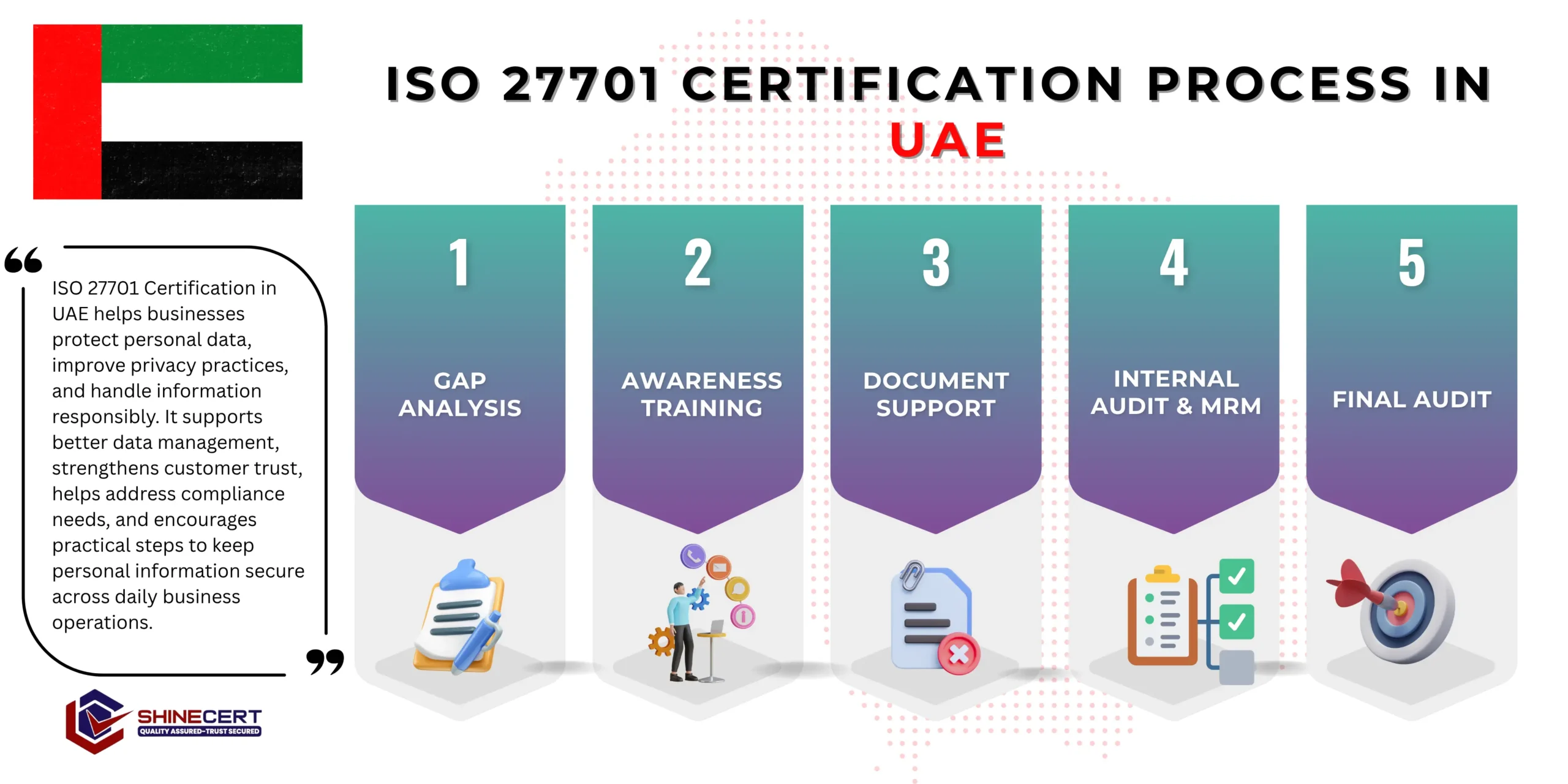
What are the steps to get ISO 27701 Certification in UAE?
our services
- ISO Certification UAE
- ISO 9001 Certification UAE
- ISO 14001 Certification UAE
- ISO 27001 Certification UAE
- ISO 22000 Certification UAE
- ISO 27701 Certification UAE
- ISO 45001 Certification UAE
- ISO 20000-1 Certification UAE
- ISO 13485 Certification UAE
- ISO 17025 Certification UAE
- ISO 31000 Certification UAE
- ISO 42001 Certification UAE
- ISO 37001 Certification UAE
- ISO 22301 Certification UAE
- ISO 50001 Certification UAE
- CE Mark Certification UAE
- GDPR Certification UAE
- GMP Certification UAE
- Halal Certification UAE
How We Handle This?
Data mapping and gap analysis
We map your organization’s actual data flows and assess current privacy practices against ISO 27701 and PDPL requirements.
A data mapping report and gap analysis identifying your specific privacy compliance gaps.
Documentation
Your privacy policy, data processing records, and data subject rights procedures get built around your actual data flows and UAE regulatory requirements.
A complete privacy information management documentation set aligned with PDPL.
Implementation and training
Data subject rights handling procedures and breach response processes get rolled out, with staff trained by role.
Training records and evidence of functioning data subject rights and breach response processes.
Internal audit and management review
A rigorous internal audit covering privacy control effectiveness, followed by a management review addressing regulatory compliance status.
An internal audit report and management review minutes demonstrating genuine leadership oversight.
Certification audit
We coordinate Stage 1 and Stage 2 with an EIAC-accredited or IAF-recognized body, building on your existing ISO 27001 certification.
Your ISO 27701 certificate and a surveillance audit schedule.
What You Actually Get?
- Demonstrated readiness for full UAE PDPL enforcement completing in January 2027, reducing the risk of facing significant fines during a transition period many UAE businesses are still catching up to.
- A structured way to navigate the current international data transfer gap, with documented due diligence that provides genuine protection even in the absence of official UAE adequacy guidance.
- Stronger positioning with DIFC and ADGM regulators, and with international partners who increasingly require privacy management evidence before entering data-sharing relationships.
- A functioning framework for Child Digital Safety Law compliance if you serve users under 18, since privacy-by-design principles map directly onto age verification and parental consent requirements.
- Reduced breach response risk, since tested procedures and clear data mapping mean a genuine incident gets handled with speed and precision rather than confusion.
ISO 27701 During PDPL’s Enforcement Transition
The period between now and full PDPL enforcement completing in January 2027 is exactly the window where UAE organizations have the most room to build genuinely robust privacy programs before regulatory pressure intensifies. We’ve generally recommended that UAE businesses use this transition period deliberately, rather than waiting until enforcement tightens to discover gaps under regulatory pressure. Organizations that build ISO 27701-certified privacy management systems now tend to find the eventual transition to full enforcement considerably less disruptive than those that wait, and they’re better positioned to adapt once the UAE Data Office eventually publishes clearer guidance on international transfers.
What It Costs?
Quick answer: ISO 27701 certification in the UAE typically runs AED 17,000 to AED 70,000, with existing ISO 27001 maturity and data processing complexity as the main cost drivers.
Building the privacy extension is meaningfully cheaper than starting from zero.
More extensive data mapping needed for complex data environments.
Given the current absence of UAE adequacy guidance, this requires more careful documentation.
Platforms serving minors need additional Child Digital Safety Law alignment work.
Certification body fees are separate, typically bundled efficiently with ISO 27001 surveillance audits.
Where Companies Usually Trip Up?
- Treating ISO 27701 as a standalone project separate from ISO 27001 : The two need to function as a genuinely integrated management system.
- Data mapping that misses shadow IT and departmental data silos : Marketing tools, spreadsheets, and unofficial systems often hold personal data nobody formally accounted for.
- International transfers handled with informal assumptions rather than documented due diligence : Given the current UAE adequacy gap, this needs deliberate documentation.
- Overlooking Child Digital Safety Law requirements for platforms with any under-18 users : Even platforms not explicitly targeting minors may have them as users.
Where This Shows Up Most?
Financial Services
DIFC and ADGM-regulated firms handle sensitive financial and personal data under close regulatory scrutiny.
Read moreTechnology and SaaS Companies
Platforms processing user data face direct PDPL applicability, plus Child Digital Safety Law obligations if serving younger users.
Read moreE-commerce and Retail
Companies handling customer payment and personal data across UAE and international markets.
Read moreHealthcare
Facilities and platforms handling patient data face particularly sensitive privacy obligations.
Read moreMarketing and Advertising Technology
Companies processing behavioral and personal data for targeting face direct scrutiny under PDPL’s consent requirements.
Read moreISO 27701 vs GDPR Compliance
These are closely related but distinct. GDPR is a European Union legal framework with its own extraterritorial reach; UAE PDPL is a separate UAE federal law, closely modeled on GDPR’s structure but with its own specific enforcement body (the UAE Data Office), its own penalty structure, and its own evolving guidance, including the currently unresolved international transfer question. ISO 27701 certification isn’t tied to either specific law, it’s a management system standard that, properly implemented, provides strong supporting evidence for compliance with both, since PDPL’s structure borrows heavily from GDPR’s own logic. UAE companies serving European customers, or European companies operating UAE subsidiaries, often find that a single, well-implemented ISO 27701 system supports both compliance obligations more efficiently than building two separate, parallel privacy programs.
What the Standard Actually Requires?
- Context of the Organization : Determine whether you’re a data controller, processor, or both, and map which UAE and international privacy obligations apply, PDPL, sector-specific rules from DFSA or FSRA if operating in DIFC or ADGM, and destination-country requirements if you transfer data internationally.
- Leadership : Genuine commitment to privacy as an organizational priority, with a designated privacy role (equivalent to a data protection officer) that has real authority to make decisions, not just advise.
- Planning : Privacy risk assessment covering the specific categories of personal data you handle, with particular attention to any data involving minors given the Child Digital Safety Law’s specific requirements.
- Support : Staff training on privacy obligations calibrated to role, customer service staff handling data subject access requests need meaningfully different training than marketing staff processing data for campaigns.
- Operation : This is the substantial core: data mapping across your entire organization, establishing legal basis for each processing activity, honoring data subject rights within defined timeframes, managing third-party data processor relationships through proper contracts, and handling international data transfers, a genuinely complex area given the current absence of published UAE adequacy determinations or standard contractual clauses.
- Performance Evaluation : Monitoring compliance against PDPL requirements and tracking data subject request handling and any privacy incidents.
- Improvement : Structured breach response and continual improvement of privacy controls based on incidents, regulatory guidance updates, and internal audit findings.
A UAE-Specific Wrinkle: Free Zones Run Their Own Data Protection Laws
- One of the more genuinely distinctive features of the UAE’s privacy landscape, and one that trips up companies moving here from more centralized regulatory environments, is that DIFC and ADGM each operate under their own separate data protection regulations, distinct from the federal PDPL that applies across the rest of the country. A company registered within DIFC needs to comply with DIFC’s own data protection law, enforced by the DIFC Commissioner of Data Protection, while a company registered in mainland Dubai or Abu Dhabi outside these free zones falls under federal PDPL and the UAE Data Office instead. Companies operating across multiple UAE jurisdictions, a mainland entity alongside a DIFC-registered financial subsidiary, for instance, can find themselves subject to two separate, though broadly similar, privacy regimes simultaneously.
- This isn’t a minor technicality. The specific consent requirements, breach notification timelines, and enforcement mechanisms differ in meaningful ways between DIFC’s regime and the federal PDPL, and a privacy program built around only one of them can leave a genuine gap for a multi-jurisdiction UAE group. We’ve generally recommended that UAE organizations operating across mainland and free zone entities build a single ISO 27701-certified privacy management system flexible enough to demonstrate compliance with whichever specific regime applies to each entity, rather than maintaining entirely separate, disconnected privacy programs that are harder to keep consistent and harder to audit as a whole.
Timeline
Quick answer: ISO 27701 certification in the UAE typically takes two to five months, often faster if pursued alongside or after an existing ISO 27001 certification.
Phase | Typical Duration |
Data mapping and gap analysis | 3–5 weeks |
Documentation development | 4–6 weeks |
Implementation and training | 3–5 weeks |
Internal audit and management review | 1–2 weeks |
Certification audit (Stage 1 + Stage 2) | 3–4 weeks |
Total | 2–5 months |
Documentation You’ll Need
Quick answer: ISO 27701 requires an existing or concurrent ISO 27001 certification, a privacy policy, a data processing inventory, data subject rights procedures, and breach notification procedures.
ISO 27701 extends ISO 27001 and cannot be pursued independently.
A genuine, thorough map of what personal data you hold and why.
For each processing activity, a documented justification under PDPL.
Documented processes for handling access, correction, and deletion requests within required timeframes.
Documented data processing agreements with vendors and partners.
Tested processes for detecting and reporting privacy incidents.
The evidence trail showing genuine oversight.
Why ShineCert?
We coordinate UAE engagements from ShineCert’s Riyadh and Lebanon offices, with direct familiarity with UAE PDPL, the Data Office, and the Child Digital Safety Law. Our team has guided more than 10,000 organizations through ISO certification globally, with ShineCert, the best ISO 27701 consultant in UAE, bringing specific depth in Gulf data protection compliance.
Choosing a Certification Body?
What to Check | Why It Matters |
EIAC accreditation, or another IAF-recognized body | Confirms genuine international recognition |
Genuine ISO 27001 and privacy specialization | ISO 27701 audits require both information security and privacy expertise |
Familiarity with UAE PDPL and the Data Office | Helps ensure certification genuinely supports your regulatory readiness |
Understanding of the international transfer gap | Important given the current absence of published UAE adequacy guidance |
Ready to Get Certified?
ShineCert supports UAE organizations end to end, from data mapping through certification audit, with direct experience navigating UAE PDPL and the Child Digital Safety Law. Book a free consultation or contact us directly, and we’ll review your data processing activities before proposing a fixed-scope plan.
Frequently Asked Questions
Yes, DIFC and ADGM each operate their own data protection regulations, distinct from the federal PDPL that applies to the rest of the UAE, and multi-jurisdiction groups may need to comply with more than one regime.
Typically AED 17,000 to AED 70,000, depending on organizational complexity and existing ISO 27001 maturity.
Yes, ISO 27701 extends ISO 27001 and cannot be certified independently, though the two can be implemented concurrently.
Full enforcement is completed in January 2027, with the UAE Data Office empowered to issue fines from AED 50,000 to AED 5 million.
No, as of mid-2026 there is no official UAE adequacy list or published standard contractual clauses, which requires careful documented due diligence for international transfers.
It provides a strong foundation through privacy-by-design principles, though platforms serving minors need to layer on specific age verification and parental consent mechanisms required by that law.
Typically two to five months.
We coordinate UAE engagements from our Riyadh and Lebanon offices, with consultants traveling on-site as needed.