
ISO 37001 Certification in UAE
Quick Answer
The UAE has steadily tightened its anti-corruption legal framework and increasingly expects transparency and integrity controls from companies bidding on government contracts, particularly in construction, infrastructure, and large-scale procurement. ISO 37001 is the international anti-bribery management system standard, and it gives UAE organizations a structured, independently verified way to demonstrate genuine anti-corruption controls rather than a policy document that exists mainly for show. Get certified through a body accredited by the Emirates International Accreditation Centre (EIAC) or another IAF-recognized body. Budget AED 15,000 to AED 62,000 depending on organizational size and risk exposure, and plan for two to five months from kickoff to certificate.
What This Standard Actually Does?
ISO 37001 provides a management system framework specifically designed to prevent, detect, and respond to bribery, covering bribery by the organization’s own personnel, by business associates acting on its behalf, and bribery directed at the organization itself. It requires risk assessment calibrated to your specific exposure (which countries you operate in, which sectors, whether you deal with government officials or use intermediaries), due diligence procedures for business partners and agents, financial controls designed to detect suspicious payments, and a genuinely independent reporting channel for concerns. Unlike a generic code of conduct, it demands documented evidence that these controls actually function, not just that they exist on paper.
Why This Matters So Much Here Specifically?
- The UAE’s federal anti-corruption framework, enforced through bodies including the Abu Dhabi Accountability Authority and federal anti-corruption provisions, has moved toward stricter enforcement in recent years, and government entities across the UAE increasingly build integrity and anti-bribery expectations directly into tender and procurement processes, particularly for large infrastructure, construction, and government-linked projects. Companies bidding on major government contracts, a genuinely significant category in a market where government and government-linked entities drive substantial economic activity, increasingly find that demonstrated anti-bribery controls strengthen their tender position, and in some cases are becoming a practical prerequisite rather than a nice-to-have differentiator.
- Beyond direct government contracting, the UAE’s role as a regional hub for multinational operations means many UAE-based companies operate under parent-company anti-bribery obligations (UK Bribery Act, US Foreign Corrupt Practices Act) that ISO 37001 certification helps demonstrate compliance with at the local subsidiary level.
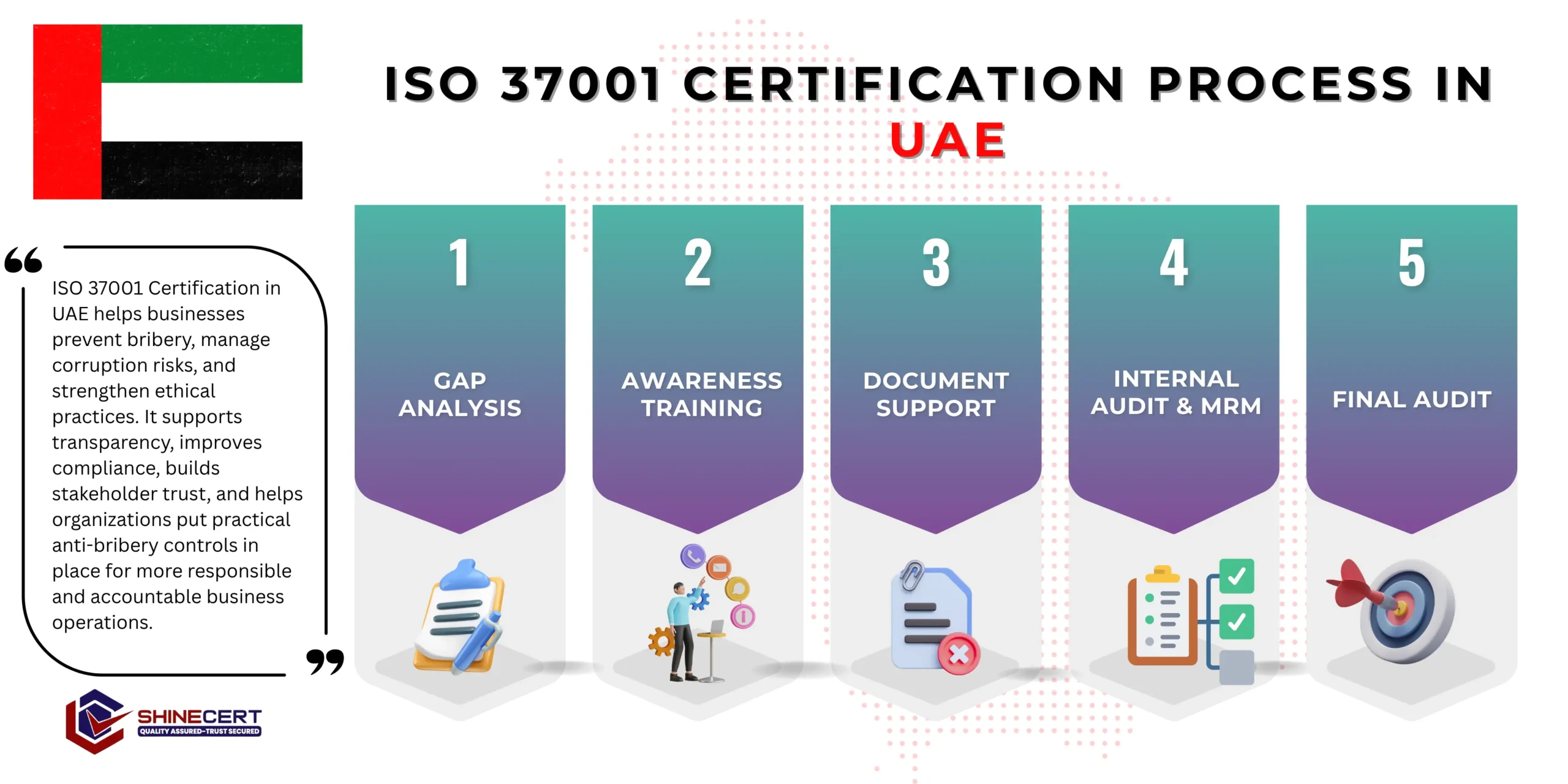
What are the steps to get ISO 37001 Certification in UAE?
our services
- ISO Certification UAE
- ISO 9001 Certification UAE
- ISO 14001 Certification UAE
- ISO 27001 Certification UAE
- ISO 22000 Certification UAE
- ISO 27701 Certification UAE
- ISO 45001 Certification UAE
- ISO 20000-1 Certification UAE
- ISO 13485 Certification UAE
- ISO 17025 Certification UAE
- ISO 31000 Certification UAE
- ISO 42001 Certification UAE
- ISO 37001 Certification UAE
- ISO 22301 Certification UAE
- ISO 50001 Certification UAE
- CE Mark Certification UAE
- GDPR Certification UAE
- GMP Certification UAE
- Halal Certification UAE
How We Handle This?
Risk assessment and gap analysis
We assess your specific bribery risk exposure, sector, geography, government interaction, and use of intermediaries, and evaluate current controls against ISO 37001 requirements.
A risk assessment and gap analysis calibrated to your actual exposure profile.
Documentation
Your anti-bribery policy, due diligence procedures, and financial control procedures get built around your specific risk profile, not a generic template.
A complete anti-bribery management documentation set, including due diligence and gifts/hospitality procedures.
Implementation and training
Risk-differentiated training gets rolled out, along with an independent reporting channel and due diligence procedures for business associates.
Training records and evidence of a functioning, genuinely independent reporting mechanism.
Internal audit and management review
A rigorous internal audit covering control effectiveness, followed by a management review addressing risk exposure and any concerns raised.
An internal audit report and management review minutes demonstrating genuine leadership oversight.
Certification audit
We coordinate Stage 1 and Stage 2 with an EIAC-accredited or IAF-recognized body.
Your ISO 37001 certificate and a surveillance audit schedule.
What You Actually Get?
- Stronger positioning for government and government-linked tenders, where demonstrated anti-bribery controls increasingly factor into procurement evaluation.
- Protection for company leadership and shareholders, since a certified anti-bribery management system provides documented evidence of reasonable prevention procedures if an allegation ever arises.
- Support for multinational parent-company compliance obligations under UK Bribery Act, FCPA, or similar extraterritorial anti-corruption legislation.
- Reduced third-party risk exposure, since due diligence procedures required by the standard genuinely reduce the likelihood of exposure through agents, subcontractors, or joint venture partners.
- Credibility with international partners and financial institutions increasingly conducting anti-corruption due diligence before entering business relationships.
ISO 37001 vs General Corporate Compliance Programs
Many UAE companies already maintain some form of internal compliance policy, and it’s worth being clear about how ISO 37001 differs. A general compliance program often bundles anti-bribery language into a broader code of conduct covering multiple topics, with limited independent verification of whether the controls actually function. ISO 37001 certification requires a dedicated, risk-based anti-bribery management system with independently audited evidence that due diligence, financial controls, and reporting mechanisms genuinely operate as designed, not just exist as policy statements. We generally recommend companies with an existing general compliance program use it as a starting foundation, but expect meaningful additional work to build the risk-specific, independently verifiable controls ISO 37001 certification actually requires.
What It Costs?
Quick answer: ISO 37001 certification in the UAE typically runs AED 15,000 to AED 62,000, with risk exposure and organizational complexity as the main cost drivers.
More extensive due diligence and control requirements around procurement interactions.
Third-party due diligence procedures require more extensive documentation and verification.
Less foundational work if formal compliance controls already exist.
Firms needing to demonstrate compliance with parent-company obligations require additional mapping work.
Certification body fees are separate, and typically scale with organizational risk profile.
Where Companies Usually Trip Up?
- Assigning compliance oversight without genuine independence : The role needs real authority separate from the business unit it monitors.
- Treating gifts and hospitality controls as an afterthought : Given regional business culture, this needs deliberate, documented policy, not informal norms.
- Underestimating third-party and subcontractor due diligence : Construction companies especially tend to focus internal controls while overlooking the layers of subcontractors that carry real risk.
- A reporting channel that exists on paper but isn’t genuinely independent or trusted : Auditors test whether concerns raised actually get investigated.
Where This Shows Up Most?
Construction and Infrastructure
Companies bidding on government and large-scale infrastructure projects face concentrated bribery risk across multiple subcontractor layers.
Read moreGovernment Contracting
Any company regularly pursuing government or government-linked tenders benefits from demonstrated integrity controls.
Read moreMultinational Subsidiaries
UAE operations of companies subject to UK Bribery Act, FCPA, or similar parent-company obligations.
Read moreTrading and Intermediary-Heavy Businesses
Companies using agents or distributors face genuine third-party bribery exposure the standard specifically addresses.
Read moreFinancial Services
Firms conducting anti-corruption due diligence on counterparties benefit from demonstrating their own certified controls.
Read moreISO 37001 and the UAE’s Tightening Integrity Expectations
The direction of travel in the UAE’s anti-corruption enforcement landscape has been toward greater rigor, not less, and government tender processes increasingly reflect this. We’ve generally recommended that UAE construction and infrastructure companies pursuing government work treat ISO 37001 certification as a genuine competitive differentiator during this transition period, rather than waiting until certification becomes a formal tender requirement, since building genuinely functioning anti-bribery controls takes real time and can’t be assembled reactively once a tender deadline is already looming.
What the Standard Actually Requires?
- Context of the Organization : Assess your actual bribery risk exposure, which markets you operate in, whether you deal directly with government officials or procurement processes, and whether you use agents, intermediaries, or joint venture partners who could expose you to third-party bribery risk.
- Leadership : Genuine top management commitment to anti-bribery, including a designated anti-bribery compliance function with real authority and independence, not a role assigned to someone who also reports to the business unit being monitored. We’ve seen UAE companies assign this responsibility without genuine organizational independence, which auditors specifically probe during certification audits.
- Planning : Risk-based objectives addressing your specific exposure, particularly relevant for UAE construction and infrastructure companies dealing with multiple layers of subcontractors and government approval processes, where bribery risk concentrates disproportionately.
- Support : Training genuinely tailored to risk level, staff handling government tenders or managing intermediary relationships need considerably more detailed training than general administrative staff, and the standard expects this differentiation to be documented and deliberate.
- Operation : Due diligence procedures for business associates, financial controls to detect suspicious transactions, controls over gifts and hospitality (a particularly relevant area given UAE business culture’s emphasis on relationship-building), and specific controls around dealing with government officials and procurement processes.
- Performance Evaluation : Monitoring the effectiveness of anti-bribery controls, including whether the independent reporting channel actually receives and properly investigates concerns raised through it.
- Improvement : Structured investigation and response when bribery concerns arise, with lessons genuinely incorporated into strengthened controls rather than treated as isolated incidents.
Making the Reporting Channel Genuinely Trusted, Not Just Technically Present
- One of the more consistent implementation gaps we see across the region, including in the UAE, isn’t a missing reporting mechanism, most companies can point to a hotline number or an email address somewhere in an employee handbook. The gap is trust: employees in many workplace cultures across the Gulf are understandably hesitant to raise concerns about a manager or a business relationship, particularly where hierarchy is respected strongly and where reporting could plausibly be perceived as damaging a relationship rather than protecting the company. A reporting channel that technically exists but that employees quietly avoid using isn’t functioning in the way ISO 37001 actually requires.
- We’ve generally recommended that UAE organizations pair the formal reporting mechanism with genuine, repeated communication from senior leadership making clear that raising concerns is expected and protected, and with a reporting channel operated by a genuinely independent third party rather than an internal figure employees might reasonably worry about approaching directly. Auditors reviewing this area increasingly look beyond the mere existence of a channel to ask whether any reports have actually come through it, and whether the organization can demonstrate those reports were investigated seriously rather than quietly closed. A reporting mechanism with zero reports over several years in a reasonably sized organization is, in practice, more often a sign the channel isn’t trusted than a sign the organization has no issues to report.
Timeline
Quick answer: ISO 37001 certification in the UAE typically takes two to five months.
Phase | Typical Duration |
Risk assessment and gap analysis | 3–4 weeks |
Documentation development | 4–6 weeks |
Implementation and training | 3–5 weeks |
Internal audit and management review | 1–2 weeks |
Certification audit (Stage 1 + Stage 2) | 3–4 weeks |
Total | 2–5 months |
Documentation You’ll Need
Quick answer: ISO 37001 requires an anti-bribery policy, risk assessment, due diligence procedures for business associates, financial control procedures, gifts and hospitality procedures, and records of the independent reporting mechanism.
Genuine leadership commitment addressing specific risk areas, not generic language.
Documented, specific to your sector, geography, and government interaction level.
For agents, intermediaries, joint venture partners, and other business associates.
Designed specifically to detect suspicious or unusual payment patterns.
Documented tracking and approval, particularly relevant given regional business culture.
Evidence the independent channel functions and concerns are genuinely investigated.
The evidence trail showing genuine oversight.
Why ShineCert?
We coordinate UAE engagements from ShineCert’s Riyadh and Lebanon offices, with direct familiarity with UAE anti-corruption enforcement and government procurement expectations. Our team has guided more than 10,000 organizations through ISO certification globally, and as the best ISO 37001 consultant in UAE, we bring specific depth in Gulf construction and government contracting compliance.
Choosing a Certification Body?
What to Check | Why It Matters |
EIAC accreditation, or another IAF-recognized body | Confirms genuine international recognition |
Construction or government contracting audit experience | Matters given the concentration of bribery risk in these sectors |
Understanding of UAE anti-corruption enforcement landscape | Helps ensure certification genuinely supports your compliance posture |
International recognition for multinational reporting purposes | Relevant for subsidiaries of companies with parent-company anti-corruption obligations |
Ready to Get Certified?
ShineCert supports UAE organizations end to end, from risk assessment through certification audit, with direct experience across construction, government contracting, and multinational compliance. Book a free consultation or contact us directly, and we’ll review your risk profile before proposing a fixed-scope plan.
Frequently Asked Questions
Employees in many workplace cultures are hesitant to report concerns about managers or business relationships, so the channel needs genuine independence and visible leadership backing, not just a hotline number in a handbook.
Typically AED 15,000 to AED 62,000, depending on risk exposure and organizational complexity.
Not universally mandatory yet, but it’s increasingly factored into tender evaluation, particularly for construction and large infrastructure projects.
Typically two to five months.
It provides documented evidence of reasonable prevention procedures, which can be a meaningful factor if an allegation arises, though it doesn’t provide absolute legal immunity.
No, it requires a dedicated, independently audited anti-bribery management system with risk-specific controls, not just general policy language.
Yes, many UAE subsidiaries of multinational companies use ISO 37001 certification to demonstrate local compliance with parent-company anti-corruption obligations.
We coordinate UAE engagements from our Riyadh and Lebanon offices, with consultants traveling on-site as needed.