
Halal Certification in UAE
Quick Answer
Halal certification in the UAE is governed by standards set through the Emirates Authority for Standardization and Metrology (ESMA), most notably UAE.S 2055, which establishes requirements for Halal food and, increasingly, Halal-relevant cosmetics and pharmaceutical products. For UAE food businesses, cosmetics manufacturers, and exporters targeting Muslim-majority markets across the Gulf, Southeast Asia, and beyond, formal Halal certification provides independently verified assurance that products genuinely meet Islamic dietary and production requirements. Get certified through a body recognized under the UAE’s Halal certification framework. Budget AED 10,000 to AED 45,000 depending on product complexity and facility scope, and plan for one to four months from kickoff to certificate.
What This Standard Actually Covers?
Halal certification verifies that products and their entire production process, ingredients, processing methods, equipment, storage, and handling, comply with Islamic dietary and production law. This goes well beyond simply confirming the absence of pork or alcohol; it covers slaughter methods for animal products, cross-contamination prevention between Halal and non-Halal production lines, ingredient traceability back to source, and increasingly, for cosmetics and pharmaceuticals, scrutiny of gelatin sources, alcohol-based ingredients, and animal-derived components that might not be obviously problematic to a non-specialist. ESMA’s UAE.S 2055 standard provides the formal technical basis for certification within the UAE, aligning with broader GCC Standardization Organization (GSO) Halal frameworks used across the wider Gulf region.
Why This Matters So Much Here Specifically?
- The UAE serves as both a substantial consumer market and, more significantly, a major regional trading and re-export hub for Halal products moving to other Muslim-majority markets across the Gulf, South Asia, and Southeast Asia. Dubai Municipality and ESMA both maintain active oversight of Halal claims within the UAE market, and government initiatives have specifically positioned the UAE as a hub for the broader global Halal economy, spanning food, cosmetics, pharmaceuticals, and Islamic finance-adjacent sectors. For UAE-based exporters, formal Halal certification recognized under UAE.S 2055 and aligned with GSO frameworks provides a credential that carries genuine weight when entering destination markets that maintain their own Halal import requirements.
- Beyond formal regulatory considerations, Halal certification functions as a genuine trust signal in a market where consumer expectations around Halal integrity are high, and where an unverified or informally claimed Halal status can create real reputational risk if challenged.
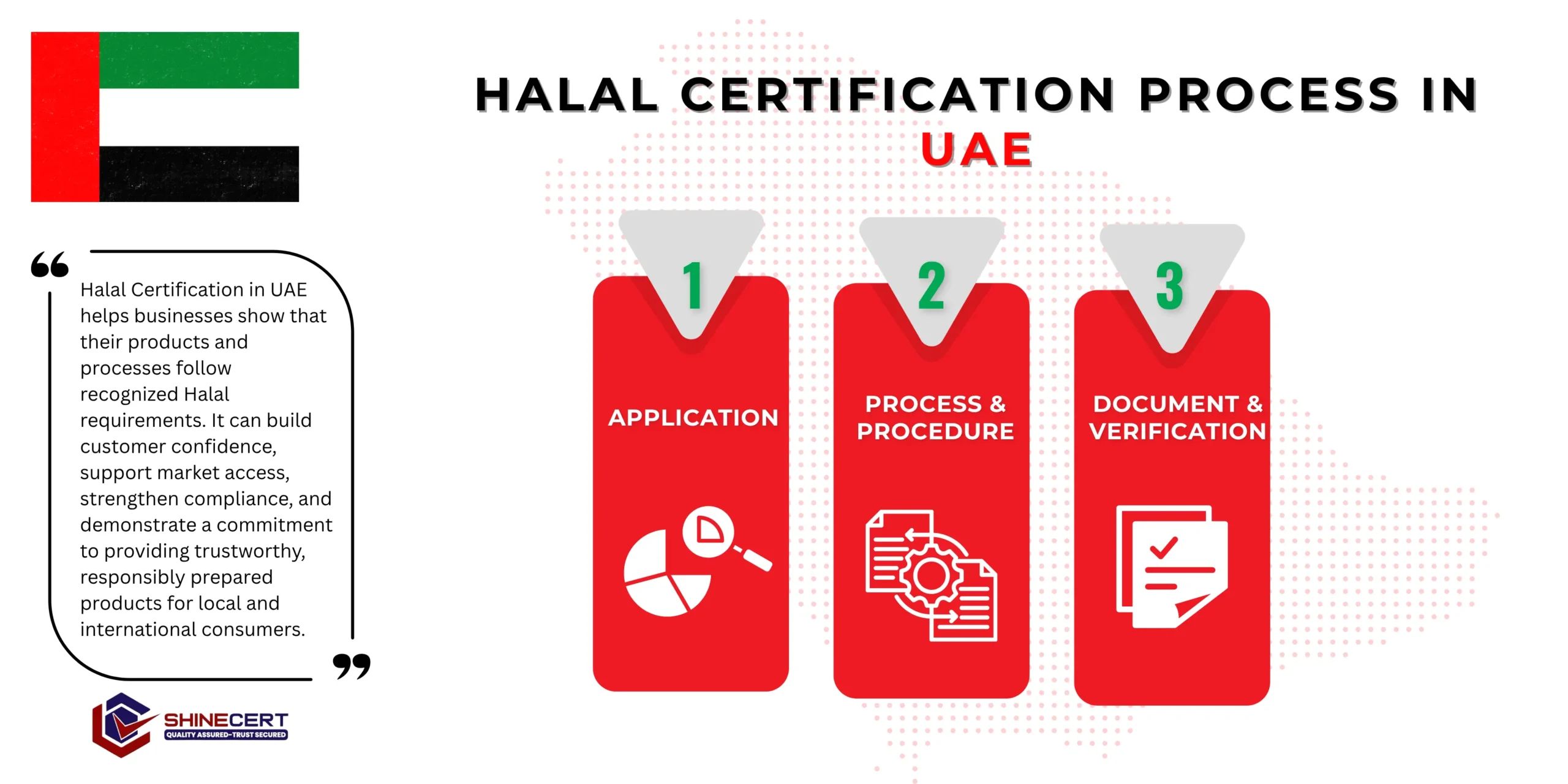
What are the steps to get Halal Certification in UAE?
our services
- ISO Certification UAE
- ISO 9001 Certification UAE
- ISO 14001 Certification UAE
- ISO 27001 Certification UAE
- ISO 22000 Certification UAE
- ISO 27701 Certification UAE
- ISO 45001 Certification UAE
- ISO 20000-1 Certification UAE
- ISO 13485 Certification UAE
- ISO 17025 Certification UAE
- ISO 31000 Certification UAE
- ISO 42001 Certification UAE
- ISO 37001 Certification UAE
- ISO 22301 Certification UAE
- ISO 50001 Certification UAE
- CE Mark Certification UAE
- GDPR Certification UAE
- GMP Certification UAE
- Halal Certification UAE
How We Handle This?
Ingredient and process review
We review your complete ingredient list and production process, identifying any Halal-sensitive components requiring verification or reformulation.
A Halal compliance gap analysis identifying specific ingredients and processes requiring attention.
Documentation
Your Halal policy, ingredient verification records, and segregation procedures get built around your actual product portfolio and production setup.
A complete Halal certification documentation set aligned with UAE.S 2055.
Implementation
Segregation controls, cleaning procedures, and traceability systems get implemented and staff trained on Halal compliance requirements specific to your operation.
Evidence of functioning segregation controls and Halal-compliant production practices.
Verification audit
We coordinate the certification audit with a recognized Halal certification body.
Your Halal certificate and a surveillance audit schedule.
Ongoing surveillance support
We help you manage the ongoing surveillance process, including flagging any supplier or ingredient changes that could affect your Halal status before they become compliance problems.
An ongoing compliance monitoring relationship protecting your certified status.
What You Actually Get?
- Formal, independently verified Halal status recognized under ESMA’s UAE.S 2055 standard, providing credibility with UAE consumers, retailers, and regulators.
- Access to export markets requires recognized Halal certification, particularly relevant given the UAE’s role as a regional trading and re-export hub.
- Stronger positioning with UAE retail chains, hotels, and food service operators who increasingly require verified Halal certification from suppliers, not just informal claims.
- Protection against reputational risk, since a formally certified Halal status withstands scrutiny in a market where consumer trust around Halal integrity runs high.
- A natural complement to ISO 22000 certification for food businesses, given substantial overlap in traceability and quality control documentation.
Halal Certification and the UAE’s Position in the Global Halal Economy
The UAE has deliberately positioned itself as infrastructure for the broader global Halal economy, not just a domestic Halal consumer market, and this shows in how seriously ESMA and Dubai Municipality treat Halal claim verification. We’ve generally recommended that UAE food, cosmetics, and pharmaceutical businesses treat Halal certification as genuine export infrastructure, particularly given how the UAE’s re-export role means certified UAE-based businesses can credibly serve destination markets across the Gulf, South Asia, and Southeast Asia without needing to certify separately in each individual market, provided the certifying body carries recognition those destination markets accept.
What It Costs?
Quick answer: Halal certification in the UAE typically runs AED 10,000 to AED 45,000, with product complexity and facility scope as the main cost drivers.
More complex product lines need more extensive ingredient verification work.
Shared traceability and documentation infrastructure lowers foundational work.
Segregation verification is simpler when facilities are already dedicated.
Each production site typically needs its own certification scope.
Certification body fees are separate, and typically scale with product and facility complexity.
Where Companies Usually Trip Up?
- Overlooking Halal-sensitive ingredients in non-obvious categories : Emulsifiers, flavorings, and processing aids often carry animal-derived components that aren’t immediately apparent.
- Weak segregation controls in shared facilities : Genuine physical or documented procedural separation is required, not an informal understanding among staff.
- Treating certification as one-time rather than ongoing : Any supplier or ingredient change needs to be assessed for Halal impact before it affects certified status.
- Assuming domestic Halal certification automatically satisfies export market requirements : Some destination markets maintain their own specific recognized certifier lists.
Where This Shows Up Most?
Food Manufacturing and Processing
The most substantial category, spanning everything from meat processing to packaged food products.
Read moreFood Import, Distribution, and Re-Export
Given the UAE’s role as a regional Halal trading hub, this represents genuinely significant volume.
Read moreCosmetics and Personal Care
A growing category where Halal-conscious consumers scrutinize gelatin, alcohol, and animal-derived ingredients.
Read morePharmaceuticals and Supplements
An increasingly relevant category given similar ingredient sourcing concerns as cosmetics.
Read moreHospitality and Catering
Hotels and restaurants serving Halal-observant guests, particularly relevant given UAE tourism volumes from Muslim-majority source markets.
Read moreHalal Certification vs ISO 22000
These are complementary, not competing, and food businesses frequently pursue both together. ISO 22000 certifies your food safety management system broadly, hazard analysis, traceability, prerequisite programs, applicable regardless of whether products are Halal. Halal certification verifies specifically that products and processes comply with Islamic dietary and production law, a distinct technical scope focused on ingredient sourcing, slaughter compliance, and segregation. A UAE food manufacturer pursuing both typically finds substantial documentation overlap, particularly around traceability and supplier verification, and we generally recommend pursuing them together where both are relevant, since the shared infrastructure makes combined certification meaningfully more efficient than two entirely separate projects.
What Certification Actually Requires?
- Ingredient Sourcing and Verification : Every ingredient needs verified Halal status, including additives, flavorings, and processing aids that might not be obviously animal-derived, gelatin, certain emulsifiers, and enzyme-based processing aids are common areas requiring careful verification.
- Slaughter and Processing Compliance : For meat and poultry products, verified compliance with Islamic slaughter requirements, including documentation of the slaughter process itself, not just the final product specification.
- Production Line Segregation : Genuine physical or procedural separation between Halal and non-Halal production, storage, and transportation, to prevent cross-contamination, a facility producing both Halal and non-Halal products needs documented, verifiable controls demonstrating this separation actually functions.
- Facility and Equipment Controls : Cleaning and sanitation procedures specifically addressing Halal compliance between production runs, and controls over shared equipment where applicable.
- Traceability Systems : Documented traceability from raw material sourcing through to finished product, allowing verification of Halal status at every stage, this matters particularly for UAE businesses importing ingredients or components from multiple international sources.
- Ongoing Surveillance : Halal certification isn’t a one-time assessment; it requires periodic surveillance audits confirming continued compliance, since Halal status can be compromised by even minor changes to suppliers, ingredients, or production processes.
Halal Tourism: A Distinctive UAE Growth Category
- Dubai and Abu Dhabi have both deliberately courted Muslim-majority tourism markets, and this has created a genuinely distinctive category of Halal-adjacent business that goes beyond conventional food and cosmetics certification: hospitality operators building Muslim-friendly travel experiences, spanning everything from prayer facilities and Halal dining options within hotels to entire resorts marketed specifically toward Halal-conscious travelers. This segment has grown into a meaningful part of the UAE’s broader tourism strategy, given the country’s role as both a destination in its own right and a stopover hub connecting travelers between Europe, Asia, and Africa.
- For UAE hospitality operators pursuing this positioning, Halal certification of food and beverage operations is typically just one component of a broader Muslim-friendly service offering, and we’ve generally recommended that hotels and resorts treat it as the credibility foundation for marketing claims that extend further, prayer room availability, alcohol-free floor options, and Halal-certified spa and cosmetics products used in guest-facing services. A property that markets itself broadly as “Halal-friendly” without formally certified food operations underlying that claim carries genuine reputational risk in a market segment where guests actively scrutinize whether the marketing claim reflects verified reality, not just branding.
Timeline
Quick answer: Halal certification in the UAE typically takes one to four months, often faster than broader management system certifications given its more focused technical scope.
Phase | Typical Duration |
Ingredient and process review | 2–3 weeks |
Documentation development | 3–4 weeks |
Implementation and segregation controls | 2–4 weeks |
Certification audit | 1–2 weeks |
Total | 1–4 months |
Documentation You’ll Need
Quick answer: Halal certification requires a Halal policy, verified ingredient documentation, slaughter compliance records where applicable, segregation procedures, and traceability records covering the full production chain.
A documented commitment specific to your Halal compliance requirements.
Halal status documentation for every ingredient, additive, and processing aid.
For meat and poultry products, documented evidence of Islamic slaughter compliance.
Documented physical or procedural separation between Halal and non-Halal production.
Full chain-of-custody documentation from raw material to finished product.
Evidence of Halal-compliant facility and equipment controls.
Ongoing evidence of maintained compliance between certification cycles.
Why ShineCert?
We coordinate UAE engagements from ShineCert’s Riyadh and Lebanon offices, with direct familiarity with ESMA’s UAE.S 2055 standard and Dubai Municipality’s Halal oversight framework. Our team has guided more than 10,000 organizations through ISO and Halal certification globally, with ShineCert as the best Halal consultant in UAE, bringing specific depth in Gulf food, cosmetics, and export markets.
Choosing a Certification Body?
What to Check | Why It Matters |
Recognition under ESMA’s UAE.S 2055 framework | Confirms genuine UAE regulatory alignment |
GSO framework alignment for GCC-wide recognition | Relevant for businesses distributing beyond the UAE |
Destination-market recognition for exporters | Some export markets maintain their own approved certifier lists |
Sector-specific technical expertise | Food, cosmetics, and pharmaceutical Halal assessment each require different technical knowledge |
Ready to Get Certified?
ShineCert supports UAE food, cosmetics, and pharmaceutical businesses end to end, from ingredient review through certification audit, with direct experience navigating ESMA’s UAE.S 2055 standard. Book a free consultation or contact us directly, and we’ll review your products before proposing a fixed-scope plan.
Frequently Asked Questions
Yes, formal Halal certification of food and beverage operations provides the credibility foundation for broader Muslim-friendly hospitality marketing, which is a genuinely significant growth segment in UAE tourism.
Typically AED 10,000 to AED 45,000, depending on product complexity and facility scope.
It’s not universally mandatory for all products, but ESMA and Dubai Municipality actively regulate Halal claims, and formal certification is expected for any product marketed as Halal.
Typically one to four months.
Yes, cosmetics and personal care products increasingly pursue Halal certification given consumer scrutiny of gelatin, alcohol, and animal-derived ingredients.
No, ISO 22000 certifies food safety management broadly, while Halal certification verifies compliance with Islamic dietary and production law specifically, they’re complementary and often pursued together.
Often yes, provided the certifying body carries recognition in the destination market, which varies by country and should be confirmed before relying on it for export purposes.
We coordinate UAE engagements from our Riyadh and Lebanon offices, with consultants traveling on-site as needed.