
ISO 9001 Certification
Quality Management System
Quick Answer
ISO 9001 is the world’s most widely used quality management system standard, published by the International Organization for Standardization. It sets requirements for how an organization plans, controls, and improves the processes that affect product and service quality. Certification is issued by an accredited, independent certification body after an on-site audit, and most organizations complete implementation and certification in three to six months at a cost that depends mainly on headcount and site count. It is used across virtually every industry and is often a prerequisite for winning contracts with larger buyers, governments, and export markets.
Introduction
If you’re researching ISO 9001 certification, you’ve probably already run into three problems: every consultancy website reads the same, nobody explains what’s actually inside the standard, and it’s genuinely hard to tell what you’re paying for. This page is built to fix that. Below, you’ll find what ISO 9001 actually says, clause by clause, separately from how you go about implementing it; what it costs and why; which industries rely on it most; and the real certification process an accredited auditor will take you through. ShineCert has taken organizations through this process from our operating offices in Riyadh, Lebanon, and India, and what follows reflects how the standard is actually applied in practice, not a marketing summary of it.
What Is ISO 9001? Understanding the Standard
ISO 9001 is an international standard that specifies requirements for a quality management system (QMS), the set of policies, processes, and records an organization uses to consistently deliver products or services that meet customer and regulatory requirements. It was first published in 1987 and is maintained by ISO’s Technical Committee 176; the current edition is ISO 9001:2015, with a revised edition (ISO 9001:2026) expected following the 2025 Draft International Standard ballot, carrying an anticipated multi-year transition period once published.
Unlike a product standard, ISO 9001 doesn’t specify what your product or service should be, it specifies how you manage the process of producing it reliably. This is why the same standard applies equally to a steel fabricator, a software company, a hospital, and a law firm: the clauses describe management discipline, not industry-specific technical requirements. Certification is a formal, documented confirmation, issued by a third-party accredited certification body, not by ISO itself, that an organization’s QMS has been independently audited and found to conform to the standard.
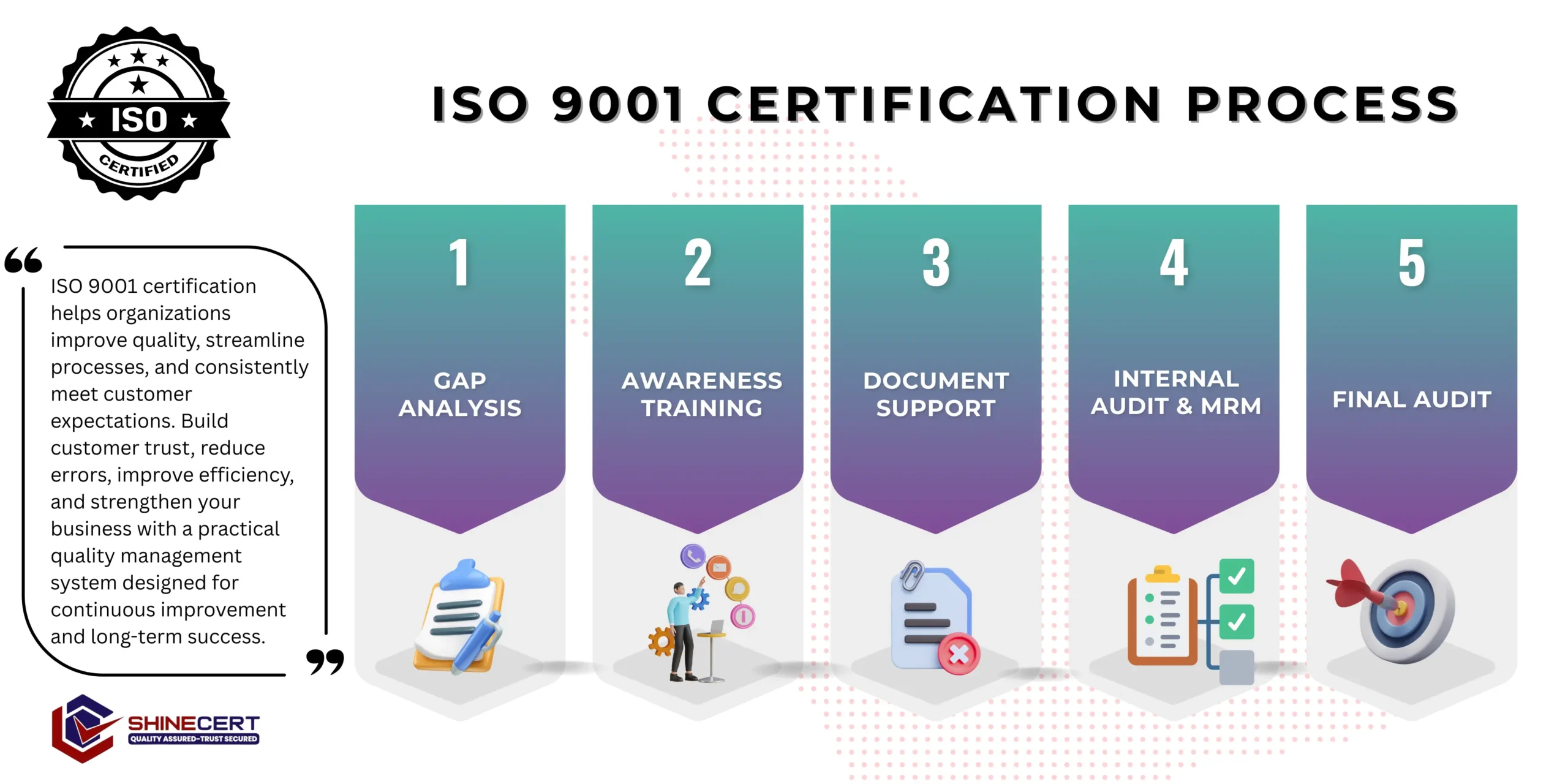
What are the steps to get ISO 9001 Certification?
our services
- ISO 9001 Certification
- ISO 14001 Certification
- ISO 27001 Certification
- ISO 22000 Certification
- ISO 45001 Certification
- ISO 13485 Certification
- ISO 17025 Certification
- CE Mark Certification
- GMP Certification
- Halal Certification
- SOC Certification
The ISO 9001 Implementation Process
This section covers how you actually build the QMS in practice, distinct from the clause requirements themselves, which were explained above.
Gap Assessment
Assess current practices against all seven operative clauses to identify what already exists, what's partially in place, and what needs to be built from scratch. This scoping step determines a realistic timeline and cost.
Gap assessment report with timeline and cost estimate.
Scope and Policy Definition
Define the QMS scope (which sites, products, services, and processes are covered) and draft the quality policy and objectives with genuine leadership involvement, not a template signed without engagement.
Defined QMS scope, quality policy, and objectives.
Process Documentation
Document the processes, procedures, and records the gap assessment identified as missing or inadequate — sized appropriately to the organization's complexity, not over-documented for the sake of appearing thorough.
Right-sized process documentation and records.
Rollout and Training
Train staff on new or changed processes, and allow the QMS to operate long enough to generate genuine records — auditors expect to see the system functioning, not freshly created the week before the audit.
Training records and live operational evidence.
Internal Audit and Management Review
Conduct at least one internal audit cycle covering all clauses and a documented management review before the certification audit, since both are themselves audit requirements under Clauses 9.2 and 9.3.
Internal audit report and management review minutes.
Gap Assessment
Assess current practices against all seven operative clauses to identify what already exists, what's partially in place, and what needs to be built from scratch. This scoping step determines a realistic timeline and cost.
Gap assessment report with timeline and cost estimate.
Scope and Policy Definition
Define the QMS scope (which sites, products, services, and processes are covered) and draft the quality policy and objectives with genuine leadership involvement, not a template signed without engagement.
Defined QMS scope, quality policy, and objectives.
Process Documentation
Document the processes, procedures, and records the gap assessment identified as missing or inadequate — sized appropriately to the organization's complexity, not over-documented for the sake of appearing thorough.
Right-sized process documentation and records.
Rollout and Training
Train staff on new or changed processes, and allow the QMS to operate long enough to generate genuine records — auditors expect to see the system functioning, not freshly created the week before the audit.
Training records and live operational evidence.
Internal Audit and Management Review
Conduct at least one internal audit cycle covering all clauses and a documented management review before the certification audit, since both are themselves audit requirements under Clauses 9.2 and 9.3.
Internal audit report and management review minutes.
The ISO 9001 Certification Process
This is the external, third-party process that leads to the certificate itself, separate from the internal implementation work above.
Stage 1 Audit
The certification body reviews QMS documentation and readiness, checking that the scope, policy, and core documented information exist and that the organization is genuinely ready for Stage 2. Gaps found here are addressed before Stage 2 is scheduled.
DocumentationStage 2 Audit
The certification body conducts an on-site (or remote, where permitted) audit evaluating whether the QMS is genuinely implemented and effective, interviewing staff, reviewing records, and sampling evidence against every operative clause. Nonconformities are classified as minor or major; major nonconformities must be resolved before certification is granted.
Nonconformities classifiedCertification Decision and Issuance
Once nonconformities are closed, the certification body issues the ISO 9001 certificate, typically valid for three years subject to ongoing surveillance.
Certificate issuedSurveillance Audits
Annual (or sometimes more frequent) surveillance audits confirm the QMS continues to function and improve, not just that it existed at the point of initial certification.
RecurringRecertification
A full recertification audit, similar in depth to the original Stage 2, occurs every three years to renew the certificate.
Every 3 yearsWhy ISO 9001 Certification Matters?
Quality failures are expensive in ways that are easy to underestimate until they happen: rework, returns, warranty claims, lost customers, and in regulated sectors, potential legal exposure. ISO 9001 exists because ad hoc quality management, relying on institutional memory and individual diligence rather than documented, repeatable processes, breaks down as organizations grow, staff turn over, and operations scale across sites or countries. Certification gives customers, regulators, and partners independent, third-party evidence that your quality management isn’t just a claim on your website; it’s been audited.
ISO 9001 Certification Cost Explained
Cost is driven primarily by organization size (employee headcount), number of sites within scope, process complexity (design and development in scope adds cost versus a simpler service delivery model), and current QMS maturity — an organization with strong existing documentation moves faster and cheaper than one starting from nothing. Certification body audit fees are typically charged separately from consulting fees and scale with audit duration, which itself scales with headcount and site count under IAF-recognized audit day calculation tables.
Mandatory Documented Information for ISO 9001
At minimum, the standard requires: QMS scope; quality policy and objectives; evidence of competence; records of monitoring and measuring equipment calibration where applicable; results of design and development reviews (if design is in scope); records of internal audits; management review records; and evidence of corrective actions taken. ShineCert provides a full documented information checklist mapped to your specific scope during the gap assessment.
The Structure of ISO 9001: Clauses Explained
ISO 9001 follows the Harmonised Structure shared across modern ISO management system standards, which is why organizations implementing ISO 9001 alongside ISO 27001 or ISO 45001 find real overlap in how the systems are built. The standard’s requirements sit in Clauses 4 through 10 (Clauses 1–3 cover scope, references, and terms, and carry no audit requirements themselves).
- Clause 4 — Context of the Organization : Requires identifying internal and external issues relevant to the QMS, the needs of interested parties (customers, regulators, employees, suppliers), and defining the scope of the QMS in a documented scope statement.
- Clause 5 — Leadership : Requires top management to demonstrate genuine leadership and commitment to the QMS, establish a quality policy, and assign clear organizational roles, responsibilities, and authorities — not delegate quality entirely to a “quality manager” while remaining disengaged themselves.
- Clause 6 — Planning : Requires identifying risks and opportunities affecting the QMS’s ability to deliver intended results, and setting measurable quality objectives with a plan to achieve them. This is where ISO 9001’s risk-based thinking requirement lives.
- Clause 7 — Support : Covers the resources the QMS needs to function: competent people, appropriate infrastructure and work environment, monitoring and measuring equipment (calibration, where relevant), organizational knowledge, and controlled documented information.
- Clause 8 — Operation : The largest clause, covering operational planning and control, requirements for products and services, design and development (where applicable), control of externally provided processes and suppliers, production and service provision, release of products and services, and control of nonconforming outputs.
- Clause 9 — Performance Evaluation : Requires monitoring, measurement, analysis, and evaluation of the QMS, customer satisfaction monitoring, internal audits at planned intervals, and management review by top management.
- Clause 10 — Improvement. Requires addressing nonconformities through corrective action that resolves root cause (not just the symptom), and continual improvement of the QMS’s suitability, adequacy, and effectiveness over time.
Understanding these clauses matters because every one of them becomes an actual audit line item, an auditor will ask for evidence against each clause specifically, so a QMS that hasn’t genuinely addressed all seven operative clauses will surface gaps at audit, not before.
Benefits of ISO 9001 Certification
Certification is frequently a stated or unstated prerequisite in supplier qualification processes, government tenders, and enterprise procurement, organizations without it are sometimes excluded from bid lists before price is even discussed. It also functions as a credible trust signal for customers evaluating unfamiliar suppliers, particularly in cross-border trade where a buyer can’t easily verify quality claims independently.
Building a genuine QMS forces process documentation that often surfaces inefficiencies leadership didn’t know existed, duplicated approvals, unclear ownership, inconsistent handoffs between departments. Organizations that implement ISO 9001 thoughtfully, rather than as a paperwork exercise, typically see measurable reductions in rework and nonconformity rates within the first year or two.
The Clause 6 risk-based planning requirement pushes organizations to identify and address quality risks proactively rather than reactively, and the Clause 10 corrective action requirement builds institutional discipline around actually fixing root causes instead of repeatedly patching the same recurring problem.
Clear roles and responsibilities (Clause 5) and documented competence requirements (Clause 7) reduce the operational fragility that comes from quality knowledge living only in a few individuals’ heads, a particularly valuable outcome for organizations with high staff turnover or rapid growth.
Who Needs ISO 9001? Industries and Reverse Suitability
- ISO 9001 is genuinely industry-agnostic, which makes it both the most widely adopted ISO standard and, for that reason, sometimes the hardest for organizations to picture concretely. In practice, adoption concentrates where a few conditions apply: the organization sells to enterprise, government, or export buyers who require it; the organization operates in a sector where quality failures carry serious cost or safety consequences; or the organization has grown to a size where informal quality management no longer scales.
- Manufacturing remains the largest adopter globally, followed by construction and engineering, where certification supports both tender qualification and subcontractor management. Professional and business services firms (IT services, consulting, logistics) increasingly pursue certification because enterprise clients now request it in vendor onboarding. Healthcare-adjacent and food-adjacent organizations that don’t need the sector-specific standards (ISO 13485, ISO 22000) but still want a recognized quality baseline also frequently choose ISO 9001.
- The reverse question, which standard suits your industry, rather than which industries suit this standard, matters just as much. Manufacturers handling regulated medical devices should look at ISO 13485 instead of, or alongside, ISO 9001. Organizations whose primary risk is information security rather than general quality should prioritize ISO 27001. Food producers should evaluate ISO 22000. ISO 9001 is frequently the right starting point specifically because it’s the foundational quality standard other sector-specific standards build structurally upon.
Ready to scope your ISO 9001 certification project? Book your free consultation or contact ShineCert directly.
Book Free ConsultationReady to scope your ISO 9001 certification project? Book your free consultation or contact ShineCert directly.
Book Free ConsultationChoosing an Accredited Certification Body
Confirm the certification body holds current IAF-recognized accreditation for ISO 9001 through a recognized national accreditation body, and check their auditor’s familiarity with your specific sector, an auditor experienced in manufacturing will assess a professional services QMS differently, and vice versa.
ISO 9001 Certification Timeline
Phase | Typical Duration |
Gap assessment | 1–2 weeks |
Documentation development | 3–6 weeks |
Implementation and staff training | 4–8 weeks |
Internal audit and management review | 2–3 weeks |
Stage 1 and Stage 2 audits | 1–2 days combined, small organizations; more for larger, multi-site scopes |
Certificate issuance | 2–4 weeks after Stage 2 |
Why Choose ShineCert for ISO 9001 Certification?
ShineCert has guided more than 10,000 organizations through ISO certification from genuine operating offices in Riyadh, Lebanon, and India. We build QMS documentation sized to your actual operation, not a generic template, and we stay engaged through surveillance audits rather than disappearing after the certificate is issued.
Common Implementation Challenges
- Documentation built for the audit, not for daily use. Procedures nobody actually follows day to day tend to unravel quickly once surveillance audits begin.
- Leadership commitment that’s nominal rather than genuine. Clause 5 findings are common where quality policy exists on paper but top management isn’t visibly engaged in quality objectives.
- Internal audits that rubber-stamp rather than genuinely test. An internal audit program that never finds anything wrong is itself a red flag to external auditors.
- Corrective action that treats symptoms, not root cause. Recurring nonconformities across audit cycles usually trace back to superficial root-cause analysis the first time around.
Frequently Asked Questions
ISO 9001 certifies that an organization’s quality management system meets the world’s most widely adopted quality standard. It’s typically worth pursuing for organizations selling to enterprise, government, or export buyers who require it, or those that have outgrown informal quality management.
Cost depends on headcount, site count, and process complexity. ShineCert provides a fixed quote after a short scoping call.
Most organizations move from kickoff to certificate in three to six months.
At minimum: QMS scope, quality policy and objectives, competence evidence, internal audit records, management review records, and corrective action records.
It applies across virtually every industry, though manufacturing, construction, and professional services show the highest adoption. Sector-specific alternatives exist for medical devices (ISO 13485) and food safety (ISO 22000).
Implementation is the internal work of building your QMS; certification is the external, third-party audit process (Stage 1, Stage 2, surveillance) that verifies it.