
ISO Certification for Food and Beverage
Quick Answer
Food and beverage manufacturers and processors most commonly pursue ISO 22000 for food safety management as their foundational certification, often paired with ISO 9001 for broader quality management and ISO 14001 where environmental impact from processing, packaging, or water use is significant. Companies exporting to Muslim-majority markets or serving Halal-conscious consumer segments typically add Halal certification alongside their ISO food safety credentials, since the two address genuinely different concerns and neither substitutes for the other. ShineCert typically completes ISO 22000 certification in four to seven months, depending on process complexity and existing food safety maturity.
Why Certification Matters in Food and Beverage?
Food safety failures carry a distinctive consequence profile compared to most other industries: a contamination event doesn’t just damage a brand’s reputation, it can cause genuine, immediate harm to consumers, trigger regulatory recalls, and end up in public health reporting that follows a company for years afterward. This pressure shows up differently across the sector: a food manufacturer supplying retail chains faces it through increasingly rigorous retailer own-brand quality and safety audits layered on top of regulatory requirements, a beverage producer faces it through consistency and contamination control across high-volume production runs, and an exporter faces it through the reality that many destination markets simply won’t accept product without recognized food safety certification accompanying it.
The honest picture: certification doesn’t eliminate food safety risk entirely, contamination and process failures can still occur in even the most rigorously managed operations, but it demonstrates a structured, HACCP-based system for identifying and controlling hazards systematically, which increasingly determines whether a food or beverage company can access retail shelf space and export markets at all, not merely whether it competes more effectively once there.
What are the steps to get ISO Certification?
our services
- ISO 9001 Certification
- ISO 14001 Certification
- ISO 27001 Certification
- ISO 22000 Certification
- ISO 45001 Certification
- ISO 13485 Certification
- ISO 17025 Certification
- CE Mark Certification
- GMP Certification
- Halal Certification
- SOC Certification
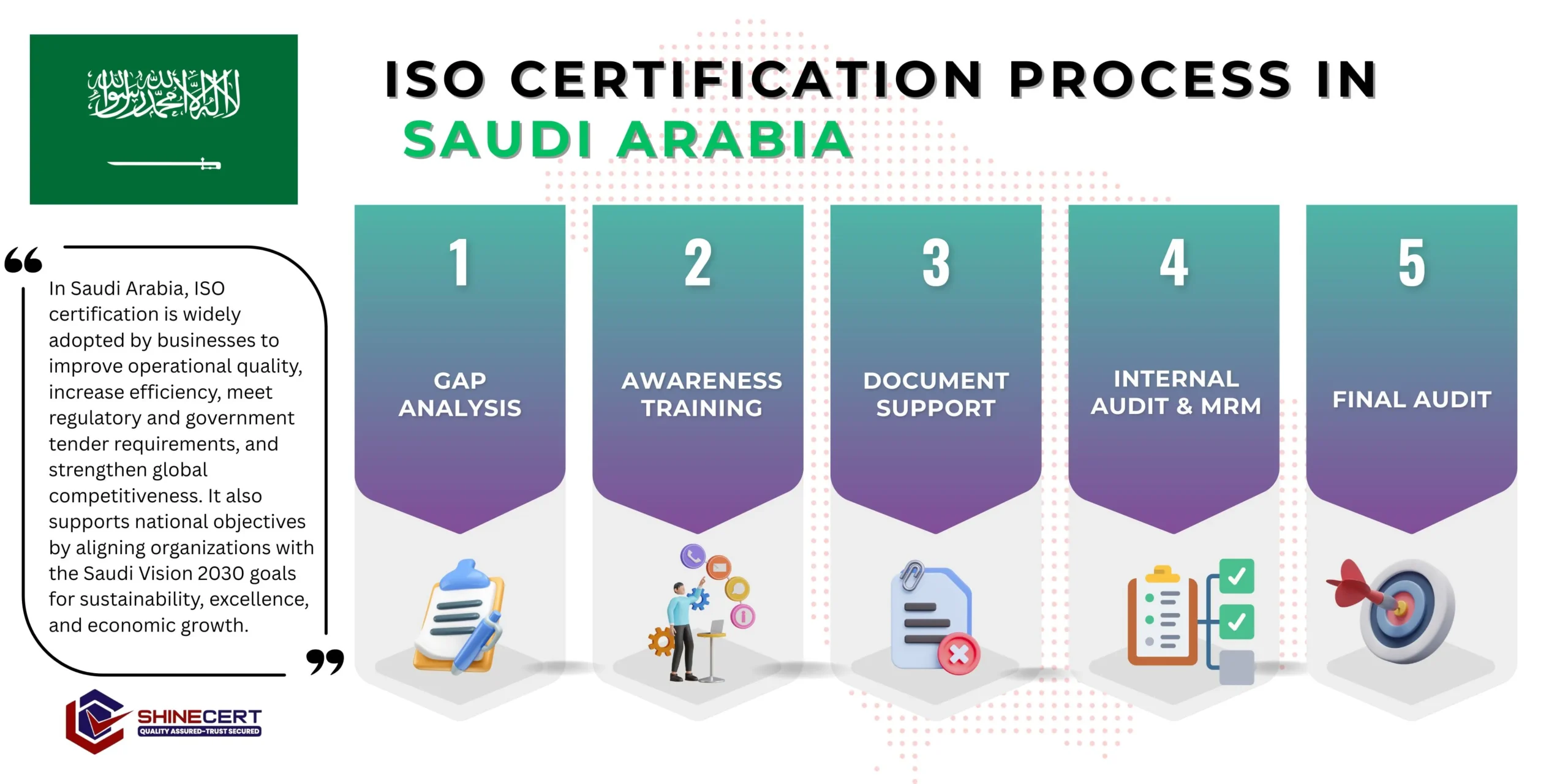
ShineCert’s 5-Step Certification Process for Food and Beverage
Gap Analysis
ShineCert reviews current food safety, quality, and HACCP practices against ISO 22000 and any additional target standard requirements.
Gap assessment report and HACCP plan review.
Documentation and HACCP Plan Development
Food safety policy, prerequisite programs, and a validated HACCP plan covering your specific processes are developed.
Complete food safety management system documentation and HACCP plan.
Implementation and Staff Training
Critical control point monitoring, traceability systems, and prerequisite programs are rolled out, and production staff are trained on food safety procedures.
Training records and implementation evidence.
Internal Audit
An internal audit and management review evaluate the food safety management system, including a mock traceability recall exercise.
Internal audit report, mock recall results, and management review minutes.
Certification Audit Support
ShineCert supports Stage 1 and Stage 2 audits with your chosen accredited certification body.
ISO 22000 certificate (and any additional certificates) and surveillance audit schedule.
Gap Analysis
ShineCert reviews current food safety, quality, and HACCP practices against ISO 22000 and any additional target standard requirements.
Gap assessment report and HACCP plan review.
Documentation and HACCP Plan Development
Food safety policy, prerequisite programs, and a validated HACCP plan covering your specific processes are developed.
Complete food safety management system documentation and HACCP plan.
Implementation and Staff Training
Critical control point monitoring, traceability systems, and prerequisite programs are rolled out, and production staff are trained on food safety procedures.
Training records and implementation evidence.
Internal Audit
An internal audit and management review evaluate the food safety management system, including a mock traceability recall exercise.
Internal audit report, mock recall results, and management review minutes.
Certification Audit Support
ShineCert supports Stage 1 and Stage 2 audits with your chosen accredited certification body.
ISO 22000 certificate (and any additional certificates) and surveillance audit schedule.
Food Safety Certification and Retailer Own-Brand Audits — How They Connect
Major retail chains increasingly layer their own supplementary supplier audits on top of ISO 22000 certification, examining specific practices relevant to their own brand standards that may go beyond the certificate’s baseline requirements, particularly around allergen management, supplier traceability depth, and specific labeling accuracy expectations. Food and beverage companies that treat ISO 22000 certification as fully satisfying every retail buyer’s expectations sometimes find gaps during a retailer’s own audit process, which is why ShineCert builds food safety systems designed to hold up under this additional layer of scrutiny, not merely the certification audit alone.
Applicable ISO Standards for Food and Beverage
ISO 22000
Food Safety Management System
ISO 22000 — Food Safety Management System
ISO 22000 has become the internationally recognized baseline for demonstrating systematic food safety management, integrating Hazard Analysis and Critical Control Points (HACCP) principles into a broader management system framework covering prerequisite programs, traceability, and continual improvement. For manufacturers and processors targeting retail supply, export markets, or food service supply chains, ISO 22000 certification frequently determines whether a company even qualifies for supplier consideration, since major retailers and food service buyers increasingly require it as a baseline rather than treating it as a differentiator among otherwise similar suppliers.
ISO 9001
Quality Management System
ISO 9001 — Quality Management System
Alongside food safety specifically, ISO 9001 addresses the broader quality management discipline around consistent production, customer requirement management, and process control that ISO 22000's food-safety-specific scope doesn't fully cover on its own. Food and beverage companies pursuing both standards find genuine efficiency in integrated implementation given the substantial overlap in documentation, internal audit, and management review requirements between the two frameworks, and many buyers specifically request both certifications together as a combined quality and safety signal.
ISO 14001
Environmental Management System
ISO 14001 — Environmental Management System
Food and beverage processing frequently involves significant water use, packaging waste, and, particularly for beverage producers, substantial energy and water consumption in production, making environmental management a genuine operational concern beyond pure regulatory compliance. ISO 14001 certification demonstrates structured management of these environmental aspects, and increasingly, retail buyers and export markets factor supplier environmental performance into broader sustainability sourcing criteria that extend beyond food safety alone.
Halal
Halal Certification
Halal Certification
For companies exporting to Muslim-majority markets or serving Halal-conscious consumer segments in any market, Halal certification addresses a distinct set of requirements around permissible ingredients, slaughter methods where applicable, and prevention of cross-contamination with non-Halal materials throughout production, concerns that ISO food safety standards don't address at all, since they're built around hazard and quality control rather than religious dietary compliance. Companies sometimes assume ISO 22000 certification alone satisfies Halal market access requirements, but the two are genuinely complementary, not substitutes, and destination markets requiring Halal certification will not accept ISO 22000 certification as a replacement.
Right-Sized Certification Matters
The reverse question applies here too: very small-scale food producers serving purely local markets without retail chain or export ambitions sometimes find full ISO 22000 certification premature relative to their current commercial needs, though even smaller producers often benefit from adopting the standard's HACCP-based thinking informally as a foundation for future growth.
Common Implementation Challenges in Food and Beverage Certification
- HACCP plans that don’t reflect actual process reality : A HACCP plan developed at a desk without genuine validation against actual production conditions is a common and serious audit finding.
- Traceability systems that don’t support a genuine recall : Traceability records that would take days to trace an affected batch during an actual recall fail the practical test the standard is designed to satisfy.
- Allergen management is treated informally : Cross-contact risk between allergen-containing and allergen-free production runs requires genuine, documented control, not just general awareness among staff.
- Supplier ingredient verification gaps : Food safety depends heavily on incoming ingredient quality and safety, and companies that don’t extend genuine verification to their own supply base create a persistent risk.
Benefits of Certification for Food & Beverage Organizations
- International business and market access benefits : ISO 22000 and Halal certification together open export markets and retail supply relationships that would otherwise be closed entirely, since many destination countries and major retail chains treat these certifications as non-negotiable entry requirements rather than competitive differentiators among already-qualified suppliers.
- Trust and reputation benefits : In a category where consumer trust depends heavily on confidence in what’s actually in a product and how safely it was produced, certification provides an independently verified signal that a self-declared quality claim on packaging simply can’t replicate, particularly valuable when entering new markets where a brand has no existing reputation to draw on.
- Process improvement and operational benefits : Structured food safety management frequently surfaces genuine operational gaps, critical control points that were being monitored informally rather than systematically, traceability records that would struggle to support a genuine recall investigation, supplier ingredient quality that wasn’t being verified consistently — and companies that engage seriously with the improvement cycle typically see measurable reductions in product holds, customer complaints, and recall risk over time.
- Regulatory and risk-reduction benefits : Certified food safety management provides a stronger position with food safety regulators and, in the event of an incident, demonstrates that reasonable, structured controls were genuinely in place, which matters significantly both for regulatory standing and for limiting liability exposure.
Food & Beverage Certification Cost: What Actually Drives It
- Company size and production volume : A high-volume processor running multiple production lines faces a larger HACCP scope and audit man-day requirement than a smaller, single-line operation.
- Nature of the business and product risk category : High-risk product categories, ready-to-eat foods, dairy, seafood, require more rigorous hazard analysis than lower-risk categories like dry packaged goods.
- Number of departments and product lines in scope : Certification covering multiple product categories or processing facilities as distinct units costs more than a single-line, single-facility certification.
- Existing food safety maturity : Companies with established HACCP practices, even if informal, typically implement faster and at lower cost than those building food safety management from scratch.
- Additional certifications pursued : Adding Halal certification or ISO 14001 alongside ISO 22000 adds distinct scope and cost, though integrated implementation reduces combined cost below separate projects.
Traceability and Mock Recall Exercises
- A food safety management system’s genuine value is tested not during routine operation but in the moment a potential contamination issue is identified and a company needs to trace affected product quickly and accurately, which is why a genuine mock recall exercise, tracing a specific batch or ingredient forward and backward through the full supply and distribution chain within a defined time target, reveals far more about real food safety maturity than reviewing traceability documentation alone.
- Companies that only discover their traceability system’s actual limitations during a genuine incident face a materially worse outcome than those that identify and fix those limitations during a planned, low-stakes exercise conducted well before any real contamination event. ShineCert builds mock recall exercises into every ISO 22000 implementation specifically because a traceability system that looks complete on paper sometimes reveals significant gaps only when genuinely tested end to end under realistic time pressure.
Halal and ISO Certification for Export Markets
- Companies targeting both conventional and Halal-conscious export markets need to think carefully about how Halal and ISO food safety requirements interact operationally, since maintaining separate Halal and non-Halal production lines, or managing genuine segregation within a shared facility, requires deliberate physical and procedural controls that a food safety system alone doesn’t automatically provide.
- Cross-contamination risk between Halal and non-Halal materials needs the same rigor as any other hazard in the HACCP plan, and companies that treat Halal compliance as a separate, bolted-on afterthought rather than genuinely integrating it into their core food safety and traceability systems often find inconsistencies surface during either certification body’s audit. ShineCert helps food and beverage exporters design integrated systems where Halal segregation, ISO food safety hazard control, and traceability work together coherently, since a fragmented approach across multiple, poorly coordinated certification efforts creates both operational inefficiency and genuine compliance risk.
Why Choose ShineCert for Food and Beverage Certification?
ShineCert has guided more than 10,000 organizations through international certification from genuine operating offices in Riyadh, Lebanon, and India, with practical experience across food manufacturing, beverage production, and export-oriented processors serving both conventional and Halal-conscious markets.
Food and Beverage Certification Timeline
Phase | Typical Duration |
Gap analysis | 2–4 weeks |
Documentation and HACCP plan development | 5–9 weeks |
Implementation and staff training | 5–9 weeks |
Internal audit and mock recall exercise | 1–2 weeks |
Certification body Stage 1 + Stage 2 audit | 2–4 weeks |
Total for ISO 22000 certification | 4–7 months |
Choosing an Accredited Certification Body for Food and Beverage
What to Check | Why It Matters |
IAF-recognized accreditation for ISO 22000 (and Halal accreditation where relevant) | Confirms certificates carry genuine recognition with your target retail and export markets |
Food sector and product category audit experience | Auditors familiar with your specific product category assess hazard analysis and controls more effectively |
Recognition by your target export destination markets | Confirms certification will satisfy the specific import and retail requirements you’re targeting |
Halal certifying body recognition in destination markets | Relevant since Halal certification recognition varies by destination country and importing authority |
Start Your Food and Beverage Certification Journey
ShineCert provides end-to-end certification support, from gap analysis through certification audit, for food manufacturers, beverage producers, and exporters targeting both conventional and Halal-conscious markets. Book your free consultation or contact ShineCert directly, and our team will review your production processes, target markets, and current food safety maturity before proposing a fixed-scope engagement plan.
Frequently Asked Questions
Most commonly ISO 22000 for food safety, often paired with ISO 9001, and Halal certification specifically for Muslim-majority destination markets or Halal-conscious consumer segments.
No, they address genuinely different concerns, food safety hazard control versus religious dietary compliance, and destination markets requiring Halal certification won’t accept ISO 22000 as a substitute.
It depends on production volume, product risk category, and existing food safety maturity. ShineCert provides a fixed quote after gap analysis.
Typically four to seven months, depending on process complexity and existing HACCP maturity.
Many major retailers layer their own supplementary audits on top of ISO 22000 certification, examining brand-specific requirements beyond the certificate’s baseline.
Certification scales to producers of any size, though very small, local-market-only producers sometimes find full certification premature relative to current commercial need.
It’s most valuable where water use, packaging waste, or energy consumption are significant, and increasingly relevant as retail buyers factor sustainability into sourcing decisions.