
ISO Certification in Bahrain
Quick Answer
Bahraini businesses most commonly start with ISO 9001, then add ISO 27001 if they’re in Bahrain’s substantial financial services sector, or ISO 45001 if they’re in construction or industrial operations. Confirm your certification body is accredited by the Gulf Accreditation Center (GAC) or another IAF MLA signatory, Bahrain doesn’t run its own separate national accreditation scheme the way some neighbors do, so GAC recognition is the practical benchmark. Budget roughly BHD 800 to BHD 3,500 for a single standard at a small or mid-sized company, and expect three to six months from kickoff to certificate.
Why ISO Certification Matters to Bahraini Businesses?
Bahrain built its modern economy on being the Gulf’s first mover, first with oil, first with a stock exchange, first with a fully liberalized banking sector. That first-mover advantage still shapes how Bahraini businesses compete today, but it now runs through international credentialing rather than simple regulatory speed. The Central Bank of Bahrain (CBB) regulates one of the region’s most mature financial services sectors, and its operational resilience and cybersecurity expectations for licensed institutions increasingly overlap with what ISO 27001 already requires, a bank or fintech that can point to an actual certified security management system has a materially easier conversation with the CBB than one relying on informal controls.
Beyond finance, Bahrain’s manufacturing and logistics sectors, anchored by Aluminium Bahrain (Alba) and the Khalifa Bin Salman Port, increasingly expect ISO 9001 from their supplier base, following the same pattern seen across the wider GCC as larger buyers push quality expectations down their supply chains.
Bahrain’s Accreditation Landscape
Bahrain’s certification bodies are typically accredited by the Gulf Accreditation Center (GAC), the regional GCC accreditation body that has built genuine international standing as one of the first multi-economy accreditation agencies in the Middle East, Asia, and Pacific region to achieve broad international recognition. GAC accreditation covers management system certification under ISO/IEC 17021-1, along with related conformity assessment scopes. Many certification bodies operating in Bahrain also carry accreditation from other IAF MLA signatories such as UKAS or DAkkS, which is equally valid, what actually matters for a Bahraini business is confirming IAF MLA signatory backing exists somewhere in the accreditation chain, not which specific body issued it.
Sector regulation adds another layer. The CBB’s rulebook increasingly references internationally recognized security and operational resilience frameworks for licensed financial institutions, and Bahrain’s Ministry of Industry and Commerce oversees broader quality and safety expectations for manufacturers and traders operating out of Bahrain’s industrial areas.
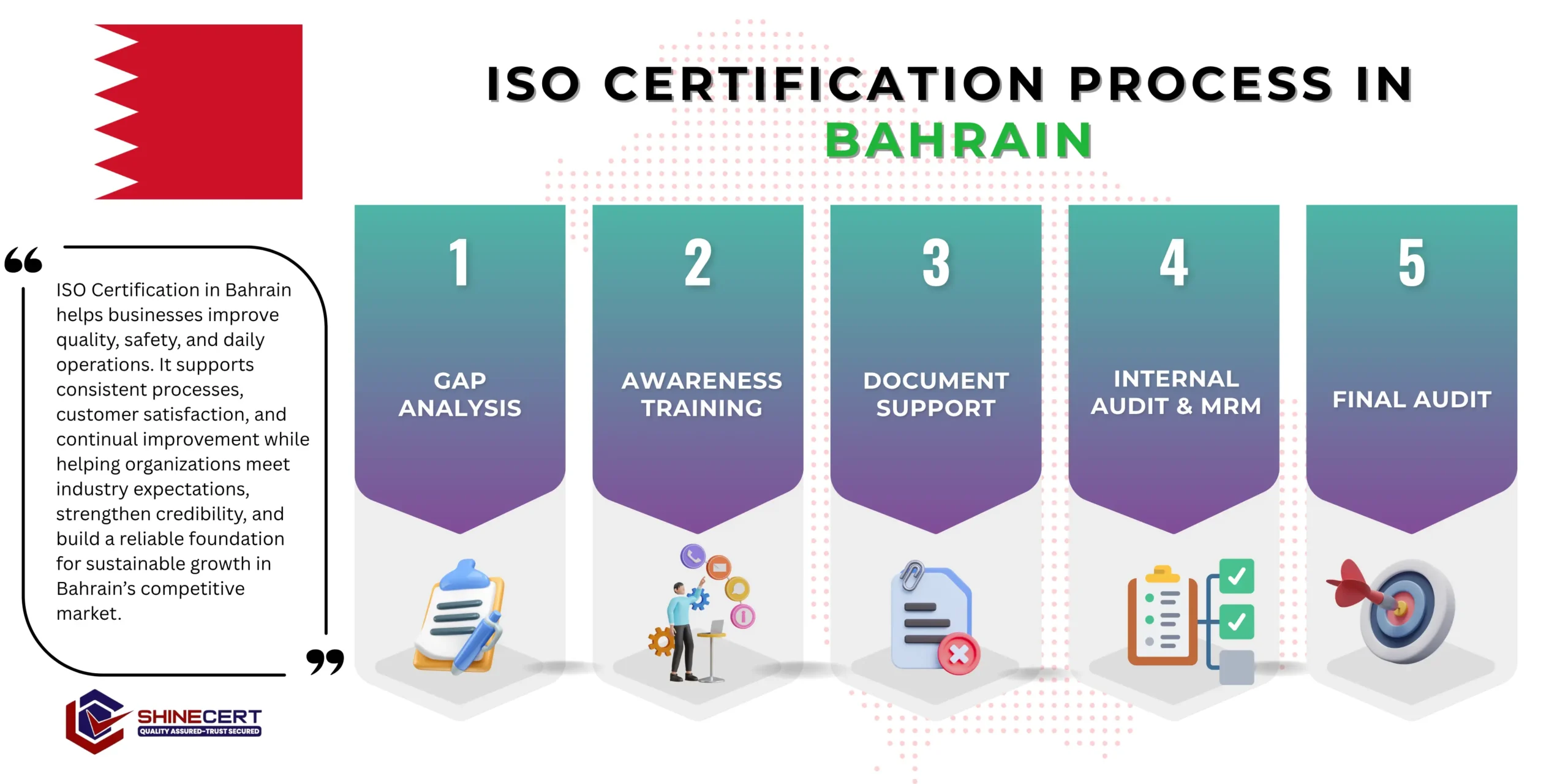
What are the steps to get ISO Certification in Bahrain?
our services
- ISO Certification Bahrain
- ISO 9001 Certification Bahrain
- ISO 14001 Certification Bahrain
- ISO 27001 Certification Bahrain
- ISO 22000 Certification Bahrain
- ISO 27701 Certification Bahrain
- ISO 45001 Certification Bahrain
- ISO 20000-1 Certification Bahrain
- ISO 13485 Certification Bahrain
- ISO 17025 Certification Bahrain
- ISO 31000 Certification Bahrain
- ISO 42001 Certification Bahrain
- ISO 37001 Certification Bahrain
- ISO 22301 Certification Bahrain
- ISO 50001 Certification Bahrain
- CE Mark Certification Bahrain
- GDPR Certification Bahrain
- GMP Certification Bahrain
- Halal Certification Bahrain
ShineCert’s Certification Process in Bahrain
Gap Analysis
We assess your current operations against your target standard, with particular attention to CBB regulatory overlap for financial services clients.
Documentation Development
We build your management system documentation with your team, in English with Arabic available where needed for your Bahraini workforce.
Implementation and Training
We train staff through practical, scenario-based sessions, adapted to your sector, financial controls training looks very different from industrial safety training, and we treat them accordingly.
Internal Audit and Management Review
We run a rigorous internal audit before external certification, followed by formal management review and documented corrective action.
Certification Audit
We coordinate Stage 1 and Stage 2 audits with a GAC-accredited or other IAF-recognized certification body, and establish a surveillance schedule to maintain certification value long-term.
ISO Certification Cost in Bahrain
Expect roughly BHD 800 to BHD 3,500 for a single standard at a small or mid-sized company. Financial services firms pursuing ISO 27001 or ISO 22301 often see costs toward the higher end given the depth of control documentation CBB-regulated environments require. Industrial and manufacturing clients’ costs scale mainly with site count and headcount. As with most GCC markets, bundling standards, ISO 9001 with 45001 for industrial clients, or ISO 27001 with ISO 22301 for financial institutions, reduces total cost compared to running them separately, since a meaningful share of the audit and documentation work overlaps.
Benefits of ISO Certification in Bahrain
- Easier conversations with the CBB : Financial institutions with ISO 27001 or ISO 22301 certification typically find regulatory security and resilience reviews go more smoothly, since much of the evidence already exists in structured form.
- Credibility with GCC and international partners : Bahrain’s businesses often compete regionally, and a GAC or IAF-recognized certificate travels well across Gulf borders without needing separate justification.
- Operational consistency at scale : Certification imposes a structure that helps growing Bahraini businesses maintain quality as they expand beyond the size where informal processes worked reliably.
- Supply chain access : Larger Bahraini manufacturers and government entities increasingly expect certified suppliers, making certification a practical requirement for accessing certain contracts.
- Reduced operational risk : Structured safety and environmental management reduces incident rates and associated costs for Bahrain’s industrial operators.
- A verifiable answer during due diligence : For Bahraini businesses seeking investment or partnership, certification provides an independently verifiable operational maturity signal.
- Consolidated regulatory tracking : CBB, Ministry of Industry and Commerce, and sector-specific requirements fold into one auditable system rather than being tracked separately.
- International recognition beyond Bahrain : A GAC or IAF-recognized certificate reads identically to buyers across the GCC and internationally.
ISO Standards Most Relevant to Bahrain
ISO 9001 Quality Management
The standard most Bahraini businesses pursue first, given its broad recognition across government and private tenders alike. It reassures procurement teams about consistent quality and gives smaller firms a credible foundation for winning new contracts.
ISO 14001 Environmental Management
Bahrain’s industrial sector, particularly around Alba and the Sitra petroleum refining area, faces growing environmental compliance expectations that certification helps demonstrate systematically to regulators, international clients, and corporate partners alike.
ISO 45001 Occupational Health and Safety
Alba’s aluminium smelting operations and the broader industrial base around Bahrain’s ports and free zones drive consistent demand for structured safety management among suppliers and contractors, helping firms meet client expectations and win contracts.
ISO 27001 Information Security Management
Bahrain’s mature, CBB-regulated financial services sector, one of the most developed in the Gulf, has made this close to a standard expectation for banks, insurers, and fintech companies operating under CBB licensing, reflecting strict regulatory oversight and growing cyber risk.
ISO 22000 Food Safety Management
Bahrain’s food import dependency and hospitality sector, which serves a significant regional tourism market, make food safety certification relevant for importers, manufacturers, and hospitality operators, helping them meet regulatory standards and maintain customer trust.
ISO 22301 Business Continuity Management
Bahrain’s financial services concentration makes operational resilience a genuine regulatory concern, and ISO 22301 gives institutions a structured way to demonstrate they can maintain critical operations through disruption, protecting clients, markets, and reputation alike.
ISO 13485 Medical Devices Quality Management
Bahrain’s positioning as a regional medical tourism and healthcare hub has created steady demand among device suppliers and healthcare facility vendors for quality certification that satisfies regulators, hospitals, and international patients.
ISO 50001 Energy Management
Bahrain’s energy-intensive economy and its 2060 net-zero commitment push heavy users like Alba, petrochemical plants, and large commercial buildings to manage consumption systematically, cutting costs while demonstrating compliance with national efficiency targets.
Bahrain’s Insurance Sector and Takaful Providers
- Bahrain has built a genuinely notable concentration of insurance and reinsurance companies, along with a significant cluster of Takaful (Islamic insurance) providers, drawn partly by the CBB’s well-established regulatory framework for the sector.
- This concentration has created its own certification dynamic: insurers and reinsurers handling large volumes of sensitive policyholder data increasingly pursue ISO 27001 not just to satisfy the CBB, but because regional and international reinsurance partners conducting due diligence on Bahraini counterparties treat certification as a meaningful signal of operational maturity before committing to larger reinsurance treaties. For Takaful providers specifically, demonstrating both Sharia governance compliance and internationally recognized operational certification together has become an increasingly common combination that larger institutional partners look for during partnership evaluations.
Common Challenges in Bahrain
- Assuming CBB regulatory compliance and ISO 27001 certification are interchangeable : They overlap significantly but are separate obligations, certification supports the CBB conversation, it doesn’t replace it.
- Underestimating documentation depth expected in financial services : CBB-regulated entities often need more granular control documentation than a typical ISO 27001 rollout elsewhere.
- Industrial safety training is treated as a paperwork exercise : Alba-adjacent suppliers in particular need genuine behavioral change, not just signed records.
- Not confirming GAC accreditation before committing : A certificate without a clear IAF MLA link can create friction during larger tender evaluations or partner due diligence.
Bahrain’s Logistics Corridor and Port Modernization
- Khalifa Bin Salman Port has undergone successive modernization phases aimed at positioning Bahrain as a competitive alternative to larger regional ports, and that ambition has direct certification implications for the freight forwarders, customs brokers, and logistics operators working through it.
- International shipping lines and cargo owners routing goods through Bahrain increasingly expect the same ISO 9001-certified operational discipline they’d find at any major regional port, and Bahrain’s relatively compact geography, which makes it possible to move goods between port, airport, and industrial zones considerably faster than in larger neighboring markets, has become a genuine competitive selling point that certified logistics operators are well positioned to capitalize on when courting international shipping and freight partners looking for efficient, reliable Gulf transit options.
Industries We Support in Bahrain
Financial services
Bahrain’s banking, insurance, and fintech sector, regulated by the CBB, is where we see the strongest demand for ISO 27001 and ISO 22301.
Read moreManufacturing and industrial
Alba’s aluminium operations and the broader Sitra industrial area drive demand for ISO 9001 and 45001 among suppliers and contractors.
Read moreLogistics and trade
Khalifa Bin Salman Port and Bahrain’s role as a regional trade hub create demand for quality-certified logistics and freight handling operations.
Read moreHealthcare
Bahrain’s medical tourism positioning has grown demand for ISO 13485 among device suppliers and healthcare facility vendors.
Read moreHospitality and food service
Bahrain’s regional tourism draw supports demand for ISO 22000 among food importers, manufacturers, and hospitality operators.
Read moreISO Certification Timeline in Bahrain
Phase | Typical Duration |
Gap analysis | 2–3 weeks |
Documentation development | 4–7 weeks |
Implementation and training | 4–6 weeks |
Internal audit and management review | 1–2 weeks |
Certification audit (Stage 1 + Stage 2) | 3–4 weeks |
Total, single standard | 3–6 months |
Bahrain’s Fintech and Economic Diversification Push
- Bahrain got to “first” in Gulf banking decades before its larger neighbors built comparable financial centers, and it’s now applying that same first-mover instinct to fintech. Bahrain FinTech Bay, established as a regional innovation hub, has attracted a growing cluster of payments, digital banking, and insurtech startups, and the CBB’s regulatory sandbox program has made Bahrain a genuinely attractive testing ground for financial technology that would face heavier friction elsewhere in the region. This creates a specific certification dynamic worth understanding: fintech startups graduating out of the CBB sandbox into full licensing increasingly find that ISO 27001 certification substantially eases that transition, since much of the security documentation the CBB expects during full licensing overlaps directly with what ISO 27001 already requires.
- Beyond fintech, Bahrain’s broader push to diversify away from hydrocarbon dependency, visible in its growing logistics, tourism, and light manufacturing investments, has widened which sectors encounter certification expectations from government-linked development programs and international joint venture partners. A decade ago, certification conversations in Bahrain centered almost entirely on oil and gas contractors and financial institutions; today we field inquiries from a noticeably broader range of sectors reflecting that diversification.
Where We Support Clients in Bahrain?
We coordinate Bahrain engagements from ShineCert’s Riyadh and Lebanon offices, with consultants traveling to Manama, Sitra, and Bahrain’s broader industrial and financial districts for on-site work.
Choosing a Certification Body in Bahrain?
What to Check | Why It Matters |
GAC or other IAF MLA accreditation | Confirms genuine international recognition for your certificate |
CBB regulatory familiarity (financial services clients) | Ensures ISO 27001/22301 scoping actually aligns with CBB expectations |
Experience with Bahraini industrial sector safety norms | Matters for ISO 45001 clients around Alba and Sitra |
Willingness to audit bilingually | Reduces friction for Bahraini workforces |
Why Choose ShineCert in Bahrain?
We manage the full certification journey for Bahraini businesses across financial services, manufacturing, logistics, and healthcare. Our team has guided more than 10,000 organizations through international certification, with ShineCert as the best ISO consultant in Bahrain and particular familiarity in the CBB regulatory overlap that shapes how ISO 27001 and ISO 22301 should be scoped for Bahrain’s financial institutions.
Start Your ISO Certification Journey in Bahrain
ShineCert supports Bahraini businesses end to end, from gap analysis through certification audit. Book a free consultation or contact us directly, and we’ll review your sector and target standard before proposing a fixed-scope plan.
Frequently Asked Questions
Typically BHD 800 to BHD 3,500 for a single standard at a small or mid-sized company, covering consulting and certification body audit fees.
No, it’s voluntary outside specific regulated sectors, though CBB expectations for financial institutions and larger industrial tenders increasingly treat it as a practical necessity.
Bahrain relies primarily on the Gulf Accreditation Center (GAC) and other IAF MLA signatories rather than a separate standalone national accreditation scheme.
ISO 27001 gives financial institutions a structured security framework that supports demonstrating compliance with CBB’s operational resilience and cybersecurity expectations, though the two remain distinct obligations.
Typically three to six months from kickoff to certificate.
We coordinate Bahrain engagements from our Riyadh and Lebanon offices, with consultants traveling on-site as needed.
Yes, beyond CBB expectations, regional reinsurance partners increasingly treat certification as a meaningful due diligence signal before committing to larger treaties.