
ISO 31000 Certification in Bahrain
Quick Answer
ISO 31000 is the international standard providing principles and guidelines for risk management, and it’s important to understand upfront that ISO 31000 is not a certifiable standard. There is no “ISO 31000 certificate” issued by an accredited certification body, unlike ISO 9001 or ISO 27001. What organizations pursue instead is genuine implementation of the framework, sometimes followed by an independent conformity review confirming the framework has been properly adopted. In Bahrain, this matters particularly for CBB-regulated financial institutions with real risk governance expectations, and for companies bidding on Tender Board contracts where structured risk management increasingly features in evaluation criteria. Plan for two to four months for a genuine implementation. Cost depends on organizational complexity and risk maturity, not a flat number.
What Is ISO 31000, Technically Speaking?
ISO 31000 is fundamentally different from the other standards on this site, and understanding that difference matters before committing a budget to it. It is a guidance standard, not a requirements standard, it uses “should” language throughout rather than the “shall” language of certifiable management system standards like ISO 9001 or ISO 27001, and it deliberately contains no Annex SL Harmonized Structure clauses written for third-party audit. ISO 31000 gives organizations principles, a framework, and a process for managing risk, but it leaves the specific implementation details, what risk appetite statement to write, what risk register format to use, how often to review, to the organization’s own judgment, rather than prescribing auditable requirements.
The standard’s technical architecture rests on three interlocking components. The Principles (eight of them, including “integrated,” “structured and comprehensive,” and “the best available information”) describe the characteristics effective risk management should have. The Framework describes how risk management should be integrated into organizational governance, leadership and commitment, integration, design, implementation, evaluation, and improvement, essentially a management cycle for the risk management function itself, distinct from the Process. The Process is the operational core: establishing scope and context, risk assessment (identification, analysis, and evaluation), risk treatment, and the two continuous threads of monitoring/review and communication/consultation running throughout.
A genuinely important technical concept within the Process is the distinction between risk analysis and risk evaluation, analysis is understanding a risk’s nature, sources, likelihood, and consequences, while evaluation is comparing analyzed risk against defined risk criteria to decide whether the risk is acceptable or requires treatment. This distinction matters practically: an organization that skips straight to “is this risk acceptable” without genuinely analyzing likelihood and consequence first tends to make inconsistent, gut-feeling risk decisions rather than defensible, evidence-based ones.
Because ISO 31000 isn’t independently certifiable, organizations wanting external validation typically pursue one of two paths: embedding ISO 31000’s framework and process into a certifiable management system standard that does reference risk management formally (ISO 27001’s Clause 6.1 or ISO 22301’s Clause 6.1, for example, both expect a genuine risk assessment process that can be built directly on ISO 31000 principles), or commissioning an independent conformity review, not a certification audit, where an advisor assesses how genuinely the framework has been adopted against the standard’s principles and process, without issuing a certificate.
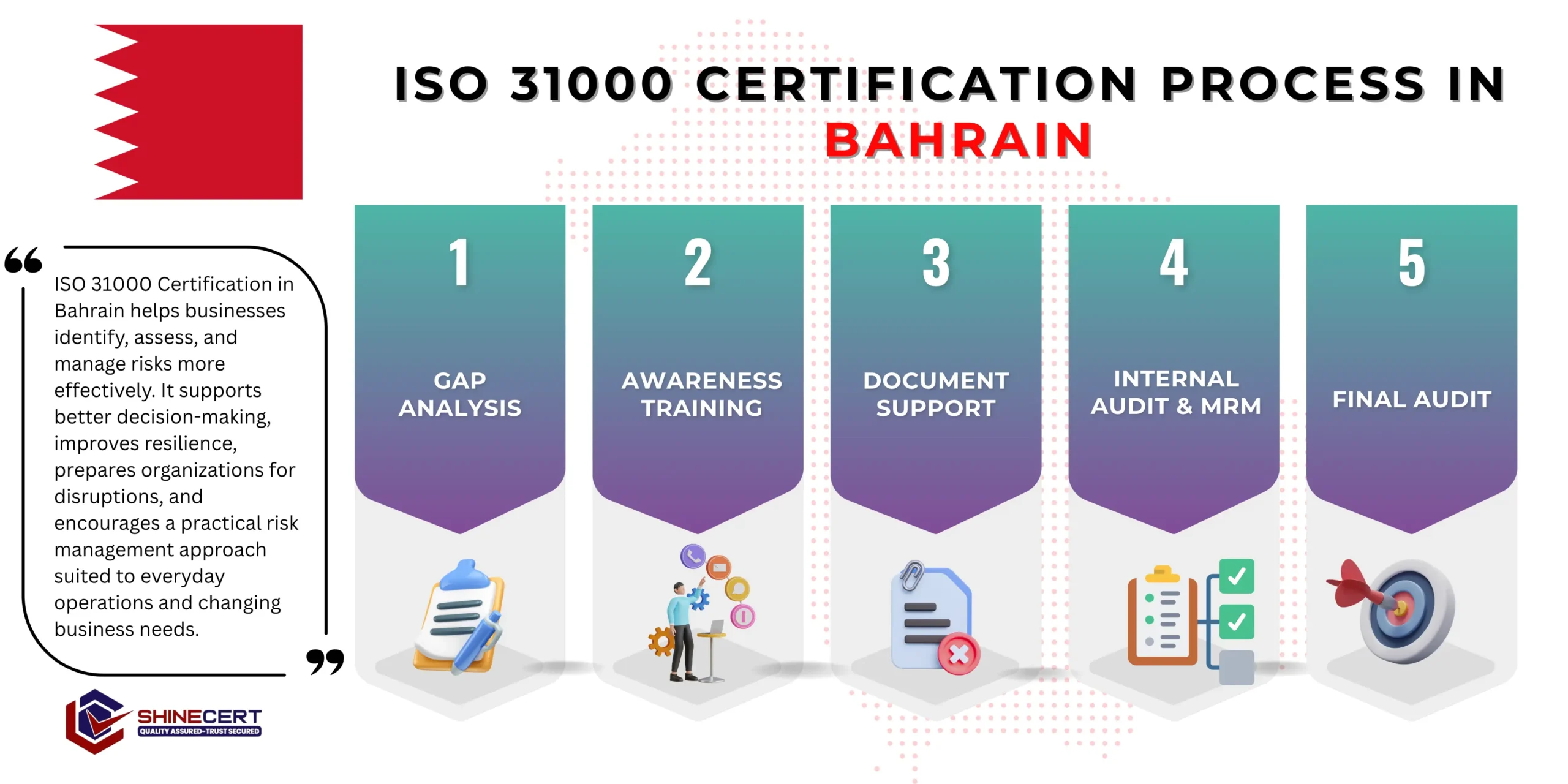
What are the steps to get ISO 31000 Certification in Bahrain?
our services
- ISO Certification Bahrain
- ISO 9001 Certification Bahrain
- ISO 14001 Certification Bahrain
- ISO 27001 Certification Bahrain
- ISO 22000 Certification Bahrain
- ISO 27701 Certification Bahrain
- ISO 45001 Certification Bahrain
- ISO 20000-1 Certification Bahrain
- ISO 13485 Certification Bahrain
- ISO 17025 Certification Bahrain
- ISO 31000 Certification Bahrain
- ISO 42001 Certification Bahrain
- ISO 37001 Certification Bahrain
- ISO 22301 Certification Bahrain
- ISO 50001 Certification Bahrain
- CE Mark Certification Bahrain
- GDPR Certification Bahrain
- GMP Certification Bahrain
- Halal Certification Bahrain
Our Five-Step Implementation Process: What to Actually Expect
Because ISO 31000 isn’t certifiable, this process culminates in an independent conformity review, not a certification audit, an important distinction worth understanding before you start.
Risk Maturity Assessment
We evaluate your current risk practices against ISO 31000’s principles, framework, and process. What this means for you: an honest picture of whether risk management currently lives in genuine governance or in a forgotten annual spreadsheet.
A risk maturity assessment report.
Framework Design
Your risk appetite statement, governance structure, and framework documentation get built around your organization’s actual context and objectives. What this means for you: a framework your board can genuinely use in real decisions, not a generic template nobody reads after the kickoff meeting.
A complete ISO 31000-aligned framework document set.
Process Implementation and Training
Risk identification, analysis, evaluation, and treatment processes roll out, with staff and leadership trained on genuine use. What this means for you: this phase determines whether risk management becomes a living practice or another binder on a shelf.
Training records and an initial risk register reflecting real organizational risks.
Embedding and Testing
We test whether risk management genuinely feeds into real decisions, board papers, project approvals, budget decisions. What this means for you: gaps between “documented process” and “actual practice” get caught and closed.
Evidence of risk management functioning in genuine decision-making.
Independent Conformity Review
An independent advisor reviews your framework’s genuine alignment with ISO 31000’s principles and process. What this means for you: credible, independent validation you can reference with regulators, boards, and tender evaluators, without the misleading claim of an “ISO 31000 certificate,” which doesn’t exist.
A conformity review report suitable for board and regulatory reference.
Why This Matters So Much in Bahrain Specifically?
- Bahrain’s financial sector, anchored by CBB-regulated institutions, operates under regulatory modules with genuine risk governance expectations; boards and senior management are expected to demonstrate structured, documented risk oversight, not informal risk awareness. ISO 31000 gives these institutions a recognized, internationally consistent language and framework for building that oversight, one that regulators, auditors, and rating agencies are broadly familiar with, reducing the friction of explaining a bespoke internal risk methodology from scratch.
- Beyond financial services, Tender Board evaluation criteria for larger construction and infrastructure contracts increasingly reward bidders who can demonstrate structured project risk management, not just quality and safety credentials. A company that can show a genuine ISO 31000-aligned risk framework, covering financial, operational, and project delivery risk, often presents a more credible bid than one relying purely on informal risk awareness, even where the underlying project capability is comparable.
Bahrain at a Glance: What Shapes ISO 31000 Demand Here
01
Financial sector risk governance
the Central Bank of Bahrain’s regulatory modules embed genuine risk management expectations for licensed institutions, and ISO 31000 provides a recognized framework for meeting them.
02
Tender Board evaluation
structured risk management is increasingly a factor in evaluating larger government contract bids, particularly for construction and infrastructure projects.
03
National resilience agenda
Economic Vision 2030’s Sustainability and Competitiveness pillars implicitly reward organizations with genuine forward-looking risk discipline, not just reactive crisis management.
04
SME funding available
Tamkeen offers training and business development grants that can offset risk management framework implementation costs for eligible companies.
What Actually Drives Your Cost?
We don’t quote a flat number, because a flat number would misrepresent how different two Bahrain organizations’ actual risk complexity can be. Here’s what genuinely drives cost :
A single-site company with straightforward operations needs meaningfully less framework depth than a multi-division financial institution with credit, operational, market, and compliance risk all in scope.
CBB-regulated institutions need deeper documentation and board-governance alignment than unregulated commercial businesses.
Each unit with distinct risk exposure needs its own contribution to the risk register and its own trained risk owners.
Organizations with some existing risk practices, even fragmented ones, aren’t starting from zero. Organizations with purely informal, undocumented risk awareness need more foundational work.
Frameworks genuinely embedded in board decision-making take more facilitation time to design well, but produce meaningfully more durable results than frameworks imposed top-down without leadership buy-in.
Building ISO 31000 alongside ISO 27001 or ISO 22301 implementation shares meaningful risk assessment infrastructure, reducing marginal cost.
An internal risk or compliance lead who can own framework documentation reduces consultant hours needed.
Where your project qualifies for co-funding, youWhere your project qualifies for co-funding, your genuine out-of-pocket cost can be meaningfully lower.
r genuine out-of-pocket cost can be meaningfully lower.
A compressed timeline driven by a regulatory review or tender deadline sometimes needs more concentrated consultant hours in a shorter window.
Common Pitfalls We See in Bahrain ISO 31000 Projects
- Marketing it as a “certification” : Because ISO 31000 has no certifiable requirements, claiming “ISO 31000 certified” status is misleading, the accurate claim is genuine framework implementation, optionally validated through an independent conformity review.
- Building a risk register without genuine board integration : A comprehensive risk register that never reaches board decision-making is documentation theater, not risk management, the framework’s value comes from genuine integration into real decisions.
- Treating risk appetite as a one-time statement : Risk appetite should evolve as organizational strategy and external conditions change; a static statement written once and never revisited quickly becomes disconnected from reality.
- Running risk management as a parallel process to strategic planning : ISO 31000’s Integration principle specifically expects risk considerations woven into strategy and planning, not run as a separate, disconnected annual exercise.
Benefits at a Glance
01
A structured, board-defensible risk governance framework
02
Stronger positioning for CBB regulatory risk expectations
03
More credible Tender Board bids on risk-sensitive contracts
04
Access to potential Tamkeen funding support
05
A foundation that strengthens ISO 22301, ISO 27001, and ISO 9001 risk clauses
Benefits: What Genuine Implementation Actually Changes
- Defensible, consistent risk decisions : Moving from gut-feeling risk judgment to a structured analysis-then-evaluation process produces decisions that hold up to board and regulatory scrutiny.
- Stronger regulatory positioning : For CBB-regulated institutions, a genuine ISO 31000-aligned framework gives regulators and auditors a recognized structure to assess, rather than a bespoke internal methodology that takes longer to evaluate and trust.
- More credible tender bids : Demonstrable risk management maturity increasingly differentiates bids on larger, more complex Tender Board contracts.
- Stronger foundation for certifiable standards : Because ISO 27001, ISO 22301, and ISO 9001 all require genuine risk assessment processes, a well-implemented ISO 31000 framework directly strengthens those certifiable systems rather than existing in isolation.
- Access to Tamkeen-supported funding : Depending on eligibility, implementation-related training and consulting costs may be partially offset through Tamkeen’s programs.
What Happens When a Bahrain Organization Operates Without a Structured Risk Framework?
- This is worth understanding concretely. Without a structured risk framework, organizations don’t necessarily lack risk awareness, but that awareness tends to live informally in individual managers’ heads, applied inconsistently, and rarely synthesized into a coherent picture for board or regulatory review. For CBB-regulated institutions specifically, this fragmentation is exactly what regulatory reviews are designed to catch, and remediation under regulatory pressure tends to be more costly and time-constrained than proactive implementation. For companies bidding on risk-sensitive Tender Board contracts, the absence of a demonstrable framework can quietly cost points in competitive evaluations without ever being explicitly flagged as the reason for a lost bid.
- We generally recommend Bahrain organizations, particularly regulated financial institutions and companies bidding on complex infrastructure projects, treat ISO 31000 implementation as proactive governance infrastructure, not something to build only after a regulator or lost tender forces the issue.
Risk Management Framework Components, Explained
- Principles : Eight characteristics, including that risk management should be integrated into all organizational activities, structured and comprehensive, and based on the best available information, that describe what “good” risk management looks like, used as a benchmark for self-assessment rather than an audit checklist.
- Leadership and Commitment (part of the Framework) : Genuine board and senior management ownership of risk management, not delegation to a single risk officer disconnected from real decision-making.
- Integration : Risk management woven into governance, strategy, planning, and operational decision-making, not a standalone annual exercise disconnected from how the organization actually runs.
- Design : Deliberately designing the risk management framework around the organization’s specific context, objectives, and stakeholders, rather than adopting a generic template.
- Establishing Context (part of the Process) : Defining the internal and external context risk decisions will be made within, genuinely understanding your operating environment, regulatory landscape, and stakeholder expectations.
- Risk Assessment (identification, analysis, evaluation) : The operational core, finding risks, understanding them, and deciding which need treatment.
- Risk Treatment : Selecting and implementing options for addressing evaluated risks, avoiding, accepting, sharing, or mitigating.
- Monitoring, Review, Communication, and Consultation : The continuous threads running throughout, ensuring the framework stays genuinely current and that risk information flows to the people who need it.
Tamkeen Funding: Does Your ISO 31000 Project Qualify for Subsidy?
Tamkeen’s training and business development programs can apply to risk management framework implementation, particularly the training components, depending on your company’s size, sector, and program eligibility. We generally recommend checking eligibility before finalizing your implementation budget.
Applicable Standards by Industry
Financial Services and Banking
CBB-regulated institutions use ISO 31000 to build the integrated risk governance regulators expect.
Read moreConstruction and Infrastructure
Contractors bidding on major Tender Board projects use structured risk management to strengthen bid credibility.
Read moreInsurance
Insurers and reinsurers use ISO 31000 principles to formalize underwriting and operational risk assessment consistency.
Read moreGovernment-Adjacent and Public Sector Entities
Organizations delivering public services increasingly need demonstrable risk governance as part of public accountability expectations.
Read moreLarge Private Enterprises
Multi-division companies use ISO 31000 to give boards a coherent, comparable view of risk across genuinely different business units.
Read moreCase Study: A Bahrain Financial Institution’s Risk Framework Buildout
- The following is an illustrative, composite example based on the kind of project ShineCert typically runs, not a specific named client. A Bahrain-based financial services firm licensed under CBB had a functioning but fragmented risk approach, credit risk, operational risk, and compliance risk were each managed by separate teams using different methodologies and terminology, making board-level risk reporting genuinely difficult to synthesize into a coherent picture. The trigger was a CBB regulatory review that specifically flagged the lack of an integrated, enterprise-wide risk framework.
- The assessment found each team’s individual risk practices were reasonably sound, but the absence of a shared framework, common risk appetite language, and consistent analysis methodology meant the board couldn’t genuinely compare a major operational risk against a major credit risk using consistent criteria. The bulk of implementation work went into building a shared risk appetite statement and common analysis methodology that each existing team could adopt without discarding their genuine domain expertise, plus a consolidated risk register giving the board a coherent, comparable view across risk types. The independent conformity review confirmed genuine alignment with ISO 31000’s principles, and the pattern we typically see afterward held: board risk discussions became noticeably more substantive once risks could genuinely be compared on the same terms rather than debated in three different vocabularies.
Recommended Documentation
Genuine board-level commitment specific to your organization.
Defined, meaningful thresholds for acceptable risk.
Covering leadership, integration, design, implementation, evaluation, and improvement.
Reflecting genuinely identified, analyzed, and evaluated organizational risks.
For risks requiring active mitigation, with owners and timelines.
Evidence of ongoing, genuine framework review and updates.
Why ShineCert?
We coordinate Bahrain engagements from ShineCert, the best ISO 31000 consultant in Bahrain, Riyadh and Lebanon offices, with direct familiarity with CBB regulatory risk expectations, Tender Board evaluation practice, and Tamkeen’s funding programs. Our team has guided more than 10,000 organizations through ISO framework implementation globally, and we build every Bahrain risk management engagement around your actual organizational structure, regulatory exposure, and funding eligibility, not a one-size-fits-all package, and always with an honest, upfront explanation of what ISO 31000 can and can’t formally certify.
Choosing an Independent Advisor in Bahrain?
What to Check | Why It Matters |
Genuine understanding that ISO 31000 isn’t certifiable | Advisors who market a fictional “certificate” misrepresent the standard |
Experience with CBB regulatory risk expectations | Ensures the framework genuinely satisfies what financial regulators actually look for |
Experience with Tender Board bid risk criteria | Helps ensure your framework strengthens genuine bid competitiveness |
Sector-specific risk experience | Financial services, construction, and public sector each involve meaningfully different risk profiles |
Ready to Get Certified?
ShineCert supports Bahrain organizations from initial risk maturity assessment through framework implementation and independent conformity review, including checking whether your project qualifies for Tamkeen funding support. Book a free consultation or contact us directly, and we’ll walk through your specific risk landscape and cost factors before proposing a fixed-scope plan.
Frequently Asked Questions
It’s the international standard providing principles, a framework, and a process for managing risk, a guidance standard, not a certifiable requirements standard.
No, ISO 31000 is not a certifiable standard. There is no accredited “ISO 31000 certificate.” Organizations implement the framework and can commission an independent conformity review instead.
It genuinely depends on factors like organizational complexity, regulatory overlay, and existing risk maturity, we scope every project individually.
Not by name specifically, but CBB’s regulatory modules embed risk governance expectations that ISO 31000 provides a recognized framework for meeting.
Typically two to four months.
Potentially, Tamkeen’s training and development programs can apply to implementation-related training costs depending on eligibility.
ISO 31000 is a general-purpose risk management guidance standard; ISO 27001’s Clause 6.1 requires a specific, certifiable information security risk assessment process that can be built directly on ISO 31000 principles.
Not by name in most cases, but demonstrable, structured risk management increasingly strengthens bid competitiveness on larger, more complex contracts.
Yes, a multi-division organization with several distinct risk categories in scope is a meaningfully larger project than a single-site company with straightforward operations.
We coordinate Bahrain engagements from our Riyadh and Lebanon offices, with consultants traveling on-site as needed.