
CE Mark Certification in Bahrain
Quick Answer
CE Marking is important to understand precisely before anything else: it is not a Bahrain certification, and ShineCert does not issue or process CE Marking in Bahrain, CE Marking is a European Union regulatory conformity mark, and it’s relevant to Bahrain businesses specifically as an export requirement for any product being sold into the European Economic Area, not as a domestic Bahrain compliance credential. What ShineCert provides Bahrain manufacturers and exporters is compliance advisory, helping you understand which EU regulations apply to your specific product, what technical documentation and conformity assessment procedures you need, and how to work with the right European-recognized bodies to affix CE Marking legally. The EU’s regulatory landscape is expanding significantly in 2026, with the AI Act, updated Machinery Regulation, and Battery Regulation all affecting a wider range of product categories, plus new Digital Product Passport requirements phasing in for several sectors. Plan for two to six months depending on your product’s risk category and applicable regulations. Cost depends on genuine factors, product complexity, regulatory category, testing requirements, not a flat number.
What Is CE Marking, Technically Speaking?
CE Marking (“Conformité Européenne”) is a conformity marking indicating that a product has been assessed and meets EU health, safety, and environmental protection requirements applicable to that specific product category, allowing it to be legally sold within the European Economic Area. It’s genuinely important to understand what CE Marking is not: it is not a quality mark in the way ISO 9001 certification implies broad quality management, it is not a certification of origin, and it does not indicate the product was manufactured in Europe, it is specifically and narrowly a declaration that the product meets applicable EU regulatory requirements for that product category.
The technical mechanism behind CE Marking is the “New Legislative Framework,” under which the EU issues product-category-specific directives and regulations (the Machinery Regulation, Low Voltage Directive, EMC Directive, Medical Devices Regulation, and dozens of others) each defining “essential requirements” a product must meet. Manufacturers — or in some cases their authorized representative or importer, must determine which of these EU legal instruments apply to their specific product, then follow the conformity assessment procedure that instrument specifies. Critically, conformity assessment procedures vary genuinely by risk level: many lower-risk products allow “self-declaration,” where the manufacturer conducts their own assessment against harmonized technical standards and issues a Declaration of Conformity without third-party involvement, while higher-risk products require assessment by a “Notified Body”, an EU-recognized, accredited conformity assessment organization, before the CE Mark can be legally affixed.
Technical documentation is the backbone of genuine CE Marking compliance regardless of the assessment route: a Technical File or Technical Documentation dossier must demonstrate how the product meets each applicable essential requirement, typically referencing “harmonized standards” (European technical standards that, when followed, create a presumption of conformity with the essential requirements) alongside test reports, risk assessments, and design documentation. This file must be maintained and available for EU market surveillance authorities even after the product has been placed on the market, CE Marking compliance is an ongoing obligation, not a one-time achievement.
The 2026 regulatory expansion is genuinely significant for Bahrain exporters to understand. The EU AI Act introduces specific conformity requirements for products incorporating AI systems, with risk-tiered obligations depending on the AI system’s classified risk level, a Bahrain manufacturer exporting AI-embedded industrial equipment or consumer electronics now needs to assess AI Act applicability alongside traditional CE Marking directives. The updated Machinery Regulation (replacing the older Machinery Directive) expands and tightens requirements around software-controlled and partly autonomous machinery, directly relevant to increasingly automated industrial equipment. The Battery Regulation introduces new due diligence, carbon footprint, and recyclability documentation requirements for products containing batteries, extending well beyond the product’s core function into supply chain and lifecycle documentation. The Digital Product Passport requirement, phasing in across several sectors, requires digitally accessible product information, material composition, repairability, recyclability, that goes beyond traditional paper-based Technical File documentation.
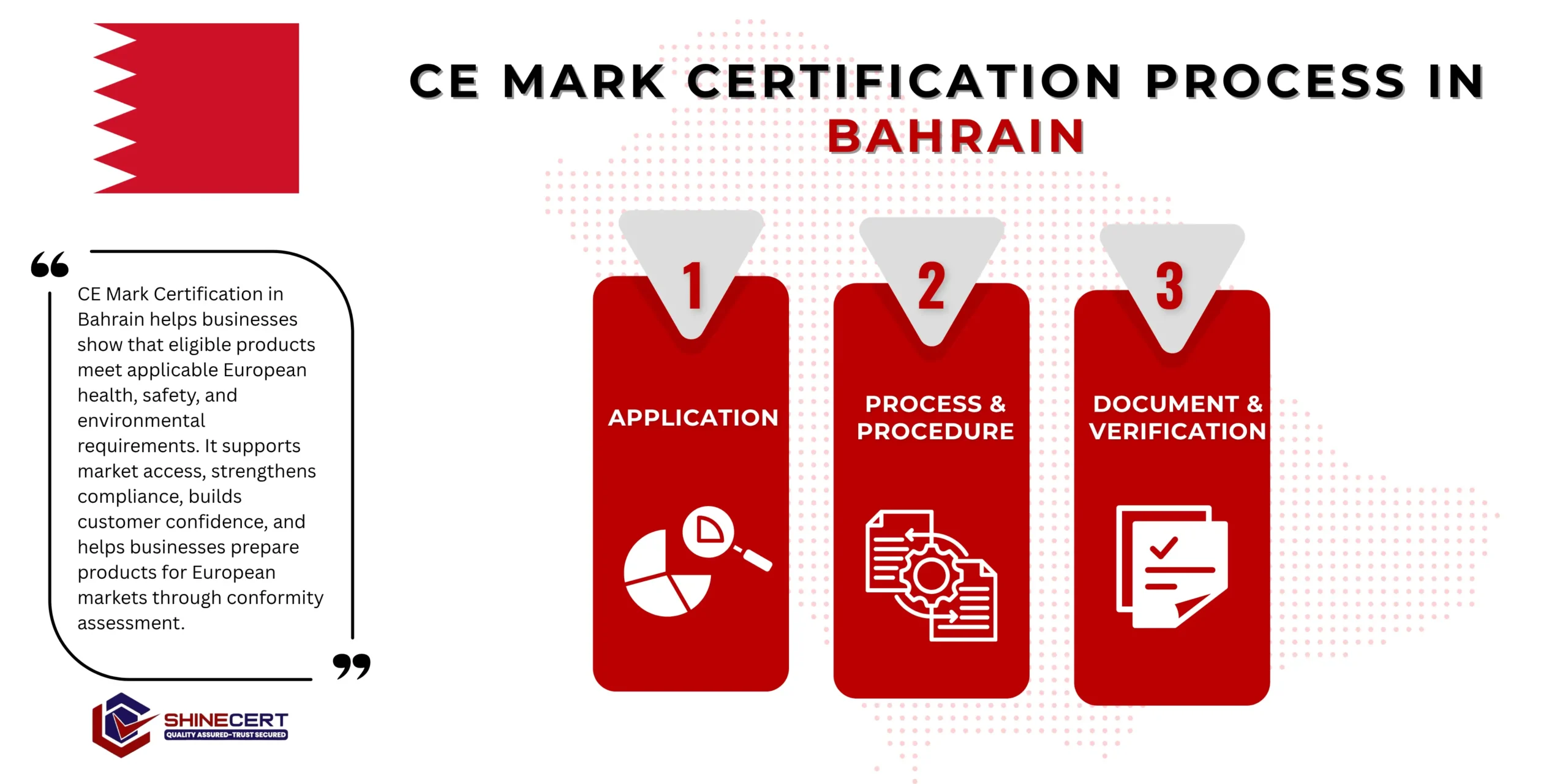
What are the steps to get CE Mark Certification in Bahrain?
our services
- ISO Certification Bahrain
- ISO 9001 Certification Bahrain
- ISO 14001 Certification Bahrain
- ISO 27001 Certification Bahrain
- ISO 22000 Certification Bahrain
- ISO 27701 Certification Bahrain
- ISO 45001 Certification Bahrain
- ISO 20000-1 Certification Bahrain
- ISO 13485 Certification Bahrain
- ISO 17025 Certification Bahrain
- ISO 31000 Certification Bahrain
- ISO 42001 Certification Bahrain
- ISO 37001 Certification Bahrain
- ISO 22301 Certification Bahrain
- ISO 50001 Certification Bahrain
- CE Mark Certification Bahrain
- GDPR Certification Bahrain
- GMP Certification Bahrain
- Halal Certification Bahrain
Our Five-Step Advisory Process: What to Actually Expect
Because CE Marking is administered by EU bodies, not Bahrain or GCC authorities, our process is advisory and preparatory, guiding you to the correct EU-recognized bodies and documentation rather than issuing certification ourselves.
Applicable Legislation Assessment
We determine which specific EU legal instruments apply to your product, including the 2026 AI Act, Machinery Regulation, and Battery Regulation where relevant. What this means for you: clarity on exactly what you’re being assessed against, before investing in documentation or testing.
An applicable legislation and requirements map specific to your product.
Essential Requirements Gap Analysis
We assess your current product design and documentation against the essential requirements and relevant harmonized standards. What this means for you: an honest picture of what genuinely needs to change in your product or documentation, not a generic checklist.
A gap analysis report specific to your product.
Technical Documentation Development
Your Technical File, including risk assessments, test reports, and design documentation, gets built to demonstrate genuine conformity. What this means for you: documentation that would actually hold up under EU market surveillance scrutiny, not a superficial paper exercise.
A complete Technical File.
Conformity Assessment Coordination
For self-declaration routes, we support your internal assessment process; for Notified Body routes, we help identify and coordinate with an appropriately accredited EU body for your product category. What this means for you: you’re working with genuinely qualified, EU-recognized assessors, not an unrecognized intermediary.
Completed conformity assessment, whether self-declared or Notified Body certified.
Declaration of Conformity and CE Marking Guidance
We guide you through finalizing the Declaration of Conformity and correctly affixing the CE Mark. What this means for you: a legally sound declaration you can stand behind, with documentation ready for EU customs and market surveillance.
Your finalized Declaration of Conformity and CE Marking readiness.
Why This Matters So Much for Bahrain Exporters Specifically?
- Bahrain’s manufacturing base, spanning aluminum-adjacent products, electronics assembly, and industrial equipment, increasingly looks to European markets as part of genuine export diversification, and CE Marking is a hard, non-negotiable legal gate for that market, not a competitive nice-to-have the way some quality certifications function.
- A product without proper CE Marking simply cannot be legally placed on the EU market, regardless of how well-made or competitively priced it might be, and EU market surveillance authorities genuinely enforce this at ports of entry and through ongoing market monitoring.
- The 2026 regulatory expansion adds genuine urgency for Bahrain exporters currently in or entering the European market: products that complied with older Machinery Directive requirements or had no prior AI-specific obligations may face new, additional conformity requirements they haven’t yet assessed, and companies that discover this gap only when a shipment is held at an EU port face costly, disruptive delays.
Bahrain at a Glance: What Shapes CE Marking Advisory Demand Here
01
What CE Marking actually is?
a mandatory conformity marking for specific product categories sold within the European Economic Area, confirming compliance with applicable EU health, safety, and environmental protection legislation, administered entirely by EU-recognized bodies, not by any Bahrain authority.
02
Bahrain’s export orientation
Bahrain manufacturers in electronics, machinery, industrial equipment, and consumer goods increasingly target European markets as part of export diversification beyond the traditional GCC trading sphere.
03
2026 EU regulatory expansion
the EU AI Act, updated Machinery Regulation, and Battery Regulation are significantly expanding which products need CE Marking conformity assessment and under what specific technical requirements.
04
Digital Product Passport rollout
new EU requirements phasing in for several product sectors, requiring digitally accessible product information beyond traditional CE Marking documentation.
What Actually Drives Your Cost?
We don’t quote a flat number, because a flat number would misrepresent how different two Bahrain exporters’ actual regulatory exposure can be. Here’s what genuinely drives cost :
A low-risk product qualifying for self-declaration needs meaningfully less investment than a higher-risk product requiring Notified Body assessment and extensive third-party testing.
A product triggering multiple frameworks, say, the Machinery Regulation and the Battery Regulation together, needs documentation and assessment across each one.
Products incorporating AI functionality need a genuine assessment of AI Act risk classification, potentially adding meaningful additional conformity requirements depending on the classification.
Manufacturers with strong existing engineering and testing documentation aren’t starting from zero. Manufacturers with informal design records need substantial documentation-building work.
Products needing extensive laboratory testing against harmonized standards face genuinely higher costs than those where existing engineering data largely supports the essential requirements assessment.
Products in sectors where this requirement has phased in need additional digital documentation infrastructure beyond traditional paper-based Technical Files.
An internal engineering or regulatory affairs lead who can own technical documentation reduces consultant hours needed.
A compressed timeline driven by a specific export opportunity or distributor deadline sometimes needs more concentrated consultant hours in a shorter window, though genuine testing and assessment work has real minimum time requirements.
Common Pitfalls We See Among Bahrain CE Marking Exporters
- Assuming CE Marking is a single, uniform certification : It’s actually a marking confirming compliance with whichever specific set of EU legal instruments apply to a given product, assuming a generic, one-size-fits-all approach misses genuinely product-specific requirements.
- Not assessing 2026 framework applicability for existing compliant products : Products that achieved CE Marking under older requirements may now face additional obligations under the AI Act, updated Machinery Regulation, or Battery Regulation, assuming past compliance remains sufficient is a genuine risk.
- Treating self-declaration as requiring no genuine documentation : Self-declaration removes third-party assessment, but it doesn’t remove the requirement for a genuine, defensible Technical File, market surveillance authorities can and do request this documentation after the fact.
- Working with unrecognized or improperly accredited assessment bodies : Only genuinely EU-recognized Notified Bodies can perform mandatory third-party conformity assessment where required, working with an unrecognized intermediary produces a CE Mark with no genuine legal standing.
Benefits at a Glance
01
Legal access to the European Economic Area market
02
Structured readiness for the 2026 EU regulatory expansion
03
Reduced risk of shipment delays or market surveillance action
04
Credibility with European distributors and buyers
05
A foundation transferable to other export-market conformity requirements
Benefits: What Proper Advisory Support Actually Changes
- Legal market access, full stop : Without proper CE Marking, EU market entry simply isn’t legally possible for regulated product categories, this isn’t a competitive advantage question, it’s a market access gate.
- Avoided shipment delays and market surveillance action : Products correctly assessed and documented before export avoid the genuine risk of goods held at EU ports or, worse, market surveillance action after products are already in distribution.
- Readiness for 2026’s expanded requirements : Manufacturers who proactively assess AI Act, Machinery Regulation, and Battery Regulation applicability now avoid scrambling when enforcement intensifies as these frameworks mature.
- Stronger European buyer and distributor confidence : Correctly documented CE Marking compliance, including genuinely maintained Technical Files, gives European partners confidence they won’t inherit compliance risk from an improperly marked product.
- Transferable export compliance capability : The rigor built through proper CE Marking assessment, understanding applicable regulations, building technical documentation, assessing conformity routes, transfers usefully to other regulated export markets beyond the EU.
What Happens When a Bahrain Exporter Ships Without Proper CE Marking?
- This is worth understanding concretely. Products requiring CE Marking that arrive at EU ports without it face genuine, immediate barriers, customs authorities can and do detain non-compliant shipments, and market surveillance authorities can order products already in distribution to be withdrawn from the market, both carrying real financial and reputational cost well beyond the value of the specific shipment involved. Bahrain exporters who discover a CE Marking gap only when a shipment is already held at a European port face costly, time-pressured remediation, and potentially damaged relationships with European distributors who assume compliance was already handled.
- We generally recommend Bahrain manufacturers targeting European markets build CE Marking assessment into product development from the design stage, particularly given how significantly the 2026 regulatory expansion is broadening which products face new or additional requirements.
CE Marking Compliance Requirements, Explained
- Identifying Applicable EU Legislation : The genuinely first and most consequential step, determining which specific EU directives and regulations apply to your product category, since this determines every subsequent requirement.
- Essential Requirements Assessment : Understanding and demonstrating how your product meets the health, safety, and environmental protection requirements defined in each applicable legal instrument.
- Conformity Assessment Procedure : Following the specific assessment route your product’s risk category requires, self-declaration against harmonized standards for lower-risk products, or third-party Notified Body assessment for higher-risk categories.
- Technical Documentation : Building and maintaining a complete Technical File demonstrating conformity, including test reports, risk assessments, and design documentation, kept available for EU market surveillance.
- Declaration of Conformity : A formal, legally significant document the manufacturer signs, declaring the product meets all applicable requirements, this carries genuine legal liability if inaccurate.
- AI Act, Machinery Regulation, and Battery Regulation Assessment (2026-specific) : Determining whether your product falls under these expanded frameworks and what additional conformity, documentation, or Digital Product Passport requirements apply.
Applicable Standards by Industry
Industrial Machinery and Equipment Manufacturing
Directly affected by the updated Machinery Regulation, particularly for automated or software-controlled equipment.
Read moreElectronics and Consumer Goods
Products need assessment against Low Voltage, EMC, and increasingly AI Act requirements for smart or connected devices.
Read moreBattery and Energy Storage Products
Directly affected by the new Battery Regulation’s due diligence, carbon footprint, and recyclability documentation requirements.
Read moreAluminum and Metal Fabrication Products
Bahrain’s aluminum-adjacent manufacturing base faces CE Marking requirements for construction products and certain fabricated goods entering EU markets.
Read moreMedical and Diagnostic Equipment
Faces the Medical Devices Regulation’s especially rigorous conformity assessment, generally requiring Notified Body involvement.
Read moreCase Study: A Bahrain Industrial Equipment Manufacturer’s EU Market Entry
- The following is an illustrative, composite example based on the kind of project ShineCert typically runs, not a specific named client. A Bahrain-based manufacturer of industrial equipment incorporating automated control software had an opportunity to supply a European distributor, but had never previously exported to the EU and had no existing CE Marking experience. Given the equipment’s automated control features, both the updated Machinery Regulation and, depending on the specific control system’s functionality, potential AI Act applicability needed genuine assessment.
- The gap analysis found the equipment’s underlying engineering was genuinely sound, but the company had no Technical File, no formal risk assessment against the Machinery Regulation’s essential requirements, and hadn’t determined whether its control software’s functionality triggered AI Act obligations. The bulk of implementation work went into building a complete Technical File, conducting a formal risk assessment addressing the equipment’s automated functions specifically, and determining, through careful assessment of the control system’s actual decision-making function, that it fell below the AI Act’s risk thresholds requiring additional conformity steps, a genuinely important finding that avoided unnecessary additional compliance work. The self-declaration route was confirmed appropriate given the equipment’s risk category, and the company successfully affixed CE Marking and completed the European distributor agreement.
Documentation You’ll Need
Complete design and engineering documentation for your product.
Identifying which EU technical standards your product should be assessed against.
From accredited testing laboratories, covering applicable essential requirements.
Documenting identified hazards and how they’ve been addressed.
The complete conformity documentation package, maintained on an ongoing basis.
The signed, legally significant conformity declaration.
Why ShineCert?
We coordinate Bahrain export advisory engagements from ShineCert’s Riyadh and Lebanon offices, with direct familiarity with the EU’s regulatory framework and the significant 2026 expansion affecting Bahrain’s manufacturing export base. We help you understand precisely which EU requirements apply to your specific product, with ShineCert as the best CE Mark consultant in Bahrain, build genuine, defensible technical documentation, and connect with properly accredited EU assessment bodies, always being clear that CE Marking itself is administered by EU authorities and bodies, not by ShineCert or any Bahrain entity.
Choosing the Right EU-Recognized Assessment Partners?
What to Check | Why It Matters |
Genuine EU Notified Body accreditation, where required | Only accredited bodies can legally perform mandatory third-party conformity assessment |
Product-category-specific expertise | Machinery, electronics, and battery products involve genuinely different applicable regulations |
Familiarity with 2026 framework changes | Ensures your assessment accounts for AI Act, updated Machinery Regulation, and Battery Regulation where applicable |
Genuine technical documentation rigor | Ensures your Technical File would hold up under real market surveillance scrutiny |
Ready to Get Certified?
ShineCert supports Bahrain manufacturers and exporters in understanding exactly which EU requirements apply to their products and building genuine, defensible compliance documentation ahead of the 2026 regulatory expansion. Book a free consultation or contact us directly, and we’ll walk through your specific product and target market before proposing a fixed-scope advisory plan.
Frequently Asked Questions
It’s a European Union conformity mark confirming a product meets applicable EU health, safety, and environmental protection requirements, required for legal sale within the European Economic Area.
No, CE Marking is administered by EU-recognized bodies and, for self-declaration routes, by the manufacturer’s own conformity assessment. ShineCert provides advisory support helping Bahrain exporters navigate this process correctly.
It genuinely depends on factors like product risk category, applicable EU legislation, and testing requirements, we scope every project individually.
The EU AI Act, updated Machinery Regulation, and Battery Regulation are significantly expanding which products need conformity assessment and under what specific requirements, alongside new Digital Product Passport requirements phasing in for several sectors.
Typically two to six months, depending heavily on your product’s risk category and how many EU legal instruments apply.
No, many lower-risk products qualify for manufacturer self-declaration against harmonized standards, while higher-risk categories require third-party Notified Body involvement.
If it incorporates AI functionality, a genuine assessment of its risk classification under the AI Act is needed to determine what additional obligations, if any, apply.
No, it’s a narrow regulatory conformity marking specific to applicable EU legal requirements, not a broad quality management credential.
Yes, a product triggering several frameworks simultaneously needs documentation and assessment across each one.
We coordinate Bahrain engagements from our Riyadh and Lebanon offices, with consultants traveling on-site as needed.