
ISO 9001 Certification in Bahrain
Quick Answer
ISO 9001 is the world’s most widely adopted quality management system standard, and in Bahrain it sits directly inside the government’s own competitiveness agenda, Economic Vision 2030, launched in 2008 around the pillars of Sustainability, Fairness, and Competitiveness, explicitly treats international standards compliance as part of how Bahraini businesses compete regionally and globally. Get certified through a body accredited under the Global Accreditation Cooperation (GAC) framework, formed from the January 2026 IAF-ILAC merger. Plan for three to five months from kickoff to certificate. What you’ll actually pay depends on genuine factors specific to your business, company size, number of departments, number of sites, and how much documentation you already have in place, not a generic number that may have nothing to do with how your business actually runs. Also worth checking early: whether your project qualifies for Tamkeen co-funding, which can meaningfully change what you end up paying out of pocket.
What Is ISO 9001, Technically Speaking?
ISO 9001 is the certifiable standard within the broader ISO 9000 family of quality management standards. The family also includes ISO 9000, which sets out fundamental concepts and vocabulary rather than requirements, and ISO 9004, which offers guidance for organizations pursuing sustained long-term success beyond the minimum bar ISO 9001 sets, ISO 9001 itself is the only member of the family written in a form a certification body can actually audit and certify against. When people talk about “getting ISO 9001 certified,” this is the specific document being audited.
Structurally, the current ISO 9001:2015 follows the Harmonized Structure, sometimes still referred to by its older name, Annex SL, the common ten-clause skeleton now shared across most current ISO management system standards, including ISO 14001, ISO 45001, and ISO 27001. This is a deliberate technical design choice, not a coincidence: it means an organization implementing multiple management systems can share genuinely common infrastructure, one management review process, one internal audit program, one document control system, rather than running entirely separate, disconnected systems for each standard it holds.
The standard operates on the Plan-Do-Check-Act (PDCA) cycle as its underlying operating model. Planning covers understanding your context and risks (Clauses 4 and 6); Doing covers support and operation (Clauses 7 and 8); Checking covers performance evaluation (Clause 9); and Acting covers improvement (Clause 10), each cycle feeding into the next, which is exactly why a functioning ISO 9001 system should genuinely evolve year over year rather than staying static after the first certification.
Two structural shifts define the current 2015 version compared to earlier revisions, and understanding them helps explain why some of what auditors ask for might feel different from an older or more informal quality program. First, risk-based thinking replaced the standalone “preventive action” clause that existed in the 2008 version, embedding risk consideration directly into planning rather than treating it as a separate, easily-ignored afterthought clause. Second, the standard adopts a genuine process approach, treating an organization as a system of interrelated processes with defined inputs, outputs, and interactions, rather than a collection of isolated departmental procedures that don’t talk to each other. This is part of why Clause 4’s context-of-organization mapping matters so much in practice: it forces you to actually identify what your real processes are and how they connect before you start documenting anything.
Running through every clause are seven quality management principles: customer focus, leadership, engagement of people, process approach, improvement, evidence-based decision making, and relationship management. These aren’t decorative language in a preamble, an auditor assessing your system against Clause 9’s performance evaluation requirements is, in practice, testing whether evidence-based decision making is a genuine habit inside your organization, not just a phrase in a policy document.
For context, ISO 9001 traces back to 1987, drawing heavily on the UK’s BS 5750 standard, which itself had roots in defense procurement quality standards used by NATO. It was revised in 1994, 2000, 2008, and 2015, with the 2000 revision marking the most significant conceptual shift of the standard’s history, introducing the process approach that still defines it today, and the 2015 revision adding risk-based thinking and the Harmonized Structure. As covered further down this page, a 2026 revision is now in the final stages of the ISO development process.
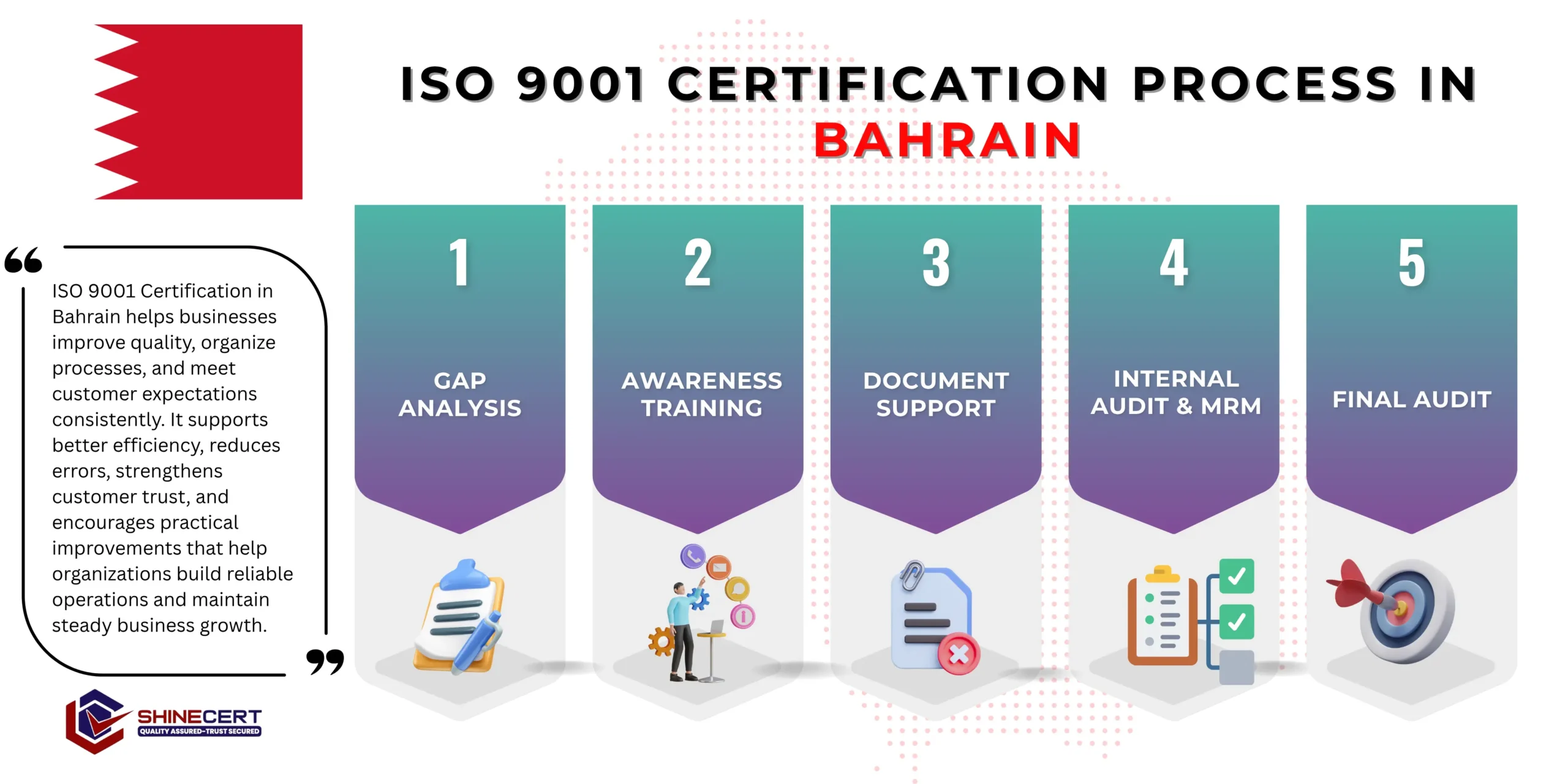
What are the steps to get ISO 9001 Certification in Bahrain?
our services
- ISO Certification Bahrain
- ISO 9001 Certification Bahrain
- ISO 14001 Certification Bahrain
- ISO 27001 Certification Bahrain
- ISO 22000 Certification Bahrain
- ISO 27701 Certification Bahrain
- ISO 45001 Certification Bahrain
- ISO 20000-1 Certification Bahrain
- ISO 13485 Certification Bahrain
- ISO 17025 Certification Bahrain
- ISO 31000 Certification Bahrain
- ISO 42001 Certification Bahrain
- ISO 37001 Certification Bahrain
- ISO 22301 Certification Bahrain
- ISO 50001 Certification Bahrain
- CE Mark Certification Bahrain
- GDPR Certification Bahrain
- GMP Certification Bahrain
- Halal Certification Bahrain
Our Five-Step Certification Process: What to Actually Expect
Certification isn’t a single event, it’s a structured project with five distinct phases, and knowing what happens at each stage, and why, helps you plan around it rather than being surprised by it.
Gap Assessment
We evaluate your current processes and documentation against ISO 9001’s requirements, identifying genuine gaps rather than assuming a generic starting point. What this means for you: a clear, honest picture of exactly how much work lies ahead, before you commit to a full budget or timeline.
A gap assessment report specific to your operations.
Documentation Development
Your quality policy, procedures, and objectives get built around what you actually do, not a template copied from another industry. What this means for you: you’re not left holding a generic manual that doesn’t reflect how your business really works, every document should make sense to your own staff.
A complete ISO 9001 documentation set.
Implementation and Training
The system rolls out across your organization, with staff trained on their specific role in maintaining it. What this means for you: this is usually the longest phase, because genuine behavior change takes longer than writing a document, expect real questions and pushback from staff, which is a healthy sign the training is landing.
Training records and evidence of the system functioning in daily operations.
Internal Audit and Management Review
We test whether the system genuinely works, with findings feeding into a management review before the external audit. What this means for you: any weaknesses surface here, in a low-stakes internal setting, rather than during the actual certification audit where they’d delay your certificate.
An internal audit report and management review minutes.
Certification Audit
We coordinate Stage 1 and Stage 2 audits with a certification body accredited under the GAC framework. What this means for you: Stage 1 checks your documentation is ready; Stage 2, typically a few weeks later, tests whether the system genuinely functions in daily operations; both need to pass before your certificate is issued.
Your ISO 9001 certificate and a clear surveillance audit schedule.
Why This Matters So Much in Bahrain Specifically?
- If you’ve ever lost a bid to a competitor who seemed, on paper, no more capable than you, just better documented, you already understand the real problem ISO 9001 solves in Bahrain.
- Economic Vision 2030 isn’t a vague aspirational document; it names competitiveness against regional and global markets as a core pillar, and international quality standards are one of the concrete mechanisms the government has pointed to for getting there.
- That translates directly into procurement practice: government tenders above BHD 10,000 run through the Tender Board’s centralized eTendering system, and across the industries ShineCert works with, ISO 9001 certification shows up regularly as either a scoring advantage or an outright eligibility requirement, particularly for multinational and government-adjacent contracts.
What makes Bahrain genuinely distinctive compared to some neighboring markets is Tamkeen. As a public authority built specifically to support private-sector competitiveness under Vision 2030, Tamkeen offers wage subsidies, training grants, and business development funding that, depending on your company’s size and eligibility, can meaningfully offset the cost of pursuing ISO 9001 certification, something worth investigating before you assume the full cost falls entirely on your own balance sheet, especially if cash flow is already tight.
Bahrain at a Glance: What Shapes ISO 9001 Demand Here
01
National standards body
the Bahrain Standards and Metrology Directorate (BSMD), under the Ministry of Industry and Commerce, adopts GCC and international standards and can also develop Bahrain-specific ones.
02
Government tender threshold
contracts above BHD 10,000 are published centrally through the Tender Board’s eTendering system, where quality certification is frequently a scoring or eligibility factor.
03
SME funding available
Tamkeen, Bahrain’s Labour Fund, offers wage subsidies, training support, and business development grants that can offset certification-related costs for eligible companies.
04
National strategy
Economic Vision 2030’s three pillars, Sustainability, Fairness, Competitiveness, explicitly reference international standards compliance as part of Bahrain’s economic diversification push.
What Actually Drives Your Cost?
We don’t quote a flat number here, because a flat number would be misleading, the honest truth is that two Bahrain companies of roughly similar size can end up with meaningfully different certification costs depending on how they’re actually structured and how ready their existing processes are. Here’s what genuinely moves the needle, and why.
A services firm with mostly desk-based processes typically needs less documentation depth than a construction or manufacturing operation with physical production steps, equipment, and site-based risk; the more physical parts your business has, the more there is to document and control.
Every distinct function in scope, sales, procurement, operations, warehousing, finance, needs its own documented procedures and staff trained on their specific role. A company with three functions in scope is a genuinely different project than one with eight.
Each additional site generally needs its own implementation attention and its own audit time, since a certification body can’t simply assume what’s true at your head office also holds true at a branch or job site.
More staff means more training to deliver and a larger pool for auditors to sample during interviews, this doesn’t scale the cost linearly, but it does add real hours.
If you’re already running fairly disciplined operations with some documentation in place, even informal spreadsheets and checklists, you’re not starting from zero, and that genuinely reduces the work ahead. If quality control currently lives entirely in one supervisor’s head, expect more foundational work.
Regulated or technically complex sectors need deeper risk assessment and more detailed procedures than a straightforward service business with low regulatory exposure.
If ISO 14001 or ISO 45001 are also on your radar, pursuing them alongside ISO 9001 shares meaningful implementation and audit infrastructure, which lowers the marginal cost of each additional standard compared to doing them one at a time, years apart.
If you have someone internally who can own documentation and coordinate training, that reduces the consultant hours needed. If your team is already stretched thin just running daily operations, which, honestly, describes most SMEs we work with, expect to lean more heavily on outside support, and budget accordingly.
Where your project qualifies for co-funding, your genuine out-of-pocket cost can end up meaningfully lower than the full advisory fee, this is exactly why we recommend checking eligibility before, not after, you finalize a budget.
A compressed timeline driven by a looming tender deadline sometimes needs more concentrated consultant hours in a shorter window than a project with a comfortable runway.
Common Pitfalls We See in Bahrain ISO 9001 Projects
- Treating the Tamkeen conversation as an afterthought : Companies that investigate funding eligibility only after committing to a certification budget sometimes miss program windows or miscalculate their actual net cost, check eligibility early, not after the contract is signed.
- Building documentation before confirming Tender Board scoring criteria : Companies targeting government contracts sometimes build a generic ISO 9001 system without first checking exactly how quality certification factors into the specific tenders they’re targeting, missing an opportunity to align documentation with what evaluators actually weigh.
- Assuming BSMD adoption of a GCC standard means local certification requirements differ from the international standard : BSMD’s role is adopting and administering standards nationally, not altering ISO 9001’s actual requirements, the certification itself follows the same international standard as anywhere else, audited by a GAC-accredited body.
- Starting certification only after a specific tender is already open : Certification takes three to five months from kickoff; companies that wait until a promising tender appears often find themselves unable to certify in time, losing the scoring advantage on exactly the opportunity that prompted the search.
Benefits at a Glance
01
Independently verified quality credential for Tender Board bids
02
Access to potential Tamkeen funding support
03
Fewer errors, less rework, tighter operational control
04
Stronger footing with multinational partners and franchise principals
05
A foundation that transfers cleanly into ISO 14001 or ISO 45001 later
Benefits: What Certification Actually Changes
- Direct alignment with Vision 2030’s competitiveness pillar : Certification gives you independently verified evidence of exactly the quality maturity Bahrain’s national strategy is pushing businesses toward.
- Stronger position in Tender Board evaluations : Certified companies are better positioned for the quality scoring criteria that frequently appear in eTendering system submissions above the BHD 10,000 threshold.
- Access to Tamkeen-supported funding : Depending on eligibility, certification-related training and consulting costs may be partially offset through Tamkeen’s business development programs.
- Reduced operational waste and rework : A functioning quality management system genuinely reduces the errors and inefficiencies that quietly erode margin in unmanaged operations, the kind of quiet cost that doesn’t show up on an invoice but shows up in your margin at year-end.
- Credibility with multinational partners : International partners and franchise principals increasingly expect demonstrable quality management from Bahrain-based suppliers and subsidiaries.
Migrating from ISO 9001:2015 to ISO 9001:2026: What Bahrain Businesses Need to Know
Current Version
ISO 9001:2015 remains the certifiable version described in your supplied content.
FDIS Stage
ISO 9001:2026 reached Final Draft International Standard ballot stage in April 2026.
Preparation
Certification bodies are expected to spend late 2026 into mid-2027 getting trained and accredited.
Transition Window
The International Accreditation Forum is expected to confirm a three-year transition period.
- This is genuinely current and worth planning for now, even though it isn’t urgent yet. ISO 9001:2026 reached the Final Draft International Standard (FDIS) ballot stage in April 2026 and is expected to formally replace ISO 9001:2015 around September 2026. Until that official publication, ISO 9001:2015 remains the only valid, certifiable version, if you’re pursuing certification today, you’re certifying against the 2015 version, and that’s the right and only choice available right now.
- What’s actually changing is less dramatic than a version number jump might suggest. Roughly 80% of the new standard builds directly on the existing 2015 quality management system structure, so a company already ISO 9001:2015 certified faces meaningfully less rework than a first-time implementation would suggest. The genuine additions include a more direct integration of climate change considerations into risk and opportunity planning, a clearer separation between risks and opportunities as distinct concepts rather than one combined idea, and strengthened expectations around quality culture and ethical conduct as part of leadership’s genuine responsibility, not just a compliance afterthought.
- For the transition itself, certification bodies are expected to spend late 2026 into mid-2027 getting trained and accredited against the new version, with very few ISO 9001:2026 certificates issued during that window. The International Accreditation Forum is expected to confirm a three-year transition period, likely running to around 2029, giving currently certified Bahrain businesses ample runway to migrate at their next scheduled recertification cycle rather than needing to act immediately. We generally recommend Bahrain companies currently pursuing or holding ISO 9001:2015 certification proceed exactly as planned today, and simply build awareness of the 2026 revision into their next recertification planning conversation, rather than delaying a current certification project to wait for a standard that isn’t yet published or auditable.
What Happens When a Bahrain Company Bids Without Certification on a Scored Tender?
- This is worth understanding concretely, because the cost of skipping certification isn’t always obvious until a specific bid is already lost. When a tender published through the Tender Board’s eTendering system includes quality certification as a scored criterion, an uncertified bidder isn’t disqualified outright in most cases, but it starts the evaluation meaningfully behind competitors who can point to independently verified quality management, and that gap can be the exact margin that decides a close award, particularly on larger, multi-bidder government contracts.
- Companies that discover this only after losing a bid they were otherwise well-positioned to win often end up starting certification under real time pressure ahead of the next opportunity, rather than having a certificate already in hand when the right tender appears. We generally recommend Bahrain contractors that expect to bid on eTendering system contracts above the BHD 10,000 threshold treat ISO 9001 as standing infrastructure to have ready, not something to start only once a specific tender is already open.
Quality Management Requirements, Clause by Clause
Understanding what each clause actually asks of your business, not just its title, is what separates a quality management system that passes an audit from one that genuinely improves how you operate. Here’s what each clause means in practice.
- Context of the Organization (Clause 4) : This clause asks you to step back and map your actual business environment: who are your interested parties, what do they expect, and what’s the real scope of what your quality management system needs to cover. For a Bahrain contractor, this genuinely includes Tender Board evaluators as an interested party if government contracts matter to your business, their expectations around documented quality control shape what “conformity” needs to look like for you specifically, not just what a generic template assumes.
- Leadership (Clause 5) : This is about whether top management commitment is genuine or just a signed policy sitting in a drawer. Auditors look for evidence that leadership actually reviews quality performance, allocates real resources to it, and holds people accountable, not just that a quality policy document exists somewhere.
- Planning (Clause 6) : Risk-based thinking means identifying what could realistically go wrong in your specific operations, a late shipment, a subcontractor failure, a data entry error in a bid submission, and building measurable quality objectives that address those genuine risks, rather than generic objectives copied from an unrelated industry.
- Support (Clause 7) : Competence, awareness, and communication requirements exist because a quality system only works if the people running it actually understand their role in it. This clause is tested through interviews during the audit, an auditor asking a warehouse worker what they’d do if they found a defective batch is testing this clause directly.
- Operation (Clause 8) : This is the largest clause in practice, covering how you actually plan and control your core processes, including any sector-specific regulatory requirements. For most Bahrain businesses, this is where the majority of new documentation and process discipline gets built during implementation.
- Performance Evaluation (Clause 9) : Monitoring, measurement, internal audit, and management review test whether the system produces genuine results. An auditor wants to see that your internal audits found real issues and that management review meetings actually discussed and acted on them, not just rubber-stamped a report.
- Improvement (Clause 10) : Structured handling of nonconformities means genuine root-cause analysis, not a quick fix that lets the same problem recur next quarter. This is often where certification bodies find the most meaningful gaps in an otherwise solid system.
Tamkeen Funding: Does Your ISO 9001 Project Qualify for Subsidy?
- This is worth investigating early, because it’s a genuine cost advantage Bahrain-based companies have that businesses in some neighboring markets simply don’t. Tamkeen, Bahrain’s Labour Fund, was established specifically to strengthen private-sector competitiveness under Economic Vision 2030, and its programs include training subsidies and business development grants that can apply to quality management system implementation, depending on your company’s size, sector, and specific program eligibility at the time you apply.
- We generally recommend checking your Tamkeen eligibility before finalizing your certification budget, since co-funded training and consulting support can meaningfully change the effective cost of certification for qualifying SMEs. This isn’t guaranteed for every company or every program cycle, and eligibility criteria shift over time, so it’s worth a direct conversation with Tamkeen or a consultant familiar with current program terms rather than assuming either full funding or no funding at all.
Applicable Standards by Industry
Construction and Contracting
Companies bidding through the Tender Board’s eTendering system regularly find ISO 9001 either scored favorably or explicitly required for larger contracts.
Read moreManufacturing
Bahrain’s manufacturing base, spanning aluminum-adjacent supply chains and light industry, uses ISO 9001 as a baseline quality credential for both domestic and export customers.
Read moreFinancial and Professional Services
Firms serving regulated clients increasingly need demonstrable quality management alongside sector-specific compliance requirements.
Read moreHospitality and Tourism
Operators find ISO 9001 supports consistent service delivery standards as Bahrain’s tourism sector continues expanding under Vision 2030.
Read moreLogistics and Trading
Companies operating through Bahrain’s ports and free zones use ISO 9001 to demonstrate consistent service quality to international trading partners.
Read moreCase Study: A Bahrain Contractor’s First Certification Cycle
- The following is an illustrative, composite example based on the kind of project ShineCert typically runs, not a specific named client, but it reflects the pattern we see often enough that it’s worth walking through concretely. A mid-sized Bahraini construction contractor, roughly 60 employees, had never held ISO 9001 and relied on informal, relationship-based quality control: the site supervisor’s judgment, verbal instructions, and a general sense that “we do good work.” The trigger was a specific Tender Board opportunity where the tender documentation explicitly scored ISO 9001 certification, and the company was in danger of losing points to competitors who already held it.
- The gap assessment found the company’s actual practices weren’t far from ISO 9001’s requirements in substance, inspections happened, problems did get fixed, but almost none of it was documented in a way an auditor could verify. The bulk of the implementation work went into building genuine, usable documentation around existing good practices, rather than inventing new processes from nothing, and training supervisors to keep the records that made their existing judgment visible and auditable. The company also checked its Tamkeen eligibility early in the process, reducing its net cost meaningfully. Certification landed a few weeks before the tender deadline, and the pattern we generally see afterward held here too: once documentation habits are established, the ongoing effort to maintain certification drops off considerably from the initial implementation lift.
Mandatory Documents Required for Certification
Genuine leadership commitment specific to your business, not boilerplate language.
Documented, defining exactly which operations and locations are covered.
Measurable, tied to genuine business priorities.
Specific to your actual operations, not a generic industry template.
Evidence of genuine, ongoing oversight.
Evidence that problems get genuinely investigated and fixed, not just logged.
Why ShineCert?
We coordinate Bahrain engagements from ShineCert’s Riyadh and Lebanon offices, with direct familiarity with Tender Board eTendering requirements and Tamkeen’s funding programs, and genuine experience helping Bahrain SMEs pursue certification without absorbing the full cost alone where funding support is available. Our team has guided more than 10,000 organizations through ISO certification globally, with ShineCert as the best ISO 9001 consultant in Bahrain, building every Bahrain engagement around your specific tender pipeline, department structure, and funding eligibility, not a one-size-fits-all package.
Choosing a Certification Body in Bahrain?
What to Check | Why It Matters |
Accreditation under the GAC framework | Confirms genuine, internationally recognized certification |
Experience with Tender Board and eTendering-linked certification timelines | Helps ensure your certificate lands before a specific bid deadline, not after |
Familiarity with Tamkeen’s documentation requirements, if you’re pursuing funding | Some funding programs need specific project documentation alongside the certification itself |
Sector-specific audit experience | Construction, manufacturing, and services each involve meaningfully different audit focus |
Ready to Get Certified?
ShineCert supports Bahrain businesses from initial gap assessment through certification audit, including checking whether your project qualifies for Tamkeen funding support. Book a free consultation or contact us directly, and we’ll walk through your specific cost factors before proposing a fixed-scope plan.
Frequently Asked Questions
It’s the international standard for quality management systems, setting requirements for consistently meeting customer and regulatory requirements while pursuing genuine improvement.
It genuinely depends on factors like your company’s size, number of departments, number of locations, existing process maturity, and whether you qualify for Tamkeen funding, we scope every project individually rather than quoting a generic figure that likely won’t reflect your actual business.
Potentially, Tamkeen’s training and business development programs can apply to certification-related costs depending on your company’s eligibility, though this varies by program cycle and should be confirmed directly.
Not universally, but it’s regularly a scoring factor or explicit requirement for tenders published through the Tender Board’s eTendering system, particularly above the BHD 10,000 threshold.
Typically three to five months.
No, BSMD adopts and administers standards nationally, but ISO 9001 certification itself is issued by an accredited third-party certification body, not BSMD.
No, ISO 9001:2015 remains the only valid, certifiable version until the new standard is officially published, expected around September 2026, with a multi-year transition period after that.
Around 80% builds on the existing 2015 structure, with the main additions being climate change integration into risk planning, a clearer split between risks and opportunities, and stronger quality culture and ethical conduct expectations.
Yes, meaningfully, each department in scope needs its own documented procedures and trained staff, so a company with several distinct functions is a genuinely bigger project than one with a single, simple operation.
We coordinate Bahrain engagements from our Riyadh and Lebanon offices, with consultants traveling on-site as needed.