
GDPR Certification in Bahrain
Quick Answer
The General Data Protection Regulation (GDPR) is European Union law, and it’s important to understand precisely why it can still matter to a Bahrain-based company: GDPR’s Article 3 gives it genuine extraterritorial scope, applying to organizations outside the EU that offer goods or services to individuals in the EU, or that monitor the behavior of individuals located in the EU, meaning a Bahrain fintech serving European customers, or a Bahrain e-commerce business shipping to EU addresses, can fall under GDPR’s requirements regardless of having no physical EU presence. This sits alongside, not instead of, Bahrain’s own Personal Data Protection Law (Law No. 30 of 2018), and there is no EU adequacy decision recognizing Bahrain’s data protection framework as equivalent, meaning cross-border transfers of EU personal data to Bahrain need specific safeguards, typically Standard Contractual Clauses. ShineCert provides compliance advisory helping you determine genuine GDPR applicability and build compliant practices, this is not a certifiable ISO standard, and there is no “GDPR certificate.” Plan for two to four months depending on your EU customer exposure. Cost depends on genuine factors, EU customer volume, data processing complexity, cross-border transfer mechanisms, not a flat number.
What Is GDPR, Technically Speaking, and Why Does It Reach Bahrain?
GDPR is European Union Regulation 2016/679, and its technical architecture is built around a genuinely broad definition of territorial and material scope specifically designed to prevent companies outside the EU from processing EU residents’ data without meaningful accountability. Article 3(2), the extraterritorial scope provision most relevant to Bahrain businesses, applies GDPR to processing of personal data of individuals in the EU by organizations not established in the EU, where the processing relates to either offering goods or services to those individuals (regardless of whether payment is required), or monitoring their behavior as far as that behavior takes place within the EU.
This “offering goods or services” test isn’t satisfied merely by a website being technically accessible to EU visitors, the regulation and subsequent regulatory guidance look for genuine evidence of targeting the EU market: pricing in euros, shipping to EU addresses, EU-specific marketing, language options clearly aimed at EU markets, or explicit mention of EU customers. A Bahrain company with a generic English-language website that happens to be reachable from Europe, with no EU-specific targeting, likely falls outside Article 3(2), but a Bahrain fintech actively marketing to European users, pricing services in euros, or a Bahrain e-commerce operation shipping products to EU addresses, likely falls squarely within it.
The “monitoring behavior” limb of Article 3(2) is technically distinct and captures a different scenario, tracking, profiling, or analyzing individuals located in the EU, commonly relevant to companies using web analytics, advertising technology, or behavioral tracking that captures EU visitors’ online activity, even where no direct commercial transaction occurs.
Once General Data Protection Regulation (GDPR) applies, its substantive requirements are genuinely more prescriptive than many national data protection laws, including several distinctive technical elements: the requirement for a documented “lawful basis” for every processing activity (consent, contract necessity, legal obligation, vital interests, public task, or legitimate interests, each with specific conditions); the “privacy by design and by default” principle requiring data protection considerations built into systems from inception; mandatory breach notification to supervisory authorities within 72 hours of becoming aware of a breach, where feasible; and, for many organizations, formal Data Protection Impact Assessments for high-risk processing activities.
Cross-border transfer restrictions are particularly technically relevant for Bahrain companies: GDPR Chapter V restricts transfers of personal data outside the European Economic Area unless specific safeguards apply. Because the European Commission has not issued an adequacy decision for Bahrain, transfers of EU personal data into Bahrain require an alternative legal mechanism, most commonly Standard Contractual Clauses (SCCs), a set of European Commission-approved contractual terms that impose GDPR-equivalent obligations on the receiving party through binding contract law rather than through Bahrain’s domestic legal framework meeting an adequacy bar.
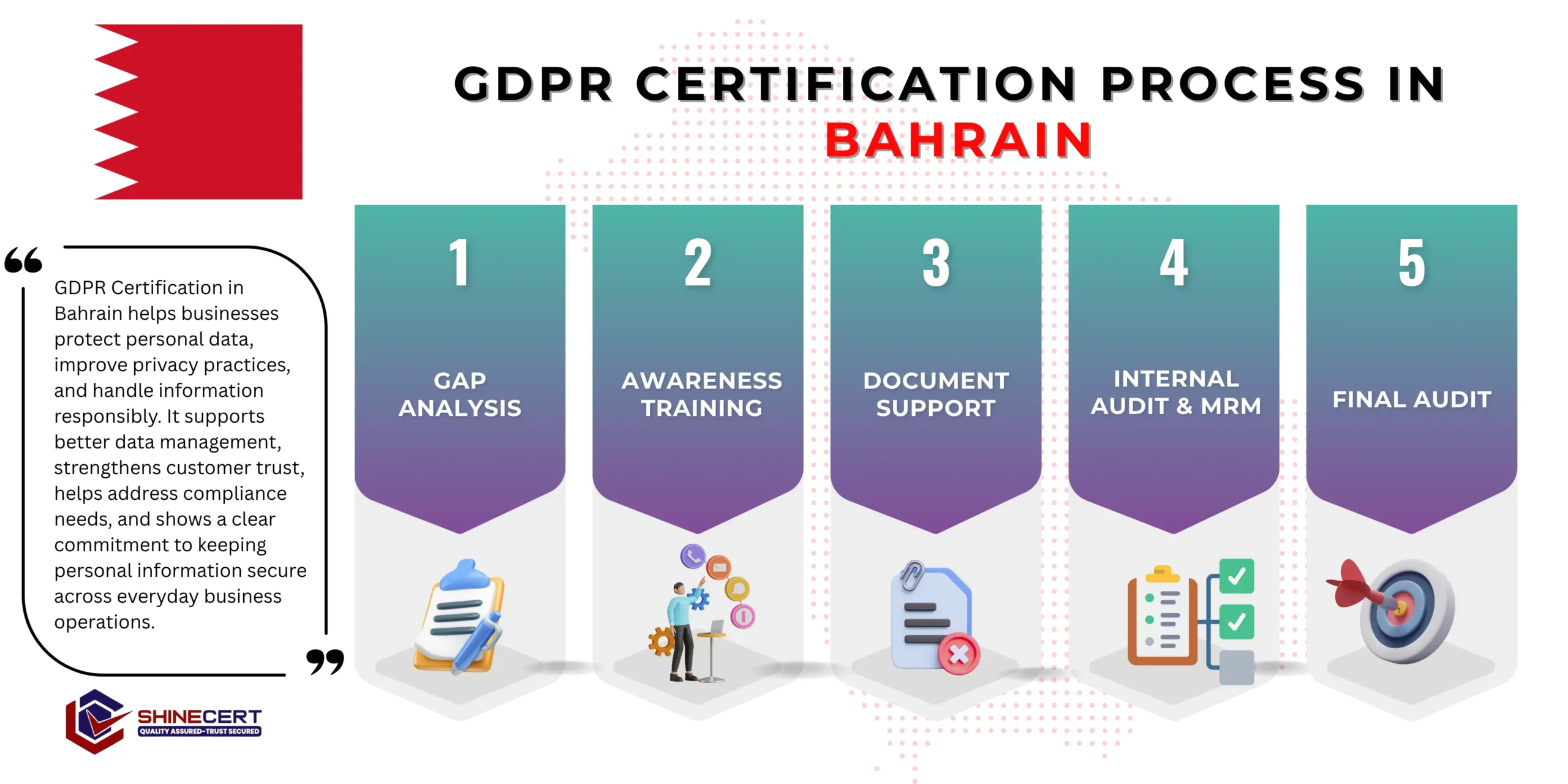
What are the steps to get GDPR Certification in Bahrain?
our services
- ISO Certification Bahrain
- ISO 9001 Certification Bahrain
- ISO 14001 Certification Bahrain
- ISO 27001 Certification Bahrain
- ISO 22000 Certification Bahrain
- ISO 27701 Certification Bahrain
- ISO 45001 Certification Bahrain
- ISO 20000-1 Certification Bahrain
- ISO 13485 Certification Bahrain
- ISO 17025 Certification Bahrain
- ISO 31000 Certification Bahrain
- ISO 42001 Certification Bahrain
- ISO 37001 Certification Bahrain
- ISO 22301 Certification Bahrain
- ISO 50001 Certification Bahrain
- CE Mark Certification Bahrain
- GDPR Certification Bahrain
- GMP Certification Bahrain
- Halal Certification Bahrain
Our Five-Step Advisory Process: What to Actually Expect
Because General Data Protection Regulation (GDPR) is not a certifiable standard and ShineCert does not claim to issue “GDPR certification”, no such thing exists, our process is compliance advisory, building genuine, defensible practices rather than a formal certificate.
Territorial Scope Assessment
We determine precisely whether your business activities trigger GDPR’s Article 3(2) extraterritorial scope through genuine EU market targeting or behavioral monitoring. What this means for you: clarity on whether GDPR genuinely applies to you before investing in a compliance program that may not be necessary, or discovering too late that it genuinely is.
A territorial scope assessment specific to your business activities.
Gap Assessment
We evaluate your current data protection practices, including existing PDPL compliance work, against applicable GDPR requirements. What this means for you: a clear picture of the genuine incremental gap, avoiding duplicate effort against work already done for PDPL.
A gap assessment report specific to your data processing activities.
Documentation and Mechanism Development
Your lawful basis register, data subject rights procedures, and cross-border transfer mechanisms, typically Standard Contractual Clauses, get built around your actual data flows. What this means for you: documentation and contracts that genuinely reflect how your organization actually processes and transfers EU personal data.
A complete GDPR compliance documentation and transfer mechanism set.
Implementation and Training
Processes roll out with staff trained on their specific GDPR responsibilities, including breach notification procedures. What this means for you: your team can genuinely handle a real data subject request or a suspected breach within GDPR’s specific timeframes.
Training records and evidence of processes functioning.
Ongoing Compliance Support
As your EU-facing business activity evolves, new markets, new data flows, new partnerships, we help you reassess and update your compliance posture. What this means for you: your GDPR compliance stays genuinely current rather than becoming a stale, one-time exercise disconnected from your actual, evolving business.
Ongoing advisory support and periodic compliance reviews.
Why This Matters So Much for Bahrain Businesses Specifically?
- Bahrain’s genuine positioning as a regional fintech and financial services hub, alongside its growing e-commerce and professional services export activity, creates real, concrete scenarios where GDPR’s extraterritorial reach applies, this isn’t a theoretical or unlikely edge case for many Bahrain businesses with international ambitions.
- A Bahrain fintech onboarding European users, a Bahrain professional services firm processing EU client data as part of cross-border engagements, or a Bahrain e-commerce platform shipping to EU customers all face genuine, direct GDPR exposure independent of their PDPL obligations.
- The absence of an EU adequacy decision for Bahrain adds a genuine, ongoing practical requirement: any Bahrain company receiving personal data transfers from EU-based partners, customers, or group companies needs Standard Contractual Clauses or another valid transfer mechanism actively in place, not just a general awareness that GDPR exists. Companies that overlook this specific mechanical requirement, even while otherwise handling EU customer data responsibly, technically lack a valid legal basis for the transfer itself.
Bahrain at a Glance: What Shapes GDPR Advisory Demand Here
01
Domestic law
Bahrain’s own Personal Data Protection Law (Law No. 30 of 2018), in force since August 2019, governs data processing of Bahrain residents, overseen by the Personal Data Protection Authority (PDPA).
02
No EU adequacy decision
the European Commission has not issued an adequacy decision recognizing Bahrain’s data protection framework as providing equivalent protection to GDPR, meaning transfers of EU personal data to Bahrain need specific legal safeguards.
03
Growing EU-facing business activity
Bahrain’s fintech, e-commerce, and professional services sectors increasingly serve European customers or partners, creating genuine GDPR exposure independent of PDPL compliance.
04
Two distinct, overlapping obligations
a Bahrain company can be simultaneously subject to PDPL (as a Bahrain-based data controller) and GDPR (if it targets or monitors EU individuals), requiring a coordinated, not duplicated, compliance approach.
What Actually Drives Your Cost?
We don’t quote a flat number, because a flat number would misrepresent how different two Bahrain companies’ actual General Data Protection Regulation (GDPR) exposure can be. Here’s what genuinely drives cost :
Companies with no genuine EU market targeting or behavioral monitoring may need only a documented assessment confirming non-applicability, a meaningfully smaller project than full compliance implementation.
Companies processing substantial volumes of EU customer data need deeper data subject rights infrastructure than those with limited, occasional EU data touchpoints.
Each EU-based partner, customer, or group company sending you personal data needs its own Standard Contractual Clauses execution.
Companies with strong existing PDPL compliance infrastructure need meaningfully less incremental work than those building data protection compliance from scratch.
Higher-risk processing activities, profiling, large-scale processing, sensitive data categories, may need Data Protection Impact Assessments adding genuine additional scope.
An internal legal or compliance lead who can own documentation and contract execution reduces consultant hours needed.
A compressed timeline driven by a partner due-diligence deadline sometimes needs more concentrated consultant hours in a shorter window.
Common Pitfalls We See Among Bahrain Companies Regarding GDPR
- Assuming GDPR doesn’t apply simply because the company is based outside the EU : Article 3(2)’s extraterritorial scope specifically exists to reach exactly this scenario, genuine EU market targeting or monitoring triggers GDPR regardless of where the company is physically located.
- Assuming PDPL compliance automatically satisfies GDPR : The two laws share substantial conceptual overlap, but GDPR’s specific mechanical requirements, the 72-hour breach window, Standard Contractual Clauses for transfers, and certain data subject rights, aren’t automatically satisfied by PDPL compliance alone.
- Operating without Standard Contractual Clauses for EU data transfers : Given the absence of an EU adequacy decision for Bahrain, companies receiving EU personal data without SCCs or another valid mechanism in place lack a genuine legal basis for the transfer, regardless of how well they otherwise protect the data.
- Treating GDPR assessment as a one-time exercise : As a company’s EU-facing activity evolves, new markets, new marketing approaches, new partnerships, territorial scope applicability can change, requiring periodic reassessment rather than a single, static determination made once and never revisited.
Benefits at a Glance
01
Genuine legal compliance for EU-facing business activity
02
Valid cross-border transfer mechanisms in place
03
Reduced risk of significant GDPR enforcement penalties
04
Stronger trust with European partners and customers
05
A coordinated approach avoiding duplicated PDPL and GDPR effort
Benefits: What Proper Advisory Support Actually Changes
- Genuine legal compliance for EU-facing activity : Where GDPR genuinely applies, proper compliance removes real regulatory and financial risk, GDPR penalties can be genuinely severe, calculated as a percentage of global annual turnover for the most serious violations.
- Valid, defensible cross-border data transfers : Properly implemented Standard Contractual Clauses give your EU partners and customers a valid legal basis for sending personal data to your Bahrain operations, removing a genuine blocker to European business relationships.
- Reduced breach and enforcement risk : Structured lawful basis documentation, data subject rights processes, and breach readiness genuinely reduce both the likelihood of a compliance failure and its consequences if one occurs.
- Stronger European partner and customer trust : Demonstrable GDPR readiness is increasingly a genuine factor in due diligence from European businesses considering Bahrain-based partners or vendors.
- Coordinated, non-duplicated compliance effort : Because PDPL and GDPR share substantial conceptual overlap, a properly coordinated compliance program addresses both without redundant, separately built systems.
What Happens When a Bahrain Business Ignores GDPR Applicability
- This is worth understanding concretely. GDPR enforcement carries genuinely significant financial risk; penalties for the most serious violations are calculated as a percentage of global annual turnover, a structure specifically designed to make non-compliance costly even for companies based well outside the EU. Beyond direct enforcement risk, Bahrain companies that lack valid cross-border transfer mechanisms face a more immediate, practical problem: European partners and customers who are themselves subject to GDPR cannot legally send personal data to a Bahrain company without a valid transfer mechanism in place, meaning the absence of Standard Contractual Clauses can quietly block or delay European business relationships even before any enforcement action becomes relevant.
- Companies that discover GDPR applicability only after a European partner’s due-diligence questionnaire flags a gap, or worse, after a data subject complaint reaches an EU supervisory authority, face considerably more pressure-filled remediation than those who proactively assess their genuine exposure.
GDPR Compliance Elements, Explained
- Article 3 Territorial Scope Assessment : The genuinely essential first step, determining whether your specific business activities trigger GDPR’s extraterritorial application through EU market targeting or behavioral monitoring.
- Lawful Basis Documentation : Identifying and documenting the specific lawful basis for each category of personal data processing involving EU individuals.
- Data Subject Rights Mechanisms : Building genuine, timed processes for GDPR’s data subject rights, access, rectification, erasure, portability, objection, which are broader and more specifically defined than many other jurisdictions’ equivalent rights.
- Cross-Border Transfer Mechanisms : Implementing Standard Contractual Clauses or another valid transfer mechanism for personal data flowing from the EU to Bahrain, given the absence of an adequacy decision.
- Breach Notification Readiness : Building the capability to detect, assess, and notify relevant supervisory authorities within GDPR’s 72-hour breach notification window where required.
- Privacy by Design and Data Protection Impact Assessments : For higher-risk processing activities, building structured impact assessment processes evaluating privacy risk before deployment.
Applicable Standards by Industry
Fintech and Financial Technology
Companies onboarding European users or partnering with EU financial institutions face direct, genuine GDPR exposure.
Read moreE-Commerce
Businesses shipping products to EU customers or pricing in euros likely trigger Article 3(2)’s extraterritorial scope.
Read moreProfessional Services and Consultancies
Firms processing EU client data as part of cross-border engagements need genuine GDPR-aware data handling practices.
Read moreTechnology and SaaS Providers
Companies with EU-based customers or users, particularly those using analytics or tracking technology, need careful assessment of both scope limbs of Article 3(2).
Read moreCase Study: A Bahrain Fintech’s GDPR Readiness Project
- The following is an illustrative, composite example based on the kind of project ShineCert typically runs, not a specific named client. A Bahrain-based fintech company, already navigating PDPL compliance domestically, began actively marketing its services to European users as part of an international expansion strategy, without having assessed whether this triggered GDPR obligations. The trigger was a European payment processing partner’s due-diligence questionnaire specifically asking about GDPR compliance and Standard Contractual Clauses.
- The territorial scope assessment found the company’s EU marketing activity, euro pricing, EU-targeted advertising, and active EU user onboarding, clearly triggered Article 3(2)’s extraterritorial scope, meaning the company was genuinely subject to GDPR independent of its existing PDPL compliance. The bulk of implementation work went into building a lawful basis register specifically covering EU users, executing Standard Contractual Clauses with the European payment partner and other EU-based vendors, and extending the company’s existing PDPL-driven data subject rights process to explicitly cover GDPR’s broader specific rights, like data portability, which PDPL doesn’t identically mirror. The partnership was finalized once compliance documentation was in place, and the pattern we typically see afterward held: the coordinated PDPL-GDPR approach meant most of the underlying operational infrastructure, access controls, data subject request handling, only needed extension rather than complete rebuilding.
Documentation You’ll Need
Mapping what personal data you process, from whom, and for what purpose, specifically identifying EU individuals’ data.
Documenting the specific legal basis for each category of processing involving EU individuals.
Or another valid transfer mechanism, executed with EU-based partners, customers, or group companies sending you personal data.
Documented, with defined response timeframes for access, erasure, and other GDPR rights requests.
Documented process for detecting, assessing, and notifying within GDPR’s 72-hour window where applicable.
For higher-risk processing activities, where genuinely applicable.
Why ShineCert?
We coordinate Bahrain engagements from ShineCert’s Riyadh and Lebanon offices, with direct familiarity with both PDPL and GDPR’s extraterritorial scope, helping Bahrain businesses build a coordinated, non-duplicated compliance approach across both frameworks. Our team helps you determine genuine GDPR applicability, with ShineCert as the best GDPR consultant in Bahrain, build defensible documentation, and implement valid cross-border transfer mechanisms, always with an honest, upfront explanation that GDPR compliance is an ongoing legal discipline, not a one-time certificate.
Choosing the Right Advisory Partner?
What to Check | Why It Matters |
Genuine understanding that GDPR has no certification scheme | Advisors who market a fictional “GDPR certificate” misrepresent the regulation |
Experience with Article 3 territorial scope assessment | This determination genuinely shapes your entire compliance scope and shouldn’t be assumed |
Familiarity with both PDPL and GDPR | Ensures a coordinated approach rather than duplicated, disconnected compliance work |
Genuine Standard Contractual Clauses execution experience | Ensures your transfer mechanisms are properly implemented, not just referenced in a policy document |
Ready to Get Certified?
ShineCert supports Bahrain businesses in determining genuine GDPR applicability and building coordinated, defensible compliance alongside existing PDPL obligations. Book a free consultation or contact us directly, and we’ll walk through your specific EU-facing activity and cost factors before proposing a fixed-scope advisory plan.
Frequently Asked Questions
It’s the EU’s General Data Protection Regulation, governing how personal data of individuals in the EU is processed, with genuine extraterritorial reach to companies outside the EU under specific conditions.
It depends on whether you genuinely target the EU market (through pricing, marketing, or shipping) or monitor the behavior of individuals located in the EU, a specific assessment, not an assumption in either direction.
No, GDPR has no formal certification scheme. ShineCert provides compliance advisory, building genuine, defensible practices rather than issuing a certificate.
It genuinely depends on factors like whether GDPR applies at all, EU data volume, and existing PDPL compliance maturity, we scope every project individually.
Typically two to four months, depending on your EU-facing business activity and existing compliance infrastructure.
No, the two laws overlap substantially in concept, but GDPR has specific mechanical requirements like Standard Contractual Clauses for transfers that PDPL compliance alone doesn’t satisfy.
European Commission-approved contractual terms that provide a valid legal basis for transferring personal data from the EU to a country, like Bahrain, without an EU adequacy decision.
Genuine enforcement risk, including penalties calculated as a percentage of global annual turnover for serious violations, plus practical barriers to EU business relationships lacking valid transfer mechanisms.
Yes, higher volumes of EU personal data processing generally need deeper data subject rights infrastructure and more transfer relationships to document.
We coordinate Bahrain engagements from our Riyadh and Lebanon offices, with consultants traveling on-site as needed.