
ISO 42001 Certification in Bahrain
Quick Answer
ISO/IEC 42001 is the world’s first international standard for AI management systems, and Bahrain is an early, genuine adopter of the underlying governance thinking it formalizes. Bahrain’s National AI Policy and its adoption of the GCC AI Ethics Manual establish a national framework for responsible AI use, and organizations like the Nasser Centre for Science and Technology have already achieved ISO 42001 certification locally, signaling the standard’s genuine relevance to Bahrain’s AI-forward government services strategy. Get certified through a body accredited under the Global Accreditation Cooperation (GAC) framework. Plan for three to four months from kickoff to certificate, typically faster than other management system standards, since most certifying organizations already have partial AI governance in place. Cost depends on genuine factors, number and risk level of your AI systems, data sensitivity, deployment scale, not a flat number.
What Is ISO 42001, Technically Speaking??
ISO/IEC 42001:2023 is the first international, certifiable management system standard specifically for artificial intelligence, published jointly by ISO and IEC. Like ISO 9001 and ISO 27001, it follows the Harmonized Structure, but its subject matter, AI systems, required genuinely new technical concepts not present in earlier management system standards, because AI systems carry risks (bias, explainability, autonomous decision drift) that traditional quality or security frameworks weren’t built to address.
The standard’s central technical mechanism is the AI risk assessment combined with an “AI system impact assessment”, a genuinely distinct concept from a conventional security or quality risk assessment. Where ISO 27001’s risk assessment focuses on confidentiality, integrity, and availability of information, ISO 42001’s impact assessment specifically evaluates how an AI system’s outputs affect individuals and groups: could this system produce biased or discriminatory outcomes, could its decisions be adequately explained to an affected person, and what happens when it makes a genuinely wrong prediction with real consequences. Annex A of the standard provides a structured control set addressing exactly these AI-specific concerns, covering areas like data quality for training, AI system impact on individuals, transparency and explainability, and third-party and customer relationships involving AI components.
A genuinely distinguishing feature of ISO 42001 compared to other management system standards is its treatment of the full AI lifecycle rather than a single deployment snapshot, the standard expects organizations to govern AI systems from data sourcing and model development through deployment, monitoring, and eventual retirement, recognizing that an AI system’s risk profile can shift meaningfully after deployment as it encounters real-world data that differs from its training data (a phenomenon sometimes called “model drift”). This means an ISO 42001 management system isn’t a one-time certification exercise the way a narrower compliance checklist might be; it requires ongoing monitoring specifically designed to catch performance or bias drift over time.
The standard also formally addresses the role distinction between an AI provider (an organization developing or supplying an AI system) and an AI user or deployer (an organization applying a third-party AI system within its own operations), recognizing that governance obligations differ meaningfully between building an AI system and simply using one, a distinction increasingly mirrored in emerging AI regulation globally, including frameworks similar to the EU AI Act’s risk-tiered approach.
For Bahrain organizations specifically, ISO 42001’s structured approach to AI ethics, transparency, and human oversight maps closely onto the principles embedded in the GCC AI Ethics Manual that Bahrain has formally adopted, meaning certification doesn’t just demonstrate abstract international good practice, it demonstrates genuine alignment with Bahrain’s own stated national AI governance direction.
What are the steps to get ISO 42001 Certification in Bahrain?
our services
- ISO Certification Bahrain
- ISO 9001 Certification Bahrain
- ISO 14001 Certification Bahrain
- ISO 27001 Certification Bahrain
- ISO 22000 Certification Bahrain
- ISO 27701 Certification Bahrain
- ISO 45001 Certification Bahrain
- ISO 20000-1 Certification Bahrain
- ISO 13485 Certification Bahrain
- ISO 17025 Certification Bahrain
- ISO 31000 Certification Bahrain
- ISO 42001 Certification Bahrain
- ISO 37001 Certification Bahrain
- ISO 22301 Certification Bahrain
- ISO 50001 Certification Bahrain
- CE Mark Certification Bahrain
- GDPR Certification Bahrain
- GMP Certification Bahrain
- Halal Certification Bahrain
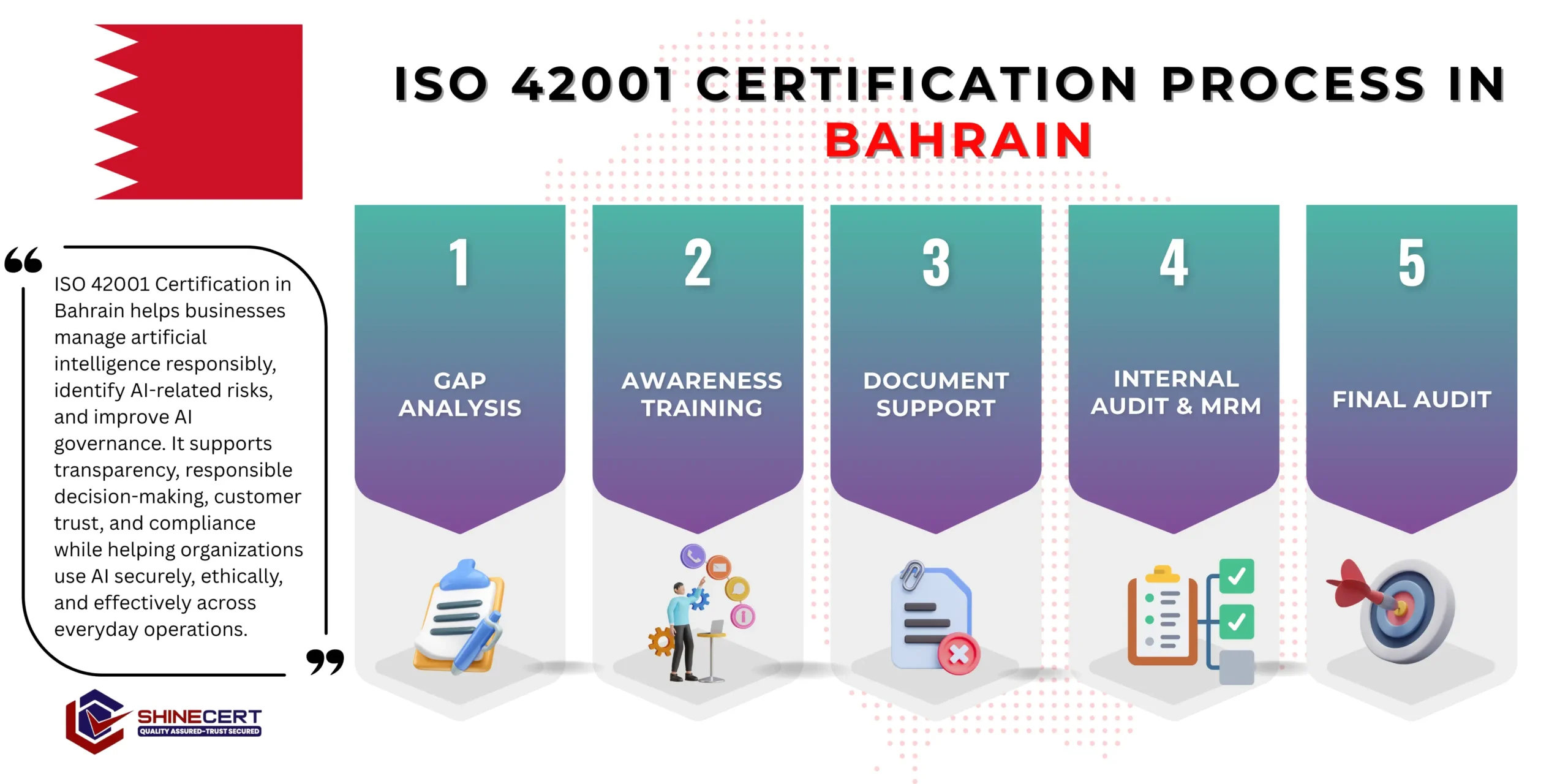
Our Five-Step Certification Process: What to Actually Expect
Gap Assessment
We evaluate your current AI development and deployment practices against ISO 42001’s requirements. What this means for you: a clear picture of which AI systems genuinely need governance attention and which practices are already reasonably sound.
A gap assessment report specific to your AI systems and use cases.
Documentation Development
Your AI policy, risk assessment methodology, and impact assessment framework get built around your actual AI systems, not generic templates. What this means for you: a governance framework your data science and engineering teams can genuinely use, not paperwork disconnected from real development practices.
A complete ISO 42001 documentation set.
Implementation and Training
Governance controls roll out across your AI development and deployment lifecycle, with staff trained on bias, explainability, and monitoring responsibilities. What this means for you: your team builds genuine habits around impact assessment and drift monitoring, not a one-time compliance exercise.
Training records and evidence of controls functioning across your AI lifecycle.
Internal Audit and Management Review
We test the system internally, surfacing weaknesses before the real audit. What this means for you: governance gaps get caught and fixed before they can delay certification.
Internal audit report and management review minutes.
Certification Audit
Stage 1 and Stage 2 audits with a GAC-accredited certification body. What this means for you: Stage 1 checks documentation readiness; Stage 2 verifies your AI governance genuinely functions in practice.
Your ISO 42001 certificate and a surveillance audit schedule.
Why This Matters So Much in Bahrain Specifically?
- Bahrain has deliberately positioned itself as a regional digital government pioneer, with AI prioritized across government service delivery, and the Kingdom’s National AI Policy explicitly frames responsible AI governance as core to that ambition rather than a constraint on it.
- Organizations building or deploying AI systems that touch government services, financial services, or healthcare, sectors where Bahrain’s AI ambitions are most visible, increasingly need to demonstrate the kind of structured governance ISO 42001 formalizes, both to satisfy emerging expectations and to get ahead of the AI regulation currently moving through Parliamentary review.
- The Nasser Centre for Science and Technology’s certification is a genuinely meaningful local signal: it demonstrates that ISO 42001 isn’t a theoretical framework disconnected from Bahrain’s actual innovation ecosystem, but a standard already being adopted by organizations operating inside it. For technology companies, government contractors, and AI-forward businesses in Bahrain, certification is increasingly becoming a genuine differentiator in partnerships and public-sector engagement, not just an internal governance exercise.
Bahrain at a Glance: What Shapes ISO 42001 Demand Here
01
National AI Policy
Bahrain has formally adopted a national AI policy and the GCC AI Ethics Manual, establishing a governance framework for responsible AI use across sectors.
02
Proposed AI legislation
a formal AI regulation bill approved by the Shura Council has been under Parliamentary review in 2025–2026, signaling that today’s voluntary governance framework may become a genuine statutory requirement.
03
Early local adoption
the Nasser Centre for Science and Technology has already achieved ISO/IEC 42001:2023 certification, demonstrating the standard’s practical relevance to Bahrain’s innovation and digital transformation agenda.
04
Digital government leadership
Bahrain’s government has positioned AI as central to service delivery modernization, creating genuine expectations for vendors and partners to demonstrate structured AI governance.
What Actually Drives Your Cost?
We don’t quote a flat number, because a flat number would misrepresent how different two organizations’ actual AI footprint can be. Here’s what genuinely drives cost.
A single, low-stakes internal AI tool needs meaningfully less governance depth than multiple customer-facing systems making consequential decisions.
Organizations building their own AI models face more extensive technical governance requirements than those deploying third-party AI systems within defined boundaries.
Systems trained on or processing sensitive personal, financial, or health data need deeper data governance controls.
A pilot AI system serving a small internal team is a genuinely smaller governance project than a production system serving thousands of citizens or customers.
Companies with established model testing and review processes aren’t starting from zero. Companies where AI development happens ad hoc need more foundational work.
Pursuing ISO 27001 alongside ISO 42001 shares meaningful risk assessment and management review infrastructure, particularly for AI systems handling sensitive data.
An internal AI or data science lead who can own technical documentation reduces consultant hours needed.
Where your project qualifies for co-funding, your genuine out-of-pocket cost can be meaningfully lower.
A compressed timeline driven by a procurement or partnership deadline sometimes needs more concentrated consultant hours in a shorter window.
Common Pitfalls We See in Bahrain ISO 42001 Projects
- Treating AI governance as a one-time documentation exercise : ISO 42001 explicitly expects ongoing lifecycle monitoring for drift and degraded performance, a static policy document that’s never revisited doesn’t satisfy the standard’s genuine intent.
- Confusing AI provider and AI deployer governance requirements : Companies using a third-party AI model sometimes build governance as if they developed the model themselves, missing the more relevant deployer-specific controls around monitoring and appropriate use.
- Underestimating impact assessment depth for consequential decisions : Systems making decisions that genuinely affect people, hiring, credit, government services, need deeper impact assessment than internal productivity tools, and treating them identically under-serves the higher-risk systems.
- Building governance disconnected from actual engineering practice : A governance framework that data science teams don’t genuinely use in their daily workflow tends to exist only on paper, and fails exactly when an audit or incident tests whether it’s real.
Benefits at a Glance
01
Genuine alignment with Bahrain’s National AI Policy and GCC AI Ethics Manual
02
Structured framework ahead of pending Bahrain AI legislation
03
Differentiation in government and enterprise AI vendor selection
04
Reduced risk of biased, unexplainable, or drift-affected AI outcomes
05
A foundation that transfers cleanly into ISO 27001 for AI systems handling sensitive data
Benefits: What Certification Actually Changes
- Structured readiness ahead of AI regulation : With formal AI legislation under Parliamentary review, organizations that build ISO 42001 governance now are positioned well ahead of whatever statutory requirements eventually emerge, rather than scrambling to retrofit governance under regulatory pressure.
- Genuine differentiation in AI vendor and partner selection : As government bodies and larger enterprises increasingly ask AI vendors how they manage bias, explainability, and model risk, certification gives you a credible, independently verified answer rather than an internal policy document nobody outside the company has reviewed.
- Reduced risk of costly AI failures : Structured impact assessment and ongoing drift monitoring genuinely reduce the risk of a biased or wrong AI decision causing real harm, and the reputational and legal fallout that follows.
- Alignment with national direction : Certification demonstrates concrete alignment with Bahrain’s National AI Policy and the GCC AI Ethics Manual, useful positioning for any organization engaging with government AI initiatives.
- A foundation for broader governance : Organizations already running ISO 27001 find meaningful shared infrastructure when adding ISO 42001, particularly around risk assessment methodology and management review processes.
What Happens When a Bahrain Organization Deploys AI Without Structured Governance?
- This is worth understanding concretely. Deploying an AI system without structured governance doesn’t just create abstract compliance risk, it creates genuine operational risk: biased outputs that damage trust, unexplainable decisions that create legal exposure, and model drift that silently degrades performance until a customer or regulator notices. Organizations that discover governance gaps only after an incident, a biased hiring-screening tool, an inaccurate government-service chatbot response, face significantly more expensive and reputationally damaging remediation than those who build governance proactively.
- With Bahrain’s AI legislation moving through Parliamentary review, organizations without structured governance today are also positioned poorly for whatever statutory requirements eventually take effect, likely facing a compressed retrofit timeline rather than a comfortable, planned transition.
AI Management System Requirements, Clause by Clause
- Context of the Organization (Clause 4) : Mapping your genuine AI use, which systems you build or deploy, what data they use, and which interested parties (regulators, affected individuals, customers) have a stake in how those systems behave.
- Leadership (Clause 5) : Top management accountability for AI governance, including genuine commitment to responsible AI principles, not a signed ethics statement disconnected from actual development and deployment decisions.
- Planning (Clause 6) : AI risk assessment and AI system impact assessment, identifying not just technical risks but genuine impacts on individuals and groups affected by your AI systems’ outputs.
- Support (Clause 7) : Competence requirements specific to AI, ensuring staff developing or overseeing AI systems genuinely understand bias, explainability, and the specific risks of the systems they’re building or managing.
- Operation (Clause 8) : Operational controls across the AI lifecycle, data quality management, model development practices, deployment controls, and ongoing performance monitoring for drift.
- Performance Evaluation (Clause 9) : Monitoring, measurement, and internal audit test whether AI systems are genuinely performing as intended and whether governance controls are catching real issues.
- Improvement (Clause 10) : Structured handling of AI-related incidents, a biased output, an explainability failure, a drift-related performance drop, with genuine root-cause analysis feeding back into system design.
Tamkeen Funding: Does Your ISO 42001 Project Qualify for Subsidy?
Tamkeen’s training and business development programs can apply to AI management system implementation, particularly training-related costs, depending on your company’s size, sector, and program eligibility. Given the genuine novelty of AI governance projects, checking Tamkeen eligibility early is especially worthwhile, since dedicated AI governance training is a genuine cost component many companies underestimate.
Applicable Standards by Industry
Government Technology and Digital Services
Providers building AI-powered citizen services find ISO 42001 directly supports alignment with Bahrain’s National AI Policy and government procurement expectations.
Read moreFinancial Services and Fintech
Companies using AI for credit scoring, fraud detection, or customer service increasingly need demonstrable AI governance alongside CBB regulatory expectations.
Read moreHealthcare Technology
AI-powered diagnostic or triage tools need especially rigorous impact assessment given the direct consequences of errors on patient outcomes.
Read moreHuman Resources Technology
AI-powered recruitment and screening tools carry genuine bias risk, making structured governance particularly important.
Read moreRetail and Customer Service Technology
Companies deploying AI chatbots and recommendation systems use ISO 42001 to demonstrate responsible use of customer-facing AI.
Read moreCase Study: A Bahrain GovTech Provider’s AI Governance Buildout
- The following is an illustrative, composite example based on the kind of project ShineCert typically runs, not a specific named client. A Bahrain-based technology company supplying an AI-powered citizen-services chatbot to a government-adjacent client had built a technically capable system, but governance was informal, model updates happened without a documented review process, and there was no structured way to track or investigate cases where the chatbot gave a wrong or unclear answer. The trigger was a procurement requirement from the government client explicitly referencing alignment with Bahrain’s National AI Policy principles.
- The gap assessment found the company’s underlying AI engineering was genuinely solid, but almost none of the governance layer, impact assessment, bias testing, explainability documentation, monitoring for drift after updates, existed in a documented, auditable form. The bulk of implementation work went into building a genuine AI risk and impact assessment process, formalizing a model-update review procedure, and establishing ongoing monitoring specifically designed to catch degraded response quality after data or model changes. Certification was achieved in time to support the government procurement process, and the pattern we typically see afterward held: the formal monitoring process caught a genuine quality regression after a model update within the first quarter, something the previous informal review process had missed for weeks in a prior incident.
Mandatory Documents Required for Certification
Genuine leadership commitment to responsible AI development and deployment.
Documented, defining exactly which AI systems and use cases are covered.
Reflecting your actual systems, data, and affected stakeholders.
Covering training data sourcing, quality, and bias mitigation practices.
Evidence of ongoing performance and drift monitoring post-deployment.
Evidence of genuine, ongoing oversight.
Why ShineCert?
We coordinate Bahrain engagements from ShineCert’s Riyadh and Lebanon offices, with direct familiarity with Bahrain’s National AI Policy, the GCC AI Ethics Manual, and Tamkeen’s funding programs. Our team has guided more than 10,000 organizations through ISO certification globally, with ShineCert, the best ISO 42001 consultant in Bahrain, building every Bahrain AI governance engagement around your actual systems, deployment scale, and use cases, not a one-size-fits-all package.
Choosing a Certification Body in Bahrain?
What to Check | Why It Matters |
Accreditation under the GAC framework | Confirms genuine, internationally recognized certification |
Genuine technical understanding of AI systems | ISO 42001 audits require assessors who understand model risk, not just generic management system auditing |
Familiarity with Bahrain’s National AI Policy and GCC AI Ethics Manual | Ensures your governance framework genuinely aligns with national direction |
Experience with government or regulated-sector AI procurement | Helps ensure your certificate supports genuine procurement and partnership goals |
Ready to Get Certified?
ShineCert supports Bahrain organizations from initial gap assessment through certification audit, including checking whether your project qualifies for Tamkeen funding support. Book a free consultation or contact us directly, and we’ll walk through your specific AI systems and cost factors before proposing a fixed-scope plan.
Frequently Asked Questions
It’s the first international standard for AI management systems, setting requirements for the responsible development, deployment, and ongoing governance of AI systems.
It genuinely depends on factors like the number and risk level of your AI systems, data sensitivity, and deployment scale, we scope every project individually.
Not currently, Bahrain’s AI regulation is still under Parliamentary review, but certification positions organizations well ahead of eventual statutory requirements.
Typically three to four months, often somewhat faster than other management system standards since organizations frequently have partial AI governance already in place.
Potentially, Tamkeen’s training and development programs can apply to certification-related training costs depending on eligibility.
Yes, the standard distinguishes between AI providers and AI deployers, with governance requirements tailored to each role.
Yes, the Nasser Centre for Science and Technology has achieved ISO/IEC 42001:2023 certification, demonstrating the standard’s local relevance.
ISO 27001 focuses on information security broadly; ISO 42001 specifically addresses AI-specific risks like bias, explainability, and model drift across the AI system lifecycle.
Yes, each system’s risk level and use case genuinely shapes the depth of impact assessment and monitoring required.
We coordinate Bahrain engagements from our Riyadh and Lebanon offices, with consultants traveling on-site as needed.