
ISO Certification for Cosmetics, Personal Care and Consumer Goods
Quick Answer
Cosmetics, personal care, and consumer goods companies most commonly pursue ISO 9001 for quality management as their foundational certification, paired with ISO 14001 given the packaging and ingredient sourcing environmental considerations increasingly important to retail buyers and regulators alike. Companies exporting to Muslim-majority markets or serving Halal-conscious consumers typically add Halal certification, while those selling into the European market need CE Marking conformity for applicable product categories, which is a legal conformity requirement distinct from ISO certification. ShineCert typically completes ISO 9001 certification for consumer goods manufacturers in four to six months.
Why Certification Matters in Cosmetics, Personal Care & Consumer Goods?
Consumer trust in cosmetics and personal care products depends heavily on confidence in ingredient safety, manufacturing consistency, and accurate labeling, and this trust has become considerably harder to take for granted as consumers, retailers, and regulators alike scrutinize product claims and formulation transparency more closely than in previous decades. This pressure shows up differently across the sector: a cosmetics manufacturer faces it through ingredient safety and batch consistency expectations that both regulators and increasingly sophisticated consumers now demand documented evidence for, a personal care brand exporting internationally faces it through the reality that different destination markets impose genuinely different regulatory and religious compliance requirements that a single domestic-market approach doesn’t satisfy, and a broader consumer goods manufacturer faces it through retail buyer expectations around quality and environmental performance that have tightened considerably as sustainability scrutiny has intensified across the sector.
The honest picture: certification doesn’t guarantee zero product complaints or eliminate every formulation risk, and no credible framework claims otherwise, but it demonstrates a structured, auditable approach to quality, environmental, and market-specific compliance management that increasingly determines whether a cosmetics or consumer goods brand can access particular retail shelves and export markets at all, not merely how it competes once already there.
What are the steps to get ISO Certification?
our services
- ISO 9001 Certification
- ISO 14001 Certification
- ISO 27001 Certification
- ISO 22000 Certification
- ISO 45001 Certification
- ISO 13485 Certification
- ISO 17025 Certification
- CE Mark Certification
- GMP Certification
- Halal Certification
- SOC Certification
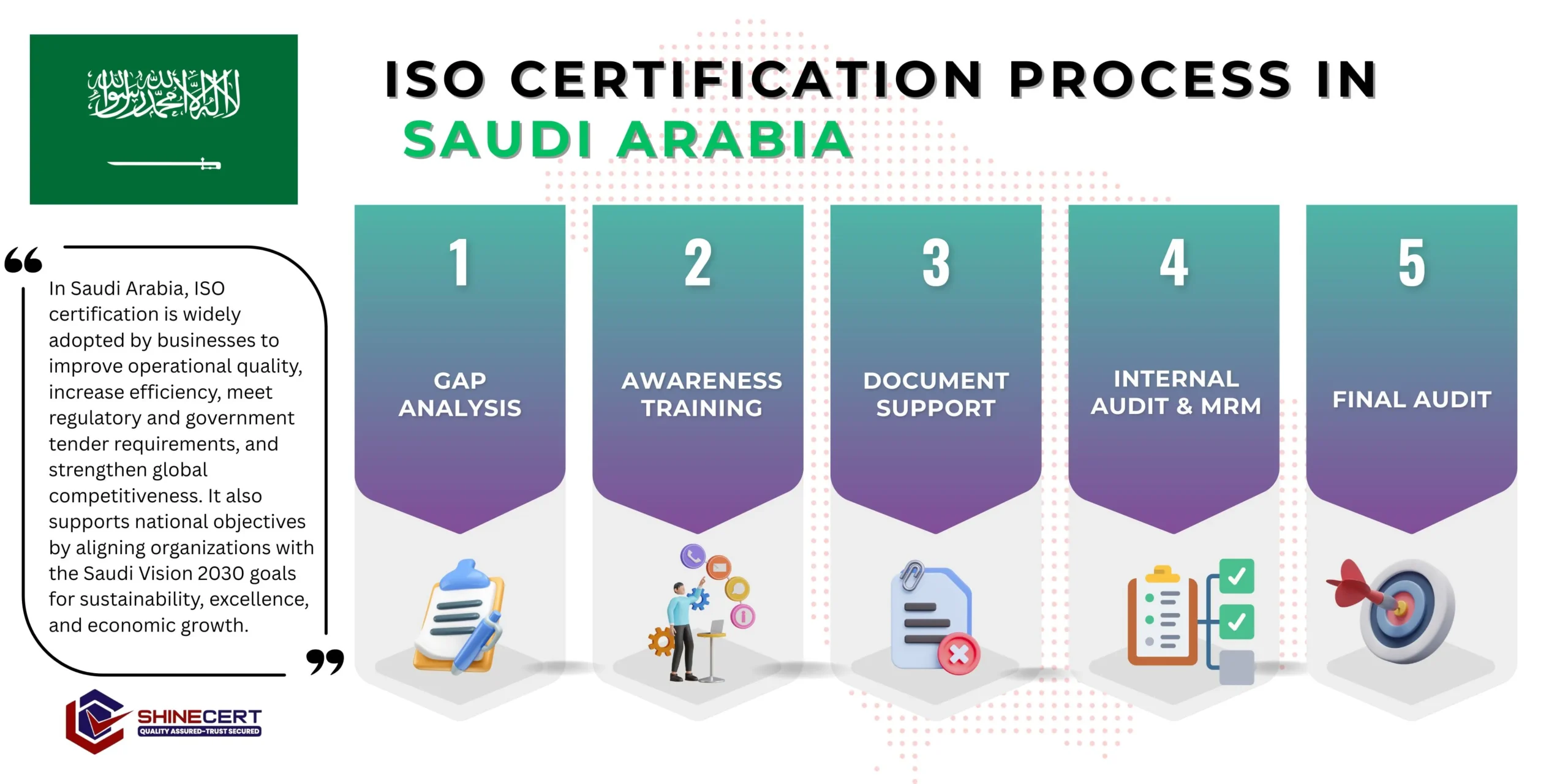
ShineCert’s 5-Step Certification Process for Cosmetics, Personal Care & Consumer Goods
Gap Analysis
ShineCert reviews current formulation control, quality, and environmental practices against your target standards.
Gap assessment report.
Documentation Development
Quality manual, batch control procedures, and environmental management documentation are developed, with Halal or CE Marking requirements mapped where relevant.
Complete management system documentation.
Implementation and Staff Training
Formulation control, traceability, and packaging waste management practices are rolled out, and production staff are trained on new procedures.
Training records and implementation evidence.
Internal Audit
An internal audit and management review evaluate the quality and environmental management system.
Internal audit report and management review minutes.
Certification or Conformity Support
ShineCert supports ISO Stage 1 and Stage 2 audits, Halal certification body assessment, and CE Marking self-declaration and technical file preparation as applicable.
ISO certificate(s), Halal certificate where pursued, and CE Marking technical documentation.
Gap Analysis
ShineCert reviews current formulation control, quality, and environmental practices against your target standards.
Gap assessment report.
Documentation Development
Quality manual, batch control procedures, and environmental management documentation are developed, with Halal or CE Marking requirements mapped where relevant.
Complete management system documentation.
Implementation and Staff Training
Formulation control, traceability, and packaging waste management practices are rolled out, and production staff are trained on new procedures.
Training records and implementation evidence.
Internal Audit
An internal audit and management review evaluate the quality and environmental management system.
Internal audit report and management review minutes.
Certification or Conformity Support
ShineCert supports ISO Stage 1 and Stage 2 audits, Halal certification body assessment, and CE Marking self-declaration and technical file preparation as applicable.
ISO certificate(s), Halal certificate where pursued, and CE Marking technical documentation.
Cosmetics Certification and Retail Buyer Requirements — How They Connect
Major retail chains and beauty distribution partners increasingly layer their own supplementary supplier requirements on top of baseline ISO certification, examining specific formulation transparency, sustainability packaging commitments, and ingredient sourcing practices that may extend beyond what certification alone verifies. Cosmetics and consumer goods companies that treat ISO 9001 certification as automatically satisfying every retail buyer’s expectations sometimes find gaps during a retailer’s own supplier qualification process, which is why ShineCert builds quality and environmental systems designed to hold up under this additional layer of retail scrutiny, not merely the certification audit itself.
Applicable ISO Standards for Cosmetics, Personal Care & Consumer Goods
ISO 9001
Quality Management System
ISO 9001 — Quality Management System
ISO 9001 establishes the foundational quality discipline around formulation control, batch consistency, and corrective action that underlies reliable cosmetics and consumer goods production, addressing the reality that a quality escape in this category can affect consumer safety and trigger costly product recalls that damage brand reputation for years afterward. Retail buyers and larger distribution partners increasingly expect current ISO 9001 certification as a baseline supplier qualification requirement, particularly for private label and contract manufacturing arrangements where the retailer's own brand reputation depends directly on the manufacturer's quality control.
ISO 14001
Environmental Management System
ISO 14001 — Environmental Management System
Cosmetics and consumer goods production involves packaging materials, ingredient sourcing with genuine environmental footprint considerations, and often water and chemical use in formulation and manufacturing processes, making environmental management a genuine operational concern that extends well beyond simple regulatory compliance. ISO 14001 certification demonstrates structured management of these environmental aspects, and increasingly, retail buyers building their own sustainability commitments and reporting obligations push similar expectations down through their cosmetics and consumer goods supplier base, making certified environmental management a genuine competitive factor in retail buyer relationships.
Halal
Halal Certification
Halal Certification
For cosmetics and personal care brands targeting Muslim-majority export markets or Halal-conscious consumer segments in any market, Halal certification addresses ingredient sourcing, formulation, and manufacturing process requirements distinct from anything ISO quality or environmental standards cover, since it concerns religious dietary and lifestyle compliance rather than quality or environmental management. Brands sometimes assume general quality certification alone satisfies Halal-conscious market expectations, but the two address genuinely different concerns, and destination markets or retail partners specifically requiring Halal certification will not accept ISO certification as a substitute.
CE
CE Marking
CE Marking
For cosmetics, personal care devices, and applicable consumer goods categories sold into the European Economic Area, CE Marking indicates the product meets relevant EU health, safety, and environmental protection requirements, but it's important to understand this is a legal conformity marking based on manufacturer self-declaration against applicable EU directives, not an ISO-style third-party certification, and the distinction matters both for accurate compliance communication and for understanding what CE Marking actually verifies versus what a genuine third-party quality certification demonstrates. Companies selling applicable product categories into European markets need CE Marking conformity as a legal market access requirement, separate from and complementary to any ISO quality certification they hold.
Right-Sized Certification Matters
The reverse question applies here too: very small, artisanal cosmetics producers serving purely local markets without retail chain or export ambitions sometimes find the full certification combination premature relative to current commercial needs, though even smaller producers increasingly find retail buyers and marketplace platforms expect at least foundational quality documentation as their business grows.
Common Implementation Challenges in Cosmetics Certification
- Batch consistency data not systematically tracked : Formulation variance between production batches that isn’t actively monitored undermines genuine quality control even where a documented recipe exists.
- Ingredient supplier verification gaps : Product safety and Halal compliance both depend heavily on ingredient sourcing, and companies that don’t extend genuine verification to their own supply base create persistent risk.
- CE Marking is treated as equivalent to ISO certification : Marketing CE Marking as if it were a third-party certified quality credential, rather than accurately describing it as manufacturer self-declared conformity, creates both compliance and reputational risk.
- Packaging waste reduction efforts not genuinely measured : Sustainability claims around packaging that aren’t backed by actual measured reduction data increasingly draw skepticism from both retail buyers and consumers.
Certification Benefits for Cosmetics & Consumer Goods
- International business and market access benefits : ISO 9001, Halal certification, and CE Marking together open export markets and retail relationships that would otherwise remain closed, since destination countries, religious market segments, and European regulatory requirements each impose genuinely distinct access conditions that certification and conformity marking directly satisfy.
- Trust and reputation benefits : In a category where consumer trust depends heavily on confidence in what’s actually in a product and how consistently it’s manufactured, certification provides an independently verified signal that packaging claims and marketing language alone can’t replicate, particularly valuable when a brand is entering a new market where it has no existing reputation to draw on.
- Process improvement and operational benefits : Structured quality and environmental management frequently surfaces genuine operational gaps, formulation consistency that varied between production batches without being systematically tracked, packaging waste that was never actively measured or targeted for reduction, ingredient supplier verification that wasn’t consistently applied, and companies that engage seriously with the improvement cycle typically see measurable reductions in product complaints, batch rejections, and packaging cost over time.
- Retail and competitive differentiation benefits : Certified quality and environmental management increasingly determines retail buyer willingness to stock a brand at all, particularly for private label arrangements and larger retail chains building supplier sustainability criteria directly into procurement decisions.
Cosmetics, Personal Care & Consumer Goods Certification Cost: What Actually Drives It
- Company size and product line complexity : A manufacturer with multiple product categories and complex formulations faces more extensive documentation than a single-product-line specialist.
- Nature of the business and ingredient sourcing complexity : Products with complex, multi-sourced ingredient supply chains require more rigorous traceability and supplier verification than simpler, single-source formulations.
- Number of departments and product lines in scope : Certification covering multiple product categories or manufacturing facilities as distinct units costs more than a narrowly scoped single-line certification.
- Existing quality and environmental maturity : Companies with established, even if informal, batch control and environmental practices typically implement faster and at lower cost than those building systems from scratch.
- Certification combination and target markets : Adding Halal certification, CE Marking conformity, or ISO 14001 alongside ISO 9001 adds distinct scope and cost depending on your specific target export markets.
Ingredient Traceability: The Foundation of Both Safety and Halal Compliance
- Cosmetics and personal care ingredient traceability serves double duty in a genuinely well-run quality system, supporting both product safety investigation if a formulation issue arises and Halal compliance verification for brands pursuing that certification, and companies that build genuinely robust traceability once find it serves both purposes rather than needing entirely separate systems for each. Building this well requires tracking ingredients back to their actual source, not merely to an immediate supplier who may themselves be sourcing from further upstream without full visibility, and companies that stop traceability at the first supplier tier often discover gaps when a genuine product safety or Halal compliance question requires tracing an ingredient’s full origin.
- ShineCert helps cosmetics and consumer goods companies build traceability systems that genuinely support both quality investigation and, where relevant, Halal certification requirements, since building these as separate, uncoordinated efforts duplicates work while still leaving gaps that only become visible when a real investigation is needed.
Understanding CE Marking’s Legal Status Alongside ISO Certification
- Cosmetics and consumer goods companies entering European markets sometimes assume CE Marking works the same way as ISO certification, independently verified by a third-party auditor, when in most applicable categories it’s actually based on manufacturer self-declaration of conformity against relevant EU directives, supported by a technical file the manufacturer prepares and retains, with a Notified Body’s independent involvement required only for specific higher-risk product categories.
- This distinction matters both for accurate legal compliance and for honest communication with customers and retail partners, since overstating CE Marking as equivalent to third-party ISO certification creates both a compliance risk if the claim is scrutinized and a genuine reputational risk if the distinction is ever publicly challenged. ShineCert helps companies build technical files and conformity documentation that genuinely support the self-declaration, and is explicit with clients about exactly what CE Marking does and doesn’t verify, so that marketing claims and actual compliance status remain accurately aligned.
Why Choose ShineCert for Cosmetics, Personal Care & Consumer Goods Certification?
ShineCert has guided more than 10,000 organizations through international certification and conformity support from genuine operating offices in Riyadh, Lebanon, and India, with practical experience across cosmetics manufacturers, personal care brands, and consumer goods companies navigating multiple, genuinely distinct market compliance requirements.
Cosmetics, Personal Care & Consumer Goods Certification Timeline
Phase | Typical Duration |
Gap analysis | 2–3 weeks |
Documentation development | 4–8 weeks |
Implementation and staff training | 4–8 weeks |
Internal audit and management review | 1–2 weeks |
Certification body Stage 1 + Stage 2 audit (and Halal/CE Marking processes where pursued) | 2–4 weeks |
Total for ISO 9001 certification | 4–6 months |
Choosing an Accredited Certification Body for Cosmetics, Personal Care & Consumer Goods?
What to Check | Why It Matters |
IAF-recognized accreditation for ISO standards (and Halal accreditation where relevant) | Confirms certificates carry genuine recognition with your target retail and export markets |
Cosmetics and consumer goods sector audit experience | Auditors familiar with formulation control and ingredient traceability assess your system more effectively |
Recognition by your target export destination markets | Confirms certification will satisfy the specific import and retail requirements you’re targeting |
Understanding of CE Marking’s self-declaration nature | A credible partner explains CE Marking accurately rather than conflating it with third-party ISO certification |
Start Your Cosmetics, Personal Care & Consumer Goods Certification Journey
ShineCert provides end-to-end certification and conformity support, from gap analysis through certification audit and CE Marking technical file preparation, for cosmetics manufacturers, personal care brands, and consumer goods companies. Book your free consultation or contact ShineCert directly, and our team will review your product lines, target markets, and current quality maturity before proposing a fixed-scope engagement plan.
Frequently Asked Questions
Most commonly ISO 9001 for quality management, Halal certification for Muslim-majority or Halal-conscious markets, and CE Marking conformity for applicable categories sold into Europe.
No, CE Marking is a legal conformity marking generally based on manufacturer self-declaration, distinct from third-party ISO certification, though both matter for different compliance purposes.
It depends on product line complexity, ingredient sourcing structure, and existing quality maturity. ShineCert provides a fixed quote after gap analysis.
Typically four to six months, depending on formulation complexity and existing management system maturity.
No, Halal certification addresses religious dietary and lifestyle compliance specifically, not general product quality or safety management, which ISO 9001 addresses separately.
Certification scales to brands of any size, though very small, local-market-only producers sometimes find full certification premature relative to current commercial needs.
Many major retail chains layer their own supplementary supplier requirements on top of ISO 9001 certification, particularly around sustainability and formulation transparency.