
What is ISO Certification in Saudi Arabia?
ISO certification in Saudi Arabia- Real Market Context ?
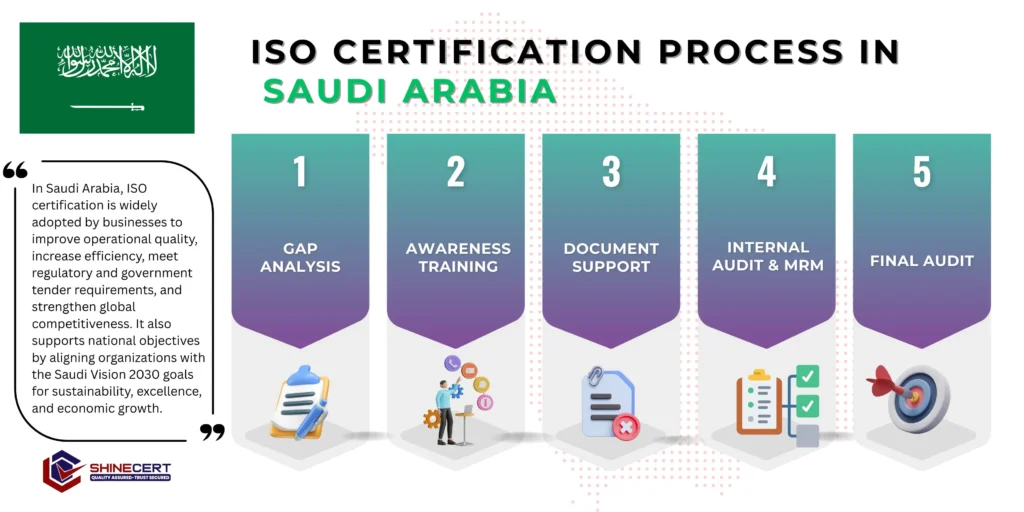
What are the steps to get ISO Certification in Saudi Arabia?
- ISO Certification Saudi Arabia
- ISO 9001 Certification
- ISO 14001 Certification
- ISO 45001 Certification
- ISO 27001 Certification
- ISO 22000 Certification
- ISO 13485 Certification
- ISO 17025 Certification
- ISO 20000-1 Certification
- ISO 22301 Certification
- ISO 31000 Certification
- CE Mark Certification
- Halal Certification
- GDPR Certification
- HIPPA Certification
We Are in Major City's
Popular ISO Certifications Standards in Saudi Arabia
Saudi organizations commonly implement the following ISO standards based on sector and risk profile:
ISO 9001 – Quality Management System
Essential for construction, services, manufacturing, logistics, and professional firms supplying government and private projects.
ISO 14001 – Environmental Management System
Widely adopted for projects involving environmental impact, sustainability, and regulatory oversight.
ISO 45001 – Occupational Health & Safety Management System
Critical for construction, oil & gas, industrial operations, and high-risk work environments.
ISO 27001 – Information Security Management System
Increasingly required by government entities, banks, fintechs, IT services, and data-driven organizations.
ISO 13485 – Medical Devices
Relevant for medical device manufacturers, importers, and healthcare suppliers serving regulated markets.
ISO 22301 – Business Continuity
Adopted by financial institutions, telecoms, IT services, and critical infrastructure providers.
ISO 17025 – Testing & Calibration Laboratories
Required for laboratories seeking formal technical competence recognition.
ISO Certification Process in Saudi Arabia
Current practices are assessed against the selected ISO standard(s). Common Saudi findings include undocumented processes, weak risk assessment, and limited performance monitoring.
Policies, procedures, and controls are developed to reflect actual Saudi operations, regulatory context, and project requirements.
Systems are implemented across departments and sites. Challenges such as role clarity, contractor control, and workforce awareness are addressed.
Internal audits verify system effectiveness. Top management reviews performance, risks, and objectives—this step is heavily scrutinized by Saudi auditors.
An accredited certification body conducts Stage 1 and Stage 2 audits. Certification is issued only after successful closure of findings, followed by annual surveillance audits.
Benefits of ISO Certification for Businesses in Saudi Arabia
- Increased Trust: These businesses become viewed as reliable and global professionals automating greater trust from customers and partners, as well as from regulators.
- Access to Government & Large Private Sector: Large Private Sector in Saudi Arabia and most Government entities require ISO Certification as a prerequisite to begin the partnership.
- Increased Efficiency and Quality: ISO standards foster the expediting of processes, the decrease of operational errors, and the enhancement of uniformity.
- Legal Compliance: ISO frameworks assist businesses attaining Saudi regulatory and safety as well as environmental and data protection standards.
- Edge Over Competitors in the Saudi Marketplace: ISO Certification allows entrepreneurs to be different from the crowd. This especially matters in highly regulated or saturated industries.
Key Industries Using ISO Certification in Saudi Arabia
Construction, infrastructure, and mega-projects
Oil & gas, petrochemicals, and energy services
Manufacturing and industrial production
Healthcare and medical services
Banking, fintech, and financial services
IT, cloud services, and cybersecurity
Logistics, ports, and supply chain operations
Government contractors and public services
Providing Worldwide Reach on a Local Scale: Shinecert Across the Kingdom of Saudi Arabia
Why are ISO Consultants Important in Saudi Arabia?
Cost of ISO Certification in Saudi Arabia
Why Choose Shinecert for ISO Certification in Saudi Arabia?
Let’s Collaborate with Us!
ISO certification is not always legally mandatory, but it is frequently required for government projects, tenders, and multinational contracts.
ISO certificates are issued by accredited certification bodies, not consultants.
Yes. ISO certificates issued by accredited bodies are globally accepted.
Yes. ISO standards are scalable and applicable to SMEs as well as large enterprises.
ISO certificates are valid for three years, with annual surveillance audits.
Yes. New businesses and startups in Saudi Arabia are able to apply for ISO certification. ISO certification standards are designed to be adaptable and can be implemented.
Start ISO Certification in Saudi Arabia with Confidence
If your organization needs ISO certification to qualify for Saudi tenders, comply with Vision 2030 expectations, or work with multinational clients, Shinecert ISO Consulting and Certifications can guide you through a practical, audit-focused ISO certification journey in Saudi Arabia.
Speak with an experienced consultant to understand the right ISO certification strategy for your business in Saudi Arabia.
Request Free Consultation