
ISO 31000 Certification in Saudi Arabia
Quick Answer
ISO 31000 is important to understand correctly: it’s a guidance standard providing principles and a framework for risk management, not a certifiable management system standard like ISO 9001 or ISO 27001. No organization can be “ISO 31000 certified” in the formal accredited sense, and any consultant claiming otherwise is misrepresenting the standard. What ShineCert offers is structured implementation support to help Saudi organizations build a genuine enterprise risk management framework aligned with ISO 31000’s principles, which can then support formal certifiable standards like ISO 9001, ISO 27001, or ISO 37001 that do require documented risk assessment as part of their certifiable requirements. Budget roughly SAR 15,000 to SAR 70,000 for implementation support depending on organizational complexity, with no formal certification audit cost since certification isn’t applicable.
Why ISO 31000 Matters for Businesses in Saudi Arabia?
Saudi Arabia’s Vision 2030 transformation has introduced substantial complexity and change across the Saudi business environment, from giga-project execution risk to regulatory reform pace to broader economic diversification uncertainty, making structured enterprise risk management genuinely valuable for Saudi organizations navigating this environment rather than managing risk informally or reactively. Government entities and large Saudi corporations increasingly expect formal enterprise risk management frameworks from major contractors and partners, reflecting broader governance maturity expectations tied to the Kingdom’s economic reform agenda.
For Saudi organizations pursuing multiple ISO certifications, whether ISO 9001, ISO 14001, ISO 27001, or ISO 37001, building a genuine ISO 31000-aligned risk management framework first provides a coherent foundation that makes each certifiable standard’s specific risk assessment requirements considerably more consistent and less duplicative, since risk identification and evaluation principles remain largely consistent across these different certifiable standards even though each addresses a distinct risk domain.
ISO 31000 as a Foundation for Saudi Arabia’s Certifiable Standards
- We consistently advise Saudi organizations planning to pursue multiple ISO certifications, whether ISO 9001, ISO 14001, ISO 27001, or ISO 37001, to build their ISO 31000-aligned risk management framework early and treat it as shared infrastructure supporting each certifiable standard’s specific risk assessment requirements, rather than allowing each certification project to develop its own disconnected risk assessment approach.
- In our experience, organizations that take this coordinated approach not only reduce duplicated consulting and internal effort across multiple certification projects, but also end up with genuinely more coherent risk governance, since the same underlying risk identification and evaluation logic applies consistently across quality, environmental, security, and anti-bribery risk domains, even though the specific risks identified within each domain differ substantially. This matters particularly for Saudi organizations under time pressure to pursue multiple certifications simultaneously to meet Vision 2030-linked contracting deadlines, where efficient, coordinated risk framework development can meaningfully compress overall certification timelines.
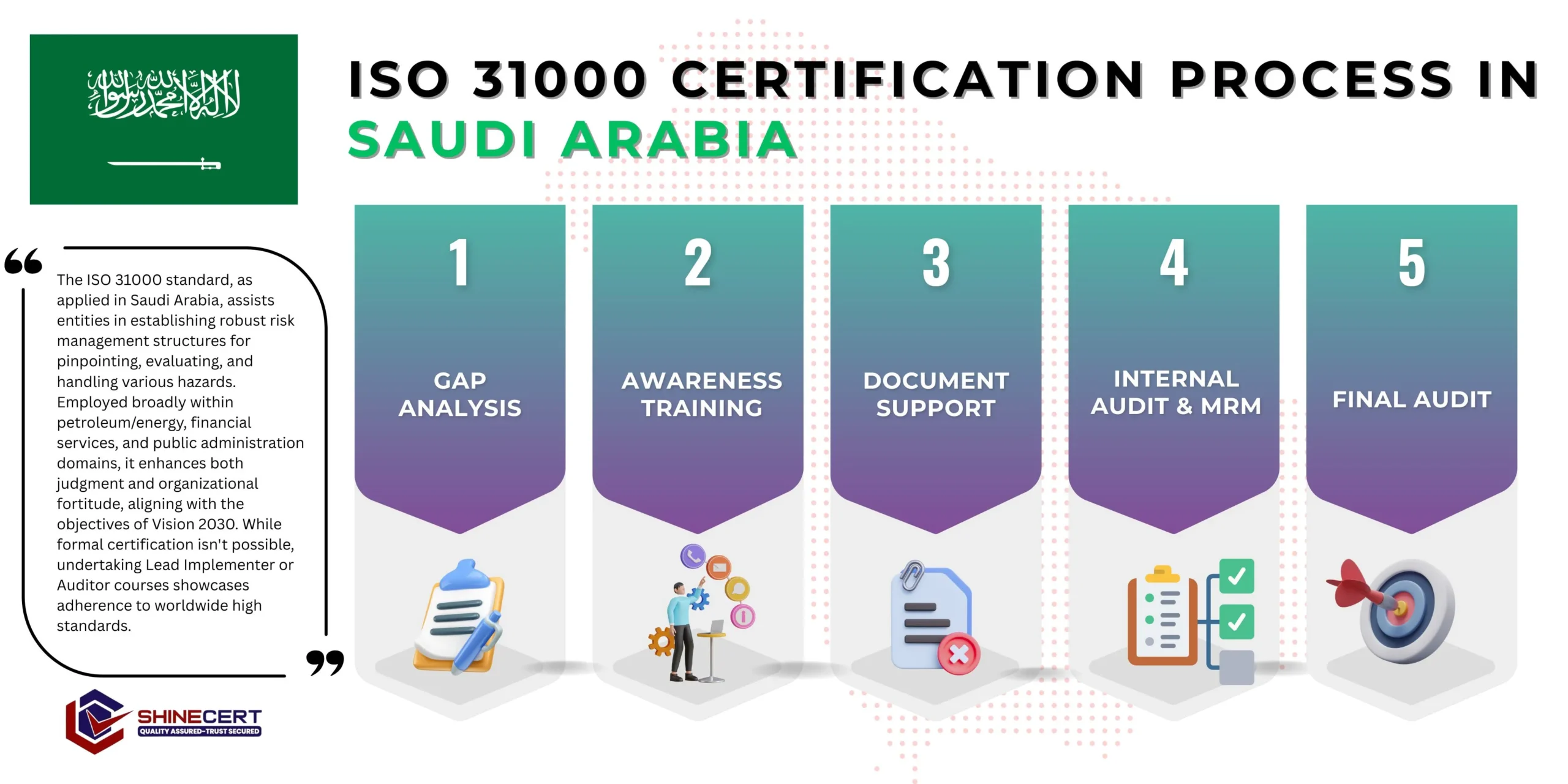
What are the steps to get ISO 31000 Certification in Saudi Arabia?
our services
- ISO Certification Saudi Arabia
- ISO 9001 Certification Saudi Arabia
- ISO 14001 Certification Saudi Arabia
- ISO 27001 Certification Saudi Arabia
- ISO 22000 Certification Saudi Arabia
- ISO 27701 Certification Saudi Arabia
- ISO 45001 Certification Saudi Arabia
- ISO 20000-1 Certification Saudi Arabia
- ISO 13485 Certification Saudi Arabia
- ISO 17025 Certification Saudi Arabia
- ISO 31000 Certification Saudi Arabia
- ISO 42001 Certification Saudi Arabia
- ISO 37001 Certification Saudi Arabia
- ISO 22301 Certification Saudi Arabia
- ISO 50001 Certification Saudi Arabia
- CE Mark Certification Saudi Arabia
- GDPR Certification Saudi Arabia
- GMP Certification Saudi Arabia
- Halal Certification Saudi Arabia
- SOC Certification Saudi Arabia
major citys
ShineCert’s ISO 31000 Implementation Process in Saudi Arabia
Context and Risk Criteria Establishment
We work with your leadership to establish your organization's specific risk context and criteria, reflecting your actual operating environment, sector, and Vision 2030-related exposure where relevant.
A documented risk management context and criteria framework tailored to your organization.
Risk Identification and Assessment
We facilitate a structured risk identification process across your organization, then conduct risk analysis and evaluation determining which risks require priority treatment.
A documented risk register with analysis and prioritization scoped to your organization.
Risk Treatment Planning
We help you develop and document risk treatment plans for priority risks, with clear ownership and defensible rationale for treatment decisions.
Documented risk treatment plans with assigned ownership and monitoring criteria.
Framework Integration and Training
We help embed the risk management framework into your existing governance and decision-making processes, training relevant leadership and staff on ongoing risk management practices.
Documented evidence of risk management genuinely integrated into organizational decision-making, plus training records.
Ongoing Monitoring and Review Support
We help establish a structured review cadence ensuring your risk framework remains current as your organization and its operating environment evolve.
A documented monitoring and review schedule with defined triggers for framework updates.
Context and Risk Criteria Establishment
We work with your leadership to establish your organization's specific risk context and criteria, reflecting your actual operating environment, sector, and Vision 2030-related exposure where relevant.
A documented risk management context and criteria framework tailored to your organization.
Risk Identification and Assessment
We facilitate a structured risk identification process across your organization, then conduct risk analysis and evaluation determining which risks require priority treatment.
A documented risk register with analysis and prioritization scoped to your organization.
Risk Treatment Planning
We help you develop and document risk treatment plans for priority risks, with clear ownership and defensible rationale for treatment decisions.
Documented risk treatment plans with assigned ownership and monitoring criteria.
Framework Integration and Training
We help embed the risk management framework into your existing governance and decision-making processes, training relevant leadership and staff on ongoing risk management practices.
Documented evidence of risk management genuinely integrated into organizational decision-making, plus training records.
Ongoing Monitoring and Review Support
We help establish a structured review cadence ensuring your risk framework remains current as your organization and its operating environment evolve.
A documented monitoring and review schedule with defined triggers for framework updates.
What Is ISO 31000?
ISO 31000 is the international standard providing principles and generic guidelines for risk management, published by the International Organization for Standardization to help organizations of all types and sizes manage risk more effectively. Unlike ISO 9001 or ISO 27001, which are management system standards with specific, auditable requirements that certification bodies verify, ISO 31000 is explicitly designed as guidance, offering a framework and process for identifying, analyzing, evaluating, and treating risk that organizations adapt to their specific context rather than a checklist of mandatory requirements. The standard emphasizes that risk management should be integrated into organizational governance and decision-making, not treated as a separate, standalone activity. Because it’s guidance rather than a requirements standard, there’s no accredited certification audit against ISO 31000 itself, though its principles frequently inform the risk assessment requirements embedded within certifiable standards.
ISO 31000 Implementation Cost in Saudi Arabia
Quick answer: ISO 31000 framework implementation support in Saudi Arabia typically costs between SAR 15,000 and SAR 70,000, depending on organizational complexity and scope, with no certification audit fee since formal accredited certification against ISO 31000 doesn’t exist.
- Organizational complexity drives cost significantly : Larger, more complex organizations with diverse risk exposure require more extensive risk identification and assessment work.
- Existing risk management maturity reduces cost : Organizations with some existing risk awareness, even informal, need less foundational framework-building work.
- No certification body fees apply : Since ISO 31000 isn’t certifiable, costs are limited to implementation support, unlike certifiable standards with separate consulting and certification body fees.
- Integration with existing certifiable standards affects scope : Organizations building this framework specifically to support ISO 9001, 27001, or 37001 certification need coordinated planning across both efforts.
- Ongoing framework maintenance support is typically a separate, smaller engagement : Initial implementation is the larger cost component; ongoing review support is more modest.
Key Documents in an ISO 31000-Aligned Risk Management Framework
Quick answer: While ISO 31000 doesn’t mandate specific documented information the way certifiable standards do, a genuinely functional risk management framework typically includes a risk management policy, a risk register, risk treatment plans, and documented review records.
- Risk Management Policy : A documented statement of leadership commitment to structured risk management, though not formally mandated, that establishes genuine organizational intent.
- Risk Context and Criteria : Documentation defining your organization’s specific risk context and the criteria used to evaluate risk significance.
- Risk Register : A living document tracking identified risks, their analysis, evaluation, and treatment status.
- Risk Treatment Plans : Documentation of specific actions taken to address priority risks, with assigned ownership.
- Review and Monitoring Records : Evidence that the risk framework is genuinely reviewed and updated, not established once and left static.
Saudi organizations building risk frameworks that will later support ISO 9001, ISO 27001, or ISO 37001 certification should ensure this documentation genuinely aligns with those standards’ specific risk assessment requirements, since a well-designed ISO 31000-aligned framework can meaningfully reduce duplicate risk assessment work across multiple certifications.
Key Principles of ISO 31000
ISO 31000 is structured around principles, a framework, and a process, rather than clauses with specific auditable requirements:
- Risk Management Principles : The standard articulates that effective risk management should be integrated into organizational processes, structured and comprehensive, customized to the organization’s specific context, inclusive of stakeholder engagement, dynamic and responsive to change, and based on the best available information. For Saudi organizations, this means risk management shouldn’t be a static annual exercise disconnected from actual business decision-making, but genuinely embedded into how leadership makes strategic and operational choices, including decisions about Vision 2030-related opportunities and their associated execution risks.
- Leadership and Commitment : The framework explicitly requires genuine leadership commitment to risk management, including integrating risk considerations into organizational strategy and objective-setting, not delegating risk management entirely to a compliance function disconnected from strategic decision-making. We’ve found that Saudi organizations building risk management frameworks for the first time often already have informal risk awareness among leadership, but lack the structured, documented process that makes that awareness genuinely actionable and consistent across the organization.
- Risk Assessment Process : ISO 31000’s core process involves risk identification, risk analysis examining likelihood and consequence, and risk evaluation determining which risks require treatment and their priority. For Saudi organizations, this process should genuinely reflect the specific operating environment, including regulatory change pace, giga-project execution dependencies, and sector-specific risk factors, rather than applying a generic international risk taxonomy without local context.
- Risk Treatment : The framework requires selecting and implementing appropriate risk treatment options, whether avoiding, mitigating, transferring, or accepting identified risks, with documented rationale for treatment decisions. This structured approach helps Saudi organizations make consistent, defensible risk decisions rather than ad hoc responses that vary depending on who happens to be involved in a particular decision.
- Monitoring, Review, and Continual Improvement : ISO 31000 emphasizes that risk management should be dynamic, with regular monitoring and review ensuring the risk framework remains relevant as the organization’s context and risk environment evolve, genuinely important given how quickly Saudi Arabia’s regulatory and business environment continues changing under ongoing Vision 2030 implementation.
Benefits of ISO 31000 in Saudi Arabia
A well-built risk management framework streamlines risk assessment requirements across ISO 9001, ISO 14001, ISO 27001, and other certifiable standards your organization may pursue.
Structured risk assessment helps Saudi organizations evaluate giga-project and diversification-related opportunities with genuine rigor rather than reactive decision-making.
Certification supports participation in Saudi Energy Efficiency Center programs targeting industrial and commercial energy performance.
Structured risk evaluation reduces inconsistency in how different parts of the organization respond to similar risk categories.
Understanding which risks genuinely warrant priority attention helps Saudi organizations allocate limited risk management resources more effectively.
A structured framework gives Saudi boards and leadership teams genuine visibility into organizational risk exposure, supporting better strategic decision-making.
ISO 31000 Implementation Timeline in Saudi Arabia
Phase | Typical Duration |
Context and criteria establishment | 1–2 weeks |
Risk identification and assessment | 3–4 weeks |
Risk treatment planning | 2–3 weeks |
Framework integration and training | 2–4 weeks |
Total | 2–4 months |
Organizations in Saudi Arabia That Benefit from ISO 31000 Implementation
Government entities and government-linked companies
Governance maturity expectations increasingly favor structured, documented risk management approaches.
Read moreLarge contractors and giga-project participants
Vision 2030 project execution risk genuinely benefits from structured evaluation and treatment planning.
Read moreFinancial institutions
Enterprise risk management complements SAMA's regulatory risk expectations, though financial institutions typically also need sector-specific risk frameworks.
Read moreFamily businesses transitioning to formal governance
Saudi Arabia's substantial family business sector increasingly adopts structured risk management as part of broader governance professionalization.
Read moreOrganizations pursuing multiple ISO certifications
A shared risk management foundation streamlines risk assessment across ISO 9001, ISO 14001, ISO 27001, and other certifiable standards.
Read moreWhy Choose ShineCert for ISO 31000 Implementation in Saudi Arabia?
We’re headquartered in Riyadh, giving us direct familiarity with Saudi Arabia’s Vision 2030-driven risk environment and the governance expectations increasingly placed on Saudi organizations. Our team has guided more than 10,000 organizations through ISO certification globally, and we’re transparent that ISO 31000 implementation, unlike our certifiable standard work, is expert guidance rather than a path to formal accredited certification.
Choosing a Risk Management Consultant for ISO 31000 in Saudi Arabia?
What to Check | Why It Matters |
Honesty about ISO 31000’s non-certifiable nature | Any consultant offering “ISO 31000 certification” is misrepresenting the standard; be wary of this claim |
Genuine enterprise risk management expertise | Distinct from and broader than technical certifiable standard implementation alone |
Vision 2030 and Saudi regulatory environment familiarity | Helps ensure the framework reflects genuine local risk context, not generic international risk categories |
Experience integrating risk frameworks with certifiable standards | Valuable if you’re also pursuing ISO 9001, 27001, or 37001 certification |
Common Misunderstandings About ISO 31000 in Saudi Arabia
- Believing ISO 31000 certification exists : It doesn’t; the standard is guidance, and no accredited certification body issues ISO 31000 certificates. Be skeptical of any provider claiming otherwise.
- Treating the framework as a one-time document : ISO 31000’s principles explicitly emphasize dynamic, ongoing risk management, not a static risk register created once and forgotten.
- Building risk management disconnected from strategic decision-making : The framework’s genuine value comes from integration into how leadership actually makes decisions, not from documentation existing separately from real governance.
- Duplicating risk assessment work across multiple certifiable standards : Organizations pursuing several ISO certifications without a coordinated risk framework often unnecessarily repeat similar risk identification work multiple times.
Build Your Risk Management Framework in Saudi Arabia
ShineCert helps Saudi organizations build genuine, ISO 31000-aligned enterprise risk management frameworks, whether standalone or as a foundation for certifiable standards. Book a free consultation or contact us directly, and we’ll review your organization’s risk environment before proposing a fixed-scope plan.
Frequently Asked Questions
No, ISO 31000 is a guidance standard, not a certifiable management system standard; no accredited certification exists against it.
Typically SAR 15,000 to SAR 70,000 for implementation support, with no separate certification body audit fee.
Typically two to four months to build a functioning, embedded risk management framework.
No, but a well-built ISO 31000-aligned framework provides a strong foundation that streamlines those certifiable standards’ specific risk requirements.
This is a misrepresentation of the standard; organizations should be cautious of any provider making this claim.
Yes, it provides valuable general risk management guidance for any organization, independent of pursuing formal certification elsewhere.
Yes, Riyadh is one of ShineCert’s genuine physical offices, alongside Lebanon and India.