
ISO 37001 Certification in Saudi Arabia
Quick Answer
ISO 37001 is the international standard for anti-bribery management systems, and in Saudi Arabia it’s increasingly relevant given the National Anti-Corruption Commission’s (Nazaha) active enforcement role and growing government procurement emphasis on contractor integrity and governance. Certification should come from a body accredited by the Saudi Accreditation Center (SAAC) or another IAF-recognized national accreditation body. Budget roughly SAR 18,000 to SAR 85,000 depending on company size and international trade exposure, and expect three to six months from kickoff to certificate.
Why ISO 37001 Matters for Businesses in Saudi Arabia?
The National Anti-Corruption Commission (Nazaha) has taken an increasingly visible and active enforcement role in Saudi Arabia over recent years, reflecting the Kingdom’s broader Vision 2030 commitment to governance reform and transparency as part of its economic diversification strategy. This has translated into practical procurement consequences: Saudi government entities and increasingly, Vision 2030 giga-project developers, factor demonstrated anti-corruption governance into contractor and supplier evaluation, particularly for large-value contracts where integrity due diligence has become a standard part of the bidding process rather than an afterthought.
For Saudi businesses engaged in international trade, ISO 37001 certification also provides meaningful value beyond domestic government contracting, since international partners, particularly those based in jurisdictions with extraterritorial anti-bribery legislation, increasingly conduct anti-corruption due diligence on Saudi counterparties before entering joint ventures or supply relationships, and certification provides a structured, verifiable answer to that due diligence process.
ISO 37001 and Saudi Arabia’s Governance Reform Direction
- Saudi Arabia’s Vision 2030 governance reform agenda has positioned transparency and anti-corruption as genuine strategic priorities, not just regulatory compliance checkboxes, reflected in Nazaha’s increasingly visible enforcement activity and the Kingdom’s improving international governance perception metrics over recent years. We’ve found that Saudi businesses treating ISO 37001 certification as part of this broader governance narrative, rather than a narrow tender-qualification exercise, build considerably more robust and genuinely effective anti-bribery management systems.
- This distinction matters particularly for businesses positioning themselves for international investment or expansion, where investors and partners increasingly view genuine anti-corruption governance maturity as a meaningful signal of broader organizational governance quality, extending well beyond the specific bribery risk the certification directly addresses.
What are the steps to get ISO 37001 Certification in Saudi Arabia?
our services
- ISO Certification Saudi Arabia
- ISO 9001 Certification Saudi Arabia
- ISO 14001 Certification Saudi Arabia
- ISO 27001 Certification Saudi Arabia
- ISO 22000 Certification Saudi Arabia
- ISO 27701 Certification Saudi Arabia
- ISO 45001 Certification Saudi Arabia
- ISO 20000-1 Certification Saudi Arabia
- ISO 13485 Certification Saudi Arabia
- ISO 17025 Certification Saudi Arabia
- ISO 31000 Certification Saudi Arabia
- ISO 42001 Certification Saudi Arabia
- ISO 37001 Certification Saudi Arabia
- ISO 22301 Certification Saudi Arabia
- ISO 50001 Certification Saudi Arabia
- CE Mark Certification Saudi Arabia
- GDPR Certification Saudi Arabia
- GMP Certification Saudi Arabia
- Halal Certification Saudi Arabia
- SOC Certification Saudi Arabia
major citys
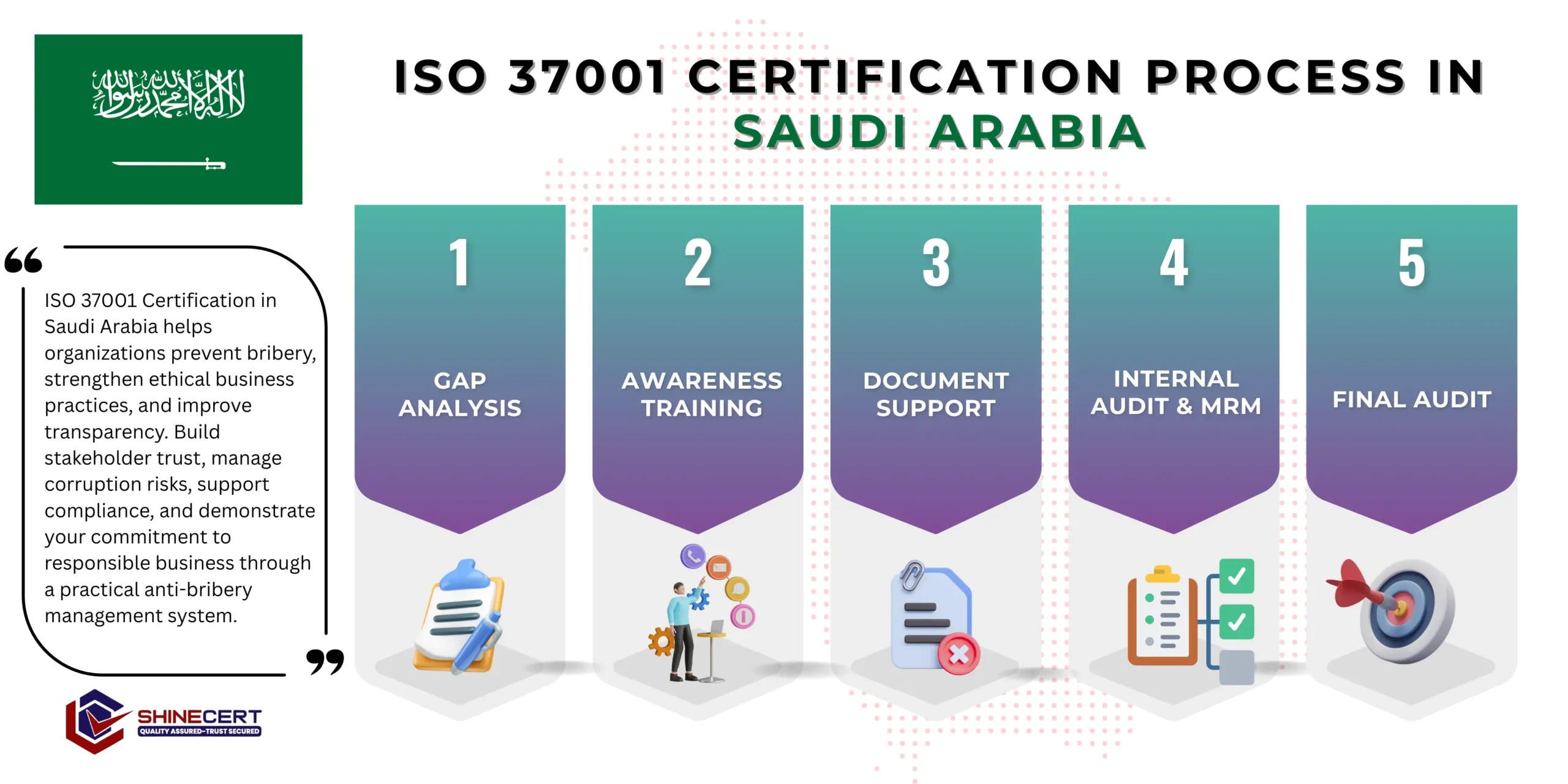
ShineCert’s ISO 37001 Certification Process in Saudi Arabia
Gap Analysis and Bribery Risk Assessment
We assess your current anti-bribery practices against ISO 37001's requirements and conduct a structured bribery risk assessment covering your specific industry, geography, and business relationships.
A documented gap analysis and bribery risk assessment scoped to your operations.
Documentation Development
We build your anti-bribery policy, due diligence procedures, and reporting mechanism collaboratively, ensuring higher-risk scenarios like third-party agent relationships are explicitly addressed.
A complete anti-bribery management system documentation set, including your risk assessment and due diligence procedures.
Implementation and Training
We roll out due diligence processes and deliver targeted anti-bribery training, with particular depth for staff in higher-risk roles involving government or third-party agent interaction.
Documented training records and evidence of functioning due diligence and reporting mechanisms.
Internal Audit and Management Review
We conduct a rigorous internal audit covering control effectiveness and any reporting channel activity, then facilitate a management review addressing bribery risk and control performance.
A documented internal audit report and management review minutes demonstrating leadership engagement with anti-bribery governance.
Certification Audit
We coordinate Stage 1 and Stage 2 audits with a SAAC-accredited or IAF-recognized certification body, supporting you through any resulting corrective actions, then help establish your surveillance audit schedule.
Your ISO 37001 certificate and a documented surveillance audit plan.
Gap Analysis and Bribery Risk Assessment
We assess your current anti-bribery practices against ISO 37001's requirements and conduct a structured bribery risk assessment covering your specific industry, geography, and business relationships.
A documented gap analysis and bribery risk assessment scoped to your operations.
Documentation Development
We build your anti-bribery policy, due diligence procedures, and reporting mechanism collaboratively, ensuring higher-risk scenarios like third-party agent relationships are explicitly addressed.
A complete anti-bribery management system documentation set, including your risk assessment and due diligence procedures.
Implementation and Training
We roll out due diligence processes and deliver targeted anti-bribery training, with particular depth for staff in higher-risk roles involving government or third-party agent interaction.
Documented training records and evidence of functioning due diligence and reporting mechanisms.
Internal Audit and Management Review
We conduct a rigorous internal audit covering control effectiveness and any reporting channel activity, then facilitate a management review addressing bribery risk and control performance.
A documented internal audit report and management review minutes demonstrating leadership engagement with anti-bribery governance.
Certification Audit
We coordinate Stage 1 and Stage 2 audits with a SAAC-accredited or IAF-recognized certification body, supporting you through any resulting corrective actions, then help establish your surveillance audit schedule.
Your ISO 37001 certificate and a documented surveillance audit plan.
What Is ISO 37001?
ISO 37001 is the international standard for anti-bribery management systems, published by the International Organization for Standardization to help organizations implement a structured set of measures to prevent, detect, and respond to bribery. It requires organizations to conduct bribery risk assessments specific to their operations, geography, and industry, implement proportionate anti-bribery controls including due diligence on business associates and gifts and hospitality policies, and establish reporting channels for suspected bribery without fear of retaliation. The standard doesn’t guarantee bribery will never occur, but certification demonstrates that an organization has implemented reasonable, internationally recognized measures to prevent it, which carries genuine legal and reputational weight in bribery investigations and due diligence processes. Certification means an accredited auditor has verified your anti-bribery management system meets these requirements.
ISO 37001 Certification Cost in Saudi Arabia
Quick answer: ISO 37001 certification in Saudi Arabia typically costs between SAR 18,000 and SAR 85,000, depending on company size and international trade or government contracting exposure, with businesses using extensive third-party agent networks generally costing more given more extensive due diligence work.
- Third-party agent and intermediary exposure drives cost significantly : Businesses with extensive agent networks require more extensive due diligence procedure development.
- Government contracting exposure increases scope : Organizations heavily engaged in government tendering need more robust controls around this higher-risk relationship category.
- Certification body fees are separate from consulting fees : The accredited certification body’s audit fee is distinct from ShineCert’s implementation support.
- International operations increase complexity : Multi-jurisdiction operations require risk assessment addressing varying anti-bribery legal frameworks.
- Bundling with ISO 9001 reduces per-standard cost : Shared management system structure makes combined certification more efficient.
Mandatory Documents for ISO 37001
Quick answer: ISO 37001 requires documented information including an anti-bribery policy, a bribery risk assessment, due diligence procedures for business associates, and records covering gifts and hospitality, reporting channel activity, and internal audits.
- Anti-Bribery Policy : A documented, top-management-issued policy establishing genuine zero-tolerance commitment to bribery.
- Bribery Risk Assessment : A documented assessment of bribery risks specific to your industry, geography, and business relationships.
- Due Diligence Procedures and Records : Documentation of due diligence conducted on business associates, particularly third-party agents and intermediaries.
- Gifts, Hospitality, and Donations Register : A tracked record of gifts, hospitality, and charitable or political donations, evaluated against defined thresholds and controls.
- Financial and Non-Financial Controls : Documentation of controls designed to detect potential bribery, including expense and payment controls.
- Reporting Channel Records : Documentation of the confidential reporting mechanism and any concerns raised, handled with genuine protection against retaliation.
- Internal Audit and Management Review Records : Documented audit findings and management review minutes addressing anti-bribery performance.
Key Requirements of ISO 37001
ISO 37001 shares the Harmonised Structure with other modern ISO management system standards, with substantive requirements addressing bribery prevention:
- Context of the Organization (Clause 4) : Requires identifying bribery risks relevant to your specific operations, industry, and geography, and interested parties whose anti-corruption expectations matter, including Nazaha, government procurement bodies, and international business partners with their own anti-bribery compliance requirements. Saudi businesses operating across multiple sectors or with international operations need a scope statement clearly defining which parts of the organization the anti-bribery management system genuinely covers.
- Leadership (Clause 5) : Top management must demonstrate genuine, visible commitment to anti-bribery, including a documented anti-bribery policy and clear communication that bribery will not be tolerated under any circumstances, including when it might otherwise secure business. We’ve found that Saudi organizations sometimes underestimate how directly auditors probe leadership commitment during Stage 2 audits, since a policy statement without genuine, demonstrated top-level commitment fails to meet this clause’s substantive intent.
- Planning (Clause 6) : Requires a formal bribery risk assessment covering the specific risks your organization faces given its industry, geography, and business relationships, informing proportionate control selection. For Saudi businesses engaged in government contracting or international trade, this risk assessment should explicitly address higher-risk scenarios like facilitation payments, gifts to government officials, and third-party agent relationships, which represent genuinely elevated bribery risk categories requiring specific, documented controls.
- Support (Clause 7) : Covers resources, competence, and communication specific to anti-bribery, including documented evidence that staff in higher-risk roles, such as those interacting with government officials or managing procurement relationships, receive targeted anti-bribery training beyond generic organization-wide awareness sessions.
- Operation (Clause 8) : Requires implementing due diligence procedures for business associates, controls around gifts, hospitality, and donations, financial and non-financial controls to detect bribery, and a confidential reporting channel for suspected bribery, sometimes called a whistleblowing mechanism, that genuinely protects reporters from retaliation. Saudi businesses working with third-party agents or intermediaries in government contracting need particularly robust due diligence procedures given the elevated bribery risk this relationship type typically presents.
- Performance Evaluation (Clause 9) : Requires monitoring anti-bribery control effectiveness, internal audit, and management review addressing bribery risk and any concerns raised through reporting channels.
- Improvement (Clause 10) : Requires structured response to any identified bribery concerns or control failures, plus continual improvement of the anti-bribery management system as business relationships and risk exposure evolve.
Benefits of ISO 37001 in Saudi Arabia
Certification demonstrates integrity governance increasingly factored into Saudi government and giga-project procurement evaluation.
Certification provides a structured, verifiable answer for international partners conducting anti-corruption due diligence on Saudi counterparties.
A well-built anti-bribery management system demonstrates genuine engagement with Saudi Arabia’s national anti-corruption direction.
Systematic bribery risk management genuinely reduces the likelihood of bribery incidents and provides documented evidence of reasonable prevention measures if issues arise.
Due diligence requirements provide genuine visibility into business associate relationships that often otherwise receive limited scrutiny.
Certification supports a genuine corporate governance narrative valuable for investors and international expansion.
ISO 37001 Certification Timeline in Saudi Arabia
Phase | Typical Duration |
Gap analysis and risk assessment | 2–4 weeks |
Documentation development | 4–6 weeks |
Implementation and training | 3–5 weeks |
Internal audit and management review | 1–2 weeks |
Certification audit (Stage 1 + Stage 2) | 3–4 weeks |
Total | 3–6 months |
Industries in Saudi Arabia That Need ISO 37001
Government contracting and construction
Large-value Vision 2030 giga-project contracts increasingly factor anti-corruption governance into contractor evaluation.
Read moreInternational trade and export
Businesses with international partners, particularly in jurisdictions with extraterritorial anti-bribery legislation, benefit from certification's due diligence support.
Read moreFinancial services
Anti-bribery governance complements broader financial sector compliance and governance expectations.
Read moreOil, gas, and petrochemicals
High-value contracting relationships in this sector carry elevated bribery risk exposure requiring structured management.
Read moreConsulting and professional services
Firms facilitating government relationships or large transactions face particular scrutiny around intermediary and agent risk.
Read moreWhy Choose ShineCert for ISO 37001 Certification in Saudi Arabia?
We’re headquartered in Riyadh, giving us direct familiarity with Nazaha’s enforcement direction and Saudi government procurement integrity expectations. Our team has guided more than 10,000 organizations through ISO certification globally, with specific depth in Saudi Arabia’s government contracting and international trade sectors.
Choosing an Accredited Certification Body for ISO 37001 in Saudi Arabia?
What to Check | Why It Matters |
SAAC accreditation, or accreditation from another IAF-recognized body | Confirms genuine international recognition |
Genuine understanding of Saudi government contracting risk factors | Matters for businesses pursuing certification primarily for tender competitiveness |
International anti-bribery legal framework familiarity | Relevant for businesses with cross-border operations facing multiple regulatory regimes |
Robust assessment of reporting channel confidentiality | Ensures the audit genuinely tests whether the mechanism protects reporters |
Common Challenges with ISO 37001 in Saudi Arabia
- Treating the anti-bribery policy as boilerplate : Auditors specifically probe for genuine leadership commitment beyond a generic policy document.
- Underestimating third-party agent due diligence depth : Superficial due diligence on intermediaries, a genuinely elevated risk category, is a common source of Stage 2 audit findings.
- Building a reporting channel without genuine confidentiality protections : A whistleblowing mechanism employees don’t trust to protect them from retaliation fails to meet the clause’s substantive intent, regardless of documentation.
- Treating gifts and hospitality controls as a formality : Registers that exist but aren’t genuinely reviewed and enforced don’t provide the risk mitigation the standard intends.
Get ISO 37001 Certified in Saudi Arabia
ShineCert supports Saudi businesses end to end, from bribery risk assessment through certification audit, with direct experience across the Kingdom’s government contracting and international trade sectors. Book a free consultation or contact us directly, and we’ll review your business relationships and risk exposure before proposing a fixed-scope plan.
Frequently Asked Questions
Typically SAR 18,000 to SAR 85,000, depending on company size and international trade or government contracting exposure.
No, it’s voluntary, though government tender evaluation and international partner due diligence increasingly make it a practical advantage.
Typically three to six months from kickoff to certificate.
No, it demonstrates reasonable, internationally recognized prevention measures, which carries meaningful legal and reputational weight, but cannot eliminate risk entirely.
No, it complements Saudi anti-corruption law and Nazaha’s regulatory framework with a certifiable management system.
Yes, shared management system structure makes combined certification efficient.
Yes, Riyadh is one of ShineCert’s genuine physical offices, alongside Lebanon and India.