
ISO 42001 Certification in Saudi Arabia
Quick Answer
ISO 42001 is the world’s first international standard for AI management systems, and in Saudi Arabia it’s an emerging but increasingly relevant certification given the Saudi Data and AI Authority’s (SDAIA) National Strategy for Data and AI and the Kingdom’s ambition to become a global AI hub. Certification should come from a body accredited by the Saudi Accreditation Center (SAAC) or another IAF-recognized national accreditation body with genuine AI management system audit scope, which remains limited globally given the standard’s relative newness. Budget roughly SAR 25,000 to SAR 110,000 depending on company size and AI system complexity, and expect four to seven months from kickoff to certificate.
Why ISO 42001 Matters for Businesses in Saudi Arabia?
Saudi Arabia has positioned artificial intelligence as a strategic national priority under Vision 2030, with the Saudi Data and AI Authority (SDAIA) leading a National Strategy for Data and AI that includes substantial investment in AI infrastructure, talent development, and the ambition to position the Kingdom among global AI leaders. SDAIA has also published AI ethics principles addressing fairness, accountability, and transparency, reflecting the same governance concerns ISO 42001 formalizes into a certifiable management system. As Saudi giga-projects like NEOM incorporate AI extensively into their operational vision, and as Saudi financial institutions, healthcare providers, and government entities increasingly deploy AI systems for decision-making, formal AI governance credentials are becoming a meaningful differentiator for technology vendors and AI system developers serving these markets.
For Saudi technology companies and AI startups specifically, ISO 42001 certification offers an early-mover opportunity: as international enterprise customers and investors increasingly ask pointed questions about AI governance, bias management, and responsible deployment practices, a genuinely accredited certification provides a structured, third-party-verified answer at a stage when relatively few Middle East-based AI companies have pursued it, creating a real, if temporary, competitive advantage.
ISO 42001 and Saudi Arabia’s AI Ambitions
- Saudi Arabia’s investment in becoming a global AI hub, backed by substantial SDAIA-led national strategy and giga-project integration, creates a genuinely distinctive market context for ISO 42001 adoption compared to more mature AI markets. Because formal AI governance certification remains new globally, and even newer within the Middle East specifically, Saudi organizations pursuing ISO 42001 now are operating in a market where certification carries real differentiation value that will likely diminish as adoption becomes more standard over the coming years, similar to how ISO 27001 evolved from a differentiator into a baseline expectation.
- We generally advise Saudi AI companies and heavy AI adopters to treat this as a genuine early-mover opportunity rather than waiting for the standard to become a compliance requirement, particularly given how directly it aligns with the governance principles SDAIA has already articulated nationally, meaning the underlying work supports both certification and the Kingdom’s own emerging regulatory direction simultaneously.
What are the steps to get ISO 42001 Certification in Saudi Arabia?
our services
- ISO Certification Saudi Arabia
- ISO 9001 Certification Saudi Arabia
- ISO 14001 Certification Saudi Arabia
- ISO 27001 Certification Saudi Arabia
- ISO 22000 Certification Saudi Arabia
- ISO 27701 Certification Saudi Arabia
- ISO 45001 Certification Saudi Arabia
- ISO 20000-1 Certification Saudi Arabia
- ISO 13485 Certification Saudi Arabia
- ISO 17025 Certification Saudi Arabia
- ISO 31000 Certification Saudi Arabia
- ISO 42001 Certification Saudi Arabia
- ISO 37001 Certification Saudi Arabia
- ISO 22301 Certification Saudi Arabia
- ISO 50001 Certification Saudi Arabia
- CE Mark Certification Saudi Arabia
- GDPR Certification Saudi Arabia
- GMP Certification Saudi Arabia
- Halal Certification Saudi Arabia
- SOC Certification Saudi Arabia
major citys
ShineCert’s ISO 42001 Certification Process in Saudi Arabia
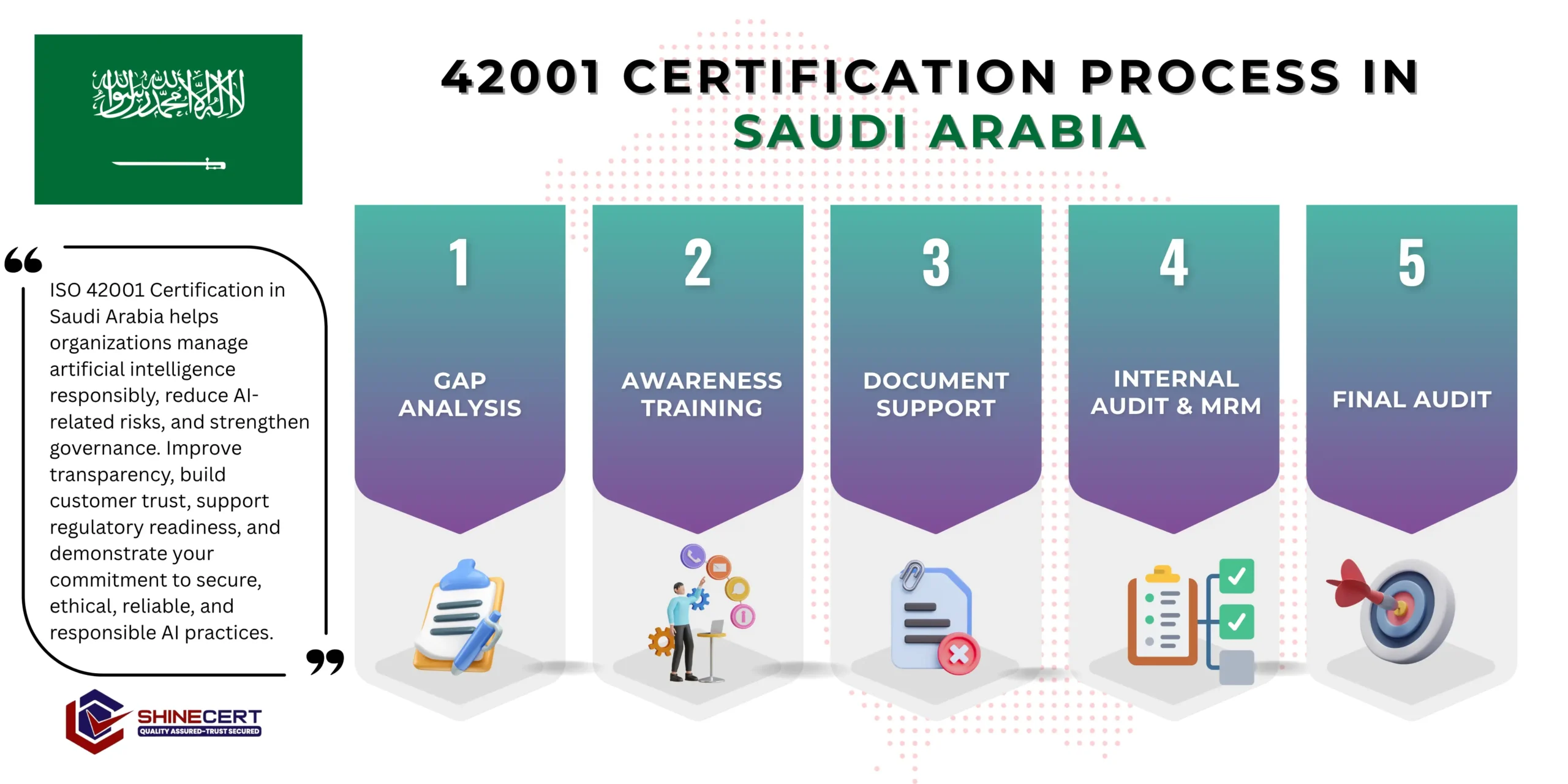
Gap Analysis and AI System Inventory
We assess your current AI governance practices against ISO 42001's requirements and build a comprehensive inventory of your AI systems, their intended purposes, and their risk profiles.
A documented gap analysis and AI system risk inventory scoped to your organization.
Documentation Development
We build your AI policy, governance procedures, and risk assessment framework collaboratively, ensuring alignment with SDAIA's AI ethics principles where relevant to your sector and use cases.
A complete AI management system documentation set, including your AI policy and system-level risk assessments.
Implementation and Training
We roll out governance controls, including bias testing and human oversight mechanisms, and train relevant staff on responsible AI practices specific to your systems.
Documented training records and evidence of governance controls functioning across your AI system lifecycle.
Internal Audit and Management Review
We conduct a rigorous internal audit covering AI governance effectiveness, then facilitate a management review addressing emerging AI risks and governance objective progress.
A documented internal audit report and management review minutes demonstrating leadership engagement with AI governance.
Certification Audit
We coordinate Stage 1 and Stage 2 audits with a certification body holding genuine accredited scope for ISO 42001, verifying this carefully given how limited accredited AI management system audit capacity remains globally as of 2026, then support you through any resulting corrective actions.
Your ISO 42001 certificate and a documented surveillance audit plan.
Gap Analysis and AI System Inventory
We assess your current AI governance practices against ISO 42001's requirements and build a comprehensive inventory of your AI systems, their intended purposes, and their risk profiles.
A documented gap analysis and AI system risk inventory scoped to your organization.
Documentation Development
We build your AI policy, governance procedures, and risk assessment framework collaboratively, ensuring alignment with SDAIA's AI ethics principles where relevant to your sector and use cases.
A complete AI management system documentation set, including your AI policy and system-level risk assessments.
Implementation and Training
We roll out governance controls, including bias testing and human oversight mechanisms, and train relevant staff on responsible AI practices specific to your systems.
Documented training records and evidence of governance controls functioning across your AI system lifecycle.
Internal Audit and Management Review
We conduct a rigorous internal audit covering AI governance effectiveness, then facilitate a management review addressing emerging AI risks and governance objective progress.
A documented internal audit report and management review minutes demonstrating leadership engagement with AI governance.
Certification Audit
We coordinate Stage 1 and Stage 2 audits with a certification body holding genuine accredited scope for ISO 42001, verifying this carefully given how limited accredited AI management system audit capacity remains globally as of 2026, then support you through any resulting corrective actions.
Your ISO 42001 certificate and a documented surveillance audit plan.
What Is ISO 42001?
ISO 42001 is the international standard for artificial intelligence management systems, published by the International Organization for Standardization to help organizations responsibly develop, deploy, and manage AI systems. Rather than regulating specific AI algorithms or technologies, it establishes a management framework requiring organizations to assess AI-related risks, implement governance controls, and demonstrate accountability throughout the AI system lifecycle, from initial development through deployment and ongoing monitoring. The standard addresses issues including AI system transparency, bias management, data governance, and human oversight, reflecting growing global expectations that organizations deploying AI do so with genuine accountability rather than treating AI governance as an afterthought. Certification means an accredited auditor has verified your AI management system meets these requirements, a genuinely new and still-maturing certification landscape as of 2026.
ISO 42001 Certification Cost in Saudi Arabia
Quick answer: ISO 42001 certification in Saudi Arabia typically costs between SAR 25,000 and SAR 110,000, depending on company size and AI system complexity, generally higher than more established standards given the specialized expertise required for AI governance assessment.
- AI system complexity and risk level drive cost significantly : Organizations with multiple high-risk AI systems face more extensive impact assessment and governance implementation work.
- Limited specialized consultant and auditor availability affects cost : As a genuinely new standard, ISO 42001 expertise remains more specialized and less commoditized than established standards.
- Certification body fees are separate from consulting fees : Accredited certification body audit fees for ISO 42001 currently run higher than for more established standards given limited accredited capacity.
- Data governance maturity affects implementation effort : Organizations with existing robust data governance practices need less foundational work than those building data governance and AI governance simultaneously.
- Bundling with ISO 27001 is often efficient : Many AI governance and information security controls overlap, making combined implementation more efficient than pursuing them entirely separately.
Mandatory Documents for ISO 42001
Quick answer: ISO 42001 requires documented information including an AI policy, an AI system inventory with risk classifications, impact assessments for AI systems, and records covering monitoring, internal audits, and management review.
- AI Policy : A documented, top-management-issued policy establishing genuine commitments to responsible AI development and deployment.
- AI System Inventory and Risk Classification : A documented register of AI systems in use or development, with risk levels assigned based on potential impact.
- AI Impact Assessments : Documented assessments of potential risks and impacts for AI systems, particularly those making or supporting consequential decisions affecting individuals.
- Data Governance Documentation : Records addressing data quality, provenance, and governance for AI training and operational data.
- Human Oversight Procedures : Documentation of how human oversight is maintained for AI systems, particularly those with significant autonomy or consequential outputs.
- Bias Testing and Fairness Monitoring Records : Evidence of ongoing testing and monitoring for bias and fairness issues in AI system outputs.
- Internal Audit and Management Review Records : Documented audit findings and management review minutes addressing AI governance performance.
Key Requirements of ISO 42001
ISO 42001 follows a structure similar to other modern ISO management system standards, with substantive requirements focused specifically on AI governance:
- Context of the Organization (Clause 4) : Requires identifying the internal and external issues relevant to your AI systems, including interested parties like SDAIA, customers affected by AI-driven decisions, and regulatory developments as Saudi Arabia’s AI governance framework continues to evolve. Saudi organizations need to clearly define which AI systems and use cases the management system scope covers, since a fintech company using AI for both credit scoring and customer service chatbots faces very different risk profiles requiring different levels of governance rigor.
- Leadership (Clause 5) : Top management must establish an AI policy and ensure genuine accountability for AI system outcomes sits with identified individuals, not diffused across technical teams without clear governance ownership. We’ve found that Saudi organizations building AI governance frameworks for the first time often have highly capable technical AI teams but lack the formal governance structure connecting AI development decisions to business risk accountability, which is precisely what this clause requires.
- Planning (Clause 6) : Requires a structured AI risk assessment covering issues like bias, fairness, transparency, and potential harm from AI system outputs, plus documented objectives for responsible AI development and deployment. This planning process should explicitly reference SDAIA’s published AI ethics principles where relevant, since alignment between your internal risk assessment and Saudi Arabia’s national AI governance direction demonstrates genuine, contextually grounded governance rather than a generic international framework applied without local awareness.
- Support (Clause 7) : Covers resources, competence, and awareness specific to AI governance, including documented evidence that personnel involved in AI system development and deployment have appropriate training in responsible AI practices, not just technical machine learning competence alone.
- Operation (Clause 8) : Requires implementing controls across the AI system lifecycle, including data quality management, bias testing, human oversight mechanisms for consequential AI decisions, and documented processes for third-party AI system or component evaluation, relevant for Saudi organizations building on foundation models or AI services from external providers rather than developing every component in-house.
- Performance Evaluation (Clause 9) : Requires monitoring AI system performance against defined objectives, including fairness and accuracy metrics where relevant, plus internal audit and management review addressing AI governance effectiveness and any emerging risks as AI systems and their deployment contexts evolve.
- Improvement (Clause 10) : Requires structured response to AI system incidents, such as identified bias or unexpected harmful outputs, plus continual improvement of AI governance practices as both the technology and Saudi Arabia’s regulatory environment for AI continue to mature rapidly.
Benefits of ISO 42001 in Saudi Arabia
Relatively few Middle East-based AI companies currently hold this certification, creating genuine competitive advantage with international enterprise customers and investors.
A well-built AI management system demonstrates genuine engagement with Saudi Arabia’s AI ethics principles and national strategy, not just generic international compliance.
Global enterprise buyers increasingly scrutinize AI governance during vendor evaluation, and accredited certification provides structured, verifiable evidence rather than marketing claims.
Systematic bias testing and human oversight requirements genuinely reduce the risk of harmful AI system outcomes affecting customers or business decisions.
AI companies raising capital increasingly face investor questions about responsible AI governance, and certification provides a credible, independently verified answer.
As Saudi Arabia’s formal AI regulatory framework continues developing, organizations with mature ISO 42001 systems are well-positioned to adapt quickly to new requirements.
ISO 42001 Certification Timeline in Saudi Arabia
Phase | Typical Duration |
Gap analysis and AI system inventory | 3–5 weeks |
Documentation development | 6–8 weeks |
Implementation and training | 4–6 weeks |
Internal audit and management review | 2–3 weeks |
Certification audit (Stage 1 + Stage 2) | 4–6 weeks |
Total | 4–7 months |
Industries in Saudi Arabia That Need ISO 42001
Financial services and fintech
AI-driven credit scoring and fraud detection systems face particularly close scrutiny given the consequential nature of financial decisions.
Read moreHealthcare technology
AI-assisted diagnostic and treatment recommendation tools require rigorous governance given direct patient impact.
Read moreTechnology and AI startups
Companies developing AI products for enterprise or government customers increasingly need certification to satisfy buyer due diligence.
Read moreGovernment and smart city initiatives
NEOM and other Vision 2030 giga-projects incorporating AI extensively into operations and services need robust governance frameworks.
Read moreTelecommunications
AI-driven network optimization and customer service applications benefit from structured governance as deployment scales.
Read moreWhy Choose ShineCert for ISO 42001 Certification in Saudi Arabia?
We’re headquartered in Riyadh, giving us direct familiarity with SDAIA’s AI ethics principles and Saudi Arabia’s national AI strategy direction. Our team has guided more than 10,000 organizations through ISO certification globally, with growing specific depth in the emerging AI governance certification landscape as it develops across Saudi Arabia’s technology and financial services sectors.
Choosing an Accredited Certification Body for ISO 42001 in Saudi Arabia?
What to Check | Why It Matters |
Genuine accredited scope for ISO 42001 specifically | Many certification bodies don’t yet hold this accreditation; confirm directly rather than assuming |
SAAC accreditation, or accreditation from another IAF-recognized body | Confirms genuine international recognition once accredited scope is confirmed |
AI and machine learning technical literacy among auditors | Essential for a meaningful assessment of genuinely technical AI governance controls |
Familiarity with SDAIA’s AI ethics principles | Helps ensure certification genuinely supports your broader Saudi AI governance positioning |
Common Challenges with ISO 42001 in Saudi Arabia
- Assuming any certification body can issue ISO 42001 certificates : Accredited scope for AI management systems remains limited globally as of 2026; verify current accreditation status directly before committing.
- Treating AI governance as purely a technical machine learning concern : The standard requires genuine business-level accountability and risk ownership, not just technical bias testing disconnected from governance structure.
- Underestimating third-party AI component risk : Organizations building on external foundation models or AI services often overlook the governance requirements this creates.
- Building documentation disconnected from SDAIA’s national AI direction : Generic AI governance frameworks that don’t reference Saudi Arabia’s specific AI ethics principles miss an opportunity to demonstrate genuinely contextual governance maturity.
Get ISO 42001 Certified in Saudi Arabia
ShineCert supports Saudi businesses building responsible AI governance frameworks, from risk assessment through certification audit. Book a free consultation or contact us directly, and we’ll review your AI systems and governance maturity before proposing a fixed-scope plan.
Frequently Asked Questions
Typically SAR 25,000 to SAR 110,000, depending on company size and AI system complexity.
No, it’s voluntary, though enterprise customer due diligence and alignment with SDAIA’s national AI direction increasingly make it a practical advantage.
Typically four to seven months from kickoff to certificate.
No, accredited scope for AI management systems remains limited globally; always verify current accreditation before choosing a provider.
No, it complements them with a certifiable management framework, but organizations should still track SDAIA’s evolving guidance directly.
Yes, the standard addresses governance for AI systems you deploy or rely on, including third-party components, not just AI you develop in-house.
Yes, Riyadh is one of ShineCert’s genuine physical offices, alongside Lebanon and India.