
GDPR Certification in Saudi Arabia
Quick Answer
GDPR compliance is important to frame accurately for Saudi businesses: it’s not a certification you obtain, but a legal compliance obligation under EU law that applies to your Saudi business only if you offer goods or services to individuals in the EU, monitor the behavior of individuals in the EU, or otherwise process personal data connected to EU data subjects, regardless of your business being based in Saudi Arabia. If GDPR applies to your operations, Saudi Arabia’s own Personal Data Protection Law (PDPL), enforced by the Saudi Data and AI Authority (SDAIA), covers your domestic obligations, meaning many Saudi businesses handling EU customer data need to navigate both frameworks simultaneously. Budget roughly SAR 15,000 to SAR 70,000 for compliance assessment and implementation support depending on data processing complexity, with ongoing compliance maintenance as an ongoing operational responsibility rather than a one-time project.
Why GDPR Compliance Matters for Saudi Arabia Businesses?
Saudi Arabia’s growing role in international e-commerce, fintech, tourism, and business services means an increasing number of Saudi companies genuinely interact with EU customers or process EU-connected personal data, whether through direct e-commerce sales to European customers, tourism and hospitality services marketed to European travelers, or business relationships with EU-based partners and clients. For these businesses, GDPR isn’t a theoretical foreign regulation but a genuine legal exposure carrying substantial potential penalties, making accurate assessment of whether and how GDPR applies a critical first step, rather than either ignoring the question entirely or assuming broad, costly compliance obligations that may not actually apply to your specific business activities.
Saudi Arabia’s own Personal Data Protection Law (PDPL) shares meaningful conceptual overlap with GDPR, both reflecting similar global trends in comprehensive data protection regulation, but the two frameworks have distinct specific requirements, meaning Saudi businesses genuinely subject to both need a coordinated compliance approach rather than assuming PDPL compliance automatically satisfies GDPR obligations, or vice versa.
What Is GDPR?
- The General Data Protection Regulation (GDPR) is the European Union’s comprehensive data protection law, governing how organizations collect, process, store, and transfer personal data belonging to individuals within the EU. Its extraterritorial scope means GDPR can apply to businesses located entirely outside the EU, including Saudi Arabia, if those businesses offer goods or services to EU individuals or monitor their behavior, a distinction many non-EU businesses initially misunderstand, assuming GDPR only applies to companies with an actual EU physical presence.
- GDPR establishes specific requirements around lawful bases for processing, data subject rights including access and deletion requests, breach notification within strict timeframes, and significant restrictions on transferring personal data outside the EU without appropriate safeguards. Unlike ISO certifications, there’s no accredited “GDPR certification” issued by a national accreditation body; compliance is a legal obligation assessed through regulatory enforcement and, for organizations wanting independent verification, various compliance assessment and attestation services, though these differ from the accredited certification model ISO standards use.
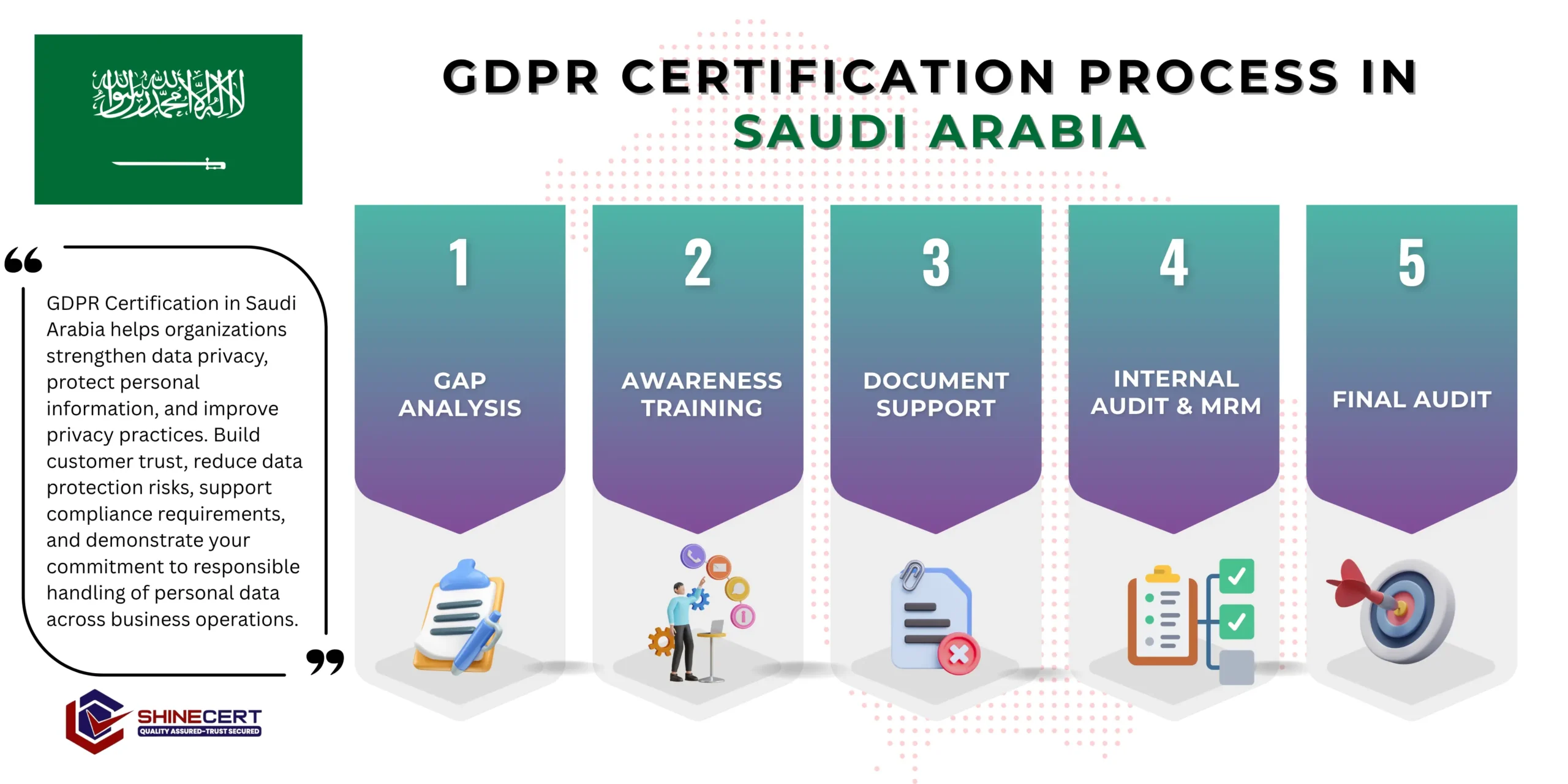
What are the steps to get GDPR Certification in Saudi Arabia?
our services
- ISO Certification Saudi Arabia
- ISO 9001 Certification Saudi Arabia
- ISO 14001 Certification Saudi Arabia
- ISO 27001 Certification Saudi Arabia
- ISO 22000 Certification Saudi Arabia
- ISO 27701 Certification Saudi Arabia
- ISO 45001 Certification Saudi Arabia
- ISO 20000-1 Certification Saudi Arabia
- ISO 13485 Certification Saudi Arabia
- ISO 17025 Certification Saudi Arabia
- ISO 31000 Certification Saudi Arabia
- ISO 42001 Certification Saudi Arabia
- ISO 37001 Certification Saudi Arabia
- ISO 22301 Certification Saudi Arabia
- ISO 50001 Certification Saudi Arabia
- CE Mark Certification Saudi Arabia
- GDPR Certification Saudi Arabia
- GMP Certification Saudi Arabia
- Halal Certification Saudi Arabia
- SOC Certification Saudi Arabia
major citys
ShineCert’s GDPR Compliance Guidance Process for Saudi Businesses
Applicability Assessment
We assess whether and how GDPR genuinely applies to your specific business activities, avoiding both under- and over-assumption of compliance scope.
A documented GDPR applicability assessment specific to your business activities and EU data exposure.
Gap Analysis Against Both PDPL and GDPR
We assess your current data protection practices against both frameworks where applicable, identifying genuine gaps and areas of overlap that streamline combined compliance.
A documented gap analysis addressing both PDPL and GDPR requirements where relevant.
Documentation and Process Development
We help you build lawful basis documentation, data subject rights procedures, and transfer safeguard mechanisms addressing both frameworks coherently.
A complete data protection compliance documentation set addressing both PDPL and GDPR requirements.
Implementation and Training
We support rolling out data subject rights processes, breach response procedures, and transfer safeguards, training relevant staff on both frameworks' requirements.
Documented training records and evidence of functioning data subject rights and breach response processes.
Ongoing Compliance Support
We help establish ongoing monitoring and review processes ensuring continued compliance as your business activities and both regulatory frameworks evolve.
A documented ongoing compliance monitoring and review schedule.
Applicability Assessment
We assess whether and how GDPR genuinely applies to your specific business activities, avoiding both under- and over-assumption of compliance scope.
A documented GDPR applicability assessment specific to your business activities and EU data exposure.
Gap Analysis Against Both PDPL and GDPR
We assess your current data protection practices against both frameworks where applicable, identifying genuine gaps and areas of overlap that streamline combined compliance.
A documented gap analysis addressing both PDPL and GDPR requirements where relevant.
Documentation and Process Development
We help you build lawful basis documentation, data subject rights procedures, and transfer safeguard mechanisms addressing both frameworks coherently.
A complete data protection compliance documentation set addressing both PDPL and GDPR requirements.
Implementation and Training
We support rolling out data subject rights processes, breach response procedures, and transfer safeguards, training relevant staff on both frameworks' requirements.
Documented training records and evidence of functioning data subject rights and breach response processes.
Ongoing Compliance Support
We help establish ongoing monitoring and review processes ensuring continued compliance as your business activities and both regulatory frameworks evolve.
A documented ongoing compliance monitoring and review schedule.
GDPR, PDPL, and the Practical Reality for Saudi Businesses
- We consistently find that Saudi businesses fall into one of two problematic patterns regarding GDPR: either ignoring it entirely because they’re based in Saudi Arabia, not recognizing GDPR’s extraterritorial reach, or becoming overly anxious about broad GDPR compliance obligations without first conducting a genuine, careful assessment of whether and how it actually applies to their specific business activities.
- The more productive approach we recommend is starting with an honest, conservative applicability assessment specific to your actual EU customer relationships and data flows, then building a coordinated compliance approach addressing both PDPL’s domestic requirements and any genuine GDPR exposure together, rather than treating them as entirely separate compliance projects that duplicate effort and create confusing, potentially conflicting internal data handling practices.
GDPR Compliance Cost for Saudi Businesses
Quick answer: GDPR compliance assessment and implementation support for Saudi businesses typically costs between SAR 15,000 and SAR 70,000, depending on data processing complexity and the extent of EU data exposure, with businesses processing significant EU customer data generally costing more.
- EU data exposure scope drives cost significantly : Businesses with extensive EU customer relationships need more comprehensive compliance work than those with limited, incidental EU contact.
- Existing PDPL compliance maturity reduces incremental cost : Businesses already compliant with PDPL need less foundational work when extending compliance to GDPR’s specific additional requirements.
- Data transfer complexity affects cost : Businesses with significant EU-to-Saudi Arabia data transfers need more extensive transfer safeguard documentation.
- No certification body fees apply : Since GDPR compliance isn’t a certifiable ISO-style standard, costs are limited to assessment and implementation support.
- Ongoing compliance maintenance is a separate, typically smaller ongoing engagement : Initial assessment and implementation represent the larger cost component.
Key Documentation for GDPR Compliance
Quick answer: GDPR compliance requires documentation including a data processing inventory identifying EU data subject processing, lawful basis documentation, data subject rights procedures, transfer safeguard mechanisms, and breach response procedures.
- Data Processing Inventory : A documented mapping of personal data processing activities involving EU data subjects, including data categories and purposes.
- Lawful Basis Documentation : Records identifying and justifying the legal basis for each processing activity involving EU data subjects.
- Privacy Notices : Clear, accessible documentation informing EU data subjects how their data is processed.
- Data Subject Rights Procedures : Documented processes for handling access, deletion, and other data subject rights requests within GDPR’s specific timeframes.
- Transfer Safeguard Documentation : Standard Contractual Clauses or other appropriate mechanisms safeguarding transfers of EU personal data to Saudi Arabia.
- Breach Response Procedures : Documented processes for detecting, assessing, and reporting personal data breaches within GDPR’s 72-hour notification timeframe where applicable.
Key Requirements Under GDPR
GDPR compliance requirements center on several core areas relevant to Saudi businesses with EU data exposure:
- Applicability Assessment : Before addressing specific requirements, Saudi businesses need genuine clarity on whether GDPR applies to their operations at all, based on whether they offer goods or services to EU individuals or monitor EU individual behavior, not simply whether they have any EU contact whatsoever. This assessment should be conducted carefully, since both over-assuming and under-assuming GDPR applicability create genuine problems, either unnecessary compliance cost or genuine legal exposure.
- Lawful Basis for Processing : GDPR requires a valid legal basis for processing personal data, such as consent, contractual necessity, or legitimate interest, documented for each processing activity involving EU data subjects. Saudi businesses need to identify and document the specific lawful basis applicable to each way they process EU customer or partner data.
- Data Subject Rights : GDPR grants EU individuals specific rights including access to their data, correction, deletion, and data portability, requiring Saudi businesses with GDPR exposure to establish genuine, functioning processes for receiving and responding to these requests within GDPR’s specific timeframes.
- Privacy Notices and Transparency : Organizations must provide clear, accessible information to EU data subjects about how their personal data is processed, requiring Saudi businesses to ensure privacy notices genuinely meet GDPR’s specific transparency requirements, not just general privacy policy language.
- Data Transfer Safeguards : Since Saudi Arabia isn’t among the jurisdictions the EU has granted “adequacy” status for data protection, Saudi businesses transferring personal data from the EU to Saudi Arabia need appropriate transfer safeguards, such as Standard Contractual Clauses, a genuinely important technical compliance requirement often overlooked.
- Breach Notification : GDPR requires notification of certain personal data breaches to relevant supervisory authorities within 72 hours of becoming aware, and in some cases, notification to affected individuals, requiring Saudi businesses to have genuinely functioning incident detection and response processes, not just a policy stating breaches will be reported.
- Data Protection Officer and Accountability : Depending on the scale and nature of processing, GDPR may require designating a Data Protection Officer, and in all cases requires demonstrable accountability, meaning documented evidence of compliance efforts, not just good-faith intentions.
Common Challenges with GDPR Compliance for Saudi Businesses
- Misjudging GDPR applicability : Both assuming GDPR doesn’t apply without genuine assessment, and assuming broad applicability without careful analysis, create real problems.
- Treating PDPL and GDPR as identical : They share conceptual similarities but have distinct specific requirements needing coordinated, not assumed-equivalent, compliance treatment.
- Overlooking data transfer safeguard requirements : Saudi Arabia’s lack of EU adequacy status makes transfer safeguards a genuinely important, sometimes overlooked compliance element.
- Underestimating breach notification timeline pressure : GDPR’s 72-hour notification requirement demands genuinely functioning, tested incident response processes, not theoretical procedures.
GDPR Compliance Benefits for Saudi Businesses
Genuine compliance reduces exposure to GDPR’s substantial potential penalties for Saudi businesses genuinely subject to its requirements.
Demonstrated GDPR compliance supports business relationships with EU customers and partners increasingly attentive to data protection practices.
A well-designed approach addressing both frameworks together avoids duplicated, disconnected compliance efforts.
The compliance process often improves broader data governance practices valuable independent of specific regulatory requirements.
GDPR-driven incident response planning genuinely improves breach detection and response capability.
Data protection compliance maturity increasingly matters for Saudi businesses expanding into other markets with comprehensive privacy regulation.
GDPR Compliance Timeline for Saudi Businesses
Quick answer: GDPR compliance assessment and implementation for Saudi businesses typically takes two to five months from kickoff to a functioning compliance program, with ongoing compliance maintenance continuing indefinitely as an operational responsibility.
Phase | Typical Duration |
Applicability assessment | 1–2 weeks |
Gap analysis against PDPL and GDPR | 2–4 weeks |
Documentation and process development | 4–6 weeks |
Implementation and training | 3–4 weeks |
Total to functioning compliance program | 2–5 months |
Saudi Businesses That Typically Need GDPR Compliance Assessment
E-commerce and retail
Saudi online retailers selling to EU customers face direct GDPR applicability given their EU customer relationships.
Read moreTourism and hospitality
Businesses marketing services to European travelers or processing European guest data face GDPR exposure.
Read moreFintech and financial services
Companies processing payments or financial data connected to EU individuals face particular GDPR scrutiny given data sensitivity.
Read moreTechnology and SaaS
Saudi technology companies serving EU business customers or processing EU user data face processor or controller obligations under GDPR.
Read moreProfessional and consulting services
Firms with EU clients or partners handling EU-connected personal data need to assess their specific GDPR exposure.
Read moreWhy Choose ShineCert for GDPR Compliance Guidance in Saudi Arabia?
We’re headquartered in Riyadh, giving us direct familiarity with PDPL’s requirements and the practical reality of Saudi businesses navigating EU data protection exposure. Our team has guided more than 10,000 organizations through international certification and compliance globally, with growing depth helping Saudi businesses coordinate PDPL and General Data Protection Regulation (GDPR) compliance.
Choosing GDPR Compliance Support for Saudi Businesses?
What to Check | Why It Matters |
Genuine understanding that GDPR isn’t a certifiable standard | Be cautious of any provider offering “GDPR certification,” which misrepresents how GDPR compliance actually works |
Coordinated PDPL and GDPR expertise | Essential for Saudi businesses needing to navigate both frameworks coherently |
Accurate, conservative applicability assessment | Ensures you neither over-invest in unnecessary compliance nor under-address genuine legal exposure |
Practical experience with EU data transfer mechanisms | Relevant for businesses with genuine ongoing EU-to-Saudi Arabia data flows |
Get GDPR Compliance Guidance for Your Saudi Business
ShineCert helps Saudi businesses navigate both PDPL and GDPR compliance where their operations touch EU data. Book a free consultation or contact us directly, and we’ll assess your actual EU exposure before proposing a fixed-scope plan.
Frequently Asked Questions
Only if you offer goods or services to EU individuals, monitor EU individual behavior, or otherwise process personal data connected to EU data subjects; a genuine assessment is needed rather than assuming either way.
Typically SAR 15,000 to SAR 70,000, depending on data processing complexity and EU data exposure.
No, GDPR is a legal compliance obligation, not a certifiable standard; be cautious of any provider claiming to offer accredited GDPR certification.
Typically two to five months to establish a functioning compliance program, with ongoing maintenance continuing indefinitely.
No, the frameworks share conceptual similarities but have distinct specific requirements needing coordinated compliance.
GDPR carries substantial potential penalties for non-compliant organizations, regardless of their location outside the EU.
Yes, Riyadh is one of ShineCert’s genuine physical offices, alongside Lebanon and India.