
ISO 45001 Certification in Uganda
Quick Answer
ISO 45001 certifies that a business has a structured, independently verified occupational health and safety management system, a genuinely different thing from workplace registration under Uganda’s Occupational Safety and Health Act, 2006, which is a legal registration issued by the Commissioner of Occupational Safety and Health rather than an ISO certification. The Ministry of Gender, Labour and Social Development administers workplace safety law and enforcement, but ISO 45001 certification itself comes through an accredited, independent certification body. The standard carries real, current weight in Uganda because in late April 2026 President Museveni assented to the Employment (Amendment) Act, which introduced new employer duties including mandatory workplace risk assessments, written OSH policies, personal protective equipment provision, and incident reporting to MGLSD within prescribed timeframes, backed by increased penalties and the possibility of criminal prosecution for serious breaches. Certification typically takes three to six months, and cost depends on real factors like your organization’s size, sector, and existing safety practices.
Understanding ISO 45001: What It Actually Is, and Why It Matters in Uganda
ISO 45001 is published by the International Organization for Standardization and sets out requirements for an occupational health and safety management system: a structured way of identifying workplace hazards, assessing the risks they carry, and building the controls and monitoring needed to keep workers genuinely safe over time. It covers everything from hazard identification and risk assessment, to worker consultation and participation, to how incidents get investigated and prevented from recurring. Certification means an accredited, independent auditor has formally verified this system is real and functioning, not a binder of policies nobody on the floor has actually seen.
Why this carries specific weight in Uganda comes down to both the scale of the existing problem and a genuinely tightening regulatory response. Ministry of Gender, Labour and Social Development data shows more than 60% of all occupational accidents in the country occur in Kampala district alone, with injury rates that construction-sector research has documented in detail, one Kampala-focused study found occupational injury prevalence among building construction workers at 32.4%, with over 80% of surveyed sites operating without a written safety and health policy and nearly a third of workers purchasing their own personal protective equipment because employers hadn’t provided it. The April 2026 Employment (Amendment) Act directly targets these gaps, making written OSH policies, documented risk assessments, and PPE provision legal requirements with real enforcement teeth behind them for the first time.
Benefits of ISO 45001 Certification for Ugandan Organizations
Here’s what certified Ugandan businesses actually gain from ISO 45001, explained in full rather than as a one-line summary:
The Act’s new requirements for written OSH policies, documented risk assessments, and incident reporting map almost exactly onto what ISO 45001 already requires, meaning certified businesses are structurally ahead of a compliance deadline that’s catching many employers off guard.
Given documented injury rates as high as 32.4% among Kampala construction workers, a genuine hazard identification and control system directly reduces the incidents that drive lost workdays, compensation claims, and reputational damage.
Government infrastructure tenders and private-sector contracts in construction, manufacturing, and logistics increasingly require documented safety management evidence as part of vendor evaluation, particularly following the heightened regulatory attention on workplace safety.
With the 2026 amendments introducing increased penalties and the possibility of criminal prosecution for serious breaches, a certified system gives a business documented, auditable evidence of genuine compliance effort rather than exposure built on informal practice.
International buyers, particularly in manufacturing and agricultural export supply chains, increasingly conduct social compliance audits that overlap heavily with ISO 45001 requirements, making certification a practical shortcut through buyer-side safety scrutiny.
Workers who see genuine, documented safety investment, proper PPE, real hazard controls, a functioning incident reporting process, are demonstrably more likely to stay, reducing the cost and disruption of constant turnover in physically demanding sectors.
Before certification, safety is often treated as an individual supervisor’s informal responsibility. ISO 45001 requires named roles, defined responsibilities, and leadership sign-off on safety objectives, removing the ambiguity about who actually owns a safety gap when one surfaces.
Informal safety practices that work for a small crew break down as a business adds shifts, sites, or subcontractors, a certified system is built to scale alongside genuine operational growth.
Businesses that later pursue ISO 14001 or ISO 9001 find that the risk assessment discipline, document control habits, and management review cycles built for ISO 45001 carry over directly, meaningfully shortening the path to the next certification.
What are the steps to get ISO 45001 Certification in Uganda?
our services
- ISO Certification Uganda
- ISO 9001 Certification Uganda
- ISO 14001 Certification Uganda
- ISO 27001 Certification Uganda
- ISO 22000 Certification Uganda
- ISO 27701 Certification Uganda
- ISO 45001 Certification Uganda
- ISO 20000-1 Certification Uganda
- ISO 13485 Certification Uganda
- ISO 17025 Certification Uganda
- ISO 31000 Certification Uganda
- ISO 42001 Certification Uganda
- ISO 37001 Certification Uganda
- ISO 22301 Certification Uganda
- ISO 50001 Certification Uganda
- CE Mark Certification Uganda
- GDPR Certification Uganda
- GMP Certification Uganda
- Halal Certification Uganda
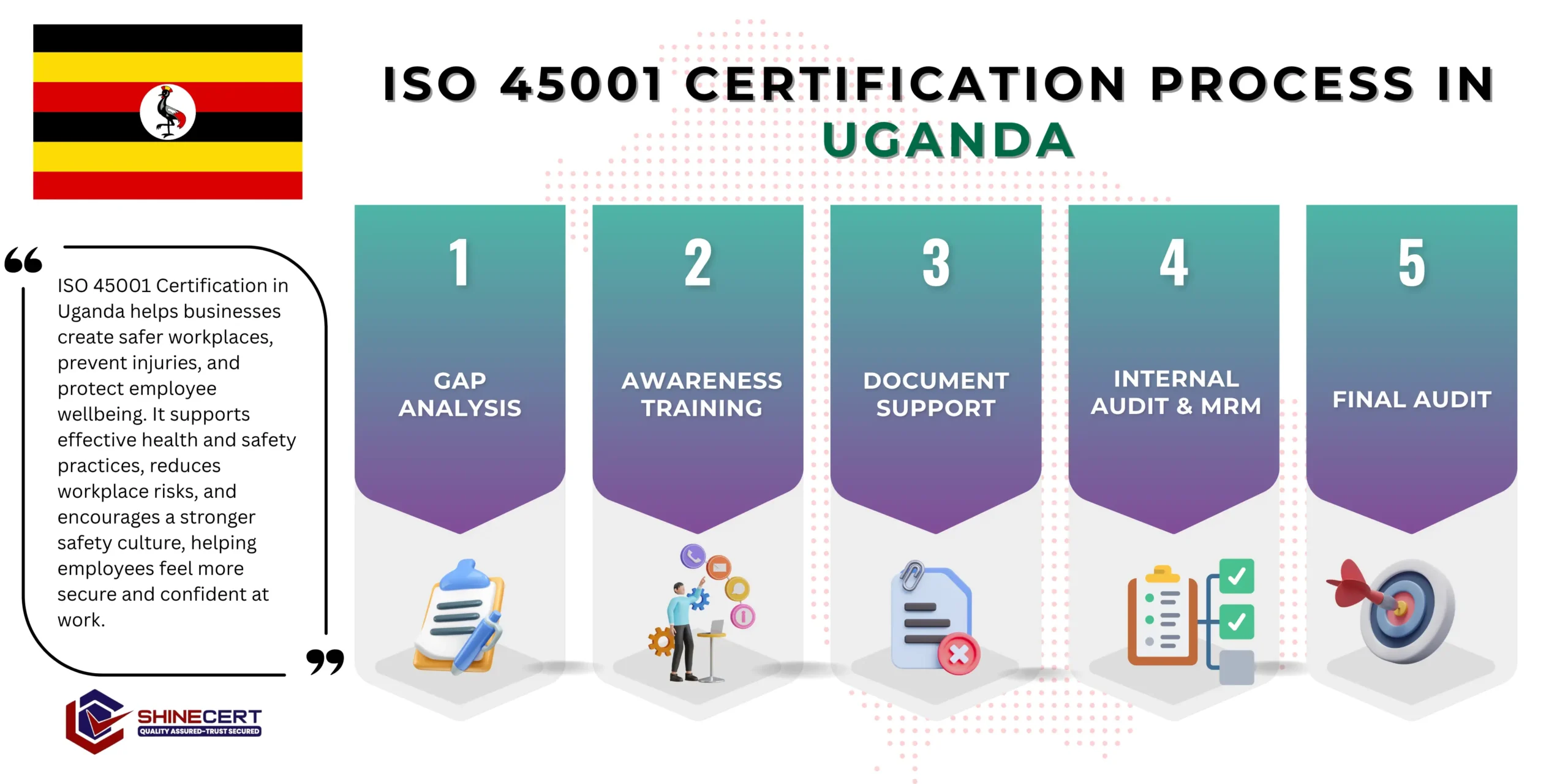
ISO 45001 Certification Process in Uganda
Getting certified is a five-stage journey, and understanding what actually happens at each stage makes the difference between a smooth certification and a stressful one.
Gap Assessment
This is where we walk through your actual site, production floor, construction area, warehouse, and compare what we find against what ISO 45001 genuinely requires, and against the specific new duties the 2026 Employment Amendment Act introduces.
A Kampala construction site and a Jinja manufacturing floor face very different genuine hazards, and the assessment reflects that.
A written gap report that becomes the roadmap for everything that follows.
Documentation
This stage builds the OH&S policy, the hazard identification and risk assessment register, and every operational procedure your business genuinely needs, written to reflect your actual hazards rather than generic template language.
A complete, genuinely usable OH&S documentation set, including the written policy and risk assessments the 2026 law now requires.
Implementation
Documentation on paper means nothing until it’s actually how your business runs.
This stage trains staff on new procedures, ensures PPE is genuinely provided and used, and begins real incident and near-miss logging.
A functioning safety management system with weeks of real operational data behind it.
Internal Audit and Management Review
Before any external auditor sees your system, we test it ourselves, clause by clause, looking specifically for the gaps a certification auditor, or an MGLSD labour inspector, would flag.
A list of corrective actions, already closed out, before the real audit begins.
Certification Audit
Stage 1 is a documentation review confirming your system is ready to be tested.
Stage 2 is the real test, the auditor is physically present, reviewing your actual records and watching your actual site practices.
Your ISO 45001 certificate, valid for three years, and a clear schedule for the surveillance audits that follow.
Staying Certified: Surveillance and Renewal
An ISO 45001 certificate runs for three years, with annual surveillance audits in years one and two reviewing whether your safety management system is genuinely still functioning. A full recertification audit at the three-year mark determines whether the certificate continues. Given the newly increased penalties under the 2026 employment law amendments, we recommend treating surveillance audits as a genuine operational checkpoint, since a system that’s allowed to lapse between audits is exactly the kind of gap that now carries real legal consequences.
Realistic Timelines for Ugandan Businesses
| Business Profile | Typical Total Timeline | What Drives This |
|---|---|---|
| Small business, single location | 2.5–3.5 months | Narrower hazard scope and simpler documentation |
| Medium business, multiple sites or shifts | 3.5–5.5 months | Broader hazard exposure across sites and shifts |
| Larger or high-hazard business | 5.5–8 months | Extensive hazard scope, subcontractor management, and site complexity |
ISO 45001 Certification Cost in Uganda
- There’s no flat price for ISO 45001 certification in Uganda, because cost genuinely tracks a specific set of factors rather than a fixed fee schedule. Headcount matters, since a larger workforce means more people to train on safety procedures and more roles to define within the management system, but the number of departments and distinct hazard categories in scope matters just as much, a business managing several genuinely different hazard types, such as machinery, chemicals, and working at height, needs a broader risk register than one with a single, well-defined hazard profile.
- The nature of the business is often the single biggest cost driver for this particular standard. Construction, manufacturing, and logistics carry meaningfully higher hazard complexity, and therefore deeper documentation needs, than a professional services firm whose main physical risk is office ergonomics; the documented injury rates in Kampala’s construction sector specifically reflect why this sector in particular needs a more thorough system. The number of locations and the use of subcontractors both add cost in a similar way, since each site and each subcontractor relationship typically needs its own risk assessment and its own share of internal audit coverage.
- How much safety documentation already exists also shapes the timeline and therefore the cost, businesses that already hold OSH Act workplace registration and have begun responding to the 2026 amendment’s new requirements aren’t starting from a blank page. Certification body fees sit outside all of this: whichever accredited body actually conducts your audit sets and bills that fee directly, and it is never bundled into our quote. Finally, businesses combining ISO 45001 with ISO 14001 or ISO 9001 share real documentation groundwork across the two projects, which brings the combined cost down compared to running them separately.
Where Certification Matters Most Across Uganda’s Economy?
Construction
Construction carries the most direct and urgent relevance for this standard, given documented injury prevalence as high as 32.4% among Kampala building construction workers and the sector’s well-established pattern of missing written safety policies and inconsistent PPE provision.
Read moreManufacturing
Manufacturing follows closely, given genuine machinery, chemical handling, and process-line hazards that the new 2026 legal duties now require to be formally assessed and documented.
Read moreLogistics and Transport
Logistics and transport businesses managing loading, warehousing, and vehicle operations face real hazard exposure that a certified system directly addresses, particularly as fleet and warehouse incidents are among the categories MGLSD’s new incident reporting duty specifically targets.
Read moreAgro-processing
Agro-processing operations handling heavy equipment, chemical treatments, and manual material handling carry genuine safety exposure alongside their environmental and quality considerations.
Read moreHealthcare and Hospitality
Healthcare facilities managing needle-stick and biohazard risk, and hospitality operators managing kitchen and maintenance hazards, round out the sectors where a certified system addresses a specific, documented operational risk rather than a generic compliance checkbox.
Read moreA Ugandan Business We’ve Worked With
- A mid-sized construction contractor based in Kampala approached us shortly after the 2026 Employment (Amendment) Act was passed, concerned that its existing informal safety practices wouldn’t hold up against the new written-policy and risk-assessment requirements.
- Our gap assessment found the company had genuinely competent site supervisors with real safety knowledge, but nothing was documented, no written OH&S policy, no formal risk assessments, and PPE provision that varied significantly from site to site depending on which supervisor was in charge.
- We built a documented OH&S management system covering the policy, a site-by-site hazard and risk register, and a standardized PPE provision and incident reporting process. Certification took just over five months, and the company was able to demonstrate documented compliance with the new legal requirements well ahead of MGLSD’s enforcement rollout.
- We see this pattern often enough to name it directly: businesses with genuinely capable people on the ground who had never formalized the safety knowledge those people already carried, this describes a recurring situation, not one specific client.
The Documentation MGLSD-Conscious Auditors Expect, Clause by Clause
- Clause 4 — Context of the Organization : Document: Scope of the OH&S Management System Statement. A written boundary defining exactly which sites, activities, and workers your safety management system covers.
- Clause 5 — Leadership and Worker Participation : Document: OH&S Policy. Top management’s signed commitment to worker safety and legal compliance, genuinely reflecting how the business actually operates. Document: Worker Consultation Records. Evidence that workers genuinely participated in hazard identification and safety planning, not just received instructions from above.
- Clause 6 — Planning : Document: Hazard Identification and Risk Assessment Register. A record identifying every genuine workplace hazard and the risk each one carries, directly satisfying the new 2026 legal requirement for documented risk assessments. Document: Legal and Other Requirements Register. A living record of every OSH Act provision and MGLSD requirement that applies to your specific operations.
- Clause 7 — Support : Document: Competence and Training Records. Evidence workers have the safety training their role genuinely requires. Document: PPE Provision Records. Documented evidence PPE was actually provided by the employer, directly addressing a documented gap in Uganda’s construction sector.
- Clause 8 — Operation : Document: Operational Control Procedures. Documented procedures for how hazardous activities are actually managed day to day. Document: Emergency Preparedness and Response Procedure. A tested plan for workplace incidents, not a document that’s never been rehearsed.
- Clause 9 — Performance Evaluation : Document: Internal Audit Records. Evidence the internal audit schedule was actually carried out against every clause. Document: Incident Investigation Records. A functioning process for investigating incidents and near-misses, feeding directly into the incident reporting the 2026 amendments now require.
- Clause 10 — Improvement : Document: Corrective Action Records. A functioning log tracking safety issues from discovery through to genuinely closed corrective action.
ISO 45001 Certification Across Uganda’s Business Hubs
ISO 45001 in Kampala
ISO 45001 in Jinja
ISO 45001 in Mbarara
ISO 45001 in Entebbe
ISO 45001 in Gulu
The Real Challenges Organizations Face While Implementing ISO 45001
Getting certified is rarely blocked by a lack of willingness, it’s the practical, day-to-day implementation work that trips organizations up. Here’s what we actually see Ugandan businesses struggle with:
- Risk assessments get done informally in supervisors’ heads, never on paper : Many site supervisors genuinely know where the hazards are, but translating that tacit knowledge into a formal, documented risk assessment the new law and ISO 45001 both require takes real, dedicated effort that’s easy to underestimate.
- PPE provision is inconsistent across sites and shifts : It’s common for PPE to be reliably available on one site or shift and quietly absent on another, which is exactly the kind of inconsistency documented in Kampala construction research and exactly what an auditor will probe.
- Worker consultation gets treated as a formality rather than genuine participation : ISO 45001 specifically requires evidence that workers were genuinely consulted on hazards affecting them, not just informed of decisions made without them, a distinction some businesses initially underestimate.
- Incident reporting culture discourages honest reporting : Where near-misses or minor incidents have historically been quietly handled rather than logged, building a genuine reporting culture, one where workers trust that reporting won’t be punished, takes real, sustained effort beyond just writing a procedure.
- Subcontractor safety management gets overlooked : Businesses that rely heavily on subcontractors often have solid internal safety practices but no formal process for verifying subcontractor safety compliance, which is a genuine gap in construction and logistics operations specifically.
Why Businesses Choose ShineCert in Uganda?
ShineCert brings 10 years of ISO consulting and certification experience to Uganda’s market, coordinated through our Riyadh and India offices with services delivered remotely or on-site depending on what your engagement genuinely needs. We’ve guided more than 10,000 organizations through ISO certification worldwide, and as the best ISO 45001 consultant in Uganda, ShineCert builds every safety engagement around your actual site conditions, hazard profile, and the specific new duties the 2026 employment law amendments introduce.
Choosing a Certification Body in Uganda?
What to Check | Why It Matters |
Accreditation under a recognized international framework | Confirms the certificate carries genuine weight with regulators, buyers, and insurers alike |
Genuine understanding of the OSH Act and 2026 amendments versus accredited ISO certification | Ensures the auditor can clearly explain how legal registration and ISO certification relate to your business |
Experience with your specific sector’s hazard profile | Construction, manufacturing, and logistics carry genuinely different safety considerations |
Recognition by your target buyers or insurers | Some international buyers and insurers have specific certification body preferences worth confirming early |
Ready to Get Started?
Whether you’re responding to the new 2026 employment law duties or building a safety system into a new site from the start, we’ll walk through your specific hazards and cost factors before proposing a fixed-scope plan, delivered remotely, on-site, or however genuinely fits your project. Book a free consultation or contact us directly to get started.
Frequently Asked Questions
Look for genuine understanding of the OSH Act and 2026 amendments versus accredited ISO certification, sector-specific hazard experience, and honest scoping before pricing. ShineCert scopes every Uganda engagement individually.
No. MGLSD administers workplace registration and enforcement under the OSH Act, but accredited ISO 45001 certification comes through an independent, accredited certification body.
It depends on your number of employees, departments, hazard profile, and existing safety documentation, we scope every project individually.
Typically two and a half to eight months depending on organization size and hazard complexity.
ISO 45001’s documentation requirements map closely onto the Act’s new duties for written policies, risk assessments, and incident reporting, though the legal registration itself remains a separate MGLSD process.
Documentation work runs fine remotely, but site audits and hazard verification genuinely need in-person visits.
Not a standalone one, we coordinate Uganda engagements from our Riyadh and India offices, with services delivered remotely or on-site as your project requires.