
GMP Certification in Uganda
Quick Answer
GMP certification confirms that a manufacturing facility follows Good Manufacturing Practice: documented, independently verified controls over production, hygiene, and quality that keep a pharmaceutical or food product safe and consistent every time it’s made. In Uganda, the National Drug Authority requires locally produced medicines to meet international GMP standards, following its own Guidelines on Good Manufacturing Practice for Medicinal Products, with local manufacturers inspected at least twice a year and required to submit full manufacturing and quality documentation in CTD format for registration. The opportunity here is genuinely significant: as of recent counts, Uganda had only six GMP-compliant facilities and six local drug manufacturers producing NDA-registered drugs, with roughly 90% of medicines still imported from countries like India and China. Certification typically takes four to eight months, and cost depends on real factors like your organization’s size, product category, and existing manufacturing infrastructure.
Understanding GMP: What It Actually Is, and Why It Matters in Uganda
Good Manufacturing Practice is a set of quality assurance principles ensuring products are consistently produced and controlled according to defined quality standards, covering everything from raw material sourcing and facility hygiene, to equipment validation, to how a batch gets documented and traced if something goes wrong. GMP certification means an accredited body or regulator has formally verified these controls are genuinely in place and functioning, not a quality manual written to satisfy a one-time inspection.
Why this carries specific weight in Uganda comes down to a genuinely stark local manufacturing gap sitting alongside real government intent to close it. With only a handful of GMP-compliant facilities producing NDA-registered drugs domestically and the overwhelming majority of medicines imported, Uganda’s pharmaceutical manufacturing sector has enormous room to grow, but that growth depends entirely on manufacturers being able to genuinely meet NDA’s GMP guidelines, which explicitly require compliance with WHO GMP standards, twice-yearly inspections, and complete CTD-format documentation. For a business willing to make the genuine investment GMP certification requires, this gap represents a real, current opportunity to capture domestic market share currently going to imports.
Benefits of GMP Certification for Ugandan Organizations
Here’s what certified Ugandan manufacturers actually gain from GMP certification, explained in full rather than as a one-line summary:
With roughly 90% of Uganda’s medicines imported, a certified local manufacturer has genuine room to capture market share simply by offering a locally produced, equally reliable alternative, something the current small pool of GMP-compliant facilities can’t fully address alone.
Since GMP compliance is a prerequisite for NDA registration of locally produced medicines, certification isn’t optional if you want to legally sell a domestically manufactured pharmaceutical product in Uganda at all.
Rather than scrambling before each scheduled inspection, a certified system means your facility genuinely operates to GMP standards year-round, making inspections a confirmation rather than a stressful pass-or-fail event.
As Uganda actively works to grow local pharmaceutical manufacturing capacity, certified manufacturers are better positioned to access government incentives or development partner support aimed at reducing import dependence.
Government health facilities and development-funded health programs increasingly prefer or require GMP-certified local suppliers as part of broader efforts to build domestic pharmaceutical resilience.
A certified system requires genuine batch documentation and traceability, meaning a quality issue can be traced and contained quickly rather than triggering a costly, reputation-damaging blanket recall.
A GMP-certified Ugandan manufacturer is better positioned to pursue export opportunities within the East African Community and beyond, rather than being confined to serving the domestic market alone.
Before certification, quality control is often informally managed by whichever technician is on shift. GMP certification requires named roles, defined responsibilities, and leadership sign-off on quality objectives, removing the ambiguity about who actually owns a quality issue when one surfaces.
Businesses that later pursue ISO 13485 or ISO 22000 find that the documentation discipline and traceability systems built for GMP carry over directly, meaningfully shortening the path to related certifications.
What are the steps to get GMP Certification in Uganda?
our services
- ISO Certification Uganda
- ISO 9001 Certification Uganda
- ISO 14001 Certification Uganda
- ISO 27001 Certification Uganda
- ISO 22000 Certification Uganda
- ISO 27701 Certification Uganda
- ISO 45001 Certification Uganda
- ISO 20000-1 Certification Uganda
- ISO 13485 Certification Uganda
- ISO 17025 Certification Uganda
- ISO 31000 Certification Uganda
- ISO 42001 Certification Uganda
- ISO 37001 Certification Uganda
- ISO 22301 Certification Uganda
- ISO 50001 Certification Uganda
- CE Mark Certification Uganda
- GDPR Certification Uganda
- GMP Certification Uganda
- Halal Certification Uganda
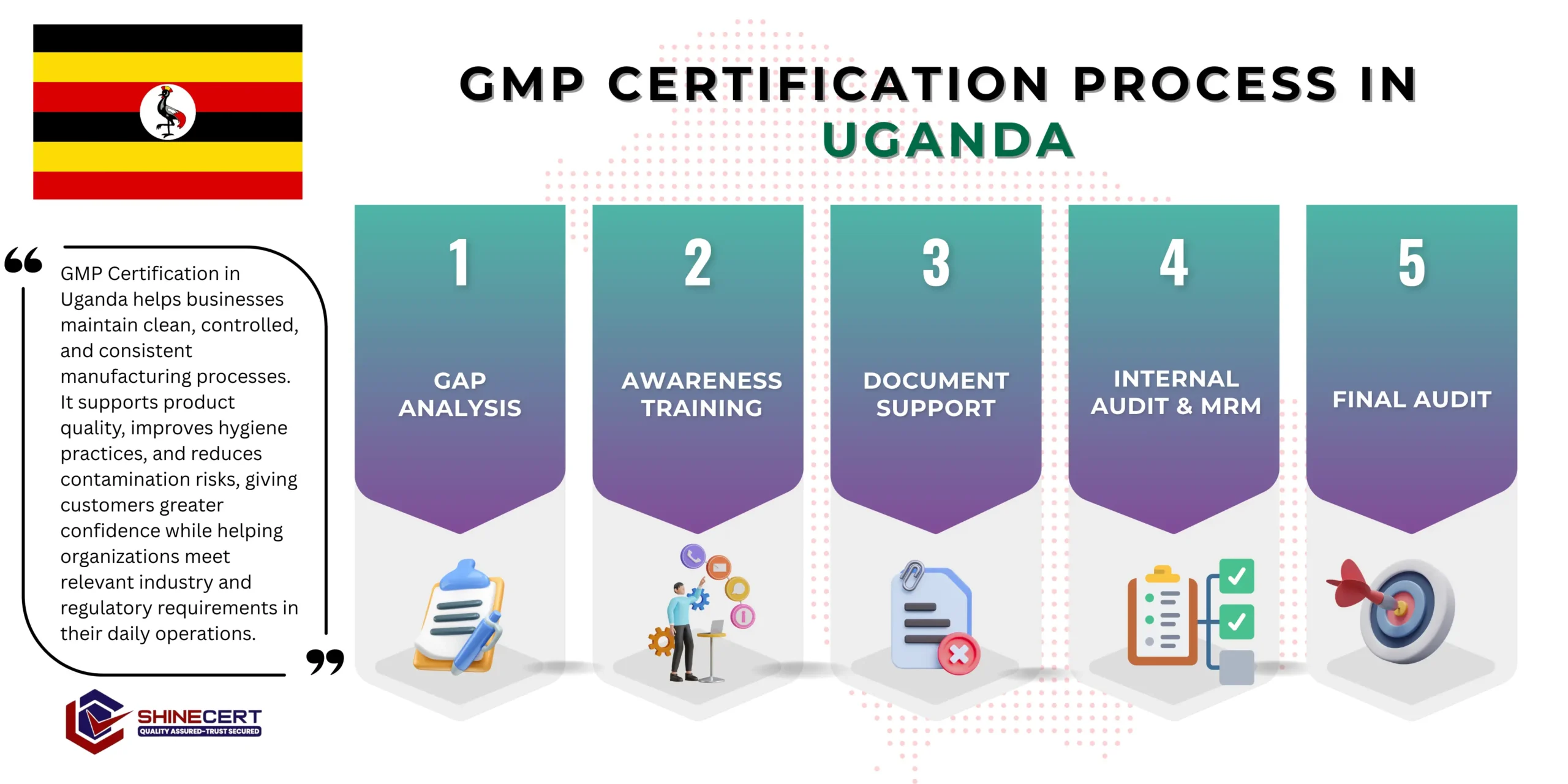
GMP Certification Process in Uganda
Reaching Good Manufacturing Practice (GMP) compliance is a genuinely thorough process, and treating each stage seriously is what actually gets a facility through NDA’s twice-yearly inspection regime without repeated findings.
Facility Gap Assessment
We conduct a genuine walkthrough of your production areas, equipment, and current documentation practices, comparing them against NDA’s specific GMP guidelines for medicinal products.
A facility producing solid oral dosage forms and one producing sterile injectables face very different genuine requirements, and the assessment reflects that.
A detailed gap report identifying exactly what stands between your current operations and GMP compliance.
Documentation
This stage builds the Site Master File, standard operating procedures, and batch manufacturing record systems your facility genuinely needs, written to match how your specific production process actually runs.
A complete GMP documentation set matched to your actual manufacturing operations.
Implementation
Documentation on paper means nothing until production is actually following it.
This stage trains staff on new procedures, validates equipment, and begins genuine batch-level record keeping.
Weeks of genuine batch production data demonstrating consistent GMP compliance.
Internal Verification
Before NDA’s inspectors arrive, we run our own thorough review of facility conditions, documentation completeness, and staff readiness, catching the kind of gaps an inspector would flag first.
Corrective actions completed on our own timeline rather than as inspection findings.
NDA GMP Inspection
NDA’s inspectors conduct a formal facility inspection against the Guidelines on Good Manufacturing Practice for Medicinal Products, reviewing documentation, observing operations, and testing whether your quality system genuinely functions as documented.
GMP compliance status supporting your product registration, with ongoing twice-yearly inspections to follow.
Staying Compliant: Ongoing Inspection and Renewal
NDA conducts local manufacturer inspections at least twice a year, meaning Good Manufacturing Practice (GMP) compliance in Uganda isn’t a one-time certification event but an ongoing operational standard. We recommend treating each inspection cycle as a genuine opportunity to catch and correct drift before it becomes a finding, rather than scrambling to prepare only in the weeks before an announced or surprise visit.
Realistic Timelines for Ugandan Businesses
| Business Profile | Typical Total Timeline | What Drives This |
|---|---|---|
| Small manufacturer, single product line | 4–5.5 months | Narrower scope and simpler documentation |
| Medium manufacturer, multiple product lines | 5.5–7 months | Broader documentation across products and processes |
| Larger or sterile product manufacturer | 7–9 months | Extensive validation requirements, particularly for sterile or injectable products |
GMP Certification Cost in Uganda
- There’s no flat price for (Good Manufacturing Practice) GMP certification in Uganda, because cost genuinely tracks a specific set of factors rather than a fixed fee schedule. Headcount matters, since a larger production workforce means more people to train on GMP procedures, but product complexity is often the bigger driver, sterile or injectable product manufacturing requires considerably more extensive validation, environmental monitoring, and documentation than solid oral dosage form production.
- The nature of the facility itself is often the single biggest cost driver. A facility requiring significant infrastructure upgrades to meet GMP standards, cleanroom conditions, dedicated equipment, proper environmental controls, faces meaningfully higher costs than one already close to compliant. The number of distinct product lines adds cost in a similar way, since each product typically needs its own validation and CTD-format dossier.
- How much manufacturing documentation already exists also shapes the timeline and therefore the cost, facilities that already maintain some batch records or SOPs aren’t starting from a blank page. NDA inspection and registration fees sit outside our consulting fee and are billed separately by NDA. Finally, businesses combining GMP with ISO 9001 or ISO 22000 share real documentation groundwork across the two, which brings the combined cost down compared to running them separately.
Where GMP Certification Matters Most Across Uganda’s Economy?
Pharmaceutical Manufacturing
Pharmaceutical manufacturing sits at the absolute center of this issue, given the direct NDA registration requirement and the enormous market opportunity sitting behind Uganda’s roughly 90% import dependence for medicines.
Read moreActive Pharmaceutical Ingredient Producers
Active pharmaceutical ingredient producers face similarly direct relevance, given NDA’s dedicated GMP guidelines covering API manufacturing specifically.
Read moreNutraceutical and Supplement Manufacturers
Nutraceutical and supplement manufacturers face growing GMP expectations as the sector professionalizes and consumer awareness of quality standards increases.
Read moreFood and Beverage Manufacturers
Food and beverage manufacturers producing products for institutional or export markets increasingly need GMP alongside food safety certifications to satisfy buyer requirements.
Read moreCosmetics and Medical Device Manufacturers
Cosmetics and personal care product manufacturers, and medical device assemblers working alongside ISO 13485 requirements, round out the sectors where GMP certification addresses a genuine, specific manufacturing quality expectation rather than a generic label.
Read moreA Ugandan Business We’ve Worked With
- A Kampala-based nutraceutical manufacturer approached us after struggling to secure a supply contract with a regional pharmacy chain that required documented GMP compliance as a condition of doing business.
- Our gap assessment found the company’s actual production processes were reasonably sound, but there was no Site Master File, no formal batch manufacturing records, and no documented equipment validation history the pharmacy chain’s procurement team could review.
- We built a complete GMP documentation system covering the Site Master File, standard operating procedures, and batch record systems matched to the company’s actual production line. The certification process took just under six months, and the company secured the supply contract, along with a second regional distribution relationship that specifically cited its documented GMP compliance.
- We see this pattern often enough to name it directly: manufacturers with genuinely sound production practices that had never documented them thoroughly enough to satisfy a buyer’s own procurement standards, this describes a recurring situation, not one specific client.
The Documentation NDA-Conscious Inspectors Expect
- Site Master File : A comprehensive description of your facility’s manufacturing activities, layout, and quality management arrangements, matching NDA’s expected format.
- Standard Operating Procedures : Documented, step-by-step procedures for every significant manufacturing activity, from raw material receipt through to finished product release.
- Batch Manufacturing Records : Complete, contemporaneous documentation for every batch produced, allowing full traceability from raw material to finished product.
- Equipment Validation and Calibration Records : Evidence that manufacturing equipment is genuinely validated for its intended use and regularly calibrated, not assumed to be working correctly.
- Quality Control Testing Records : Documented testing results for raw materials, in-process samples, and finished products against defined specifications.
- Deviation and Corrective Action Records : A functioning log tracking any deviation from standard procedure, its investigation, and the corrective action taken.
- CTD-Format Product Dossiers : Complete product registration dossiers in the Common Technical Document format NDA requires for local product registration.
GMP Certification Across Uganda’s Business Hubs
GMP Certification in Kampala
GMP Certification in Jinja
GMP Certification in Mbarara
GMP Certification in Entebbe
GMP Certification in Gulu
The Real Challenges Organizations Face While Pursuing GMP Certification
Getting certified is rarely blocked by a lack of willingness, it’s the practical, day-to-day implementation work that trips organizations up. Here’s what we actually see Ugandan manufacturers struggle with:
- Facility infrastructure often needs genuine upgrading, not just documentation : Unlike some certifications that are primarily about paperwork, GMP compliance sometimes requires real physical investment in equipment, environmental controls, or facility layout that businesses underestimate going in.
- Batch documentation gets treated as an afterthought rather than a real-time record : It’s common for batch records to be reconstructed after the fact rather than genuinely completed in real time during production, which an NDA inspector will typically catch through simple cross-checking.
- Equipment validation gets skipped or done superficially : Businesses sometimes assume equipment works correctly without genuine, documented validation, missing exactly the kind of evidence an inspection is designed to require.
- CTD-format dossier preparation is a genuinely specialized skill many facilities lack in-house : Compiling a complete, correctly formatted Common Technical Document dossier is a specific technical skill that smaller manufacturers often don’t have internally, leading to delays or rejected submissions.
- Twice-yearly inspection cycles catch drift that happens between visits : Facilities that tighten up practices right before an expected inspection but let standards slip in between often get caught by NDA’s genuinely regular inspection schedule.
Why Businesses Choose ShineCert in Uganda?
ShineCert brings 10 years of certification consulting experience to Uganda’s market, coordinated through our Riyadh and India offices with services delivered remotely or on-site depending on what your engagement genuinely needs. We’ve guided more than 10,000 organizations through certification worldwide, and as the best GMP consultant in Uganda, ShineCert builds every GMP engagement around your actual facility conditions and product portfolio, with a genuine eye toward the domestic market opportunity Uganda’s import dependence represents.
Choosing a Certification Partner in Uganda?
What to Check | Why It Matters |
Genuine understanding of NDA’s specific GMP guidelines | Ensures your documentation and facility preparation matches exactly what Ugandan inspectors expect |
Experience with your specific product category | Sterile products, oral dosage forms, and nutraceuticals carry genuinely different GMP considerations |
Ability to support both documentation and facility readiness | GMP compliance often needs more than paperwork alone |
Track record supporting successful NDA registration | Confirms real experience navigating the full path from certification to market |
Ready to Get Started?
Whether you’re pursuing your first local manufacturing registration or upgrading an existing facility to meet NDA’s GMP guidelines, we’ll walk through your specific facility conditions and cost factors before proposing a fixed-scope plan, delivered remotely, on-site, or however genuinely fits your project. Book a free consultation or contact us directly to get started.
Frequently Asked Questions
Look for genuine understanding of NDA’s specific GMP guidelines, product-category experience, and honest scoping before pricing. ShineCert scopes every Uganda engagement individually.
NDA conducts the GMP inspections that determine compliance status, which is a prerequisite for registering locally manufactured medicines, functioning as both regulator and inspecting authority.
It depends on your product portfolio, facility condition, and product complexity, we scope every project individually.
Typically four to nine months depending on facility readiness and product complexity.
Limited local GMP-compliant manufacturing capacity is the primary driver, representing a genuine opportunity for new certified local manufacturers to capture market share.
Documentation work runs fine remotely, but facility assessment, equipment validation, and inspection preparation genuinely need in-person visits.
Not a standalone one, we coordinate Uganda engagements from our Riyadh and India offices, with services delivered remotely or on-site as your project requires.